Grapes the Size of Wagons:
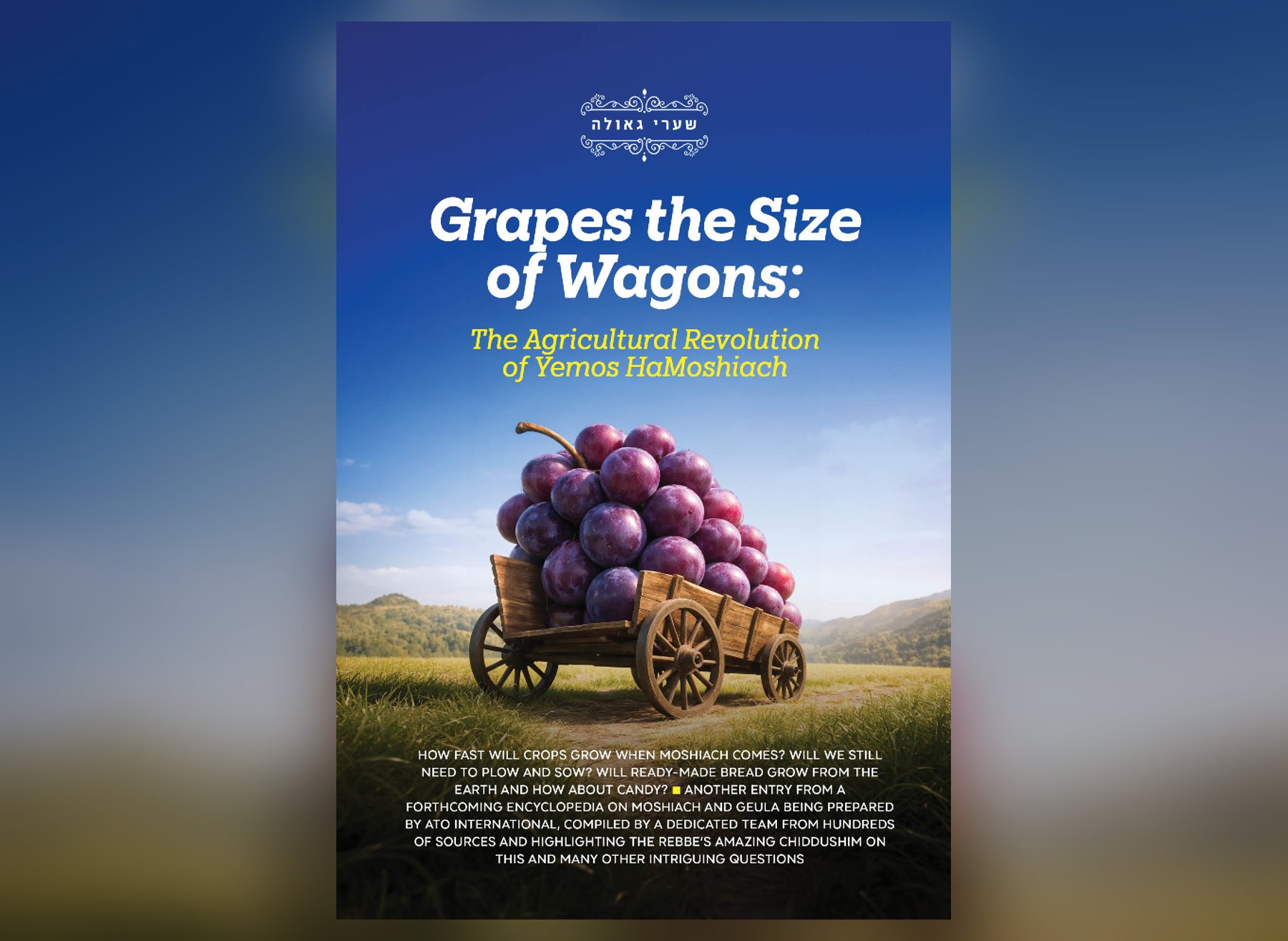
How fast will crops grow when Moshiach comes? Will we still need to plow and sow? Will ready-made bread grow from the earth and how about candy? Another entry from a forthcoming encyclopedia on Moshiach and Geula being prepared by ATO International, compiled by a dedicated team from hundreds of sources and highlighting the Rebbe’s amazing chiddushim on this and many other intriguing questions.
The Vegetable Kingdom at the Geula
As a result of the refinement and rectification of the world at the time of the Geula, a sublime Divine light will illuminate ‘min ha’tzomeach,’ the plant kingdom as well. This will cause the flora to grow with extreme rapidity and produce – even from non-fruit-bearing trees – high-quality, large-scale yields in many respects.
Primary Source
In the prophecies of the Geula, it is stated¹:
הִנֵּה יָמִים בָּאִים נְאֻם ה’ וְנִגַּשׁ חוֹרֵשׁ בַּקֹּצֵר וְדֹרֵךְ עֲנָבִים בְּמֹשֵׁךְ הַזָּרַע וְהִטִּיפוּ הֶהָרִים עָסִיס וְכָל הַגְּבָעוֹת תִּתְמוֹגַגְנָה
“Behold, days are coming, says Hashem, when the plowman shall overtake the reaper, and the treader of grapes him who sows seed; and the mountains shall drop sweet wine, and all the hills shall melt.”
This means that in the future-to-come, the speed of growth will increase so greatly that the plowman and the reaper will meet in their work because it will all be done on the same day, as the produce will grow in a single day².
Likewise, the Gemara and Medrashim expounded on the changes that will occur in the plant kingdom, as detailed below.
Contents:
The Essence and Nature of the Changes
Speed of Growth
Changes in the Nature of Vegetation
The Abundance
Growth Without Human Labor
When These Prophecies Will Materialize
A. The Essence and Nature of the Changes
Since the evil will be refined and the blemish caused by sins – beginning with the cheit eitz ha’daas (Sin of the Tree of Knowledge) – will be removed in the future-to-come, the world will return to the state it was in at the time of creation. Consequently, the limitations imposed on the plant kingdom due to these sins will be removed, as will be detailed below.
A further primary factor for these changes is that currently, the world’s materiality is not a “vessel” for Hashem’s influence; therefore, the abundance arrives through many contractions (tzimtzumim). In the future, physical things will be united with the Word of Hashem that brings them into being. This allows the abundance to be revealed immediately³, and a Divine revelation that transcends the Seder Hishtalshelus (order of emanation) will shine forth⁴. As a result, the plant kingdom will yield results of incomparable quantity and quality.
Another purpose for these changes is to allow the Jewish people to engage in spirituality and the attainment of Divinity without the need for exertion or effort in physical matters⁵.
B. Speed of Growth
In the future-to-come, vegetation will grow at a rate incomparably faster than in the present era:
Daily Harvest: The Gemara⁶ teaches that “trees are destined to produce fruit every single day”. This is derived from the passuk⁷ “and it shall bring forth boughs and bear fruit” – just as a tree produces a bough every day, it will produce fruit every day⁸.
Immediate Growth: The Medrash⁹ learns from the passuk¹⁰ “and the land shall yield her increase” that the earth will bring forth produce on the very day it is sown [in addition to the explicit verse mentioned above in ‘Primary Source’].
Restoration of Original World Nature: This nature existed at the beginning of creation but was nullified following the cheit eitz ha’daas, which resulted in the curse that man must exert effort. When “the spirit of impurity is removed from the land”¹¹ and the sin is rectified, the earth will return to its natural state of producing within a day, as explained above in section A¹².
Additionally, it is explained that the sin occurred through a tree that produces fruit once every three years, and the production of fruit every day indicates its rectification¹³.
The cause for the growth rate is the pace of the movement of the constellations (mazalos). Before the sin, the constellations traveled a short path and quickly, but due to the sin, Hashem lengthened their path. In the future, Hashem will heal them, as it is written (Yeshaya 30:26), “and the stroke of their wound He will heal”¹⁴.
Different Growth Rates: The Yerushalmi¹⁵ presents different rates of growth for the future-to-come:
Bi-Monthly/Monthly: Rabi Yuda¹⁶ maintains that trees will produce fruit every two months and grain will grow in one month (currently, fruit grows in a year and grain in six months). This is derived from the passuk¹⁷ “for its months it shall yield first-fruit,” where “months” (plural) implies at least two, and grain grows in half that time.
Monthly/Fortnightly: Rabi Yosi maintains that trees will produce fruit every month (and their consumption will heal¹⁸) and grain will grow in fifteen days, as occurred in the days of the prophet Yoel¹⁹. He interprets “for its months” as every single month.
Reconciliation: Some reconcile these views by suggesting that trees intended for medicine will grow monthly, while other trees will produce fruit daily²⁰.
Chassidus explains that the reason the growth process will be so accelerated is that a very high Divine illumination will shine within the power of vegetation²¹.
C. Changes in the Nature of Vegetation
As the world becomes a vessel for Divine revelation, the fundamental nature of plants will change:
Edible Wood: The Sages taught²² that the tree itself will be edible. This is based on the passuk²³ “fruit tree” (eitz pri); since the passuk already says “yielding fruit,” the term “fruit tree” implies that the tree itself will be edible like fruit. This was also the state at the beginning of creation.
Edible Leaves: The leaves will also be fit for consumption, as it is written²⁴: “its leaf shall not wither”²⁵.
Fruit-Bearing Non-Fruit Trees: The Sages taught²⁶ that even barren trees (ilanei sarak) are destined to produce fruit. This is based on the passuk²⁷ “and the tree of the field shall yield its fruit” [In the Gemara²⁸, this was expounded only regarding the trees of Eretz Yisrael; see below in “When These Prophecies Will Materialize” for reconciliation].
Special Wine: A unique flavor of wine will be produced from these non-fruit trees, suitable even for the elderly²⁹.
Perennial Grain: Grain will take on the characteristics of a tree – it will produce yields annually while the plant continues to exist³⁰.
Self-Sustaining: Trees will grow on their own without the need for irrigation, and the earth will be able to produce “something from nothing” (yesh me’ayin) by its own power³¹.
[Regarding gluskaos (fine breads) and k’lei milas (fine garments) that will grow ready-made, see below in section E.]
D. The Abundance
The abundance will be expressed through the massive size of the produce:
Giant Grapes: The Gemara³² describes a single grape serving as a giant vat containing at least thirty seah³³.
Transportation: To transport it, one will need a wagon or a ship, and even the grape branches will be large enough to serve as fuel for the fire under a cooking pot.
Massive Harvest: Harvesting the grapes will require an entire city’s worth of effort³⁴, as it is written³⁵ “binding his foal (iro) unto the vine,” where ir is interpreted as a city (ir) [though some interpret “iroh” as a small donkey³⁶].
Wine from Barren Trees: Every barren tree will produce enough wine to require two donkeys to carry it, as written³⁷ “and his donkey’s colt unto the choice vine”³⁸.
Giant Wheat: Wheat will grow to the size of a palm tree and will tower over the mountain peaks even when growing from valleys³⁹. This is derived from the passuk⁴⁰ “there shall be a pisas of grain in the land atop the mountains” (and this was its state at the beginning of creation).
Ox-Kidney Size Grains: A single grain of wheat will be as large as the kidneys of a large ox, as it is written⁴¹ “with the kidney-fat of wheat”.
E. Growth Without Human Labor
Because the purpose of the abundance is to allow Am Yisrael to engage in Divine revelation in tranquility, there will be no need for labor and toil in vegetation:
Ready-made Bread and Clothing: The Sages taught that gluskaos (fine breads⁴², without waste like the Manna⁴³) and klei milas (fine wool garments⁴⁴) will grow from the land in Eretz Yisrael (and in the entire world⁴⁵). This is learned from the passuk⁴⁶ “יהי פיסת בר בארץ – there shall be a pisas of grain in the land”⁴⁷. Pisas implies a width like the palm of a hand, and one does not find wheat of this size; rather, it refers to a ready-baked loaf⁴⁸. [In Aggadas Eliyahu⁴⁹, it explains that this is not to be understood literally, but that there will be such enormous abundance as if ready-made gluskaos were growing.]
Similarly, the term passim (as in Yosef’s special coat) implies fine wool garments⁵⁰, like the word pisas.
Cessation of Labors: Chassidus explains that the current need for the 39 melachos is to refine the world (birurim). In the future, once this work is completed, these things will grow ready-made⁵¹.
Effortless Wine: The tedious process of wine preparation will be bypassed⁵². A person will place a single grape in the corner of his house, and the wine will be ready to drink immediately from within the grape as if it were a barrel. This is derived from the passuk⁵³ “and of the blood of the grape you shall drink foaming wine” (dam enav tishte chamer) – indicating that the wine will come directly from the grape.
Automatic Provision: Hashem will bring a wind from His treasure house that will cast fine flour to the ground, allowing a person to take a handful⁵⁴ that will suffice for their household⁵⁵. [Since gluskaos will grow ready-made, there would seem to be no need for flour; the Ben Yehoyada⁵⁶ explains that the flour will be for cooking dishes.]
Fruit Picking: Some authorities write that fruits will fall from the trees on their own, removing the need for the toil of picking them⁵⁷.
F. When These Prophecies Will Materialize
The Rambam’s View: The Rebbe explains that according to the Rambam – who holds that the initial period of Moshiach will not necessarily see changes in nature – these changes will occur only in the second period, the era of the Techiyas HaMeisim⁵⁸.
The Raavad’s View: According to the Raavad⁵⁹, nature changes at the very beginning of the Geula and there are no distinct periods; thus, the changes in vegetation will occur immediately at the beginning of the Geula.
The Maharsha’s View: The Maharsha writes that vegetation will return to its original state of growth shortly before the arrival of the Redeemer as a sign of the approaching Geula⁶⁰.
¹ Amos 9:13.
² Commentators on the verse.
³ Likkutei Sichos Vol. 37, p. 83. Ohr HaTorah Neviim Vol. 1, p. 474.
⁴ Sefer HaMaamarim 5636 Vol. 2, p. 354; 5627, p. 409. Ohr HaTorah Vayikra Vol. 1, p. 197; ibid. Devarim Vol. 2, p. 903; ibid. Neviim Vol. 1, p. 440.
⁵ Likkutei Sichos ibid.
⁶ Shabbos 30b.
⁷ Yechezkel 17:23.
⁸ This is not in contradiction to the principle that “there is nothing new under the sun” (Koheles 1:9), for even today the tzalaf tree produces its fruit every day. Shabbos ibid.
⁹ Toras Kohanim (Sifra), Bechukosai 1.
¹⁰ Bechukosai 26:4.
¹¹ Zecharia 13:2.
¹² Tanchuma Kedoshim 67. See Avodas HaKodesh Vol. 2, ch. 38. Cited in Shabbos ibid.
¹³ Likkutei Torah Tzav 11c; Ohr HaTorah Neviim p. 156.
¹⁴ Bereishis Rabba 10:4. The cause for the growth rate is the pace of the movement of the constellations, which before the sin traveled a short path quickly, but due to the sin Hashem lengthened their path. In the future, Hashem will heal them. See there in Nezer HaKodesh, Maharz’u, Pachad Chachamim (by R’ Shlomo of Pintschov) on Yerushalmi Shekalim Ch. 6, Halacha 4.
¹⁵ Yerushalmi Taanis 4:1.
¹⁶ This is how Rabi Yehuda is referred to in the Talmud Yerushalmi.
¹⁷ Yechezkel 47:12.
¹⁸ Bamidbar Rabba 28:22; Tanchuma Bereishis 6; Pinchas 14.
¹⁹ See Yoel 2:23; Ta’anis 5b.
²⁰ Mareh HaGadol Vol. 1, p. 159.
²¹ Ohr HaTorah Bereishis Vol. 2, p. 379.
²² Toras Kohanim ibid.
²³ Bereishis 1:11.
²⁴ Yechezkel ibid.
²⁵ Aggadas Eliyahu, Yerushalmi Shekalim Ch. 6, 15.
²⁶ Toras Kohanim ibid.
²⁷ Vayikra 26:4.
²⁸ Kesubos 112b.
²⁹ Ibid. 111b.
³⁰ Aggadas Eliyahu, Yerushalmi Shekalim ibid.
³¹ Toras Shmuel 5627, p. 13.
³² Kesubos 111b.
³³ Rashi ibid.
³⁴ Rashi, Mah’dura Kamma ibid.
³⁵ Bereishis 49:11.
³⁶ Rashi and Rashbam on the verse. See Yalkut Shimoni Bereishis 160; Dikdukei Sofrim HaShalem note 106.
³⁷ Bereishis ibid.
³⁸ Kesubos ibid.
³⁹ Ibid., and in Maharsha there.
⁴⁰ Tehillim 72:16.
⁴¹ Devarim 32:14.
⁴² Aruch, entry “Gluska.”
⁴³ Sefer HaMaamarim 5683, p. 102; 5665, p. 36. This is because only in bread made by human hands is there waste, but not in what is created ready-made by Hashem.
⁴⁴ Rashi Kesubos ibid.; Yechezkel 27:18; Sanhedrin 44a; Shabbos 54a; Shevuos 6b; Gittin 56a. In Shaar HaEmunah by the Mitteler Rebbe (p. 52 onwards), he writes that they are silk garments.
⁴⁵ Toras Kohanim ibid.
⁴⁶ Tehillim ibid.
⁴⁷ Kesubos ibid.; Shabbos 30b.
⁴⁸ Kesubos ibid.
⁴⁹ Aggadas Eliyahu ibid. It explains that this is not to be understood literally, but that there will be such enormous abundance as if ready-made gluskaos were growing.
⁵⁰ Rashi.
⁵¹ Maamarei Admur HaZaken 5568, Vol. 2, p. 633.
⁵² Kesubos ibid.
⁵³ Devarim 32:14.
⁵⁴ See Yalkut Shimoni Tehillim ibid.
⁵⁵ Kesubos ibid.
⁵⁶ Ben Yehoyada, Kesubos ibid. Since gluskaos will grow ready-made, there would seem to be no need for flour; he explains that the flour will be for cooking dishes.
⁵⁷ Aggadas Eliyahu, Yerushalmi Shekalim Ch. 6, Halacha 15.
⁵⁸ Likkutei Sichos Vol. 27, p. 192.
⁵⁹ In his glosses on Rambam Hilchos Teshuva Ch. 8, Halacha 2; Hilchos Melachim Ch. 12, Halacha 1. See Likkutei Sichos ibid.
⁶⁰ Chidushei Agados on Sanhedrin 98a, section beginning ein l’cha kets meguleh mizeh.
HaTomim #18 • pp. 6-11
© 2026 Beis Moshiach Magazine. All rights reserved.
This article originally appeared in Beis Moshiach #1491B. You are welcome to share it with friends and family by email or in print, provided that you do not change, add to or omit any part of it, you credit the author and Beis Moshiach, and you include a link to archive.bmoshiach.org (written out in full in printed copies).
To republish this article in a newspaper, magazine, book or website, please request permission in advance at [email protected].