Meet Your Teachers
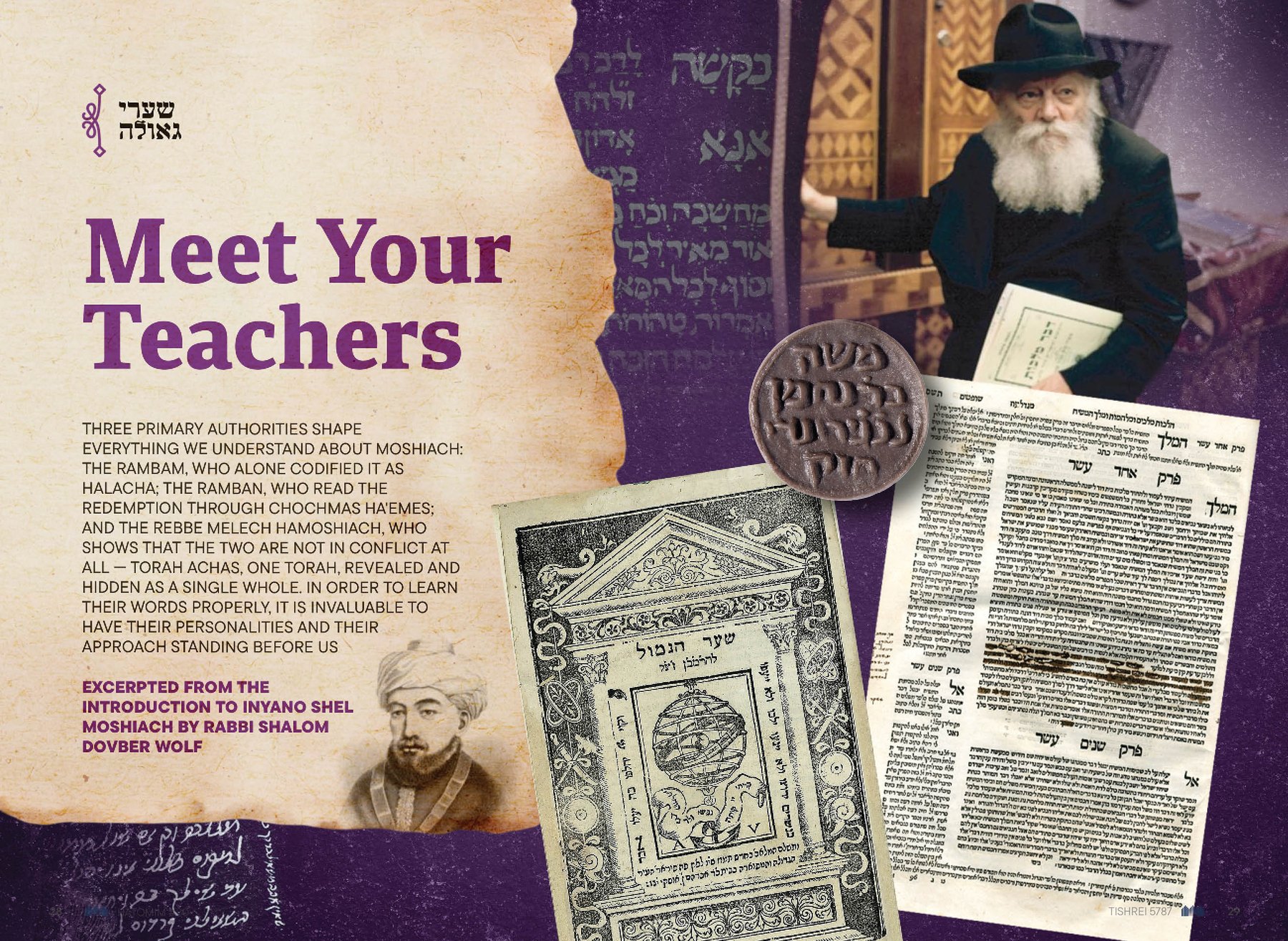
Three primary authorities shape everything we understand about Moshiach: the Rambam, who alone codified it as halacha; the Ramban, who read the redemption through chochmas ha’emes; and the Rebbe Melech HaMoshiach, who shows that the two are not in conflict at all – Torah achas, one Torah, revealed and hidden as a single whole. In order to learn their words properly, it is invaluable to have their personalities and their approach standing before us. Excerpted from the introduction to Inyano Shel Moshiach by Rabbi Sholom Dovber Wolf.
Three primary authorities shape everything we understand about Moshiach: the Rambam, who alone codified it as halacha; the Ramban, who read the Redemption through chochmas ha’emes; and the Rebbe Melech HaMoshiach, who shows that the two are not in conflict at all—Torah achas, one Torah, revealed and hidden as a single whole. In order to learn their words properly, it is invaluable to have their personalities and their approach standing before us.
The Talmud Yerushalmi teaches that one who recites a teaching in the name of its originator should see it as though the originator stands before him.1 At first hearing this seems a matter of honoring one’s sources, but the deeper meaning reaches further. In learning a Sage’s Torah one does not merely acquire information; one forms a bond with the soul of that teacher, a bond that crosses time and place. Nor does it mean picturing his appearance. It means entering his world—his character, his approach to Torah and its application to life. When one grasps something of who the teacher was, the teaching itself is illuminated in a way that detached study never achieves.
Nowhere does this hold more true than in the study of Moshiach.
The Rebbe stated it as clearly: the avoda of galus (exile) is complete, Moshiach is as good as already here, and what remains is for us to open our eyes, receive him, and begin living with that reality now. And a man cannot recognize what he does not understand. He may stand before it and fail to know what he is looking at.
So the question is not whether to learn but where to begin.
* * *
The subject has stirred the deepest hopes of the Jewish people for millennia, and countless teachings and insights on the subject have been offered across the generations. Which voices can guide us authoritatively through the complexities?
While acknowledging the contributions of many great minds throughout the generations, we return again and again to three towering figures: the Rambam (Maimonides, 1138–1204, active mainly in Cairo), the Ramban (Nachmanides, 1194–1270, who taught in Gerona and spent his final years in Eretz Yisrael), and the Rebbeim of Chabad—culminating especially with the Rebbe, the Nasi of our generation. These are the authorities whose words shape our understanding and resolve our questions.
Before we open a single sugya, then, we need to understand something about the teachers themselves. Why do their words carry such weight? What gives them their authority on this subject?
What follows are not biographies; that would require volumes of their own. They are meant to place the originator of the teaching before the reader’s eyes.
The Rebbe: Our Primary Guide
Convention would have us begin with the earliest of these masters and proceed forward in time. We begin instead with the one nearest to us. But we will actually start from the end, from “the maamarim and Likkutei Sichos of Nesi Doreinu.”2
Why so?
There is a principle that runs through Jewish tradition like a golden thread: there is no generation without someone like Moshe,3 and the Gemara even states, remarkably, that Moshe Rabbeinu did not die.4 The reason for this lies in what Moshe was—not merely a great teacher or a prophet, but the conduit through which Hashem’s Torah entered the world, a function that never ceased. In every generation someone stands in Moshe’s place, someone through whom the Torah of that generation is revealed. This is the role of the Nasi. And Hashem does not simply repeat the same Torah in every generation; each era receives its own revelation.
The Rebbe, the Nasi of our generation, is therefore the one through whom the Torah of our time is revealed. His insights and his approach to every subject occupy a special place for us, his students and contemporaries5—not because we regard earlier authorities as less, but because he is our Moshe, standing at the interface between Heaven and earth in our time, making the Torah relevant to our generation’s uniqe challenges and missions.
There is a further dimension that makes his teachings crucial here specifically. The Baal Shem Tov taught that the word אור, “light,” has the same numerical value as רז, “secret.”6 The one who knows the raz—the inner essence of a matter—is the one who can make it shine as ohr. This is what Chassidus does for Torah at large: it reveals the pnimiyus of every subject, and once the inner essence is understood the outer details resolve as they never did before. Which matters especially for fundamental questions of emuna, belief in Moshiach’s coming among them. These are not technical halachic questions; they bear on the purpose of creation, the meaning of Jewish existence, the ultimate destiny of the world. Without the insights of Chassidus we would lack the tools to grasp what is at stake.7
A Lifetime of Focus
Another thing to consider in this regard: Moshiach is not a theme the Rebbe adopted later in life, or one that grew on him over the course of his nesius. He described how, from the day he went to cheder and even before, the vision of the future Geula (Redemption) began taking shape in his consciousness8—not a vague hope but a living picture of a world.9
The Gemara tells us that the halacha follows Rav in issurim and Shmuel in monetary matters.10 Not because either Sage was limited to one area, chas v’shalom, but because each had a recognized expertise there, so his ruling in that field carried decisive weight.11 We can say something similar here: the “halacha” follows our generation’s Nasi in matters of Moshiach.12
This is not academic specialization, like of a scholar who happens to research one field extensively. For the Rebbe, Moshiach is not a subject of study. It is the central reality of his life. As he defines it himself, belief in Moshiach is the most comprehensive matter in Yiddishkeit,13 the essential point in the life of every single Jew14—expressed in constant urgency and a down-to-earth demand that the Geula be brought into the world below ten handbreadths. He sees bringing Moshiach as his life’s work.15
The Tanya explains that true comprehension effects a yichud nifla, a wondrous unity, between the mind and the concept it grasps; the more fully a person is united with his subject, the more deeply he is able to reveal its inner truth. So when the Rebbe speaks of Moshiach, we are not hearing one more learned opinion, we’re hearing from someone who Moshiach and him are an organic entity.
The Rambam: From Moshe to Moshe
When you study the Rebbe’s talks on Geula, something becomes apparent immediately: he returns again and again to the Rambam. Not exclusively, but the Rambam occupies a central, foundational role. Why?
To understand this, lets preface that the Rambam addresses the topic of Moshiach in four places—the Commentary on the Mishna in perek Chelek, Hilchos Teshuva perek 9, Hilchos Melech HaMoshiach at the close of the work, and Iggeres Teiman—and one might expect a single author to repeat himself across them. He does not. The Rebbe dwells at length on the differences, showing that they are not inconsistencies but different levels of describing one reality.
Near the Rambam’s tomb in Teverya there’s an inscription dating back at least several hundred years: “From Moshe to Moshe, none arose like Moshe.” This is no hyperbole. He was the Moshe of his generation in the most literal sense—the one through whom Torah was transmitted to his time, and a leader whose influence sent reverberations through every generation after him.
His Mishneh Torah is itself almost miraculous. Torah sheb’al peh had been developing for over a thousand years since the churban (the destruction of the Beis HaMikdash), sprawling across Mishna, Gemara, Medrash and the Geonim, much of it in difficult Aramaic and full of contradictions requiring resolution. The Rambam took all of it and produced a comprehensive code stating the halacha l’maaseh (the practical ruling) in every area of Jewish life—rendering Torah sheb’al peh, as it were, a written Torah accessible to everyone16—so authoritative that the Shulchan Aruch counts him among its three main sources. Nor did he only collect laws; he thought deeply about the principles underlying Yiddishkeit and expressed them with a clarity unmatched before or since. To this day, when a Jew says Ani Maamin, he is reciting the Rambam’s formulation.
The Only One Who Made It Halacha
But there’s something unique about his treatment of Moshiach specifically, something that sets him apart from every other sage before or after.
He is the only one who addressed Moshiach and Yemos HaMoshiach (the Messianic era) as a matter of halacha.
Great minds in every generation discussed Moshiach, offering interpretations, expounding medrashim, developing frameworks—profound and influential work, but commentary and philosophy, not piskei dinim (halachic rulings). The Rambam did something else entirely. Within Hilchos Melachim, the closing section of his legal code dealing with the laws of kings and wars, he wrote two final chapters that came to be known as Hilchos Melech HaMoshiach. Not a philosophical appendix, not speculative theology, but psak: this is what we are required to believe, this is how he will be recognized, this is what will come to pass.
The Rebbe notes a crucial principle: wherever the Rambam’s classical mefarshim (commentators)—the Raavad, the Kesef Mishneh and others—did not dispute a ruling, we assume they agreed with it.17 Since they did not challenge (most of) his laws about Moshiach, those laws stand as accepted halacha. This gives his words a weight no other source can claim. Not one opinion among many that we are free to accept or reject, but established halacha, binding on the entire Jewish people.
He was stark about the stakes, too. He established belief in Moshiach’s coming as one of the Thirteen Principles, and wrote that one who does not believe in him, or does not await his coming, denies the Torah and Moshe Rabbeinu. Denying Moshiach, according to the Rambam, is equivalent to denying the entire Torah—its a belief basic to Yiddishkeit as belief in Hashem Himself.
800 Years Sealed
For 800 years after the Rambam wrote Hilchos Melech HaMoshiach, these laws remained sealed. Not physically—the text was available, studied, copied, printed—but the deeper meaning stayed locked.
When you look at the Kesef Mishneh, who has a plethora of commentary to offer on nearly every thought of the Rambam, you find that on perek 11, halacha 1, he writes only this: that this perek and the one after it are good tidings of emuna concerning the coming of Moshiach, and he has nothing to explain in them.18 A few short comments follow, and that is all.
Consider what that means. Scholars who expounded every nuance of the Rambam’s laws and traced the source of every ruling arrived here and, in effect, laid down their pens. Not for want of learning—they had not found the key. They could read the words; the depth of what he was saying eluded them. The questions accumulated, the difficulties mounted, and the laws remained, to a certain extent, sealed.
Then came our generation’s Nasi.
The Rebbe did what eight centuries of scholars had not: he penetrated to the Rambam’s inner intent, grasping the organizing principle that makes everything else fall into place. And as the Baal Shem Tov taught, one who knows the secret of a thing is able to illuminate it. What had been obscure became clear; what had seemed contradictory revealed itself as different facets of one coherent vision. One watches it unfold as one watches a puzzle solved: at first the pieces appear random, and as they are set correctly a picture emerges that one cannot imagine having missed.
There’s a well-known approach to studying the Rambam called “Rambam according to Rambam”—that he created a complete, integrated system, and to understand any topic you need his entire worldview. The Rebbe’s approach to Torah is Torah achas: all parts of Torah, revealed and hidden, legal and mystical, fit together as one whole, different dimensions of the same Divine truth, like body and soul. So when the Rebbe learns Rambam, we might call it “Rambam according to Chassidus.”
This may seem strange at first. The Rambam lived centuries before the Baal Shem Tov; how may we read him through a lens that did not exist in his day? The Rebbe does not address the question directly. He demonstrates the method, and the results speak for themselves: long-standing difficulties disappear, passages that seemed to contradict each other harmonize. And crucially, he isn’t offering mystical readings that float above the text. In many cases he is explaining the Rambam’s pshat19—what the Rambam actually meant when he wrote the words.
To the Rebbe the difficulty does not arise. Torah is one. The Rambam was expressing truths that Chassidus would later articulate in its own language, and when we use Chassidic concepts to understand him we aren’t imposing something foreign—we’re revealing what was always there. In fact, only through Chassidus can we truly learn “Rambam according to Rambam.”
The Ramban: Another Moshe Arises
The principle of an ever-present Moshe holds across the generations. A generation after the Rambam, another Moshe arose—Moshe ben Nachman, the Ramban. Like the Rambam he dealt with the full breadth of Torah, and like the Rambam he devoted significant attention to Moshiach’s coming, chiefly in Sefer HaVikuach, Sefer HaGeula, and throughout his commentary on Torah.
One thing stands out immediately in his works: his tremendous respect for the Rambam. Living a generation later, he refers to him simply as HaRav, the Rabbi, without needing to specify which. Everyone knew. And yet he disagreed with him on numerous significant issues—including, crucially, matters of Moshiach, Yemos HaMoshiach, and techiyas ha’meisim (the resurrection of the dead).
How could he hold the Rambam in such regard and yet differ from him so fundamentally? Because the two proceeded from different starting points. The Rambam’s approach was largely philosophical: he engaged deeply with chochmas ha’chakira, rational investigation, and his descriptions of Yemos HaMoshiach often emphasize what can be grasped rationally, what accords with natural law. The Ramban, by contrast, based his understanding on Kabbalah, which he called chochmas ha’emes, the wisdom of truth, and which he saw as revealing dimensions of reality philosophy could never reach. No rejection of reason—he was himself a brilliant logician and halachist—but he understood that there are realms of Torah truth beyond what rational analysis alone uncovers.
The clearest example is the question of death in Yemos HaMoshiach. The Rambam indicates that people will still die then, and that even after techiyas ha’meisim death will eventually return—his reasoning being philosophical, that the neshama is constrained by the physical body, so its truest state is freedom from bodily limitation. The Ramban, from Kabbalah, holds that death will be abolished entirely. No one will die again, ever. Ultimate perfection is not the neshama escaping the body but the body itself elevated and refined until it can fully express the neshama without limitation.
How to Navigate Between Them
A practical question therefore presents itself: when the two disagree—which is not infrequent—how are we to decide?
The path forward is not as simple as selecting one authority and following him throughout. Both are giants upon whose shoulders we stand. The principle is as follows. The Geula has many dimensions—an external redemption and an internal one, the redemption of the body and the redemption of the neshama—and Torah likewise: Nigleh (the revealed aspects, including the bulk of halacha) and Pnimiyus (the inner dimensions taught in Kabbalah and Chassidus). Different dimensions of Torah address different dimensions of the Geula.
The Rambam, in his halachic code, focuses on the external: what the Geula will look like in practical terms, what Moshiach will do, how society will function. The Ramban, from Kabbalah, focuses on the inner. Both describe one and the same future reality from differing vantage points—which means that in most instances they are not contradicting one another at all. They are complementing one another, each supplying the portion of the picture the other does not emphasize. This is the Rebbe’s consistent approach: not to pick one and dismiss the other, but to show how both are true, each in its own dimension.
Think of describing a building. An architect’s blueprint shows you the structure and how it will function; an artist’s rendering shows the beauty and how it will feel inside. An untrained eye may perceive contradictions; a builder knows how to bring both visions together. The Rambam gives us the blueprint, the Ramban the vision of what it will feel like to live in it, and the Rebbe combines them into one whole.
And where they genuinely conflict, we ask what manner of question is before us. If it concerns the external, halachic framework—the practical “what will happen”—the halacha usually follows the Rambam. If it concerns the inner meaning at the deepest level, the halacha follows the Ramban and the Kabbalistic tradition flowing from him—the Arizal, and after him the Chassidic masters, culminating with our Rebbeim, who consistently rule according to the Ramban in these areas.20 The question of death falls into the second category: it is not halacha l’maaseh for here and now but the ultimate spiritual state of the Geula. So we follow the Ramban. Death will be abolished completely.
This is part of what the Rebbe means by Torah achas.21 The Torah is not a collection of contradictory opinions among which we take sides. It is a multi-dimensional expression of a single unified truth. Both the Rambam and the Ramban were gazing upon the truth of the Geula; that they described it differently does not mean that one was right and the other wrong. It means the truth is deep enough to encompass both.
* * *
The teachings reflect the teacher. Anochi, the first word Hashem uttered at Matan Torah, Chazal tell us, is an acronym for ana nafshi kesavis yehavis—“I have given and written Myself to you.”22 When a Sage writes and teaches Torah, he too is giving us something of his own essence.
This is why we have devoted this introduction to the personages of our teachers and not to their teachings alone. When the Rambam defines Moshiach’s qualities, he is showing us what he himself aimed for. When the Rebbe describes Moshiach’s mission, he is describing the mission he took upon himself. So as we study their words, let their presence stand before us. We are not merely analyzing texts. We are joining ourselves to souls—learning from teachers who did not only study the Geula but lived it, who did not only hope for Moshiach but worked with every fiber of their being to bring him.
With Hashem’s help, let’s begin.
Excerpted from the introduction to Inyano Shel Moshiach by Rabbi Shalom Dovber Wolf.
1. Talmud Yerushalmi, Shabbos 1:2.
2. Sicha of Tazria-Metzora 5751, where the Rebbe introduced the concept of learning about Moshiach.
3. See Tikkunei Zohar, Tikkun 69; Bereishis Rabba ch. 56.
4. Sotah 13b. See Likkutei Sichos vol. 26, the first sicha on Parshas Shemos.
5. See the talk of 2 Iyar 5710: “For us, there is nothing higher than this.”
6. Cited in HaYom Yom, entry for 6 Elul.
7. See the essay Inyanah Shel Toras HaChassidus, that Chassidus is a foretaste of the Torah of Moshiach.
8. Igros Kodesh vol. 12, letter of 11 Nissan 5716.
9. See, however, sicha of Chol HaMoed Pesach 5749 (Hisvaaduyos Vol. 3 p. 118), how this matter became ever more urgent to the Rebbe after his arrival in America.
10. Bechoros 49b, and sources cited there.
11. Rosh, Bava Kamma ch. 4, sec. 4. See also Likkutei Sichos vol. 16 p. 9ff., where the implication is that Rav “lived” the realm between man and G-d, and Shmuel the realm between man and his fellow.
12. See Sicha of Tazria-Metzora 5751: “All the books are filled with this matter… and particularly in the Torah of the Nasi of our generation.”
13. Dvar Malchus, Shabbos Parshas Chayei Sarah 5752.
14. Dvar Malchus, Shabbos Parshas Toldos 5752.
15. See Dvar Malchus, Shabbos Parshas Vaeira 5752.
16. See Likkutei Sichos vol. 26, the sicha for 20–24 Teves.
17. Likkutei Sichos vol. 5 p. 149.
18. Wording of the Kesef Mishneh, beginning of ch. 11 of Hilchos Melech HaMoshiach.
19. See Hadran on the Rambam, 5749, note 67. For a striking example, see the Hadran of 5746 on the material abundance described in Hilchos Melech HaMoshiach.
20. See Dvar Malchus, Shabbos Parshas Bo 5752, sec. 8, and sources cited there; and the talk of Shabbos Parshas Bamidbar 5727.
21. See Kuntres Halachos Shel Torah Sheb’al Peh (Simchas Torah 5752), at its conclusion.
22. Shabbos 105a, regarding Hashem Himself; “the righteous are likened to their Creator.”
HaTomim #20 • pp. 28-36
© 2026 Beis Moshiach Magazine. All rights reserved.
This article originally appeared in Beis Moshiach #1522. You are welcome to share it with friends and family by email or in print, provided that you do not change, add to or omit any part of it, you credit the author and Beis Moshiach, and you include a link to archive.bmoshiach.org (written out in full in printed copies).
To republish this article in a newspaper, magazine, book or website, please request permission in advance at [email protected].