Abba, I Need Rain
From the TzaddikStory.org collection
There was once a Chassid of the Rebbe Maharash who lived in Eretz Yisrael, back when just a small number of Yidden lived there.
Back then, it was difficult to make money. People often got sick, or crops and animals died. It was way more complicated than living in Eretz Yisrael today. But some people still loved living there – especially in the holy cities of Yerushalayim, Chevron, Tzfas and Tverya. The sun there was hot and the sand dry. But the air was heilig, the stones were heilig – and there were special Yidden who appreciated that very much.
This Chassid, whose last name was Slonim, was actually a relative of the Rebbe Maharash. He came from Rebbetzin Menucha Rochel, the daughter of the second Rebbe of Chabad, The Mitteler Rebbe R’ Dovber. Her father, though he lived in faraway Russia, loved Eretz Yisrael deeply and even bought a house and shul there in the holy city of Chevron. He sent a group of Chassidim to live there as his representatives, and eventually, his own daughter, the holy Rebbetzin, went to live there too following the advice of the third Chabad Rebbe, her cousin and brother-in-law, the Tzemach Tzedek who was the father of the Rebbe Mahrash, R’ Shmuel of Lubavitch.
So the subject of our story, a descendant of the Chabad Rebbeim, had his roots in Eretz Yisrael, but also back in Russia, where his Rebbeim lived. And so, looking forward to spending time with his beloved Rebbe, the Rebbe Maharash, he made the long journey back to Europe.
This meant he had to take a donkey and a cart down to the docks, where he’d board a boat for many, many days.
He davened and put on his Tefillin, pacing up and down the deck of the boat, where he could see the waves. R’ Slonim always said extra Tehillim, every day until he arrived.
Next, he rode a horse for many hours. As he finally reached the Rebbe Maharash’s shul, a big smile spread across R’ Slonim’s face. He was home at last! A few Chassidim that were learning in the front room welcomed him, and the shamash led him right into his Yechidus.
A visitor had arrived from the Holy Land – all the way from Eretz Yisrael!
“Rebbe, I’ve come from Eretz HaKodesh!” he said.
The Rebbe asked him how the Yidden were doing there.
As they spoke, R’ Slonim asked a question he’d been wondering about for some time.
“Rebbe… why do the holy sefarim say the Yidden in Eretz Yisrael have very high neshamos, especially holy souls…? I live in Eretz Yisrael, and all I ever see are regular people.”
Instead of answering, the Rebbe Maharash asked him a question: “How can you tell?
Could he see the piece of Hashem inside their heart? What did it look like? How could he measure it?
The Rebbe Maharash then showed him the saying was true by telling R’ Slonim a story he’d heard from his father, the Tzemach Tzedek.
* * *
Right near Yerushalayim, on a farm, lived a Jewish man who didn’t know which parts of the siddur to daven on which days. Back then, there were no siddurim with explanations… and even if there were, this man had never learned to read those small words, so they wouldn’t have helped.
All day long, he worked under the hot sun, harvesting olives and making oil. Feeding his goats, milking them, and making cheese. The rest of the day, he tended tomatoes, onions, and parsley. His lemon trees didn’t take much work. He dug holes and planted seeds. He pulled out weeds, and, most importantly, he made sure his plants had enough water. It was hot, hot, hot, and dry, dry, dry all year long.
This wonderful, simple man collected everything that was ready to eat in a basket, loaded it onto the side of his donkey, and gave it a little nudge to start the long journey uphill into the Holy City of Yerushalayim.
The sand made little dust clouds around their feet as they climbed. When he got too hot, or got a stone in his sandal, the man (and his donkey) would take a break under a nearby olive tree to drink water from his leather bottle.
As they got to Yerushalayim, the man found the market, chose a corner, and opened his basket. “Lemons! Parsley! Goat Cheese! Fresh and Delicious!” the man would chant.
That’s how this farmer sold his produce and made money for the week. Every week, the simple Jew came to Yerushalayim on market day. After counting his coins and giving some to the beggars nearby for tzedaka, the Jewish man walked through the shaded narrow streets into the home of the Rav.
The Rav recognized his knock and opened right away. “Shalom, Reb Yid,” the Rav said.
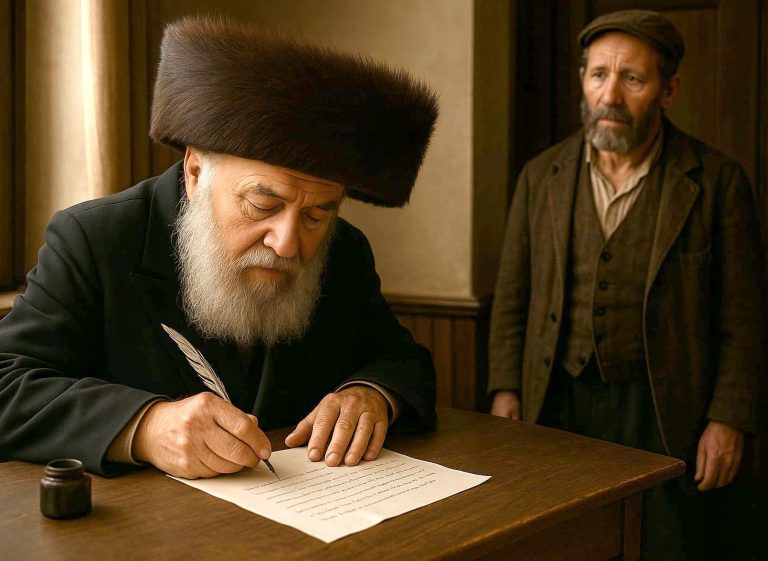
The reason this man needed to visit the Rav’s house every week, aside from saying hello and learning something new, was to know what to daven. The Rav would take a little paper and make notes and bookmarks for this special man, in a special way he could understand, telling him what to daven that week.
For example, if a new month was coming up, the Rav would tell him to daven and say Yaaleh Veyavo, and then make sure to say Hallel. If it was a regular week, he would say, “Just daven the regular davening, including tachanun.”
So, one day, near the end of fall, after Sukkos, this man collected the last tomatoes, the final stalks of parsley, and made his way to the market. It was no longer as hot, and the days were getting shorter. This would be the last market day for him for a while.
In Eretz Yisrael, there’s barely any rain all year – except during the winter. Then, all of a sudden, it rains and rains. That rain is so important. It’s meant to feed the plants and animals for the rest of the year. It’s a must! It has to refill the springs and wells and rivers.
Some days, there’s such strong rain, you cannot travel. Besides – the roads are made of dirt, and you’d get all muddy if you tried to go from the farm to the city. It might even snow!
Our Jew wouldn’t be coming to the city for a while, so he made an extra long stop at the Rav’s house, got instructions for davening for the rest of the winter, and then he went home. But then something happened, and he needed to go into Yerushalayim again, just a short time later, unexpectedly. No one remembers exactly why. Maybe his daughter needed a new comb. Who knows?
When he finally climbed the hill, turned the corner, and reached the crowded stone buildings, he was very surprised – all of the market booths were covered and locked! Oh no! Was today Shabbos? He bent down to sit on a large stone in disappointment. Then he heard footsteps and saw a Yerushalayim Jew carrying his tallis and tefillin bag. Phew! It couldn’t be Shabbos, since we don’t put on Tefillin on Shabbos.
“Excuse me, sir. What’s special about today? Why is the market closed?”
“Oh! We’re fasting. Don’t you know about the fast day…?”
“What?” the man looked so surprised. That wasn’t in his notes!
He said a hasty thank you, and ran off to the shul to find his Rav. When he walked in, the farmer started crying with a broken heart. “My esteemed Rav, I’m so hurt. I ate today. I didn’t know it was a fast day! Why didn’t you tell me? I didn’t say the right davening!”
“Oh, no,” said the Rav. “Please don’t worry. I didn’t tell you about the fast because I didn’t know about it. It’s not a regular fast. We just decided to fast today, since there isn’t enough rain. How will our crops grow? It’s already winter. We need Hashem’s help quickly!”
“No rain…?” said the simple Jew. “Why do you have to fast about that?!”
“Well, we want to call out to Hashem, so He can help us.”
“I don’t think you have to fast for that,” the man said, sighing with relief. He felt much better. He hadn’t done anything wrong. But he was still confused.
“Well, what do you think we should do?” asked the Rav.
“Well, when I go outside and I see my plants are thirsty, I just look up to clear, blue sky. I lift up my hands, and I say, Abba please – I need rain.”
“And then…?” asked the Rav.
“Then it rains,” the man answered.
“…Every time?” asked the Rav, very shocked.
“Every time.”
“Wow! Show me,” said the Rav.
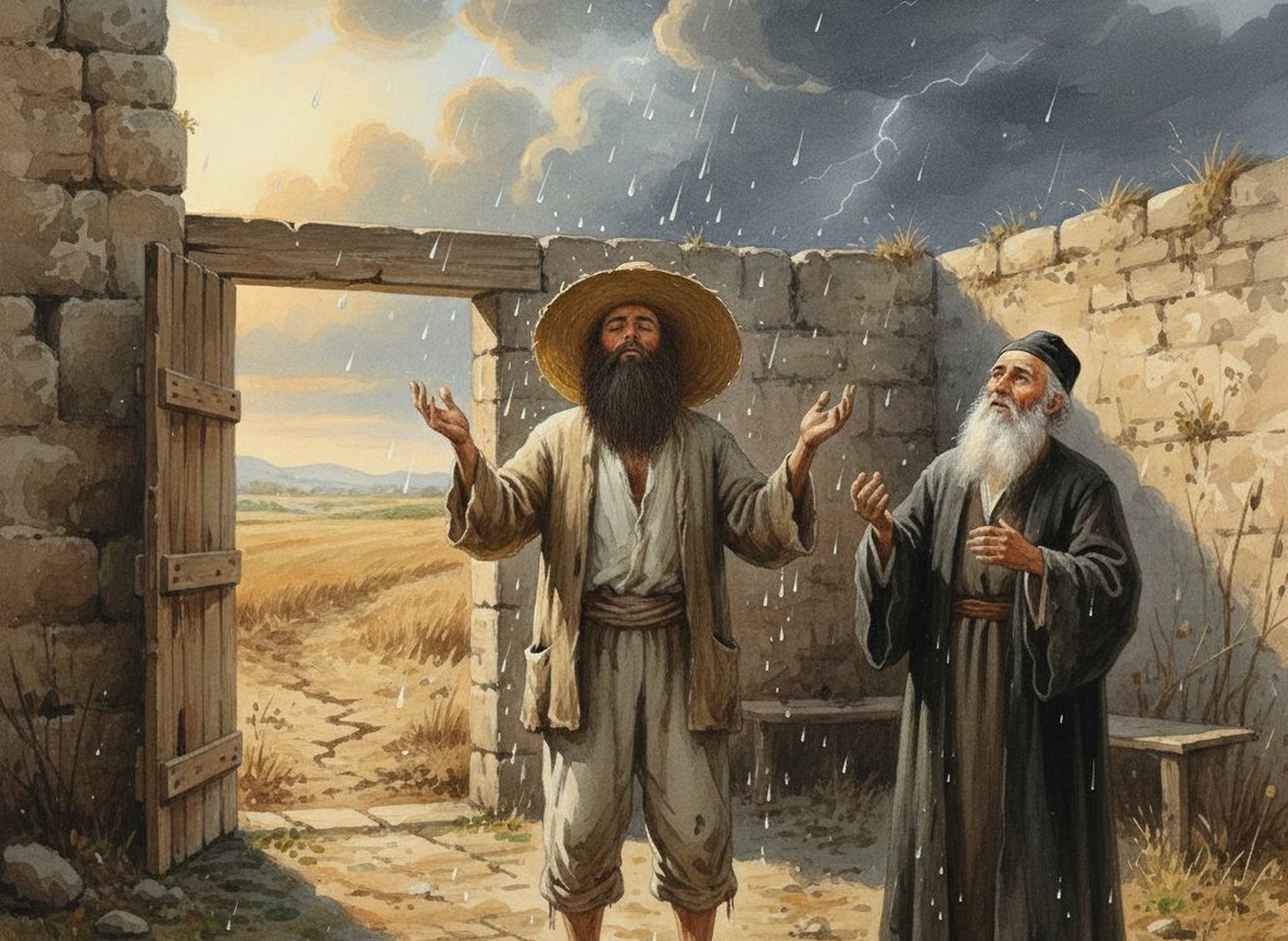
Together, the farmer and the Rav walked out of shul. There was a little yard with a stone gate.
“Like this,” said the simple man.
He looked up to Shamayim with his hands in the air. “Abba, why won’t you give your children rain? They need it. Please!”
Let me tell you, it started pouring right then and there.
When the thunder boomed and the lightning cracked, the Rav and the man raced back inside.
“I just ask Abba, and he answers,” said the man.
* * *
R’ Slonin understood now. You can’t tell how special a neshama is, just by looking at the person it belongs to – and Eretz Yisrael is such a holy place, anyone can reach Hashem from there. That was what the Rebbe Maharash was trying to teach him.
Beis Moshiach #1494 • pp. 56-58
© 2026 Beis Moshiach Magazine. All rights reserved.
This article originally appeared in Beis Moshiach #1494. You are welcome to share it with friends and family by email or in print, provided that you do not change, add to or omit any part of it, you credit the author and Beis Moshiach, and you include a link to archive.bmoshiach.org (written out in full in printed copies).
To republish this article in a newspaper, magazine, book or website, please request permission in advance at [email protected].