What the Report Card Couldn’t Know
I stretch, rub my eyes, which already hurt from staring at the computer screen, walk to the kitchen, and make myself a third cup of coffee for this evening. Then I glance quickly at the shelves – maybe there’s something yummy left to snack on alongside the coffee? Then I decide no. There’s no reason to get fat just because of report cards. Especially when I return to my computer corner and spot an empty bag of Bamba and brownie cake crumbs from Shabbos right next to it. I already forgot I ate those…
I sit back down, debate for a moment whether to make a bracha over the coffee or not. Then I take a warm, comforting sip and re-enter the file. Around me on the desk are piles upon piles of tests, quizzes, and assignments I put off until tonight. I’ve already checked them, updated the grades – all that’s left is to write the assessments. – The hardest part of the report card, on second thought.
Efrat’s report card is one of the easy ones. A boring report card of “Very Good” and “Excellent.” Even in “Conduct,” everything is an Alef – sweet as can be, perfect. If only I could duplicate her. I feel like writing exactly that in her assessment, but it’s not appropriate, so I fill in a few lines about nachas and middos tovos, write that she is pleasant to her friends, excels, and contributes a lot to the lesson. It’s not hard to write about her.
After her comes Libi’s report card. A forgiving smile rises on my face as I think about her freckled, mischievous face. She always manages to slip away – from punishment and from boring tasks alike. Her grades don’t surprise me, and they probably won’t surprise her or her parents either. I fill in a few cheerful lines about a bright smile and Ahavas Yisrael, contributing to the class with joy and zerizus… Then I add, in gentle, non-alarming words: You have willpower and potential; studying during lessons and preparing assignments will help you get better grades.
Yael. I look at Yael’s report card and sigh.
“Adequate (maspik)” in math, “Adequate” in Torah, “Adequate” in Navi. “Good” in geometry and another “Good” in reading comprehension. Only in PE does she have “Very Good,” and also in art. Two subjects where the teachers give every single student the exact same grade, without even checking. A kind of copy-paste. The PE teacher even has a theory about it. Not everyone is agile; it’s not up to them. So why ruin their report card?
I disagree with her. What does that mean? There are also kids who aren’t good at math. Maybe we should give everyone “Very Good” because why is it their fault? Just as in math I demand that students work hard, and if they don’t succeed I lower the grade, so it should be in PE too, shouldn’t it?
But I’m not the assistant principal, and no one asked me what I think, so I don’t say it – I just stay quiet. And maybe it really is out of jealousy. How nice it must be to write “Very Good” for everyone and “works well in math class”…
What do I do about Yael?
This student touches my heart.
She tried so hard this year, wanted so badly. She didn’t succeed at all…
If we were to weigh the efforts of every student in my fourth-grade class against the efforts of Yael, she would outweigh them all. And without even mentioning those whose mothers put in the effort on their behalf. Spoiled little things.
It’s a shame I can’t give her a grade based on effort. Even a ten would be too low.
I go over the grades again, trying to think of how to raise hers a little. It’s impossible. Even as it is, I was supposed to write “Insufficient,” but I couldn’t bring myself to do it. The “Adequate” is already being generous to her.
At the beginning of the year she came up to me, telling me with sparkling eyes that she had decided this year to be a good student. “My father said that if I get a good report card, I can go to medical school. I want so much to become a doctor!”
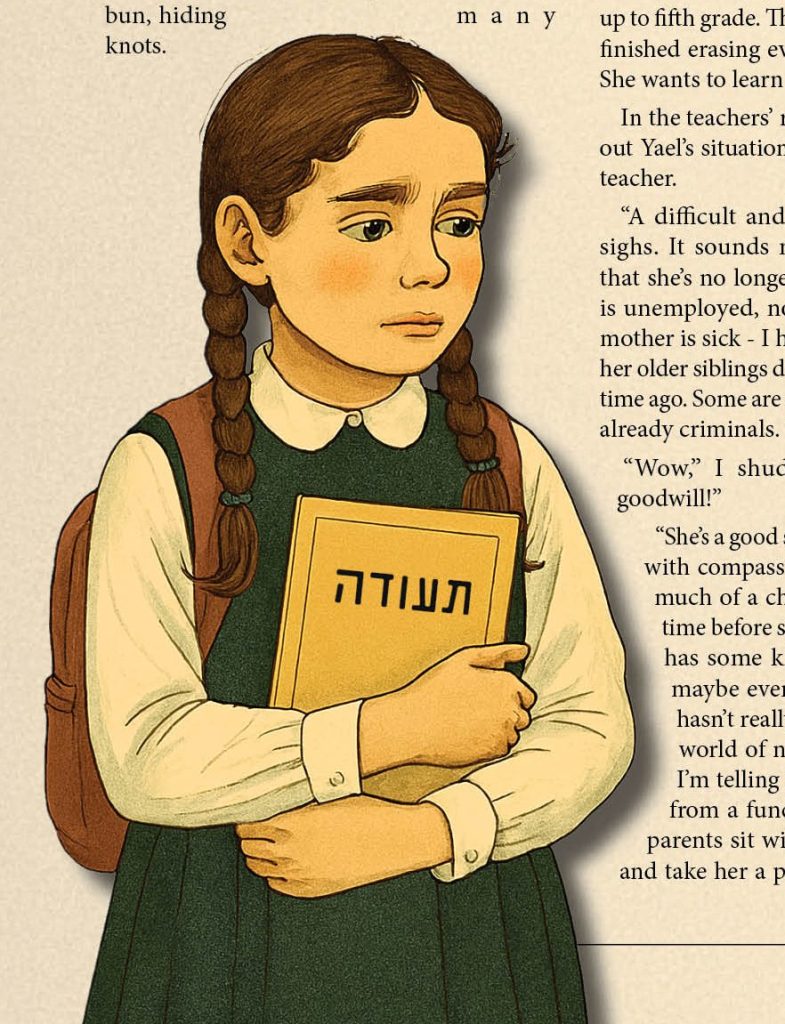
I smile, surprised. I don’t know her yet. I examine her old, worn, wrinkled school uniform blouse. The hair gathered in a curly bun, hiding many knots.
“Did you prepare for the school year?” I ask with a smile.
She nods with complete seriousness. “Of course. I tore out of all my notebooks everything that was scribbled. Now I have this,” she points to an old cloth bag, “it’s full of empty notebooks. And my brother also gave me a binder and a pen!”
She has a pen, with writing on it – an ad for something or other – and a cardboard archive binder, used but in not-bad condition. I am impressed, smiling carefully, trying to understand the situation. Around me are many new backpacks, sparkling, with a matching stationery set and another small insulated lunch bag. “Do you have textbooks?” I check.
She tells me about her neighbor. She asked her for her books, because she’s already moving up to fifth grade. They’re nice, and she’s almost finished erasing everything written in them. She wants to learn on her own.
In the teachers’ room, I carefully try to feel out Yael’s situation, sitting next to last year’s teacher.
“A difficult and discouraging story,” she sighs. It sounds more like a sigh of relief that she’s no longer her teacher. “Her father is unemployed, not really functioning. The mother is sick – I have no idea with what. All her older siblings dropped out of school a long time ago. Some are still on the streets, some are already criminals. The oldest is in prison.”
“Wow,” I shudder. “She came full of goodwill!”
“She’s a good soul…” my colleague smiles with compassion, “but she doesn’t have much of a chance. It’s only a matter of time before she breaks too. She probably has some kind of learning difficulty, maybe even more than one. She still hasn’t really grasped reading, and the world of numbers is a puzzle to her. I’m telling you, even if she had come from a functioning home, where her parents sit with her and do homework and take her a private tutor, it would have been hard for her. And given how her life looks – it’s a miracle she’s available to learn at all.”
I sigh. I don’t really know her yet, and I’m already feeling pity.
“Did they do an evaluation?” I remember to ask after two days, during which I managed to try to check her reading and discovered how her eyes blink and how she doesn’t distinguish between the vowels cholam and shoorook.
“Did they do an evaluation?” she scoffs, “Ask if they made her a sandwich…”
I don’t ask – I know. Yael is loved by most of the girls in the class, and they share their food with her. Especially the spoiled ones who can’t finish all of the thick sandwich Mommy made. She’s not picky. She eats any bread with any spread. A true “bal tashchis” representative in our class. How sad.
After the first two weeks, during which she tried to copy in the handwriting of someone who presses hard into the notebook, to open books and even do classwork, I see her beginning to break. She has no idea which page belongs to which notebook. The pen gets lost, and the page in the book from which they were supposed to cut out sentences for matching is missing. The neighbor from last year’s fourth grade probably already used it.
She’s discouraged, pushes the desk forward, lets everything scatter around. “I’m fed up!”
I’m not even angry – I just try to hold back the tears rising to my eyes. Such a small girl coping with a life that even an adult wouldn’t be able to handle.
I place a hand on her shoulder, bend down. “Remember you wanted to become a doctor?”
She looks at me, nodding sadly.
“I will help you,” I promise. While the girls cut out sentences from the book with new pink scissors, I go down to the secretary’s office and photocopy the page for her. She takes the sheet with a determined look, whispering thank you. She has no scissors, and it doesn’t bother her at all. With the skill of a survivor, she folds the page, reinforces the fold with her long nails, licks it. The page tears precisely and straight, more or less. Matching each sentence to its proper place in the book stresses her much more. After a few attempts of struggling to understand what is written, she simply walks around the classroom, checking in her friends’ books. By the end of the lesson, she too has a perfect assignment.
There were a few more moments of despair. There were moments when I myself almost broke. But the dream of becoming a doctor kept her on her feet every time, anew. It wasn’t easy for her, and it wasn’t easy for me either. Among all the things we didn’t evaluate in her, there is probably also some kind of attention difficulty, because she can’t sit still even for ten minutes – something is always falling or swaying or spilling next to her.
But she keeps holding on by her teeth.
I look at the math test, at the grade hovering over it. 43.
She studied in every free moment, really. One Tuesday, after a discouraging staff meeting, I found her in the classroom pacing back and forth, reciting things out loud. “I’m leaving already, I promise! It’s just that at home my siblings make noise, and I can’t study…”
If only I could, I would change her grade. Give her a hundred, for effort and perseverance and an enormous amount of willpower. But the voice of our assistant principal whispers to me in my head: “A report card is a binding document. Official. It has to be accurate. We can’t deceive the parents or another school which might rely on this report card to accept the child! Give her praise in the assessment…”
I certainly praised her in the assessment. I wrote to her what I truly think about her. “Yael, you are a real fighter. You never give up, even when it’s hard. You know what you want and are willing to do everything for it to happen!”
But Yael struggles with reading – I don’t know when or if she’ll ever read her assessment. The “Adequate” she will see right away. And I promised to help her achieve her dream of becoming a doctor.
Two weeks pass.
The students try their hardest to do well and behave well, not knowing that the report cards have been written for a long time already, waiting on the principal’s desk… Every morning I see Yael striving, biting her lip. Diligently writing in her notebook and sitting on the fence on the way home to do homework. My heart goes out to her. Knowing that I wrote “Adequate” on her report card gives me a feeling of being a traitor.
Report card day finally arrives. Tension in the classroom. I hold the papers in my hands, not yet distributing them. I try to explain to the class and to myself that what matters most is the effort and the striving, no matter what the grade on the report card is. A “Good” that was worked hard for is worth more than an “Excellent” that came easily – I try to phrase it as a motto. They don’t really listen – they want to look at their report cards already. Only good Efrat asks: “But if they worked hard, then surely they’ll get Excellent. ‘Yogati u’matzasi taamin,’ right?”
What’s true – is true.
The girls enter one by one in order, listen to me a little, mostly occupied with their report cards. None of them is surprised by her grades. Whoever is good, is good. Whoever didn’t try, knows it.
Yael enters among the last. She looks at me eagerly, extends her hand. A thousand words I prepared for this moment evaporate into the air. I simply hand her the report card, silent. She opens it eagerly, furrows her brow as she struggles to read what she got in which subject. Then she raises her eyes, smiles. “Maybe in the end I really will become a doctor!”
I’m happy she isn’t giving up despite the sad report card, wondering how. “Did you like the report card?” I ask cautiously.
She nods, scratching her head for a moment. “It’s a good report card.”
“I’m glad you think so.” I have no idea how those words came out of my mouth at all. “What do you think about the grade in math?”
She glances back at the report card, smiles. “You wrote Adequate, and that’s right. I really think I learned enough. You noticed that I learned a lot! Thank you for noticing!”
Report Cards – A Mother’s Perspective
My Chaim is a well-behaved child, boruch Hashem. One of those kids it’s fun to go to parent-teacher conferences for. We sit for an hour outside just to go in and see the teacher smiling, telling us how well our son learns, davens, is wonderful with friends and respectful to the teachers. He strives to reach first place in every test, quiz, or contest, and in his pure heart he always notices if someone is missing something – some lonely friend.
A well-behaved child, no ‘buts.” One year, the principal said: just duplicate him for me…
His report card, as you’ve probably figured out by now, is a boring one – all Excellents and Very Goods, Alefs across the board in conduct, etc. I’m not complaining about the report card, chas v’shalom, if anyone thinks so. Twice a year, when he gives it to us to sign, we say “Mizmor l’Soda” and give tzedaka.
When Chaim reached fifth grade there was a new teacher. A kid who got married yesterday. He was given the fifth grade, no less. There were parents who objected strongly, couldn’t understand why our children’s class had to be a guinea pig for the system. First let them give him substitute jobs or other ways to break in. After he proves himself, he can be given responsibility for a class! They even chose representatives and sent a delegation to the principal. I didn’t get involved. I thought to myself: it’s worth giving the teacher a chance to prove himself. Maybe he’ll be fine. There are those who were born to be teachers, they don’t need training at all. If there are problems, then we’ll make a fuss.
They didn’t replace him. The representatives said the principal explained why he was forced to place him davka here and davka in our class. He promised to keep a close eye on everything concerning our class.
It turned out to be unnecessary. The young teacher succeeded beyond all expectations. The kids were captivated by his lessons, passionate about the contests he organized, and they had never had such a good time socially. Chaim would come home from school every day with sparkling eyes, and open sefarim and do all sorts of extra credit assignments that the Rebbi arranged for the stronger students, who always finished homework in class.
And then the report card came. I had no expectations for a different report card, because Chaim’s report card was always excellent anyway, but this teacher managed to surprise even me. The grades were as usual – tens and nines – and the conduct was excellent. In the verbal assessment below, the place where the teacher writes every year: “Chaim, you are a very good student and participate nicely in class, pleasant to friends, etc…” – it said like this:
“Dear Chaim, I enjoyed seeing you stand by your position in the debate we had in class about ‘The Four Shomrim,’ and I was impressed by the extensive knowledge you gathered on the entire topic of ornamental fish! Your sense of humor is excellent, and you know how to use it in exactly the right dose to make us smile without hurting anyone, chas v’shalom. Keep being a Chassid, yerei shomayim and lamdan – you are one of the pillars of our class, Chaim!”
I was truly moved. I hope you understand why. In any case, I’ll be happy to explain: this teacher truly tried to get to know my son. He didn’t check off “Chaim” – a perfect child who causes no problems and will always save the class if it doesn’t know anything. It was truly important to him to know what my son likes, what he’s interested in, what unique trait he has beyond the “good boy” in him.
I was truly moved and gave money to tzedaka, wrote to the Rebbi how much the report card touched me. Now all that’s left is to pray that he’ll move up with them to sixth grade. We deserve it, don’t we? After all, we were the guinea pigs…
Report Cards – A Student’s Perspective
Report cards are a stressful thing. Every student is quite worried about the report card, unless she’s one of those perfect types who just needs to see the straight rows of nines and tens. Those who cry to the teacher because of ninety-eight on a test…
So we work hard and pray, and with a racing heart we look to see what they wrote for us. Even those who pretend they don’t care – care very much. Sometimes they’re even more afraid of the report card than those who bite their lips and chew their nails. That’s just their way of calming themselves down.
In sixth grade we got Morah Ruchama – a made-up name, of course. She’s already a real teacher of the upper grades, with a bass voice and a minimum of sense of humor. After the first week, which had many introductory lessons for all sorts of subjects and also Chai Elul and more, she suddenly said to us: “I want to talk to you about report cards.” We almost fainted. Rosh Hashana hadn’t even come yet – what report cards?
So she explained to us that we are the ones who write our own report cards. Each one writes hers. She only types in the data at the end. She showed us charts in a special binder, a chart for each subject. Written there in advance were all the tests. For example, in Torah: test on Bereishis, summary assignment on the Creation of the World, quiz on dates in the Mabul…
Below was another small chart of homework and participation or disruption during the lesson.
In the chart there were no names – only ID numbers. She asked us to memorize our ID number, briefly reminded us how to calculate an average, and left the binder on a shelf in the classroom closet. We could go to it whenever we wanted.
We stood around it in amazement, able to simply see what the whole year would look like. The expected grade was no secret, because we recorded it ourselves. When the teacher returned tests, she entered the grades into the binder.
Even when she checked homework and someone hadn’t prepared it, she sighed, took the binder, marked it in the specific subject, and said to her, “That’s what you wrote down, right?”
Our memory is short, as it turns out. Sometimes I would arrive without homework, sure it was the first time, it really didn’t seem to me that I had ever forgotten homework in reading comprehension, for instance. And then I’d go to the binder and discover that I actually had forgotten – twice already – and rush to prepare it before the teacher came.
Teachers always say that we are the ones who write our report cards, but with her it was suddenly so tangible! This approach also gave us a feeling of trust and maturity. The teacher doesn’t need to hide her grade book from us – everything is written, everything is transparent.
No student was surprised when she received her report card, and if anything, there were girls who were surprised for the better, because the teacher truly made an effort to round the average upward, with kindness and mercy.
That way, a grade of eight, which with another teacher might have been annoying (why couldn’t she give a nine?), with this teacher – when we knew that we truly deserved a seven – made us very happy.
In seventh grade we had a different teacher who behaved like every teacher in the world and it bothered me – that I didn’t really know what was going on with me – so I started marking it for myself in my diary. I had a page for each subject, and I wrote grades and times I didn’t do homework, for example, and that gave me enormous confidence, because I knew roughly where I stood.
It seems to me that the lesson we learned from Morah Ruchama was important to us for all of life, and gave us enormous confidence in ourselves and in our learning.
The complete glossary of terms on the report card:
Clear, impressive progress – I remember where you were at the beginning of the year and where you are now, and I’m proud of you for the journey you’ve made! Don’t look at the grade; look at the distance you’ve traveled!
Active participation in class – Your questions and comments make my lessons more interesting! It’s important to us to hear your voice in class!
High abilities – I can already see how far you’re capable of going, and I’m waiting for you to believe in yourself enough to soar there!
Always ready to help friends – This grade, in Ahavas Yisrael, is the real grade of life. The ability to truly see someone else is a trait that will take you farther than any math formula you’ll ever learn.
Shows curiosity and a desire to learn – Please keep asking “why.” Your questions don’t bother me at all; they help me teach the lesson properly.
Additional effort at home is needed – I believe you can go even further, and I’m here to help you do it step by step.
Beis Moshiach #1494 • pp. 42-48
© 2026 Beis Moshiach Magazine. All rights reserved.
This article originally appeared in Beis Moshiach #1494. You are welcome to share it with friends and family by email or in print, provided that you do not change, add to or omit any part of it, you credit the author and Beis Moshiach, and you include a link to archive.bmoshiach.org (written out in full in printed copies).
To republish this article in a newspaper, magazine, book or website, please request permission in advance at [email protected].