Echoes of Courage – Chapter 49: Full Circle
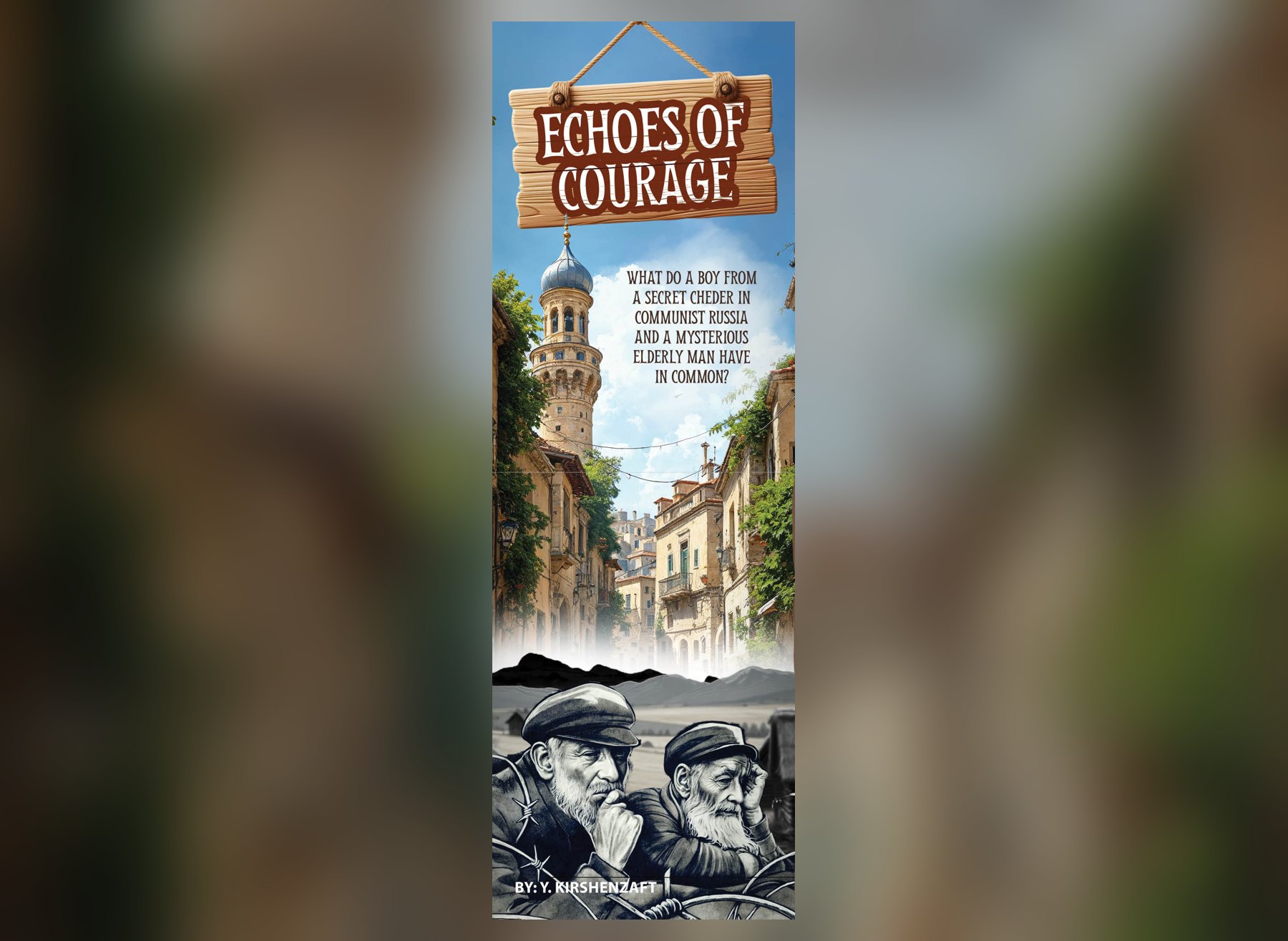
Previously: Eretz Yisrael: Boris confesses to the children about being a Russian interrogator. He plans on making major changes in his life.
Russia: Yosef Yitzchok leaves Russia for Eretz Yisrael and when he ages, he enters a senior citizen home where he is known as Yitzchok. As a result of the harsh interrogations he underwent and his suffering, he is fearful. Under his bed he hides a diary that he wrote of his life.
Yerushalayim 5785
“It’s very important to remember that we are on the Rebbe’s shlichus. He wants us to help Yitzchok,” Moishy reminded his friends.
The boys got into the car with Boris and set out.
“I see that you don’t have a picture of the Rebbe in your car,” commented Mendy, and he put a Moshiach card at the end of the windshield. It was one of many that he always had in his pocket.
After a short drive, they arrived at the familiar building, the senior center. The boys jumped out of the car while Boris began to tremble. He was at the senior center where Yitzchok, his sworn enemy of the past, lived.
The boys ran up to the second floor, like the old regulars that they were, and walked the length of the long hallways until they reached the last room. Moishy gently opened the door and they saw Yitzchok lying in bed, his eyes open, staring at the ceiling with a vacant gaze.
“Yitzchok, it’s us,” said Moishy and he motioned to his friends to come in. They did so and Moishy sat near Yitzchok and shook his hand warmly. Boris, the former interrogator and natchalnik, followed them into the room.
Yitzchok looked at them all and his gaze stopped on the tall Russian. Instantly, his vacant look became focused and he stared long and hard and turned white. His whole body began to shake. It was clear that he recognized Boris, the one who had persecuted him.
The children watched tensely, not knowing what to say and how to react.
“What did I do to you?” said Yitzchok, suddenly sitting up in bed. He began agitatedly waving his arms in every direction.
“What did Judaism do to you? What did all the Chassidim do to you that you abused them so? What? What?”
Yitzchok’s voice was terrible, broken and bitter. Boris didn’t know what to do. He knew what Yitzchok was referring to …
Yitzchok burst into tears.
“Yitzchok,” said Zalmy softly, “Boris came to confess his sins. He is doing teshuva …”
They did not expect what happened next. Yitzchok made a fist and banged it on the small table, knocking over a vase.
“I don’t believe him!” he shouted. “He’s a criminal!”
Boris approached Yitzchok’s bed, bent his head and quietly said a few words. The boys didn’t understand what he said because it was in Russian. It was a few sentences said quickly and Yitzchok immediately turned quiet, looked right and left, and then his head fell back on the pillow. Like a magic wand, whatever was said was able to calm him.
Long minutes of silence ensued when suddenly, before the children’s astonished eyes, Boris went over to Yitzchok, gave him his hand, lifted him from the bed and then embraced him in a big, warm hug. Yitzchok’s entire body shook in a spasm of sobbing which released the emotions that had been confined for so many years.
The children left the room, leaving Yitzchok and Boris alone.
Summer 5785
About half a year had passed. The Goel Yisrael shul was packed with bachurim and boys. It was bein ha’zmanim and many had gone to the shul to learn even on their time off from yeshiva. They joined the usual crowd of men who regularly learned in the shul. Among the boys were also the heroes of our story: Zalmy, Mendy and Moishy.
“There’s a half hour left until Mincha,” said Moishy, tapping Zalmy on the back.
Suddenly, in walked some unexpected men. They were the fathers of the three boys along with the director of the senior home, whom the boys had gotten to know personally. What were they doing here? wondered Mendy
“My father is also here,” mumbled Moishy, “and he was supposed to be out of town today!”
Zalmy, like his friends, felt that their unexpected arrival had something to do with them but he didn’t know what or why.
Rabbi Leibel Abramowitz, Rav of the community who sat in his usual place, got up and welcomed the men with a warm handshake. By his body language one could tell that he had been waiting for them; he knew something they didn’t know.
“I don’t understand what’s going on here,” complained Zalmy, “and yet we consider ourselves top detectives who know everything …”
Everyone stared at the men who stood near the Aron Kodesh. The Rav gave a bang on the table. He didn’t need more than that for everyone was curious to know what was going on.
“We have three dear people here with us today, members of our community,” began the Rav. “With them is Mr. Naftali, director of the senior center in our neighborhood. I don’t know how many of you know him but I can tell you that he is a rare man of chessed who is devoted to the seniors who live in the home. I want to take this opportunity to honor him with saying a few words.”
The Rav moved aside and smiled mysteriously. Naftali stood near the Rav looking a bit awkward; he wasn’t used to scenes like this.
“I’d like to say thank you. A big thank you, to three boys, heroes from our community, who are with us here today. They did a big chesed for one of the home’s residents; I can’t even tell you how big. I want to salute you, boys, kol ha’kavod!”
As he said this, he motioned toward Moishy, Zalmy and Mendel to come forward.
The three embarrassed boys blushed and walked hesitantly to the front. Loud applause filled the room. They stood facing Naftali who stood next to the three parents. Naftali took three certificates out of his briefcase and gaily handed them to the boys.
He said, “As a personal gift for you, I promise that from now on I will have a large, framed picture of the Lubavitcher Rebbe in my office to remind me to always do good.”
There was clapping again and the boys proudly held their certificates.
If that wasn’t enough, someone else walked into the shul. The boys didn’t know where he had suddenly appeared from and where he had waited until then. It was Boris who was familiar to many in the neighborhood but only the three boys had gotten to know him.
“I’m not managing so well with the kippa on my head,” said Boris shyly, as he adjusted it. “I owe these boys my spiritual life. Thanks to them, I’ve come to recognize G-d. In recent months, I’ve been in touch with Shmuel, a Chabad shliach who shares with us, Russian speakers, the beauty of Torah and Judaism, and I’ve been learning so much from him.”
He spoke briefly in broken Ivrit mixed with some unfamiliar words in Russian.
Naftali raised his hand to quiet the crowd.
“I’d like to announce additional good news. This morning, we got Yitzchok’s permission to publicize all the stories of mesirus nefesh that he wrote in his secret diary, stories that depict the terrible times that he and his father, Avremel, went through. The senior home’s administration commits to publishing the diary within the year as a book that will certainly interest the younger generation.”
Then Mendy’s father asked to speak.
“I’d like to share something with you,” he said quietly, which made everyone quiet down to better hear him. “When I was a boy their age,” he said pointing at his son and his friends, “my father told me about his father, my grandfather, who was a Chassidishe Yid who was often moser nefesh in the Russian underground. I heard many stories from him but he died suddenly, shortly after my bar mitzva, and I didn’t get to hear all his stories.
“Before coming here today, I heard the entire story that my son and his friends experienced. I spent many hours this morning with Yitzchok in his room at the senior center and heard from him from what he went through in the Russian underground. He told me a lot about Shulem, his adopted father. When I heard the special stories about Shulem I recognized some of them as stories that my father had told me about his grandfather.”
The crowd was surprised and Mendy’s father continued.
“This morning, I realized that Shulem is none other than my grandfather! I am the grandson of Shulem who saved and helped so many Chassidim in Soviet Russia. I feel like I am closing an extraordinary circle of decades!”
Applause.
Moishy asked to say something too.
“Since, throughout this project, we were operating on the Rebbe’s shlichus, I’d like to say a short sicha of the Rebbe on this week’s parsha.” Moishy spoke for a few minutes and when he finished, Zalmy gave out Moshiach cards.
Moishy, Zalmy and Mendy shook one another’s hands. They had gotten through this adventure and now they enjoyed the reward of nachas and much satisfaction.
The End!
We thank tamim Yossi Kirschnzaft for writing this serial especially for our readers. Yossi, may you continue to be a Chassid, yerei shomayim and lamdan and may we merit to continue enjoying your exciting, creative work!
Beis Moshiach #1495 • pp. 59-62
© 2026 Beis Moshiach Magazine. All rights reserved.
This article originally appeared in Beis Moshiach #1495. You are welcome to share it with friends and family by email or in print, provided that you do not change, add to or omit any part of it, you credit the author and Beis Moshiach, and you include a link to archive.bmoshiach.org (written out in full in printed copies).
To republish this article in a newspaper, magazine, book or website, please request permission in advance at [email protected].