When Tanya Became the Prescription
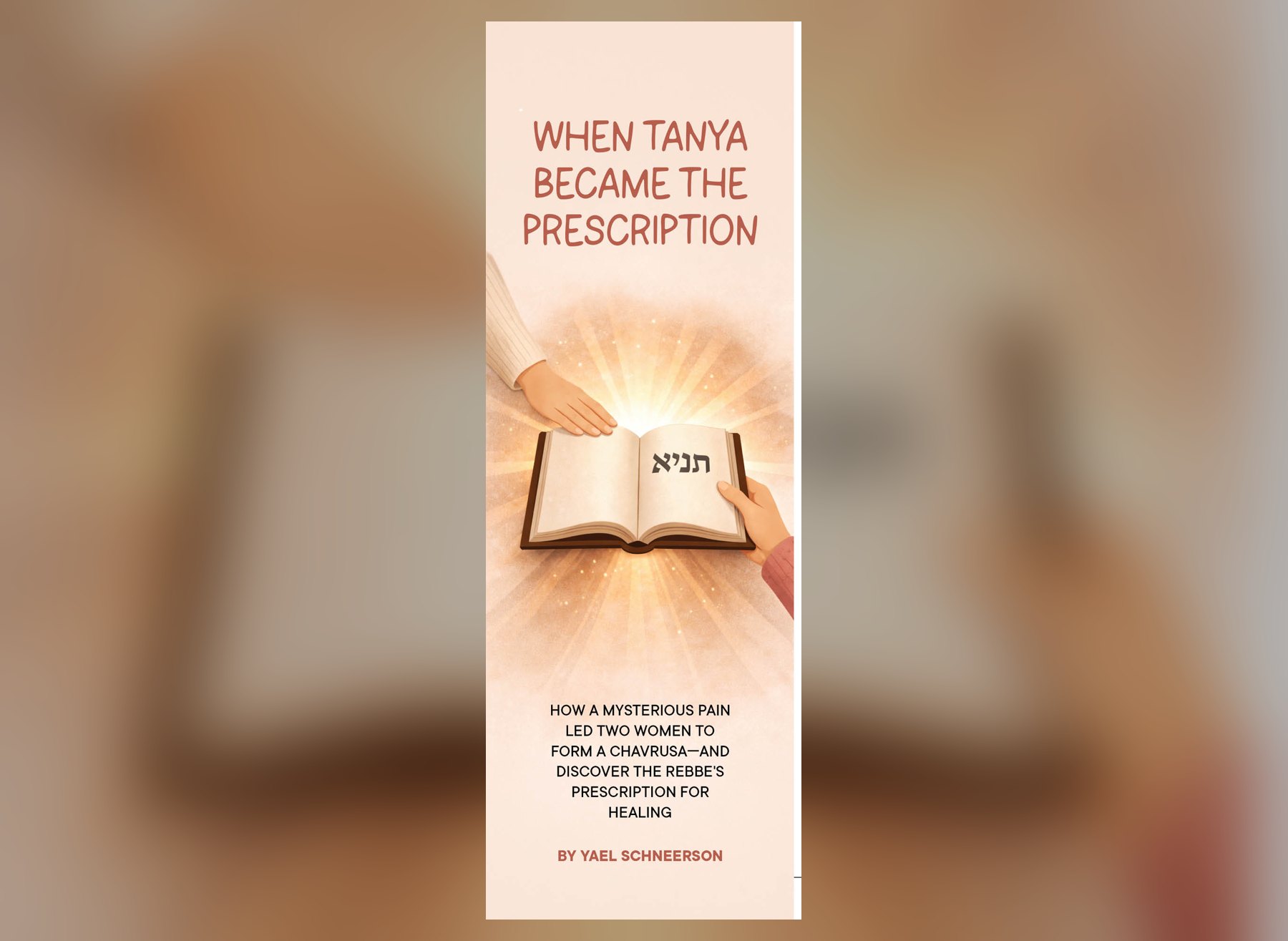
How a mysterious pain led two women to form a chavrusa – and discover the Rebbe’s prescription for healing.
Shortly after Chof-Dalet Teves, the hilula of the Alter Rebbe, I sat down for a conversation with a friend with whom I have a regular chavrusa for some time now.
Do you want to hear how we started and how far we have come? All the answers follow in this article.
A Spiritual Remedy For Pains In The Legs
Our joint story began about a year and a half ago. During that period, I had some serious pains in my legs for no clear reason. I made an appointment with an orthopedist, but as those living in Eretz Yisrael know, such appointments are made for the distant future, a wait of at least two months. In the meantime, endure the pain…
Around this time, I wrote to the Rebbe MH’M on a variety of issues, and among them I requested a bracha for health. When I opened the volume of Igros Kodesh, I didn’t find a clear answer. However, when I unintentionally turned to the next page, my eyes set upon a letter to someone suffering from leg pains, and the Rebbe writes to him (in substance): Since the leg is connected to the concept of emuna, he should assiduously study “Shaar HaYichud V’HaEmuna”, even learning several chapters from this section of Tanya by heart.
I felt that the answer was directed specifically to me, and I decided to “take the plunge.” I shared the answer that I received with my friend Carmit, and her response was immediate: “Come, let’s make a chavrusa and start learning together,” and so it began.
Carmit Oren: When Yael turned to me and told me about the answer she received, I “jumped” at the opportunity. During this time, we operated a Zoom class (and we still do), primarily for our close friends, women I “enlisted” from various social media groups for saying Tehillim. In this class, we studied Tanya, halacha, and the Rebbe’s sichos on the weekly Torah portion. However, the level of learning was made suitable for these women lacking sufficient background in the study of Chassidus. The idea that we will learn together in a more profound manner captivated me, and I decided to join this chavrusa.
Yael: It wasn’t easy to set an appropriate time for this learning, since each of us is very busy, Baruch Hashem, with other vitally important matters. We eventually decided on a rather original hour: half past eight in the morning on my day off, when Carmit is on her way to work, and we learned together on the phone. Thus, we learned each time for about ten or fifteen minutes out of the annotated sefer “Shaar HaYichud V’HaEmuna”, according to the interpretations of Rabbi Yoel Kahn. We decided in advance that the objective of our joint studies will be an in-depth learning of the material, not how many chapters we cover. “Study assiduously”, as the Rebbe wants.
After about a year, we completed “Shaar HaYichud V’HaEmuna”, and this gave us a desire to continue our learning. We moved on to Iggeres HaTeshuva, and from there to Iggeres HaKodesh, when our objective was, with G-d’s help, to complete our joint Tanya studies in depth.
Learning That Penetrates The Inner Essence
The immediate results were that within a short period of time, the pains in my legs miraculously stopped. The appointment with the orthopedist was cancelled. However, our studies didn’t just have an influence on the body, they influenced the soul as well.
Carmit: The learning gave me many things. First of all, regular Torah study doesn’t just mean periodically going out for a Torah class or a farbrengen, rather it’s a fixed commitment in learning Chassidus. Furthermore, this is an in-depth form of learning, a profound review of the Tanya. Learning Tanya is usually reduced to the daily study of Chitas, which is primarily reading (sometimes even with half-closed eyes…). And even if I managed to comprehend a little, it wasn’t really in-depth. In contrast, when we decide from the outset to learn the material thoroughly, it is more firmly established, not just read it and check all the boxes.
The learning itself gave me considerable insight. When we learned “Shaar HaYichud V’HaEmuna” and internalized what we knew, mainly on the level of “makif”, i.e., all reality in the world is essentially the One G-d and there is no other – this brought us simcha, strengthening our faith in Hashem and our connection to the Rebbe. I can safely say that my entire outlook changed. My whole line of thinking with regard to Yiddishkeit, Chassidus, and the importance of fulfilling mitzvos received much greater perceptiveness and deeper meaning.
In the merit of these studies, I started being more stringent in doing things not just because I was used to doing them, rather out of a sense of awareness that this is G-d’s Will. I know and feel that when I do a mitzva, I have a connection to Hashem in its simplest sense. Even tasks we do on a daily basis, such as saying the ‘morning brachos,’ receive the most profound direction.
Naturally, this also applies to our understanding of the world’s existence and the people around us. All kinds of things that each and every one of us experiences in life, whether it’s with our supervisor at work, annoying neighbors, or other matters, large and small, the learning reconnects you to your place in life before Hashem – and yourself.
Again, it’s impossible to say that I didn’t know this beforehand. However, this was always primarily in a manner of “makif”, and when we studied in depth, it turned into a part of me. It transformed my whole way of thinking and my response to it.
Everything Suddenly Becomes Connected
The way in which I related to my studying of other Torah subjects also changed. Prior to this, I wasn’t all that connected to the study of Chumash, and in the study of halacha, I could only see it as technical. Then, suddenly, everything connected for me. Suddenly, I realized that even those sections that seemed more technical were actually an integral part of the Torah, part of the Aibishter’s will and wisdom, literal G-dliness. As a result of this learning, I clearly see how everything revolves around this point, and no part of my Torah study seems “cumbersome” any longer. I realize that if I don’t have a proper connection, it’s because my spiritual vessel is not as clean as it should be, and I must direct myself towards encountering the Aibishter within this “technical” matter.
Yael: The study of “Shaar HaYichud V’HaEmuna” is life-changing. When I learn and contemplate the subject of Achdus Hashem, I now look upon the whole world from a new outlook. I walk outside and grasp how every leaf growing on a tree is essentially G-dliness, and I start looking at people and their actions from an alternative viewpoint. I realize that everything is merely a covering, and the only essential truth is G-d. This provides a sense of calm, tranquility, and a greater quality of life. I even began feeling different about my spiritual standing, my connection to G-d, and I realized even more how much we really don’t or can’t understand the ways of Hashem, feeling the connection from a deeper and more inner place, even without experiencing physical pain. Studying “Shaar HaYichud V’HaEmuna” in depth – is a gift of life!
Carmit: This learning directs me to see how Torah and Yiddishkeit envelops all worlds and all things, from the greatest detail down to the smallest. When we study Chassidus in depth, we reveal Hashem in everything we learn at every step of our lives. Even if it might seem to you that you’re overburdened, it’s worth it to make the effort and find fifteen minutes free once a week – a small investment with a high level of return.
Beis Moshiach #1495B • pp. 42-43
© 2026 Beis Moshiach Magazine. All rights reserved.
This article originally appeared in Beis Moshiach #1495B. You are welcome to share it with friends and family by email or in print, provided that you do not change, add to or omit any part of it, you credit the author and Beis Moshiach, and you include a link to archive.bmoshiach.org (written out in full in printed copies).
To republish this article in a newspaper, magazine, book or website, please request permission in advance at [email protected].