Gifts the Rebbe Rejects, Gifts the Rebbe Treasures
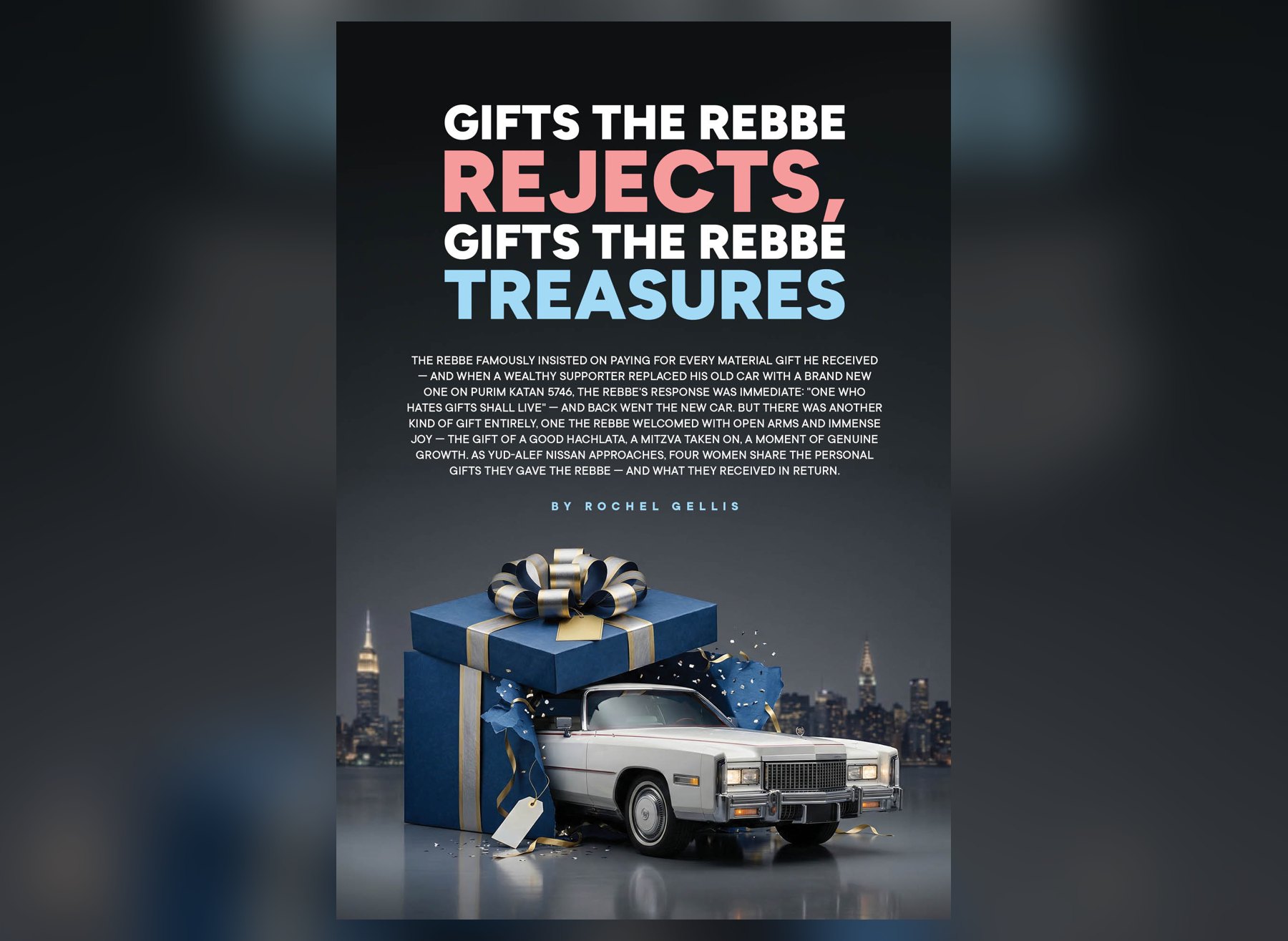
The Rebbe famously insisted on paying for every material gift he received – and when a wealthy supporter replaced his old car with a brand new one on Purim Katan 5746, the Rebbe’s response was immediate: “One who hates gifts shall live” – and back went the new car. But there was another kind of gift entirely, one the Rebbe welcomed with open arms and immense joy – the gift of a good hachlata, a mitzva taken on, a moment of genuine growth. As Yud-Alef Nissan approaches, four women share the personal gifts they gave the Rebbe – and what they received in return.
Have you heard about the Rebbe’s attitude toward gifts? An example of this is the incident of purchasing a new car on Purim Katan 5746. The car was bought by one of the wealthy supporters to replace the old one.
In a video, you can see the Chassidim crowding around the new vehicle, playing the melody “Didon Notzach.” Anyone who listened carefully could also hear the Rebbe’s reaction to the gift: “One who hates gifts shall live” – and his insistence on continuing to use the old car.
The Rebbe did not refuse gifts outright, but set a clear condition that only a few were ever permitted to waive – gifts must be paid for. Usually the Rebbe paid in cash.
However, the Rebbe related to spiritual gifts differently. He allowed us to give them to him with great love and a full heart, without limitation at all, and derived immense satisfaction from them.
Many gifts can be given to the Rebbe, and we will discuss this further in our article. For now, we will focus on the Rebbe’s rare treatment of this subject and his special request regarding the types of gifts to be given.
In a sicha on Purim 5732, the Rebbe spoke in an unusual way about the significance of gifts given in honor of Yud-Alef Nissan his birthday. These are his holy words (emphasis added):
“Since there are people who prepare for the birthday, etc., and think about how to express it… regarding a gift in general, one cannot set conditions. But still, a gift is connected to bringing nachas ruach – whether it be tzedaka in such a manner, or good deeds in such a manner, or good actions in such a manner.
In every person it is correct, desirable, good, upright, and pleasant – with all the descriptions stated in ‘Emes V’Yatziv’ – that each person should have an increase in Torah study, both in Nigleh and in Chassidus.”
The Rebbe reveals to us which gifts will bring him pleasure and make him especially happy.
The gifts the Rebbe was especially glad to receive for his birthday are an increase in Torah study and in the study of Chassidus.
When the Rebbe Asked for a Gift
Businessman Mr. David Chase, a Connecticut resident and major supporter of the Rebbe’s shluchim, once recounted that early in his connection to the Rebbe, on an ordinary day in 5741, he was surprised to find a letter from the Rebbe in his mailbox. The content surprised him even more. In the letter, the Rebbe wrote: “It is not customary for a person to request a birthday gift for himself, but I wish to act in an exceptional way – and as my upcoming birthday approaches, I would like to make a request of you: that you put on tefillin every day and recite at least the Shema in Hebrew or English. And if it is difficult for you to read more than that, I will be satisfied with this.” Further in the letter, the Rebbe expressed hope that Mr. Chase would also agree to receive a gift from him – a pair of tefillin.
Mr. Chase rushed to respond. He gladly gave the Rebbe his gift. As for the gift from the Nasi of the generation – the pair of tefillin – he mustered the courage to request three pairs: one for home, one for travel, and one for use on his yacht, where he occasionally spent time. And since he did not want this precious gift to affect the budget for the Rebbe’s other activities, he enclosed the approximate amount he believed the three pairs would cost.
The Chief Rabbi of Russia, Rabbi Berel Lazar, recounted that once a man went to the Rebbe before Yud-Alef Nissan and said he wished to give an open check for any purpose the Rebbe chose, as a birthday gift. The Rebbe told him that if he wanted to give a gift, he should donate the money to distribute shemura matza. The man was astonished and explained that he wanted to do something big. The Rebbe replied: “I am talking about something big! That every Jew should receive shmura matza.”
We, as Chabad Chassidim, do not need to wait for the Rebbe to personally request a gift. We have the Rebbe’s sichos, filled with countless instructions – we need only choose the special gift that is right for us.
To help us with this, four women share their inspiration and their personal gifts to the Rebbe:
“Every Small Step is Significant”
A gift to the Rebbe is not necessarily something physical – it is primarily a good deed, a positive decision, or a small but meaningful change. The Rebbe always emphasized that the best way to make him happy is through doing something for others, spreading the light of Chassidus in the world. Yes, I gave the Rebbe a gift – I accepted upon myself to improve in a certain area, to add another good deed, to be more precise in my derech… Some will dedicate more time to study, others will give to tzedaka. Each person finds the way that suits them. The main thing is that the gift comes from the heart. Remember that it is personal – you are not supposed to give a gift that fits someone else. It is not for nothing that G‑d created us different from one another.
Once I simply decided to be more attentive to my children – I set aside time to sit with them after candle lighting or at dinner, to truly listen to them. I prepared questions and also shared my own thoughts with them, which added a great deal of family light to the home.
This is a moment when you feel you have something real to give – and it’s not just for yourself. It connects you to something much greater than what appears on the surface. When the decision comes, there is a feeling in the heart of genuine connection and of shlichus.
There is definitely a return. Not necessarily in the conventional sense, but I received encouragement, a sense of direction, and even moments when things worked out at exactly the right time. Whoever gives from a genuine place feels it return to them, sometimes in unexpected ways.
“I Try to Give the Rebbe a Gift Every Time I Write”
A gift to the Rebbe, to me, means advancing in something the Rebbe instructed. To choose a specific topic that the Rebbe explains is important and to decide that I will focus on and advance in it. Honestly, I try very hard to give the Rebbe a gift and make a good resolution every time I write to the Rebbe and on Chassidic dates. So one could say I have given many gifts. Can I say I always succeed in keeping them all? I would not go that far. But I certainly try.
I think that the most meaningful gift was the one I gave exactly thirteen years ago, before Yud-Alef Nissan. I was becoming more observant, and at that point I was already quite involved. I tried to dress modestly, but being careful about stockings was still difficult for me. I remember the moment I decided to take the matter of modesty all the way. And since then, I have not left home anywhere without stockings.
The desire is felt most strongly on Chassidic dates – and, let’s be honest – when we have personal interests, such as before writing to the Rebbe. And yes, there are also moments of inspiration after deep study of Chassidus, when one is suddenly filled with a tremendous desire to give. It’s a wonderful feeling. But the real work comes afterward, in day-to-day life – in the challenge and the success of staying committed to the decision.
And as they say – “the Rebbe doesn’t remain indebted”? When I accept a good resolution upon myself, I remind myself that I am not giving in order to receive. And I must add that more than once, when I wrote to the Rebbe about some difficulty and took on a particularly challenging decision, the problem resolved itself through hashgacha pratis.
“A Chassid Must Always Know He Is a Chassid”
What is the meaning of a gift to the Rebbe? It is told that once some tmimim approached R’ Zusha Posner and asked him what preparation should be made before traveling to the Rebbe. R’ Zusha, surprisingly, answered: “Nothing!” The students did not understand what he meant.
R’ Zusha repeated: “Does one only begin to change when going to the Rebbe?! At all times one must study Chassidus! At all times one must study Chitas and Rambam and go out on mivtzaim!” – That point struck me. A Chassid does not remember the Rebbe only on Chassidic dates or before traveling to 770!
A Chassid must always know he is a Chassid, and that upon him rests the singular shlichus – kabbolas pnei Moshiach Tzidkeinu. He cannot shirk this responsibility.
I will share the good resolution I made last year. This resolution, boruch Hashem, actually motivated me to properly prepare for Yud-Alef Nissan.
My gift to the Rebbe was to set a goal connected to the age of Melech HaMoshiach in all matters of mivtzaim – in distributing Neshek, a letter in a Sefer Torah, in studying Chassidus, and more.
This decision changed me so profoundly – I felt connected to the Rebbe in everything.
Of course, we do not give the Rebbe a gift in order to receive a reward. We know that every giving, every directive and every good hachlata we fulfill – is truly for ourselves. The moment I add hours to learn Chassidus in order to give the Rebbe a gift, I am giving to myself. The same applies to mivtzaim and every good action.
A soldier in the army does what his commander demands. He does not calculate what he will gain from the “deal” or what he will get out of it.
In my humble opinion, in order to give the Rebbe a gift, one simply needs to give. There is a well-known story about a farmer who boasted that he would bring the king a great gift – a palace, a herd of cows, an entire pen – but the one thing he actually had, his rooster, he was not willing to give…
We need to learn not to behave like that farmer.
And one final point – love for the Rebbe is expressed when the Rebbe’s will becomes my will, and the Rebbe’s feelings become my feelings. Once you understand this, the connection looks entirely different.
Beis Moshiach #1499 • pp. 44-47
© 2026 Beis Moshiach Magazine. All rights reserved.
This article originally appeared in Beis Moshiach #1499. You are welcome to share it with friends and family by email or in print, provided that you do not change, add to or omit any part of it, you credit the author and Beis Moshiach, and you include a link to archive.bmoshiach.org (written out in full in printed copies).
To republish this article in a newspaper, magazine, book or website, please request permission in advance at [email protected].