Do You Feel Open or Exposed?
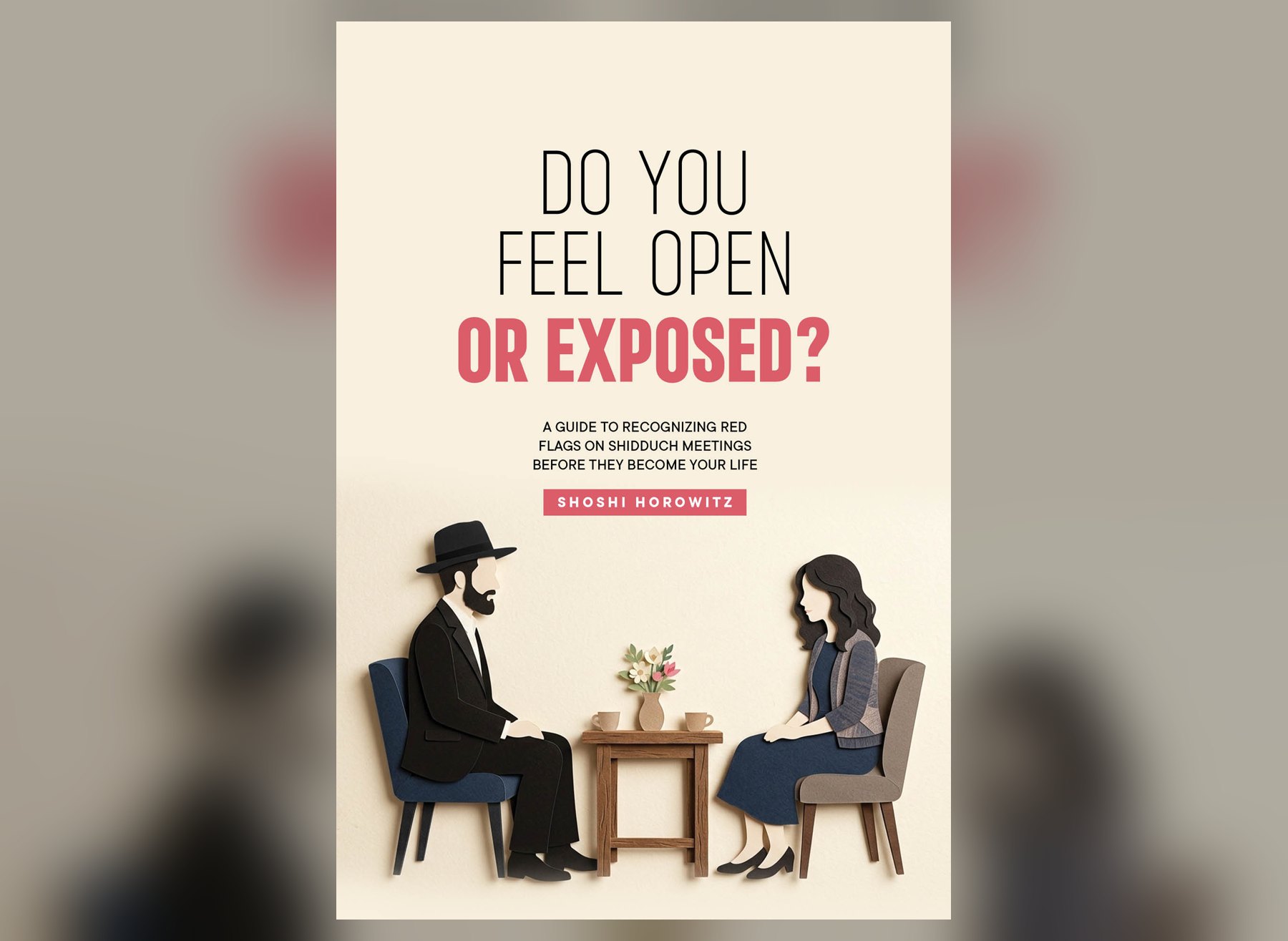
A guide to recognizing red flags on shidduch meetings before they become your life
When you’re alone with yourself – answer honestly: how much do you truly value yourself (on a scale of 1 to 10)?
We often believe our choices are rational, considered, and based on genuine reflection – but if we dig deeper, we discover that it’s not reason driving us, but need – a deep need for validation, security, and belonging.
Not long ago I heard a beautiful mashal from psychologist Sari Berlinsky: when you’re sitting at home and someone knocks offering to sell you a bottle of water, you’ll smile and say “no thanks.” If you’re out on the street and thirsty, you might buy it. If you’re on a hike with no shop nearby, you’d be willing to pay more. And if you’re in the desert, moments from dehydration, any water will make you happy – even water you’d never go near under normal circumstances. Because the greater the need, the more we compromise, and the lower our standards fall.
This pattern appears in relationships that carry potential for exploitation and harm. For example: if someone desperately needs a job or recognition of her worth, she may agree to work for an employer who underpays her or even exploits her.
After many conversations with girls and women and with dating and marriage coaches, I feel the need to raise several points worth paying attention to during the dating period (and if there are additional points I haven’t mentioned, I’m always happy to hear them).
The lower one’s self-worth, and the more the desire to marry becomes a burning need, the greater the risk of overlooking warning signs. If a girl doesn’t recognize her own value and the good, meaningful things she brings to a marriage, she may convince herself that “it’s just right now,” that “he’s not really like that,” and that “after the wedding everything will work out.”
And within that place, she may also agree to emotional, intellectual, or practical compromises that don’t truly align with her values – just to avoid losing the relationship.
So what do red flags look like in dating?
Red flags don’t always come with an alarm, and their color isn’t always glaring.
Mushki left a date with a feeling she couldn’t quite explain. On paper, everything was right: a serious bachur, Chassidish, good background, easy conversation. And yet, something grated on her. During the conversation, he mentioned a particular catering hall and said with a smile: “Anyone who relies on their hechsher probably doesn’t really understand kashrus.”
Then he spoke disparagingly about a rabbi who teaches at her seminary – one she deeply respects. Later he remarked about her cousin – a serious bachur, a yerei shamayim who had once been a shliach at his yeshiva – that he “never really gets things.”
Not harshly, not with shouting. Just in a tone that diminishes and dismisses.
It’s legitimate to prefer a certain hechsher. It’s legitimate to hold a clear opinion on an issue. But when talk about others repeatedly returns to dismissal, minimizing, and a sense that only he understands while everyone else falls short – this is no longer a matter of standards and principles. It’s an attitude.
And this is exactly where our inner world comes in: Mushki left the date not knowing how to explain what bothered her. After all, he hadn’t yelled, hadn’t directly insulted her, hadn’t rejected her opinions or said anything “assur.” On paper, everything was fine.
Then the internal dialogue began: Maybe I’m just being sensitive? Maybe I’m chasing perfection? Maybe he’s just a bachur with strong opinions? Maybe I need to learn to be more tolerant?
The stronger the desire to marry, the more convincing that voice becomes. The greater the pressure – internal or external – the more likely Mushki is to explain to herself why it doesn’t really matter, why it’s trivial, why it shouldn’t be made into a big deal.
But wait, Mushki – the question isn’t only what he said. The question is how you felt about it. Did you feel respected? Did you feel there was room and legitimacy for your opinions too? Did you feel comfortable saying: “I actually have a lot of respect for that rabbi”?
Sometimes the red flag isn’t in the sentence itself, but in the fact that you don’t feel free to be yourself.
Here the connection to self-worth becomes sharp and clear. The less certain we are of our value, the less we protect it. If you’re not sure you deserve respectful treatment, you’ll compromise on a dismissive tone. If you’re not sure your voice matters, you’ll go silent when it’s minimized. And then, slowly, without noticing, you get used to shrinking – and the habit of shrinking during dating doesn’t disappear after the wedding. It usually only becomes more entrenched.
Boundaries Tested Quietly
Some red flags have nothing to do with his opinions, but with intrusion into your privacy. Sometimes this shows up as a question that sounds innocent: “How much do you earn?” or “How many dates did you go on before me?” and then perhaps: “And why did the previous one not work out?”
Some questions come from a genuine place; others create a sense of boundary-testing. At first it might even feel flattering – he wants to know you deeply, he’s interested. But if you notice you’re being pressured to answer, sharing things you’re not ready to share, crossing your own line just to avoid appearing “closed off” – it’s worth stopping.
One girl said that on the second date, mid-pleasant-conversation, the bachur asked to see photos on her phone. “I’m just curious what your day-to-day life looks like,” he said with a smile. He wasn’t pushy – one could even interpret it as a compliment. And yet she found herself scrolling and showing, even as something inside asked her to stop.
Another described how early in the acquaintance he asked who she consults with about the dates. “I’m not a fan of too many people being involved,” he explained. Only later did she realize he wasn’t asking just to understand – but to gauge how influenced by others she was.
Yet another was surprised when, in the very first dates, he wanted to know exact details of her daily schedule – when she gets home, who she meets, what her evenings look like. It was all said in a caring, interested tone, but the feeling was of being tested.
And another story: at the end of a date, he asked her to let him know when she got home. “Just so I know you’re okay.” Concern can be beautiful and touching – but when it becomes a regular expectation or repeated check-in, it edges into control.
Remember: respect is not only measured in what he says about others, but in his ability to preserve your space.
Once a young woman sat across from me and said: “He asks a lot of personal questions – but maybe it’s good that he’s so open?” I asked her one question: “Do you feel open, or do you feel exposed?”
That’s an enormous difference.
Some bachurim test boundaries early – on emotional and personal topics, sometimes even in the realm of tznius or content inappropriate for the religious standard they project. Not bluntly, but subtly, with a half-smile, as if it’s just “honest conversation.” But if someone pushes a small boundary early on – without sensitivity, without sensing your pace – it’s reasonable to assume he’ll keep pushing boundaries later.
And again, self-worth enters here. If you feel you deserve to set the level of openness you’re comfortable with – to share only so much and no more – you won’t be embarrassed to say: “I prefer to save that for later.” If you’re not sure of your value, you’ll answer, and then regret it.
Kind Words at the Wrong Moment
Years ago, when I was a counselor at a dormitory, one of my girls came back one day unusually excited. She shared with all of us the compliments she’d received from a woman she’d met.
“You don’t understand how she spoke to me,” she said. “She said you can tell I’m responsible, that I have a good heart, that I look like someone you can trust completely.”
She repeated the words over and over. They moved her and filled her up. Only later did it become clear what had happened: the woman who complimented her had also asked a major favor – to deliver a heavy package somewhere. At first she didn’t connect the two at all. Only afterward did she begin to wonder: How did she know all this about me? She doesn’t really know me.
What had happened quickly became clear. The woman wanted to ask a significant favor, and the kind words prepared the ground. They opened the heart, softened it, created a sense of closeness and appreciation – and then the request sounded more natural.
The girl wasn’t naive. She simply needed kind words. And when she got them, they won her over before she even noticed. When there’s a deep need for validation, for a sense of worth, for recognition – words go straight inside.
The same applies in dating. Beautiful, warm words are a wonderful thing. You’re allowed to be happy about them. But when big words arrive too early – before a real connection has been built, before genuine familiarity has developed – it’s important to pause and ask: did these words come from a process, or are they creating one artificially?
Sometimes we’re not swept away by the person – but by the feeling that someone sees us.
A person with healthy self-worth doesn’t dismiss compliments – they simply don’t make life decisions based on them.
Back to Self-Worth
Most people rate themselves around 6-7. Some higher, some lower. If your number is lower, you don’t need to wait for someone else to raise your sense of worth. You can begin with small steps: for example, each evening before going to sleep, remind yourself that you have worth simply by virtue of who you are. You are a daughter of a King, and you deserve the very best. Not because someone chose you – but because that is how you were created.
Then you can ask yourself: What am I proud of in myself today?
And find three things – decisions you made, how you conducted yourself, the way you spoke, a boundary you kept, an action you chose not to take. Because ultimately, healthy self-worth doesn’t rest on compliments from the outside – it is built from within.
And to conclude, I remember a lesson on warning signs from a Bayis Yehudi course at seminary. One of the girls asked the teacher: “So if we learn to filter out all these problematic people… who will marry them?” The teacher smiled and replied simply: “I have no idea. But at least it won’t be you.”
Beis Moshiach #1503 • pp. 48-51
© 2026 Beis Moshiach Magazine. All rights reserved.
This article originally appeared in Beis Moshiach #1503. You are welcome to share it with friends and family by email or in print, provided that you do not change, add to or omit any part of it, you credit the author and Beis Moshiach, and you include a link to archive.bmoshiach.org (written out in full in printed copies).
To republish this article in a newspaper, magazine, book or website, please request permission in advance at [email protected].