The Red Apple
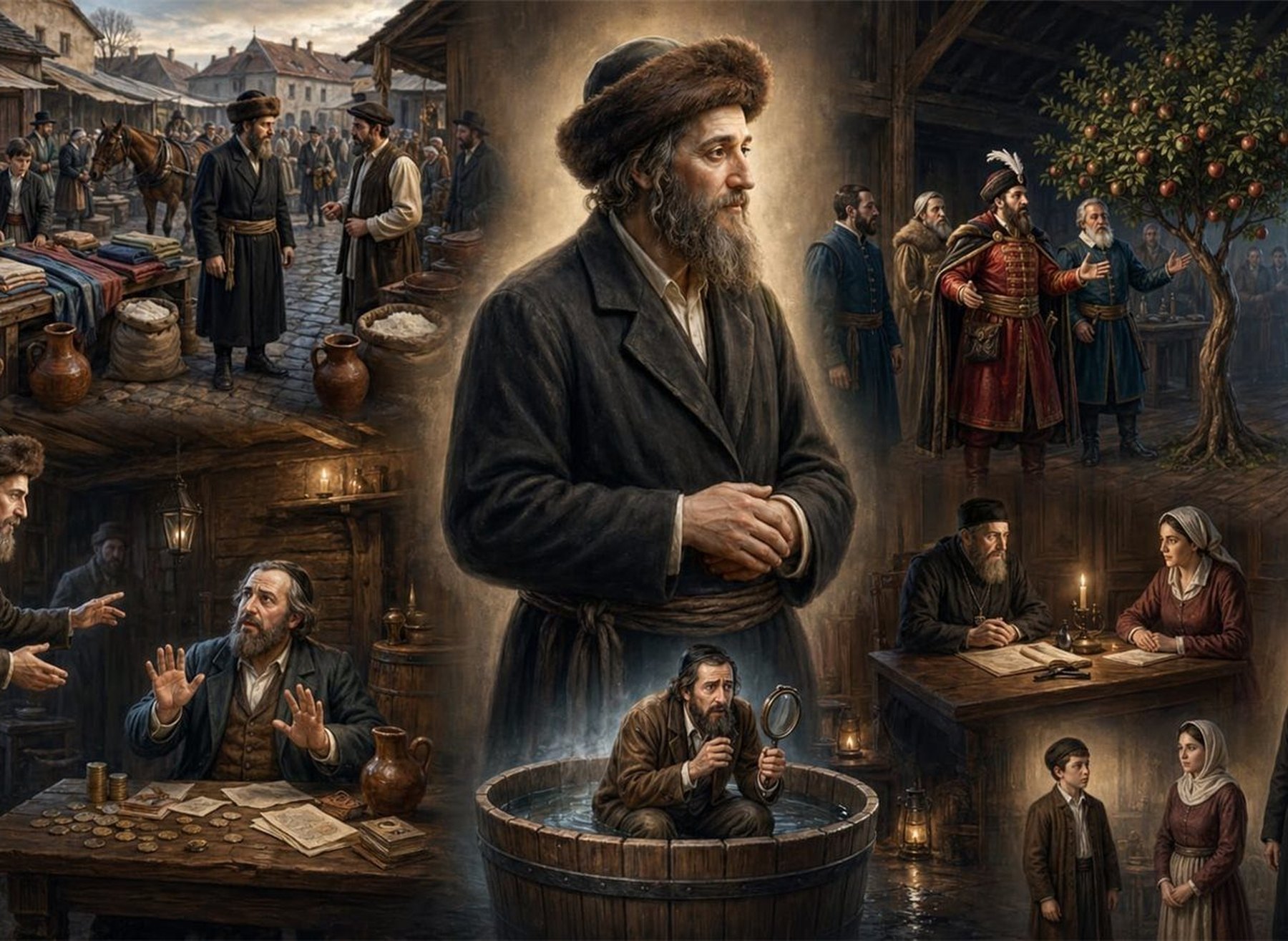
A long time ago, in a small village in Poland, there lived a very special Yid named Reb Adam Baal Shem. Most people thought he was just a regular person, but in truth, he was a hidden tzaddik with great ruach ha’kodesh. Sometimes, he even performed miracles.
Reb Adam wasn’t alone. He was the leader of a secret group of hidden tzaddikim. These tzaddikim weren’t looking for honor or fame – all they wanted was to serve Hashem and learn the deepest secrets of the Torah. They would travel from town to town dressed like simple people, helping Yidden connect to Hashem.
Reb Adam had a special student named Yisroel, who would one day be known as the Baal Shem Tov. He taught young Yisroel the deepest secrets of the Torah, called Kabbala. These teachings explain how Hashem runs the world, how every Yid is connected to Hashem, and how even the smallest mitzva makes a big difference in shamayim.
Yisroel listened carefully and soaked up every word. Years later, when he grew older, he shared these teachings with other Yidden. He showed them how precious they were to Hashem and how they could serve Hashem with joy and love.
These teachings, known as Chassidus, spread light and warmth to Yidden all over the world.
* * *
One day, Reb Adam Baal Shem saw something very frightening with his ruach ha’kodesh: In a certain town, on a busy market day, something terrible was going to happen. A Yid would be killed – chas v’shalom – for no reason at all.
I can’t let that happen! he thought. If a Yid is in danger, I must save him!
Without waiting another moment, he packed his bags and traveled to the town. He arrived the day before the market, while the streets were still calm and quiet.
But the next morning, everything changed. He barely recognized the town! It was noisy and crowded, with people rushing everywhere. Wagons rumbled past, their wheels creaking under the weight of sacks of flour and crates of chickens.
Men were setting up wooden stalls, spreading blankets on the ground, and laying out items to sell. A man hurried by, balancing stacks of fabric in beautiful colors.
“Three for a ruble! Fresh from the mill!” the man by the flour booth yelled.
“Eggs! Eggs! The finest you’ve seen!” called another merchant nearby.
Children ran between the booths, laughing and chasing each other.
“Why is it so busy today?” Reb Adam asked one of the merchants.
“Market day only comes twice a year!” the merchant shouted, barely looking up. “Everyone comes from all around to buy and sell – it’s how we feed our families!”
Reb Adam continued on. He made his way through the crowds until he reached an inn. Inside, he saw a group of merchants eating and drinking. Among them sat a wealthy-looking Jew enjoying a large meal with fine wines and fancy foods. Right away, he recognized him.
This was the man from his vision!
Reb Adam rushed over to him and spoke: “Listen carefully. In four hours, you’ll be dead.”
The man raised his eyebrows and laughed. “Who are you? What is this nonsense?”
He reached for a bottle of wine and poured himself another glass, paying no attention to Reb Adam. After he finished eating, the merchant went over to his business partner. “You won’t believe what just happened,” he joked. “Some stranger told me I’ll die in four hours!”
“Haha!” his business partner laughed. “Don’t pay attention to him. He’s probably just a crazy beggar.”
An hour later, Reb Adam came over to him again. “You now have only three hours left,” he warned.
The merchant waved him away. “You heard that man?” he told his friends. “He’s crazy!”
They all had a good laugh. “Market day sure brings out all kinds of weird people!” they said.
Another hour passed. Reb Adam came back and looked deeply into the merchant’s eyes. “You’ve laughed twice already, but soon, you won’t be laughing anymore. You only have two hours left to live.”
This time, the merchant grew a little afraid. His friends got nervous, too. “Maybe he really knows something we don’t,” they said in alarm. “Next time he comes, grab him! Ask him what’s going on and how you can save yourself!”
One more hour passed. Reb Adam returned once again.
“You have one hour left.”
This time, the wealthy man grabbed his sleeve and cried, “Who are you? What’s going on? Please – tell me how I can be saved!”
Reb Adam looked very serious. “I saw, with ruach ha’kodesh, that your life is in danger, and that you’ll be killed, for no reason. That’s why I came here. ”
The merchant began to tremble. “But… but what do you mean? How can this be?”
“Don’t worry,” Reb Adam told him. “I came here to save you. Just follow all my instructions, and you won’t be harmed.”
The merchant nodded, his face pale. Reb Adam turned to go and motioned for him to follow. The merchant got up quickly and hurried after him. Soon, they arrived at an inn a little further up the road.
“How much does it cost to rent the whole inn for the day?” he asked the innkeeper.
The innkeeper blinked in surprise. “The whole inn?”
“Yes!” said Reb Adam.
“Uh… that’ll be 500,” said the innkeeper.
Reb Adam handed him the money. “Lock the doors,” he instructed. “Don’t let anyone inside, not even into the courtyard! Do you hear me? No one! No one comes inside.”
Then he turned to one of the inn workers. “Bring us a large barrel and fill it with water.”
They hurried to do as he said. The doors were locked, and the workers brought a tall barrel. They grabbed buckets, filled them with water, and poured them in, one by one, until the barrel was almost completely full.
Then, Reb Adam turned to the merchant, “Climb inside the barrel.”
The merchant did as he was told. He climbed into the barrel and sat in the water, trembling from confusion and fear, and shivering from the cold. Just a few hours ago, life was fine and normal. Now, he was sitting in a barrel of water, scared for his life. What was going on?
Reb Adam handed him a small mirror. “Look inside and tell me what you see.”
The man looked – and turned pale.
“Tell me exactly what you see,” said Reb Adam. “Don’t leave out any details!”
The man’s hand trembled as he held the mirror. “I see my wife… with the town’s galach – the priest,” he whispered. “They’re eating and drinking together. There’s a… a gun on the table.”
His voice shook. “…Why is my wife with that galach?”
Reb Adam sighed with compassion. “I’m sorry to tell you – your wife has turned her heart away from you. She wants to marry the galach.”
He lowered his voice.
“This galach is an expert in black magic. He speaks with bad malachim from the world of klipah. He plans to shoot his gun into the air, and the bad malachim will send the bullet straight into your heart. He wants you to die, so he’ll be free to marry your wife. This is his evil plan.”
The merchant burst into tears.
“Don’t be afraid,” said Reb Adam. “I’ll help you. When he gets ready to shoot, dunk your head under the water. Wait a few seconds, then come back up.”
The man took a deep breath and nodded. He stared into the mirror, not daring to look away.
Soon, he saw the galach putting bullets inside the gun and whispering bad magic words. The merchant quickly lowered his entire body under the water.
He stayed under, heart pounding, and then came up gasping for air.
He peered into the mirror. “I see my wife. She’s crying! The galach is furious.”
“The bullet missed,” Reb Adam said. “The bad malachim told the galach that they couldn’t find you. They said ‘a holy Jew is guarding him.’”
The merchant cried with relief.
“But you’re not safe yet,” Reb Adam warned. “The galach will try again. Be ready to do the same as before.”
A second time, the merchant saw the galach aim his gun – and he ducked into the water, just before the galach fired. Again, he was saved.
The third time, Reb Adam gave new instructions. “Now, leave just your pinky finger out of the water.”
The merchant obeyed. Bang! He felt a sharp pain. The bullet struck his finger!
“Ow! Ow!” he cried, staring at his bloody hand in shock.
Reb Adam spoke: “Look again.”
The merchant peeked into the mirror. “They’re laughing and… smiling,” he said. “But why?”
“They think they succeeded in killing you,” explained Reb Adam. “The bad malachim told the galach that the bullet hit you. They didn’t realize it was only your pinky.”
He helped the merchant climb out of the barrel. “Get dressed,” he instructed. “But know this: you’re not safe yet. Listen closely – when you leave, don’t go to your house. Stay with a cousin or friend. Don’t let anyone know you’re alive. After three weeks, you can go back to the market.”
“What if I see the galach…?” asked the merchant.
“He’ll be shocked to see you, because he thinks the bad malachim killed you. When he asks who saved you, tell him: ‘A holy Jew saved me.’ He’ll demand to meet me. Tell him to choose a day and time, and write a letter to me with the details. I’ll come to meet him.”
Three weeks later, the merchant went to the market. Suddenly, he froze. There was the galach.
“You!” gasped the galach, his face filled with rage. “How are you alive?!”
“A holy Jew saved me.”
“Bring him to me! If not, you will not live another day.”
“Pick a time,” the merchant said, “and he will come.”
The galach set a date and time, and the merchant sent a letter to Reb Adam Baal Shem.
Meanwhile, the galach prepared a grand feast and invited all the noblemen to come, ready to show off his evil magical powers. “I’ll win over that Jew,” he laughed, wickedly. “I’ll teach him who’s in charge!”
On the set day, Reb Adam came before the galach. The priest sneered, “Show me what miracles you can do.”
“I don’t perform miracles,” Reb Adam replied humbly. “But whatever you can do – I can do as well.”
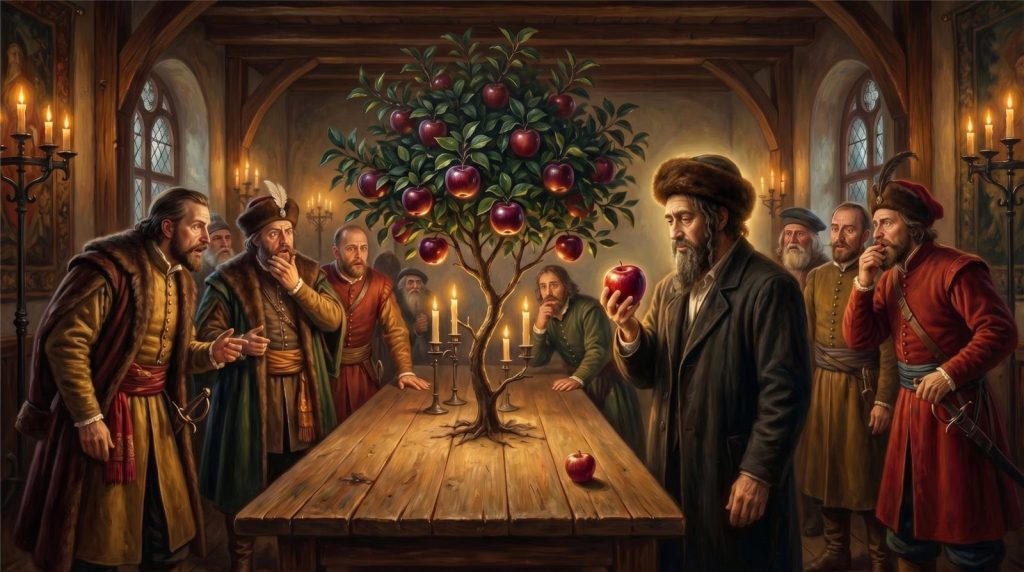
The galach pointed to a bare branch on the table and told Reb Adam to leave the room. Then he whispered words full of klipah and tumah. In moments, it grew into a beautiful tree with sparkling red apples.
“Now you try,” he smirked, calling Reb Adam back.
“Very well,” said Reb Adam. “But first, please leave the room, just as I did for you.”
The priest agreed and left.
Alone with the noblemen, Reb Adam walked around the tree. “How beautiful are these fruits,” he whispered in Polish. Then he pointed to one apple – redder and shinier than the rest.
He called over one of the noblemen. “Can you please cut off this apple?”
The nobleman did so. Reb Adam held the apple up to the light and showed it to everyone. “Look at how perfect it is!” he exclaimed. Then he called out to the galach, who was still in the other room, “I’m finished! You can come in now!”
That’s it?! The noblemen wondered. All he did was cut an apple off the tree. That’s not magic.
They turned toward the door, waiting to see what the galach would say.
But he didn’t come.
After a moment, one of them went to get him.
Suddenly, all the noblemen standing near the apple tree heard a shriek from the other room. “Something’s wrong! The priest isn’t moving!”
They rushed to the other room and were shocked to find the galach lying still on the floor. “What happened?!” they gasped.
Reb Adam Baal Shem spoke in a clear, strong voice: “The tree and its fruit were made from bad malachim, and the big, red apple was their leader. When it was cut off, the black magic was destroyed – and the galach was killed.”
The noblemen stood frozen, their eyes wide in shock. No one said a word.
Finally, one of them cried out, “Let’s throw this Jew in jail!”
But the others shook their heads. “No,” they said firmly. “If anything, it was self-defense. The galach had planned to kill him. And anyway, who other than us would believe that cutting off that apple would kill the priest?”
They turned to Reb Adam with respect in their eyes. “You are no ordinary man,” one of them said. “You’re wise and brave.”
The merchant let out a big sigh of relief. He was finally safe from the galach and his wicked plans! He went home and gave his wife a get, so they wouldn’t be married anymore. He wished she would have just asked for one in the first place. Later on, she felt bad for what she had done, and did teshuva with a full heart.
And that is how, with his ruach ha’kodesh and great courage, Reb Adam Baal Shem defeated the bad malachim and saved a Yid’s life.
He didn’t know this Yid. He’d never met him before. But that didn’t matter. When a fellow Yid was in trouble, Reb Adam stopped everything he was doing and rushed to help.
Because that’s what a true tzaddik does – he cares for every single Yid.
We can learn from Reb Adam Baal Shem to care for other Yidden too, even if they’re not our best friends, or if we don’t even know them at all. When we see someone who needs help, let’s go out of our way to take care of them. This will help us bring more goodness and light into the world, until Moshiach finally comes!
This story is found in “Sipurei Kedoshim,” a sefer of Chassidic stories printed in Piotrków, Poland, in the mid-to-late 1800s. Although published anonymously, this was not unusual at the time. The sefer appears to have been accepted as a reputable source and contains many treasured Chassidic stories.
Beis Moshiach #1504 • pp. 54-59
© 2026 Beis Moshiach Magazine. All rights reserved.
This article originally appeared in Beis Moshiach #1504. You are welcome to share it with friends and family by email or in print, provided that you do not change, add to or omit any part of it, you credit the author and Beis Moshiach, and you include a link to archive.bmoshiach.org (written out in full in printed copies).
To republish this article in a newspaper, magazine, book or website, please request permission in advance at [email protected].