Like Brother and Sister

Have you ever had something spin totally out of control, and you felt upset because nothing went the way you planned? Let me tell you a story from more than 200 years ago. At first it looked like everything had gone terribly wrong, but in the end, it became clear that things had worked out in exactly the right way.
* * *
This story takes place in the early 1800s, when Rav Chaim Halberstam was traveling through the Hungarian city of Pest. And in today’s world people know it as part of the bigger city of Budapest.
While Rav Halberstam eventually became the famous and known as the first Sanzer Rebbe and the author of the Divrei Chaim, at the time he was mostly unknown, but had been asked to be the Mesader Kiddushin at a wedding that was taking place in the city of Pest.
The young Sanzer Rebbe was so happy to be able to do this special Mitzva, especially because the Chosson, Asher Zelig, had been orphaned as a baby and had no parents.
* * *
As the final details were being taken care of for the wedding, the Sanzer Rebbe decided to find a quiet spot where he could sit and learn until it was time for the badeken to begin.
The Divrei Chaim opened up his Gemara and started to learn, but there was a particular Tosafos that he just couldn’t understand. Going over the text once, twice, three times, did nothing to help him to understand the holy words he was studying, and the Sanzer Rebbe was extremely bothered by why he was having such a hard time understanding this piece. There had to be a meaning behind it… by his lack of understanding the pshat, something that had never happened to him before.
**
“Excuse me,” came a soft voice from behind. “Is the Rebbe ready to come for the badeken? The wedding is all sets and everyone is waiting for you but we don’t want to rush you; whenever you’re ready we would love for you to join us… and of course lead the ceremony…”
The Divrei Chaim looked up from his Gemara and had a moment of inspiration. Maybe there was something going on at this wedding that was somehow creating a problem for him, keeping him from understanding the meaning of the Gemara that he was trying to learn.
Maybe it was a sign from heaven that he was supposed to do something or something needed to be taken care of. Was there some kind of message here for him? Was he getting a hint from Shamayim that something was wrong with this Shidduch, and that the Chosson and Kallah were not meant for one another? Or perhaps there was another message?
The Sanzer Rebbe asked the Gabbai who had come to take him to the badeken to bring the father of the Kallah, Reb Shloima, to him for a short conversation.
* * *
“Mazel tov, mazel tov,” said the Divrei Chaim warmly, as Reb Shloima approached. “Tell me a little about yourself and your family. Where do you come from? How many children do you have?”
The Kallah’s father was eager to bring his future son-in-law in for the badeken, and he was surprised by the question, and by the delay. Still, he took a deep breath and began answering the Sanzer Rebbe, his wide smile fading slightly as he started speaking about his children.
“Boruch Hashem Rebbe, my wife and I have six kinderlach, two girls and four boys. We had another one, a long time ago, but he unfortunately died… It was a very tragic story,” said Reb Shloima, his voice now sad and he paused mid-sentence.
“I’m sorry,” said the Sanzer Rebbe. “What happened that you lost your son?”
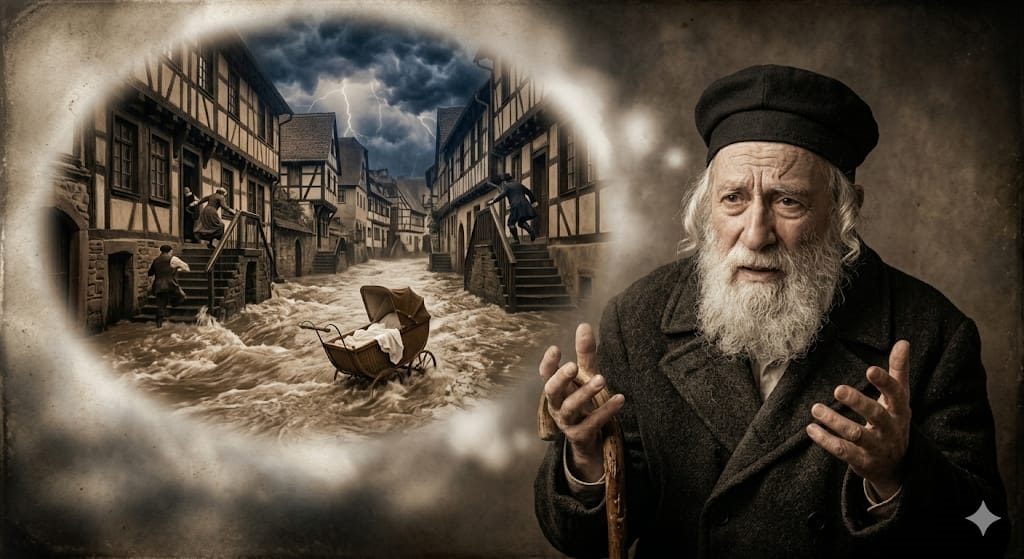
“It was a terrible story, such agmas nefesh,” said Reb Shloima. “He was a baby, and he was outside in his carriage when, out of nowhere, there was a massive flood. The rain just started pouring down; it was horrible… You’ve never seen the skies open like that before…
“… The water came flooding through the town, filling the streets in a matter of seconds. We realized right away that our Chaskel was outside and we raced out the door, but it was too late. The carriage was gone and we never saw him again. Oh Rebbe!”
“Tell me,” said the Divrei Chaim. “Was there anything unusual about Chaskel? Did he have any marks or any signs on his body? Anything about him that could be used to say that that would be him… like if he was still alive….”
Reb Shloima’s eyes opened wide for a brief second. He stared at the Rebbe, wondering what this was all about.
“Why yes, actually there was,” he replied. “He had a red birthmark on his right shoulder. It was just a small dot, but it was quite noticeable. Rebbe, why are you asking these questions?”
* * *
The Sanzer Rebbe thanked Reb Shloima for his time and told him to go back outside and to give his daughter one final Bracha before the Chuppah. As Reb Shloima left, the Divrei Chaim asked that the Chosson be sent in to him. In no time at all, a puzzled Asher Zelig came into the room where the Sanzer Rebbe was waiting for him, unsure why he had been summoned.
“Mazel tov, Chosson,” the Sanzer Rebbe said to Asher Zelig. “Tell me, my son, what do you remember about your parents?”
“My parents?” said Asher Zelig, surprised at the question. “I don’t know anything about them. They died when I was a baby and I was raised in an orphanage. I never knew them at all.”
Could it be, wondered the Sanzer Rebbe? He asked Asher Zelig to take off his shirt.
The request was an unusual one, but Asher Zelig wasn’t one to question a holy man, a Tzaddik like the Sanzer Rebbe. As he slipped his right arm out of his sleeve, the Sanzer Rebbe drew a sharp breath as he saw the small, red birthmark on the Chosson’s shoulder.
****
“Reb Shloima, Reb Shloima, come here now,” called out the Divrei Chaim in a loud voice.
Within seconds Reb Shloima had appeared, a look of confusion on his face, while the smile on the Sanzer Rebbe’s face was growing wider and wider with every passing second.
“Reb Shloima, you thought you were about to become Asher Zelig’s father-in-law?” exclaimed the Divrei Chaim. “You can’t be his father-in-law; you are his father! This is your Chaskel, your baby that you thought you lost all those years ago. Come and meet your son, not your son-in-law!”
I’m sure you can imagine the tornado of emotions that took place in that moment. There was so much joy on the part of Reb Shloima and his wife as they were reunited with the child they were sure had died eighteen years before, while Asher Zelig and his Kallah were shocked to find out that they were brother and sister. It took just a few minutes for everyone to decide that the wedding meal was to become a Seudas Hodaah for the incredible miracle that had just occurred.
* * *
Even though this story took place long before the days of cell phones and newspapers, the way the Divrei Chaim had prevented a brother and sister from marrying each other began circulating very quickly.
As word spread, the Sanzer Rebbe became extremely well known and it wasn’t long before people started lining up to give him kvitlach and pidyonos, hoping that he could help facilitate Yeshuos or Brachos on their behalf.
**
Among the many people who flocked to the Divrei Chaim’s door were Moshe and Yuta, whose son Muttele was very, very sick.
“Please Rebbe, please Daven for our Muttele,” said Moshe as he sat down to speak with the Sanzer Rebbe. “He is very, very sick and I am here with a pidyon nefesh – 300 rubles for the Rebbe. Please take the money and please give us a Bracha that Muttele should recover from this terrible illness. I can’t bear seeing my child like this.”
“I give you a Bracha that, with the Aibishter’s help, Muttele should have a Refua Shleima,” responded the Divrei Chaim. “But I am not taking your 300 rubles. For now, hold onto your money.”
Baruch Hashem, Muttele was soon completely cured, and Moshe and Yuta were extremely grateful to the Sanzer Rebbe for davening for their son. As the years went by, more and more people came to the Divrei Chaim for help, including an incredibly poor man named Velvel, who had a daughter of marriageable age, but not the money he needed for her dowry.
“Don’t worry, Velvel, you will soon have the money you need,” said the Divrei Chaim. “Go to Pest and find a wealthy man there named Moshe. He will give you 300 rubles – just tell him that the time has come for him to pay the money he offered me as a pidyon nefesh when his son was sick several years ago.”
There are so many times in life that things don’t go the way we want them to. But maybe that’s a good thing, because while we see the small picture, our Tzadikim have a much broader vision, one that can show us how things that look like problems are actually miracles in disguise.
This story is brought in the Yiddish book Shidduchim un Shadchanus by Avrom Meisels, who cites Mekor Chaim, siman Kuf-Mem, as the source.
Beis Moshiach #1505 • pp. 56-59
© 2026 Beis Moshiach Magazine. All rights reserved.
This article originally appeared in Beis Moshiach #1505. You are welcome to share it with friends and family by email or in print, provided that you do not change, add to or omit any part of it, you credit the author and Beis Moshiach, and you include a link to archive.bmoshiach.org (written out in full in printed copies).
To republish this article in a newspaper, magazine, book or website, please request permission in advance at [email protected].