Under the Open Sky
A hundred and twenty-seven days of lists, tefillos, excitement, small tears in the middle of the day, and one heart trying to understand how time runs faster than thoughts.
And here we are, at the great moment. We married off our daughter.
I still remember myself being led to the chuppa. Almost a child. Excited, confused, not really grasping the size of the moment. I stood there, entering into a covenant of life, without understanding how much that path would be filled with light, with nisyonos, with love and with building.
But marrying off a daughter?
There are no words to describe the jumble of emotions you feel. There’s no way to prepare your heart for the moment when I saw my daughter, the one whose hand I once held on the way to kindergarten, the one who once fell asleep on my shoulder, the one I once did homework with, suddenly walking to the chuppa. White and pure.
Suddenly I saw her walking the same steps I once walked. Only this time I stood to the side, with the heart of a mother who understands something about life.
Time doesn’t pass; it continues from generation to generation.
Under the chuppa there was a moment where I could almost see the chain of generations: the grandfathers, the grandmothers, the fathers and mothers. It’s known that during the chuppa, up to ten generations come down from the World of Truth to bless the chassan and kalla, to see the tears and prayers that brought us to this point. Suddenly my daughter stood there, forming yet another link. Another Jewish home, another light in the world.
Approaching the Great Moment
There’s something about a Jewish wedding that can’t be described to someone who hasn’t experienced it. Before the chuppa, it really feels like Yom Kippur. A serious and fateful time, holy and uplifted.
“Arba Bavos” played in the background. During this time the chassan covers the kalla’s face with an opaque veil, to remember that we don’t marry only what we can see. We also marry the hidden parts—everything we haven’t yet seen and will see later—and we choose those too, all the challenges still to come and all the beauty still to be revealed.
True love means agreeing to love even what is still hidden. Chazal say that the Shechina rests upon the kalla’s face, which is why she is covered. And as I stood there looking at her, I truly felt that there was something greater than her there. Something greater than all of us.
Before going to the chuppa, the chassan loosens the laces of his shoes and his tie, and the kalla does too. As if to say: we come clean. We leave behind all the old ties. Ready now to bind ourselves to only one thing, the new home being built.
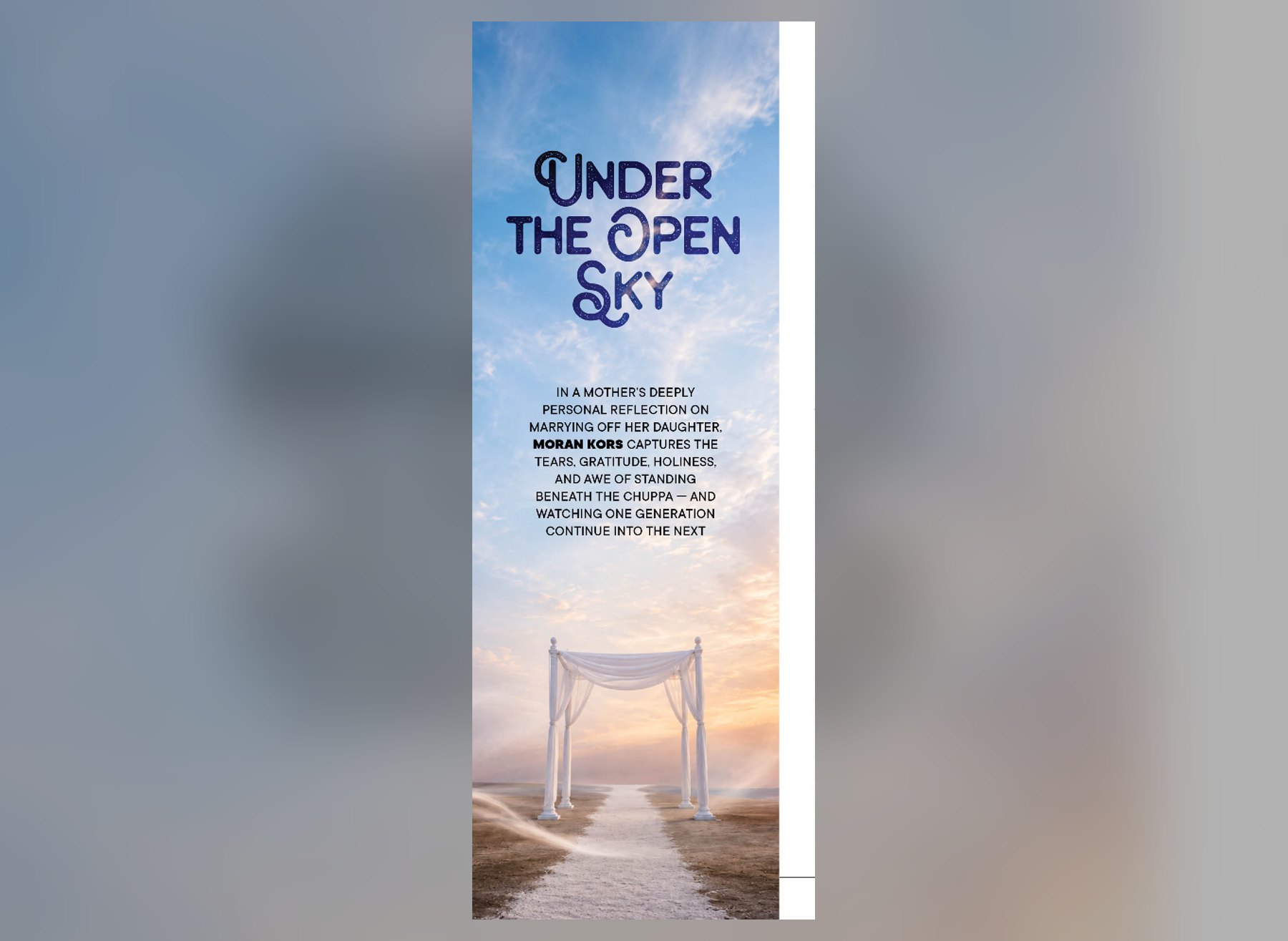
And then the chuppa. The sky open above our heads. Only Hashem and the couple.I always loved the idea that the Jewish home begins precisely under the open sky. As if to remind us: you are not alone, Someone is walking with you.
If there’s one thing I’ve learned in life, it’s that you can’t sustain a marriage with human strength alone. You need a lot of siyata dishmaya. You need a love bigger than ego. And you need Hashem within the story.
At some point during the chuppa, I found myself thinking about everyone who wasn’t standing there: the grandfathers and grandmothers, the generations before us, all the Jews who for thousands of years kept Shabbos, lit candles, prayed, cried, hoped, survived. Suddenly I felt all of them with us, as if a long chain of souls stood around the chuppa, blessing it.
And as this happened, I looked at my daughter and thought: Ribono shel olam, what a zechus. What a zechus that I became a baalas teshuva, what a zechus to build a Jewish home, what a zechus to raise children. And what a zechus to see with my own eyes another link joining the chain of the Jewish people.
Our children never really leave us. They simply continue the path. This week my daughter carried with her all the love, the values, the middos she received at home, and now begins to build a new home of her own from them.
There is no news in the whole world more moving than this. All day I keep murmuring to myself, “Ribono shel olam, thank You.”
In the end, after everything we chase in life, after all the noise and the dreams, there are moments when you understand what truly remains.
A girl who becomes a woman. A generation that continues a generation. And one mother standing to the side, with wet eyes, and a heart filling with gratitude.
Beis Moshiach #1512 • pp. 44-45
© 2026 Beis Moshiach Magazine. All rights reserved.
This article originally appeared in Beis Moshiach #1512. You are welcome to share it with friends and family by email or in print, provided that you do not change, add to or omit any part of it, you credit the author and Beis Moshiach, and you include a link to archive.bmoshiach.org (written out in full in printed copies).
To republish this article in a newspaper, magazine, book or website, please request permission in advance at [email protected].