What I Learned At the IKEA Showroom
Have you ever walked into a furniture warehouse and felt like you accidentally stumbled into a Gymboree on Chol HaMoed? Did you ever notice how many times you begin a sentence with the words: “I need”? This past summer, I took an incredible ‘staycation’—staying at home while the kids were away. I made no grand plans. No rigid schedules. No punching the clock. Just allowing myself to enjoy the ease and the liberty of choosing: What do I want to do today? Little did I realize I was on a divine tour with fantastic, unexpected discoveries. Accidentally (by hashgacha pratis), I met a friend whom I hadn’t seen in over forty years, had several opportunities to daven by the Kosel, in Meron, by the Rambam, and that’s just the beginning.
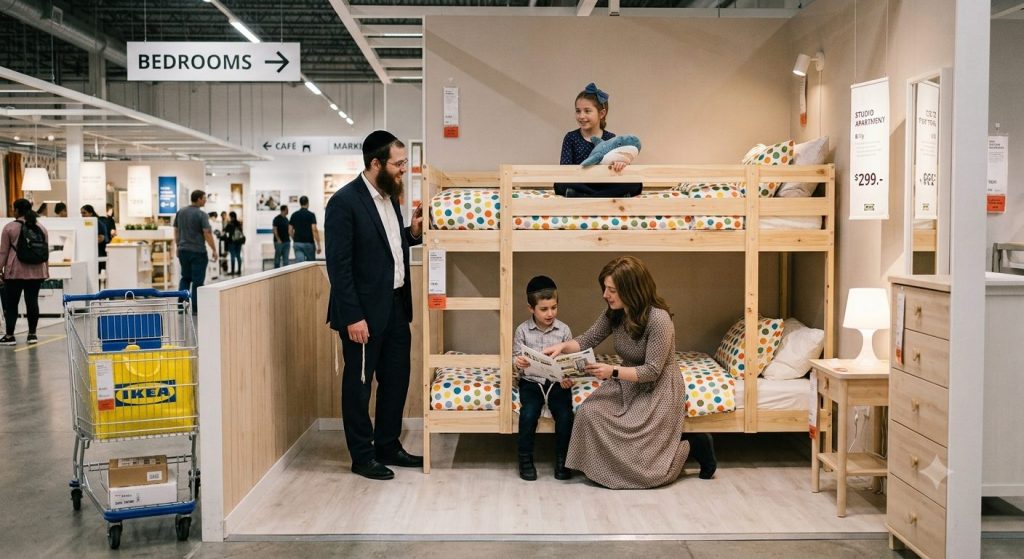
The days became so filled with meaningful activity, on my own and with my husband. After many months of adding to my long list of household items on my phone, I decided to enjoy a cool stroll. Where to? The air-conditioned IKEA home center warehouse. Just about everything is under one roof. IKEA in the peak of the summer was a universe unto itself. As I wandered through the maze of curated living rooms and equipped simplified kitchens, I could only stop to admire—vibrant Jewish life hums in every corner. A communal amusement park for so many cheder children.
Every display set had become a cozy family sanctuary. In one mock living room, a father sat relaxed on a plush sofa, chatting on his phone while his toddlers played at his feet. In another corner, a young boy in a velvet yarmulke was happily swaying back and forth in a rocking chair, totally oblivious to the shoppers passing by. Down the aisle in a model bedroom, a group of brothers sprawled over a double bed, laughing, while a young mother nearby patiently sat on the edge of a bed, tenderly changing her baby’s diaper.
It was entertaining! And insightful. These families were enjoying a cozy outing right in the middle of a commercial retail store, while discussing which items they would like to purchase, perhaps. Employees were gracious and accommodating, only too eager to assist potential customers. Then, like a lightning bolt, I thought: Life is like a magnet. The energy, that internal barometer that we broadcast, is precisely what we draw back to ourselves. How often do we ask, “Why does my life seem so complicated? Why is there fighting? Why the conflict?
When was the last time you paused? Did you ever consider:
Am I projecting frustration, defensiveness, and fear that might be a trigger? Is there any personal trade-off or ‘gain’ from annoying circumstances, even subtly?
Or, am I eliciting internal calm and patience? What you focus on expands. Focusing on the friction and the lack invites more of the same.
However, shifting the internal mindset toward tranquility and abundance attracts harmonious relationships and cooperation.
This idea connects us to פרשת כי תצא, which contains more mitzvos than any other parsha in the entire Torah—eighty-six distinct commandments according to the Rambam! Including: returning a lost item השבת אבידה, building a safety rail on your roof מעקה, to paying your workers on time ביומו תתן שכרו. On the surface, these seem like common practical ethics. Am I thinking: What do I need or what does Hashem need from me at this time? Okay, now He needs me to return a lost item, great! I am going to post an ad… Now—He needs me to pay the babysitter? I am going to Zelle her. We are in a relationship with Hashem. The more invested we are, the greater the returns.
Sometimes, we say, “I need that. I need to go here. I need this problem solved right now!”
There is a world of difference between needing something and wanting something. Need comes from a position of lack. When we feel that we “need,” in fact, we are stating that we are empty, desperate, and incomplete. Neediness projects scarcity and invites more of the same, like a magnet. However, when we want something, we are acknowledging: It would be nice. It is not mandatory, yet this can achieve greater accomplishments.
When we begin davening by recognizing that our cup is full, and that Hashem has blessed us with life, breath, family, and endless gifts—the entire davening is transformed. We aren’t begging from an empty vessel; we are filled with ‘hodaah’: “Hashem, You have gifted me so much, and I want to share these brachos. Please, send more parnassa and improved health, so that YOUR world can meet its purpose. The focus is on Hashem, not on me. We have a specific role in this destiny. We each have a custom-tailored project in our dalet amos—in our immediate circle. In the workforce, some people are paid by the hour, while others are paid by the job. With the latter, when you finish early, you get paid earlier! When we step up and complete our project, we hasten the Geula.
* * *
At the conclusion of Shemone Esrei, as we take three steps backwards, transitioning from a divine appointment into the bustling, noisy world. How can we harmoniously integrate the sacred words from the Siddur into our shopping? As we gently stroll in the field of Elul, allow these thoughts to guide you:
1. Notice your choice of words, ‘need’ or ‘want’. Are you expressing yourself from a place of abundance or lack?
2. “What you focus on increases”:
Before going to sleep at night, take five focused minutes to expand the good in your life. Thank:
* Hashem for three specific brachos that happened during the day.
* Your spouse for three thoughtful things they did or shared.
* Your children for three helpful or joyful actions.
* Yourself for three instances of patience, integrity, or effort, allowing the Neshama to sit in the driver’s seat.
3. Define and Take Ownership of Your “Project”:
Recognize that only you can accomplish your mission. Map out your project—take one concrete, joyful action today to advance that goal.
When we change what we give off, we change what we attract.
Even a stroll in a warehouse can be an integral ingredient towards completing Hashem’s project. Let’s step in—ready to get to the finish line and welcome the Geula!
Malky Grabsky runs The Lighthouse, the Jerusalem Holistic and Wellness Center for Women. She is a certified Kallah instructor and specializes in empowering women to transform their lives, relationships, and marriages into a beautiful space of warmth and connection, physically, emotionally, and spiritually. She is a designer of therapy cards and offers lectures, courses, and workshops. Malky can be reached at: [email protected] or WattsApp: (972)-457-7614.
Beis Moshiach #1519 • ח׳ אלול תשפ״ו • pp. 50-51, 52
© 2026 Beis Moshiach Magazine. All rights reserved.
This article originally appeared in Beis Moshiach #1519. You are welcome to share it with friends and family by email or in print, provided that you do not change, add to or omit any part of it, you credit the author and Beis Moshiach, and you include a link to archive.bmoshiach.org (written out in full in printed copies).
To republish this article in a newspaper, magazine, book or website, please request permission in advance at [email protected].