When The Class Turns Its Back
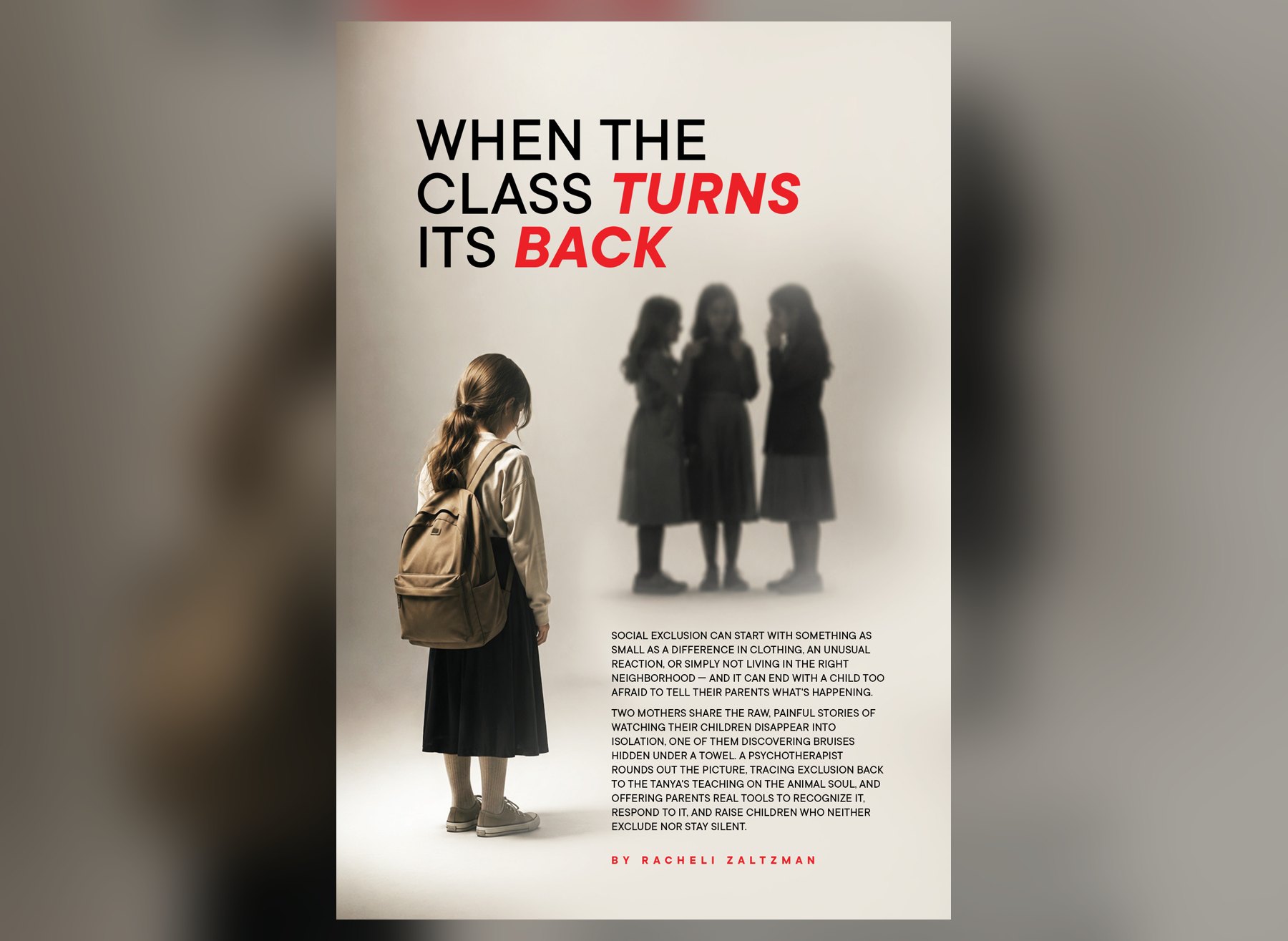
Social exclusion can start with something as small as a difference in clothing, an unusual reaction, or simply not living in the right neighborhood – and it can end with a child too afraid to tell their parents what’s happening. Two mothers share the raw, painful stories of watching their children disappear into isolation, one of them discovering bruises hidden under a towel. A psychotherapist rounds out the picture, tracing exclusion back to the Tanya’s teaching on the animal soul, and offering parents real tools to recognize it, respond to it, and raise children who neither exclude nor stay silent.
It hit me like a bolt out of the blue. I wasn’t prepared for this at all… That this could happen in my own home? I never imagined it. My daughter, an eighth grader, began withdrawing, and that was only the beginning. Later came fits of rage, crying spells, aggression toward her younger siblings, and a marked reluctance to go to school.
What was I to do? When I decided to open my heart to the mechaneches, I understood just how bottomless the pit was that she had fallen into…
A class boycott. I couldn’t imagine a worse situation. Where do I even begin to gather the pieces, draw on my strength, and fight for my daughter’s life?
Social exclusion, for anyone lucky enough not to know it yet, is a phenomenon of ostracism and shunning, in which a group deliberately and systematically rejects one of its members. It manifests as prolonged abuse, exclusion from shared activities, and the severing of ties, with the clear goal of hurting the excluded child and isolating them.
Rachel Bolton | How I Was Excluded
How did it all start? Did the exclusion hit you by surprise, or were there early signs?
I think exclusion doesn’t start all at once. It starts by highlighting difference. They target a girl or boy and begin showing everyone just how different that child is from the rest and there’s no room for the different one within the group. The group looks homogeneous, but that’s actually an illusion created by two or three kids who point to the difference and distinction between the excluded child and the rest of the group’s members.
Often, group belonging is built on silence.
The pretext for exclusion isn’t always an external trait like ethnicity, skin color, height, glasses, a stutter, being overweight, and so on. An emotional reaction can also serve as a pretext for exclusion. For example, a child is scared or frightened of something, and in the leader’s eyes that’s an unusual reaction and a reason for mockery and exclusion.
The moment a label gets stuck on a child, a dynamic mechanism of harm is created. Every time the other kids encounter the labeled child, they want to check whether the “mark” still holds. For example, if a child has been labeled as someone “who cries every time you touch his backpack,” then everyone, even those who don’t want to cause him real pain, touches his backpack again and again, just to confirm that he really does cry, meaning that what’s said about him is still true.
It’s important to understand that silent consent is part of the exclusion. When the children in the group stay silent and don’t try to protest or defend, they allow it to continue. What’s more, being ignored is deeply painful, and it is, in itself, a form of violence. When all the kids go to a party and only one child stays home because they weren’t told or invited, the group is effectively marking that child’s inferiority and weakness and declaring: “We’re not interested in him or his company.” After all, if we showed interest in him, we’d have to agree to accept the different one, the weak one and if we accept weakness as part of us, then who could we exclude or scapegoat in order to feel strong?
In my case, the “difference” stemmed from three reasons: first, I didn’t live in the area where the other kids lived; second, my mother was an unusually intelligent woman, but out of a lack of awareness she didn’t put much into how I dressed and for the other girls in the class, clothing was a very big deal, they were well dressed; third, I came into first grade already reading books, and so I was an oddity to the teacher too.
Until fourth grade they didn’t skip me. Even the school administration saw me as an oddity and didn’t think about how to help me.
How did you cope with it? Who did you confide in, and who didn’t you tell?
I would find myself walking alone. During recess I read, and essentially no one ever asked me anything, no one tried to talk to me. I wasn’t invited to a single birthday party.
I didn’t tell anyone at home what I was going through. There’s research showing that fifty percent of excluded children don’t share what’s happening with their parents, school counselor, or mechaneches. I was in that fifty percent. I had no one to share the experience with, no one to confide in. It was a harsh loneliness. Very hard.
Eventually, in fifth grade, the principal called in my older brother—at the time a lieutenant colonel in the army—and told him: “Get her out of here, either they’ll kill her or she’ll…”—and here she used a very harsh expression, and whoever understands, understands.
What helped you get through that terrible period?
Looking back, reading saved me in those days. I was a member of three libraries; at each one you could take out three books a week. There was one librarian who knew I was borrowing books from other libraries too, and she asked if it would be all right if she picked one of the three books I was taking out from her library.
I was so happy. Then she and I agreed that when I returned the book to the library, we’d talk about it. That was a ray of light for me. Someone saw me, someone understood me.
Another thing that helped me was actually my eagerness to please. Because I was so accommodating, I didn’t resent my fate, and it felt natural to me that I was outside the social circle.
What do you have to say to mothers and children on this subject?
I think that everyone who starts exclusions, divisions, and hierarchies is, in fact, aspiring to lead. I used to run leadership-training programs in schools, having kids work on the theme of leadership in society and seeing others.
My late grandson also dealt with social exclusion. His father, my son, says every parent should ask their child: Does everyone in the class have friends? Did everyone go out at recess? Is there a child the teacher may have insulted, whom nobody approached? Could you be the one to make a child that nobody approaches happy? Simply asking our children about the situation in class and encouraging them to support lonely children.
And even if a child is planning a big birthday party at home with the whole class, it’s important for the parent to make sure the whole class was invited. I once heard a mother say: “It’s my daughter’s birthday, she’ll decide who she wants to invite.” True, it is your daughter’s birthday, but you’re actually the one organizing everything. Our role is to help our children become better people.
What step do you think needs to be taken to prevent the next exclusion?
I think we need to keep raising awareness, more and more, within preschools and schools, that it’s forbidden to leave anyone behind or alone, to emphasize what unites us, not what separates us. Clothes may cover the body, but they don’t cover the wound in the soul, the wound created by being ignored, excluded, and talked about behind one’s back.
Mushka | The Exclusion My Son Went Through
Mushka chose, for understandable reasons, to remain anonymous about her family name, but her words are honest, true, and shattering.
Share with us an episode you remember from the exclusion.
The most terrible moments were when my son would come home covered in bruises. Even now, when I recall the marks from the beatings, I’m horrified and flashbacks hit me.
How did you discover the exclusion?
The exclusion went on for a long time, but throughout that whole period I didn’t suspect anything… I noticed he was coming home quieter than usual, but I thought he was simply tired. Until one day, when I said it was time to get in the shower (I was still helping him bathe then), he said “no.” I was surprised and told him more firmly that he was getting in the shower now, or I’d put him in myself.
So he went in… but when I came to wash him, I was stunned. My son was covered, all over, in blue marks! I asked my son what happened, but he was silent. I started crying… I hugged him, wrapped him in a towel, and we just cried together. Afterward he calmed down a bit and told me everything. There were kids at school forcing him to bring them candy or buy them something from a particular store, where we had an account. He couldn’t get them what they wanted, because we’d gotten angry at him and asked him not to buy things at the store without permission, and eventually we canceled the account altogether. From that day on, my son couldn’t buy them candy anymore.
I cried even harder, and hugged my son even tighter. I asked him why he hadn’t told us, and he explained that he was afraid we’d be angry that he’d bought things at the store without our knowledge, and also that the other kids had threatened to tell the principal that he was going to the corner store during school hours. So he was afraid.
Who did you turn to?
I immediately photographed the marks from the beatings, sent them first to the teacher, then to the principal, and warned that if by the time my husband and I came to the school the next day there weren’t answers, the photos would be forwarded to the police.
What did you feel in those moments?
I was furious. I didn’t know what to do with myself… I let my son sleep in our bedroom that night. I talked to him. I told him you never hide things from your parents, even if the worst thing has happened. Mommy and Tatty will always be by his side and will do everything so that he’s okay… He broke down crying again until we fell asleep. My son didn’t go to school for about a month; during that time we found out who the children were. We sat down for a very serious talk with the school staff and the parents, and the children were eventually transferred to a different school.
What helped you and your son get through it, cope, and come out the other side?
My son found the strength to go back to class thanks to his teacher. Every evening the teacher called to talk with him and tell him what had happened in class. Every Friday he’d come to our home to give him a “daf kesher,” and that’s how, little by little, my son agreed to go back. Of course, we were always by his side.
What would you like to say to children who create exclusion, and to their parents?
I would recommend that parents talk with their children every day, even about mundane topics. That’s important at any age. Parents can also share their own experiences with their children. If there’s open communication at home between parents and children, I believe there will be fewer cases of exclusion.
And to children who exclude friends, know that it never ends well. The exclusion always comes back to you like a boomerang. There are many stories of people who suffered terrible physical and emotional anguish in their lives—delays in finding a shidduch, in having children, and more—until they made amends for what they did in childhood, and in the meantime they endured long years of suffering.
Sheindy Schechter | How to Treat It
Sheindy Schechter, a psychotherapist and emotional-support counselor who works with cases of social exclusion, offers her professional perspective, drawing on the foundations of the Tanya.
In your view, what can lead to exclusion?
The Alter Rebbe teaches us in Tanya (perek 1) that every Jew has a G-dly soul and an animal soul. Exclusion is born from the animal soul, from the drive to dominate, to reject, to hurt. When a person acts out of envy or a desire to feel superior, he allows the animal soul to rule. That said, it’s worth noting that a child who excludes others is actually afraid of them. Excluders generally don’t believe in themselves; their confidence and self-image are low, even though outwardly they project a different image.
Is exclusion related to victim–aggressor dynamics?
Yes. “Whoever finds fault [in others], finds it in his own flaw” (meseches Kiddushin). The aggressor acts out of deep internal insecurity. That doesn’t absolve him of responsibility, but it explains why he, too, needs treatment. According to social psychology, the victim of exclusion carries or expresses something the group finds hard to contain, and so the group projects onto him its frustrations, fears, or tensions.
It’s important to understand that in most cases of exclusion, the central factor isn’t the victim himself, but the group’s need to create hierarchy, power, or cohesion around “someone else.” That’s why you can find smart, sociable, self-confident children who get hurt by exclusion, simply because they were chosen to be the group’s scapegoat.
How can parents tell between their son having a passing communication glitch or social difficulty, versus actual exclusion?
A child who has been excluded shows signs of trauma: he’s withdrawn, irritable, avoids school, cries for no clear reason, or, conversely, becomes emotionally numb. The parent should open a dialogue and first ask indirectly, so the child doesn’t feel threatened or humiliated, and slowly work toward the issue itself, without judgment. Genuine exclusion is organized, consistent, and prolonged. If the child says, “almost nobody’s spoken to me in a week,” that’s exclusion.
Who should people turn to?
First, the teacher. If the teacher can’t resolve the exclusion, the parents should go to the school administration. If there’s still no solution, they should turn to professionals. The Rebbe emphasizes the value of the mashpia, the spiritual mentor. Every child needs one adult who sees him and stands by his side.
Which professionals are worth turning to for help, and how do you know professional treatment isn’t working and a new approach should be tried?
A psychologist, social worker, emotional-support therapist, or a psychotherapist specializing in children. If, after 5 or 6 sessions, there’s no change in behavior or mood, it’s worth reassessing and consulting further.
How do we teach our children to connect with the pain of others, the friend going through exclusion?
It’s important to keep talking about feelings, to ask, “How did you feel when someone didn’t listen to you?” To explain that “the soul of man is the lamp of God” (Likkutei Amarim, chapter 19)—when we extinguish someone else’s light, we extinguish a part of ourselves, a part of the Elokus that exists in the world.
What can we do so that our children are neither excluders nor excluded?
Act from values, not from fear. A child who knows who he is and what he’s worth won’t need to attack and generally won’t let himself be turned into a victim.
How do we guide the children who are neither excluders nor excluded to respond to such social situations in the classroom?
“Do not stand idly by the blood of your neighbor.” A child who sees exclusion and stays silent becomes complicit. It’s important to teach children: even a single kind word, an offer of “let’s play together,” can save a neshama.
What tools can we give a parent whose child hasn’t been excluded, but struggles socially?
Ahavas Yisrael is the foundation of everything. A parent can teach their child: every person is a unique “letter” in the Sefer Torah. If one is missing, the Torah is flawed. When a child understands that both he and the other person are part of one whole, it becomes easier to bear friction.
Beyond that, it’s important to empower our children, to strengthen their self-confidence, and to make sure they know we’re always there for them. It’s important to explain to them that teasing is a social test, and it’s the way the bully “lifts himself up” by putting the other person down.
There’s a well-known story about the Rebbe Rashab and his brother Raza, who as children were playing in the yard of their home. During the game, Raza pushed his brother into a small pit, in order to appear taller (Raza was shorter than his younger brother). Their father, the Rebbe Maharash, saw what happened and said to him: “To show that you’re taller, you don’t need to push the other person down. If you want to be taller, take a chair, stand on it, and you’ll be taller than your brother. Never raise yourself up by lowering someone else.”
How much should parents intervene in conflicts among children in class?
Intervention is warranted when there’s systematic, repeated harm. With ordinary friction, the child needs to learn to cope on his own. In Tanya, the Alter Rebbe speaks of “serving Hashem through one’s own efforts.” Hashem asks a person to work using the abilities given to him, and not to rely on levels that aren’t his own. Another idea appears in Iggeres HaKodesh, which explains that there’s a difference between gifts from above and what a person achieves through his own effort. What a person acquires through his own strength becomes a more internal and stable possession.
How do we prevent the next case of exclusion?
By building a classroom culture of respect and seeing the other. The words “Love your neighbor as yourself” aren’t a slogan, they’re a daily practice. When every child feels they have a place, there’s no need to push others out.
We’ll close with a prayer: “Bring me not into nisayon, nor into bizayon.”
This is a prayer that every parent and child can adopt. May we know how to see the other, to preserve their dignity and thus uphold the G-dly soul within each of us.
Beis Moshiach #1516 • pp. 42-47
© 2026 Beis Moshiach Magazine. All rights reserved.
This article originally appeared in Beis Moshiach #1516. You are welcome to share it with friends and family by email or in print, provided that you do not change, add to or omit any part of it, you credit the author and Beis Moshiach, and you include a link to archive.bmoshiach.org (written out in full in printed copies).
To republish this article in a newspaper, magazine, book or website, please request permission in advance at [email protected].