An Activist Turned Revolutionary
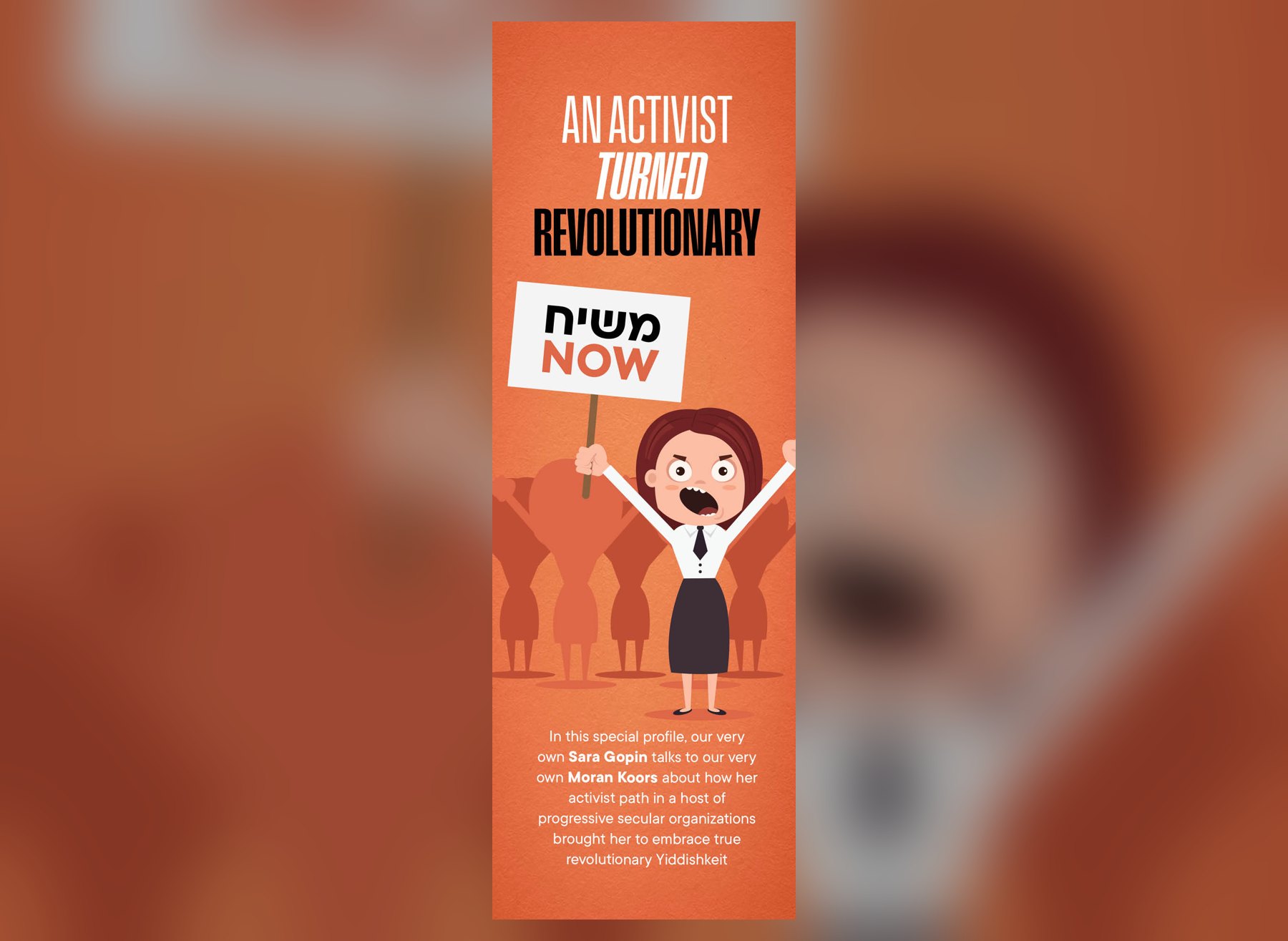
In this special profile, our very own Sara Gopin talks to our very own Moran Koors about how her activist path in a host of progressive secular organizations brought her to embrace true revolutionary Yiddishkeit
As Lubavitchers, Hashem blessed us to have an impact on the world on many fronts. Besides being a devoted wife and mother of six children, Moran Kors is a lecturer, coacher, author of two books (the third is on the way), created a set of therapeutic cards, writes uplifting columns and interviews inspiring women.
Moran is a revolutionary, as the Rebbe MH”M expects us all to be. Her latest initiative is the course that she will be giving for personal trainers based on Chassidus under the auspices of Bar Ilan University. She says, “We all want to fulfill the shlichus for which we came into the world, but sometimes we mistakenly underestimate everything that we can accomplish. At times like these it’s important to hear ‘the voice of Hashem’ within us. In my case it was that I should give my course in this framework, which is something that has never been done before.”
An Unquenchable Thirst
“I grew up in Kiryat Ono, a city near Tel Aviv, in a secular home,” Moran shares her story. “I’m the youngest of five children. All of my siblings became observant, each in their own way, and davened that I would too. The only explanation for this blessing is zechus avos. My grandfather’s grandfather, who was from the Chakak family of Iraq, was a talmid of the Ben Ish Chai. He was known as a pious man who gave blessings to people and his words would be fulfilled. Surely he was blessing us from above.
“As I teenager I kept trying to resolve my inner turmoil and confusion. I’m the kind of person who takes life to heart, and cares about what’s going on around me. I was hanging out with youth from wealthy homes in Tel Aviv and Hertzliya. They had everything, except for boundaries. I saw firsthand that being enslaved to one’s desires is a downhill slide that quickly becomes life-threatening. This motivated me to get involved in Elem, an organization that gives support to youth in distress.” She adds, “Had I not placed myself in the role of helper I could easily have found myself in a similar predicament.
“Getting active in all kinds of popular movements gave me a sense of purpose and belonging. I fought for social justice as a member of Meretz, the left-wing anti-religious political party that professes that now’s the time for a new Middle East where Jews and Arabs can live peacefully together. Only later did I realize that those who have mercy for the cruel are being cruel to the merciful.
“I also became very involved in Greenpeace, the international movement for environmental conservation. The activists gave vehement speeches about the impending danger of the growing hole in the ozone on the future of our planet. But in their personal lives they were busy partying. It just didn’t make sense.
“At the time I was also going to demonstrations on behalf of SOS Pets Israel, an organization that protects animal rights. But I eventually discovered facts that made me disillusioned with them too.
“That’s how I spent my youth, checking out different ideologies and meeting all kinds of people. They seemed impressive on the Internet, but were questionable when I got to know them in person. Nevertheless, my unquenchable thirst for truth drove me to keep searching.”
The Power of Emuna
“When I was seventeen I began volunteering to watch over patients in hospitals,” Moran says. “That’s how I got to know Asael Shabo, a nine-year-old terror victim whose undaunted emuna had a major impact on the course of my life. His mother and three brothers had been murdered before his eyes, but he was miraculously saved when his older sister thrust her body upon him. But, tragically, he lost part of his right leg.
“One day, when I was by his side, I asked him how he was able to accept what happened. He responded unequivocally, ‘Everything that Hashem does is for the good.’ Seeing how much emuna a little boy can have left me speechless. There was not a trace of anger or bitterness in his voice. I saw that faith gives people the strength to pick themselves up and move on with their lives. It’s not surprising that today Asael is an international champion in wheelchair basketball.
“What I learned from Asael remained with me, and I knew that I had to pursue it further. On one of the breaks in my army service I went to Ascent in Tzfas. By hashgacha pratis there was a seminar with Rav Yossi Ginsburgh when I arrived. I entered the class, having no idea what to expect. Although the esoteric Chassidic concepts that he was explaining were unfamiliar, at that moment there was no doubt that I’d found the truth. For the first time in my life I saw that truth wasn’t grasped by making noise, but by silence, through doing inner work.
“After my eye-opening experience in Ascent I began keeping Shabbos. I was able to terminate my army service early in order to learn in the seminary for baalos teshuva of Rav Yossi Ginsburgh in Ramat Aviv.
“Chassidus instilled in me a positive attitude, resilience and the belief that I could change. As opposed to the people who I used to spend time with, who were just doing whatever they felt like doing, I was finally meeting people who were focused on Hashem as the center of their lives. A year later I came to 770, and as soon as I walked in I knew that I’d come home.
“Shortly afterwards I married my husband Shai who was a student in the men’s yeshiva for baalei teshuva in Ramat Aviv. Our shidduch came about in quite an interesting way. My father and my husband’s father met and began venting about their kids who’d left their ‘normal’ paths and became baalei teshuva. They had the idea to set us up, and the rest is history…”
The Descent is Part of the Ascent
“Chassidus teaches you to view everything you’ve been through as hashgacha pratis,” Moran shares her message. “All of the stations in my life’s journey, the wide range of places that I found myself in, were what propelled me to do an intensive process of inner work, and it never ends.
“In my youth I always put myself in a place of taking the lead to help others, which was what safeguarded me from falling myself. Learning Chassidus on a regular basis, as well as teaching it to others, ensures that I stay strong and keep growing. My shlichus is empowering women in their choice to live in accordance with ratzon Hashem.”
Moran is effervescent as she sums it up, “אנא נסיב מלכא! – I choose the King!”
Beis Moshiach #1424 • pp. 38-39, 50
© 2026 Beis Moshiach Magazine. All rights reserved.
This article originally appeared in Beis Moshiach #1424. You are welcome to share it with friends and family by email or in print, provided that you do not change, add to or omit any part of it, you credit the author and Beis Moshiach, and you include a link to archive.bmoshiach.org (written out in full in printed copies).
To republish this article in a newspaper, magazine, book or website, please request permission in advance at [email protected].