S. Paulo’s Homegrown Shliach
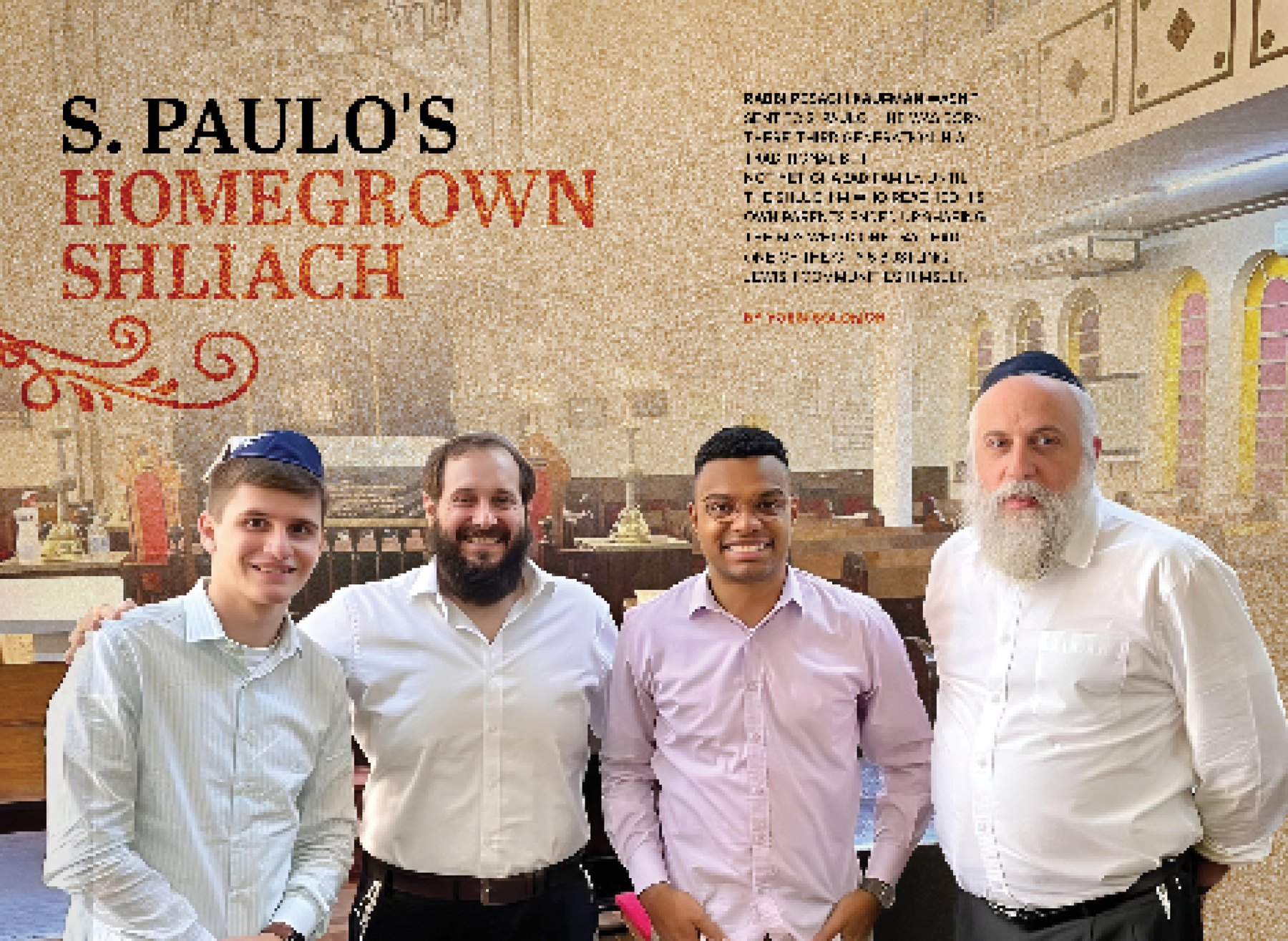
Rabbi Pessach Kauffman wasn’t sent to S. Paulo – he was born there.
S Paulo is the largest and most populous city in Brazil, home to over twenty million people. The city also contains Brazil’s largest Jewish community, numbering about one hundred thousand people!
I went there for my uncle’s wedding. On the Shabbos before the wedding, I stayed with the Rebbe’s shliach there, Rabbi Pessach Kauffman, who spoke with me at length about everything he’d been through, from his childhood, through the moment he chose to serve as the Rebbe’s shliach, to the moving stories from his work as a shliach, and including the difficulties he faced at the start of his shlichus.
What led you to settle in S Paulo?
“I was born in the city, and I’m the third generation of my family here,” says Rabbi Kauffman, surprising me. “I was born into a traditional family that kept Shabbos and chagim. They were also very active in the community and gave significant donations to the Rebbe’s shluchim in Brazil and around the world, but our family wasn’t considered a Chabad family.
“Toward the end of the ‘mems’ (1980s,)” he continues, moving from his family’s story to his own, “because of the activity of the Rebbe’s shluchim in the city—Rabbi Motl Malowany and Rabbi Noach Gansburg—we began growing closer to Chabad Chassidus. At a certain point we even flew to 770.
“On 23rd Shevat 5749, when I was a little boy, I passed by the Rebbe together with my mother during the dollar distribution, and I merited receiving a dollar from his holy hand. That was actually the first time I met the Rebbe.
“Two years later, in 5751, before I had to undergo a surgery, my mother sent a request for the Rebbe’s bracha for the surgery’s success, even though we weren’t yet truly Chassidim. That’s why, even though we didn’t receive a reply from the Rebbe, the surgery went ahead anyway. But a few weeks later we received a letter from the Rebbe stating that it would be proper to check the tefillin and mezuzos, that all those for whom a blessing was requested should make sure they are all kosher according to Jewish law. The letter arrived, admittedly, several weeks ‘late,’ but the date written on the letter’s reply was the very same date I went into surgery, 28 Shevat 5751, which, boruch Hashem, was successful.
“Of course the mezuzos and tefillin were checked, whatever needed fixing was fixed, and I returned to normal life.”
When Pessach was nine, his family grew closer still to Chassidus, until they became a genuine Chabad family. He transferred to learn at the Chabad Talmud Torah, and followed the usual course of study. Like every local Chabad bachur, he continued learning at the Chabad yeshiva in S Paulo. Upon finishing his studies, he became engaged to his wife Levana. “When we met, it was clear to us that right after the wedding we’d go out on shlichus in the city,” he recounts. Indeed, in 5774, the young couple set out as shluchim to the Chabad House for young people in S Paulo, later moving to the city center where they still serve as shluchim today. Last year they marked a decade since the opening of the Chabad House there.
We go deeper into our conversation, and I ask R’ Pessach to tell me about the difficulties he experienced at the start of his shlichus there, and how he dealt with them.
“The main difficulty we dealt with, which we’re still dealing with today, is the financial difficulty,” he says. “It’s not easy to be a shliach and carry out activities without enough funds for it. The residents aren’t from a high economic class in the neighborhood we work in. Those who start earning well and becoming established, those who could donate money to the community, move to the more developed neighborhoods in our city. That’s how we carry out our shlichus and activities almost without any money for it.
“Here in Brazil, in order to bring people to shiurim, tefillos, and other Jewish activities, you have to serve plenty of refreshments. The refreshments draw a large crowd…”
Beyond the financial difficulty, there were also early struggles, like the lack of a kosher Sefer Torah in the community. The building that served the community was also very old, to the point of serious safety issues. “Tefillos were held partly in our shul and partly in another shul,” he says. “We had to start building the whole community from scratch.”
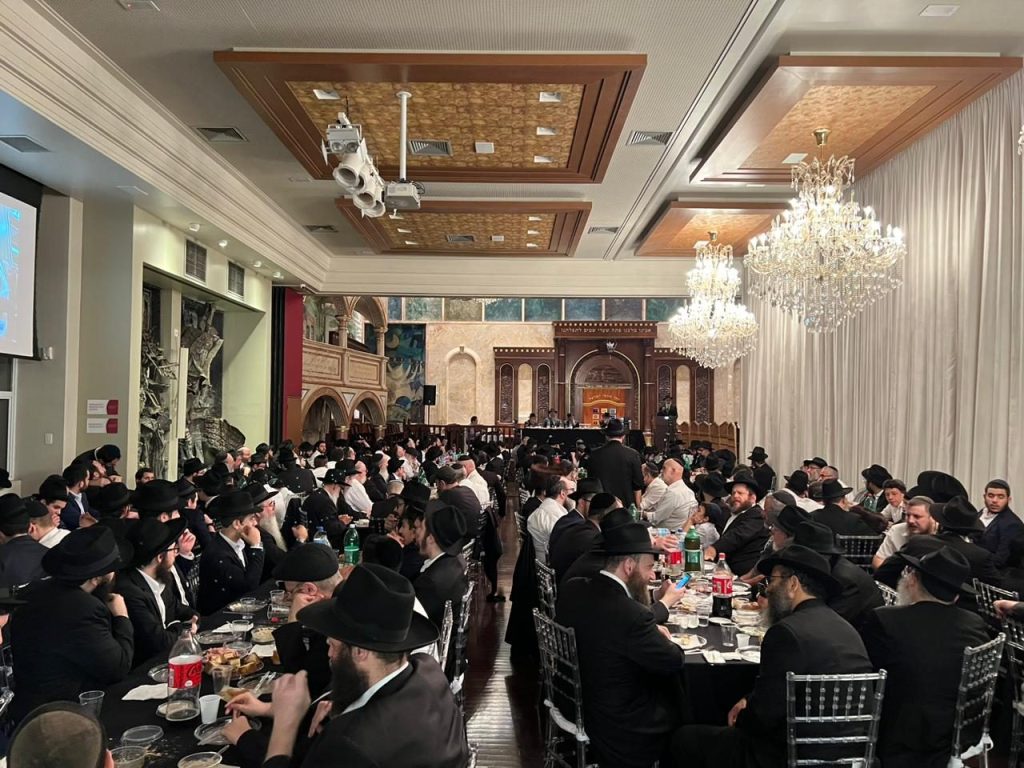
And today?
Today, boruch Hashem, we have a large, beautiful shul that serves the community for our various activities on weekdays as well as on Shabbos and chagim.
And has the funding problem been solved?
Not at all [he laughs]. But every time things get difficult, we write to the Rebbe with emuna, and boruch Hashem, Hashem takes care of us and everything works out for the good. The Rebbe never remains in debt.
Souls That Spark Revolutions
The activities that the Kauffmans hold throughout the year are the usual ones. On Shabbos and holidays there are classes, farbrengens, and joint kiddushim. It’s also when they bring in rabbanim and mashpiim who give shiurim or farbreng with the crowd.
“At the farbrengens in our shul, I speak a lot about making good hachlatos. Many times people take on keeping Shabbos, being careful about kashrus, putting on tefillin, Rabbeinu Tam, each according to his level. For a local Jew, this can entail serious personal transformation.
“We attach great importance to Chassidic dates. These are days we use to unite the whole community. Last year the farbrengens we held generated great excitement even among other shluchim in Brazil who saw our farbrengens. As a result, farbrengens were organized in other places within their areas of responsibility too. These farbrengens caused a tremendous awakening among many Jews in Brazil!”
During Chanuka they set up a large menorah on Avenida Paulista, the central and most important avenue in all of S Paulo, with festive central lightings held there each evening, attended by dignitaries from the city government and from the Jewish communities across the city. Afterward, trucks with menorahs go out and cover the entire city, publicizing the Chanuka miracle through them.

In light of the epidemic of assimilation in the country, the shluchim initiate shidduchim between Jewish families. They also organize groups of young people to travel to the Rebbe or to Eretz Yisrael. Through online social media platforms, Rabbi Kauffman reaches thousands of Jews.
“The growth in recent years in kashrus, in the number of community events, and in the number of institutions and baalei teshuva, demonstrates, more than anything, the strength and responsibility we have here in the city.”
How do you see the importance of your activity among the city’s Jews?
I see how much the activities affect them spiritually, especially when a Jew adds in actual observance of Torah and mitzvos. Sometimes it comes about in a roundabout way. Let me give you an example: There was a young man here who told me that following one of the lectures I gave, he took upon himself to stop eating pork and to try to switch to eating only kosher food. I don’t know which of the talks I gave made that impact, but the main thing is I managed to influence another Jew to stop eating treif and switch to eating kosher food”
R’ Pessach Kauffman has stories from the field that attest to the influence he has on the city’s Jews: At one of the programs we held, one of the participants came over and told me about an elderly Jew he knows who lives in the city, but unfortunately is far from Judaism. He recommended I reach out to him and try to draw him closer to Torah and mitzvos, so that he’d live appropriately in the last years of his life. He gave me his details so I could contact him.
Of course I got in touch with him by phone, and we arranged for me to go to his home for a visit. I arrived at his home with a pair of tefillin. At first he refused to put them on, but after I explained its importance to him, I managed to touch his heart, and he agreed to put on tefillin for the first time since his bar mitzva, at the age of ninety-two!…
Another moving story I was involved in: in one of the groups I was planning to take to visit the Rebbe in 5773, a woman registered intending to join the group, but a few days before the trip she was in a serious car accident. As a result of the accident, she was severely injured and fell into a coma.
Her condition was worrying. Before I traveled to the Rebbe, I went to visit her, and things looked very bad. During my time at the Rebbe, we offered many prayers for her recovery. When we returned from the visit the miracle happened! To the doctors’ astonishment, the woman woke up and, over time, recovered fully. Along with her recovery, she began growing closer to Judaism. I was with her through every stage of her journey back to Judaism, and last year I even attended her wedding. That moment, seeing her walk into her chuppa, was one of the most moving moments I’ve experienced as a shliach.
Personal Guidance From the Rebbe
R’ Kauffman continues recounting stories from his shlichus: I have an old friend who, some years ago, left Brazil and moved to Israel. He got married and today lives in Israel with his family. Despite the geographic distance between us, I call him several times a year, and that’s how we maintain our friendship. In our last conversation, which took place last week, I asked him about his physical situation, as well as his spiritual state. He shared with me honestly that he had recently stopped being careful about putting on tefillin every day.
Of course I explained to him the importance of putting on tefillin daily, and told him that if his yetzer hara had caught him specifically on this point, not letting him put on tefillin every morning, it’s only because through putting on tefillin he receives blessing and chayus for the whole day. So he shouldn’t give up on putting on tefillin.
The next day he photographed himself and sent me a picture of himself wearing tefillin, along with a message saying he was happy he’d gone back to putting on tefillin, and how grateful he was that I’d convinced him the night before to put them on.
As shluchim of the Rebbe, we can change people’s lives completely.
Like all shluchim, you surely feel the Rebbe is with you throughout your life as a shliach. So I want to ask you specifically about the awareness and feeling that the Rebbe is with you in your personal life…
Of course we feel that the Rebbe is with us in everything; it couldn’t be otherwise. We know that we represent the Rebbe, and in everything we do we can feel that the Rebbe is with us. I merit receiving clear guidance and answers from the Rebbe on every question and issue I write about.
But as you asked, let me tell you an incident or two connected specifically to our family: Boruch Hashem, we have four sons and one daughter. When my wife was pregnant, we would write to the Rebbe occasionally about various matters, and each time the Rebbe gave a bracha for the birth of a son. And indeed, that’s how it was—after a few months a son would be born to us. During another pregnancy the Rebbe wrote a bracha for the birth of a daughter—and so it was. A few months later a daughter was born to us…
Another time we merited a personal, family-specific answer was when my father fell ill. We asked for a bracha from the Rebbe through the Igros Kodesh, in which it was written that the Rebbe does not remain in debt to those who act and assist his holy causes. And indeed, my father merited living for a while longer and being present at my son’s bar mitzva. A year and a half later his condition worsened and the terrible disease was discovered. It was decided to perform a dangerous surgery on him as a last resort, but when we wrote to the Rebbe about the situation, we saw in the answer that the Rebbe was addressing the topic of mourning. Indeed, sadly, a short time later my father passed away.
S Paulo isn’t Eretz Yisrael and it isn’t Crown Heights either. It’s not easy to live there, spiritually speaking. How do you manage to raise your children with a Chassidic Jewish education?
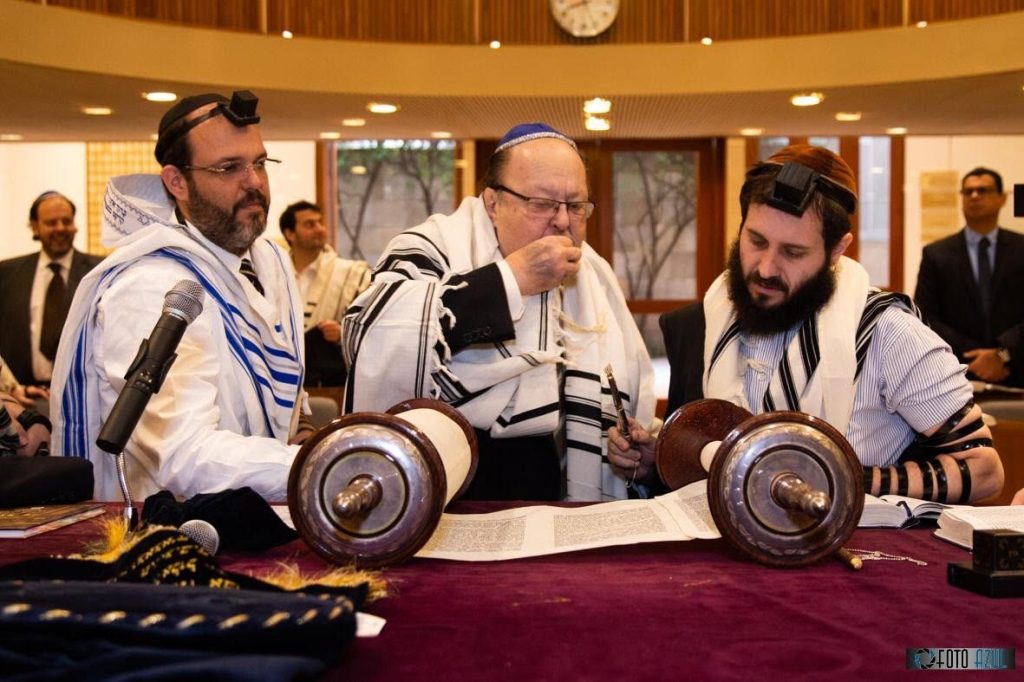
Our children attend Chabad schools in the city: the younger boys at the Chabad Talmud Torah, our daughter at the girls’ school, and the older boys are at the Tomchei Tmimim yeshivas in S Paulo. In that respect we don’t experience any special difficulties. Boruch Hashem, over the years a wonderful Chassidic educational empire has been built here.
I believe that success in raising children is divided between our example as parents and the values they receive at their schools. We need to be role models of Chassidic Jews, alongside tefillos that our children walk in the ways of Torah and Chassidus.
How much are the children involved in your shlichus activities?
The children help with all the activities we hold in the city. The older ones help with the tefillos in the shul on Shabbos, as chazzanim and baalei korei. When guests come to eat with us, every child has a role. Our guests are always pleasantly surprised, and it shows them what a Chassidic Shabbos table looks like!
They definitely have an impact on our shlichus life. During the mivtzaim we do on Fridays, my son Motti made personal contact with someone, a well-known businessman in the city. I’ve already received messages from him about how much he looks forward to my son’s visits, and how he cried with emotion one time when my son helped him put on tefillin.
The children are of course aware of their great responsibility as shluchim, and we involve them in all our decisions in our shlichus life.
One time, when I was supposed to organize a large farbrengen for the community, I was busy with several personal matters and decided I didn’t have the ability or strength to organize a big farbrengen. But my son insisted and he wrote about it to the Rebbe. The reply stated that we should hold the Chassidic farbrengen as usual, as on every Chassidic date. Boruch Hashem, I overcame the difficulty that had gripped me, and together with another important shul nearby, we held a respectable farbrengen.
The next day my son wrote to the Rebbe again, and in the reply the Rebbe wrote not to stop the activities and events we do, since these are the source of our bracha and success.”
* * *
The shluchim aren’t satisfied with what has been accomplished thus far and they want to increase the number of Torah classes they give during the week, do more community activities, and give more personal, warm attention to families as well as to individual Jews.
When I work one-on-one with someone, the work is more intensive but also more effective. Part of the secret of success in shlichus is working personally and closely with local Jews.
Finally, what’s your message to readers?
We need to be aware of the challenges facing us. People on the street are searching for spirituality, and we need to give it to them by spreading the Rebbe’s teachings, until we can announce to them that ‘hinei, Moshiach ba,’ even today.
Beis Moshiach #1518 • א׳ אלול תשפ״ו • pp. 20-27
© 2026 Beis Moshiach Magazine. All rights reserved.
This article originally appeared in Beis Moshiach #1518. You are welcome to share it with friends and family by email or in print, provided that you do not change, add to or omit any part of it, you credit the author and Beis Moshiach, and you include a link to archive.bmoshiach.org (written out in full in printed copies).
To republish this article in a newspaper, magazine, book or website, please request permission in advance at [email protected].