A Siyum Of A Different Kind
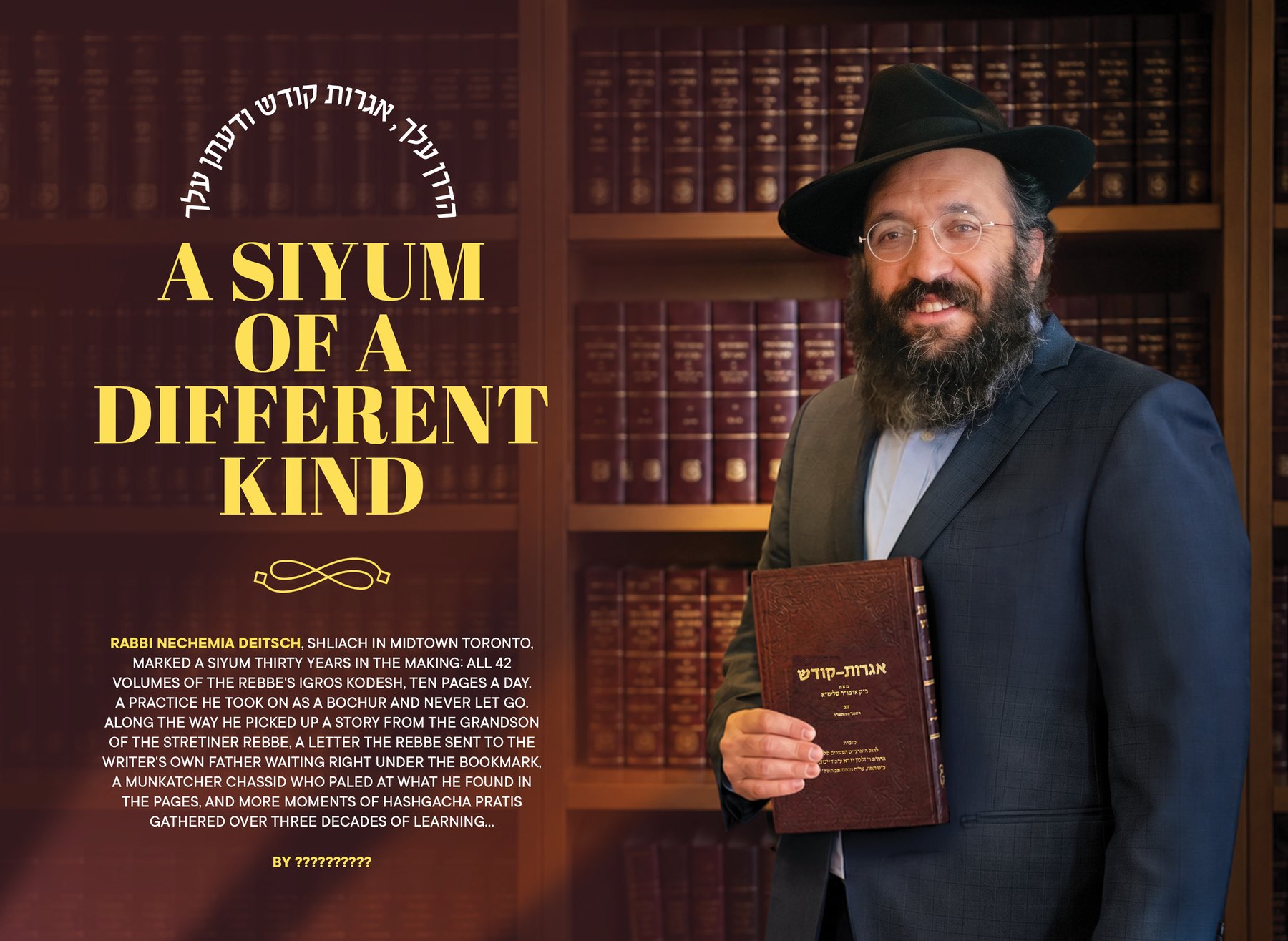
Rabbi Nechemia Deitsch, shliach in Midtown Toronto, marked a siyum thirty years in the making: all 42 volumes of the Rebbe’s Igros Kodesh, ten pages a day. A practice he took on as a bochur and never let go. Along the way he picked up a story from the grandson of the Stretiner Rebbe, a letter the Rebbe sent to the writer’s own father waiting right under the bookmark, a Munkatcher Chassid who paled at what he found in the pages, and more moments of hashgacha pratis gathered over three decades of learning…
This interview took place at the beginning of the month of Menachem Av, just as the public was beginning to arrange siyumei mesechtos, following the directive of the Rebbe Melech HaMoshiach to hold siyumim from Rosh Chodesh through the fifteenth of Menachem Av.
The siyum at the center of this article, however, is a siyum of a different kind—not on a mesechta learned over the past few months, but on a project of learning that spanned thirty years! A siyum on the entire “Igros Kodesh” series of the Rebbe—42 volumes, containing more than 15,000 letters!
About a month ago the concluding volume of the series was published, Volume 42, containing responses and letters from the years 5751–5752. With its appearance, the circle closed for Rabbi Nechemia Deitsch, the Rebbe’s shliach in Midtown Toronto.
Back in 5757 (1996), as a young bachur, he took upon himself a fixed daily study of ten pages a day, and he has kept to it ever since, six or seven days a week, volume after volume—until finishing all 42 volumes.
He got the idea from his father, Reb Zalman Yehuda Deitsch, a’h. His father was a model of a Chassid who ran a large textile-warehouse business with partnerships spanning the globe—and yet saw the essence of his life in learning Torah and Chassidus. Every morning he sat in 770 and learned the maamarim of the Rebbe Rashab with a chavrusa. Afterward he davened b’mesinus with a minyan, and only then went out to his workday.
Alongside the morning Chassidus learning, he had another fixed seder: a special chavrusa devoted to learning the Rebbe’s teachings, through which he went over the course of the years through most of the Rebbe’s maamarim and sichos.
His Father’s Bookmark
In 5757, shortly after a new volume of Igros Kodesh was published, the tamim Nechemia Deitsch—then a young bachur in 770—noticed that the position of his father’s bookmark was changing from day to day. Before long he realized his father was almost finished with the book.
“I asked him, ‘How are you reading so fast?’” Rabbi Nechemia recalls. “He answered simply: if every day you set aside a certain amount of time and read a certain number of pages, within a short time you can finish the sefer.”
The son opened the volume and did the math: three hundred pages. Ten pages a day—and the volume would be finished within a month. “I’ll try,” he thought to himself, “to close the gap of the twenty-two volumes of Igros Kodesh that had already been published so far,” and he began reading day after day, month after month.
At first it wasn’t simple: a flood of unfamiliar words (especially for a bachur who had grown up his whole life in Crown Heights on Yiddish and English alone) and abbreviations galore, which in the early volumes hadn’t yet been spelled out in footnotes the way they later were in the later volumes. Here his father taught him an important rule that has stayed with him since: “Don’t get stuck on abbreviations. Prepare a list, and when you have a question, call me and I’ll help you.”
At the end of those volumes, evidence of the method is recorded to this day: page numbers and abbreviations gathered while reading. From time to time, father and son would sit and go over the lists together—the father filling in the abbreviations, explaining and interpreting. “The more you learn, the more you improve,” R’ Deitsch says. “It gets easier. You learn the language, and you learn how to approach it.”
“I Just Read a Letter the Rebbe Wrote a Munkatcher Chassid!”
One day R’ Zalman Deitsch came home from work and told over the following tale: a Munkatcher Chassid had come into the office that day to buy textiles. “What kind of Chassid are you?” R’ Zalman asked him, and the man answered: “A Munkatcher Chassid.” R’ Zalman responded: “A Munkatcher Chassid! I just read a letter the Rebbe wrote to a Munkatcher Chassid!”
R’ Zalman kept a set of Igros Kodesh at the office too, and apparently “stole” moments of learning there between deals. He opened Volume 21 and showed the customer: in a letter from the end of Tishrei 5712, the Rebbe sends a blessing to a Munkatcher Chassid—wishing him and his wife a good and sweet year, materially and spiritually, a year of the fulfillment of their hearts’ wishes for good. The Rebbe goes on to instruct him to periodically picture the image of his rebbe—the author of Minchas Elazar, the Rebbe of Munkatch—and to work at spiritually sustaining others, and Hashem will sustain him abundantly, materially and spiritually. The customer turned pale. “That’s the most amazing thing I’ve ever heard,” he said. “I’m the son of the man that letter was written to.”
The Chassid from Munkatch took that volume of Igros Kodesh home with him, a gift from R’ Zalman.
How do you keep up such consistency day after day, for decades?
The personal seder I took upon myself is ten pages a day, and that’s how I started back in 5757. Generally, I keep to this learning schedule six or seven days a week. Many times it happened that I finished the volumes that had already been published and had to wait for the next one, and during the waiting period I switched to the Igros Kodesh of the Rebbe Rayatz and of the Rebbe Rashab, so that even between one volume and the next, the learning didn’t stop.
Ten pages a day is not a small amount. There are also difficult, scholarly letters.
True. The main difficulty was specifically in Volume 1 and Volume 2, where there’s a lot of learned material—an entire treatise on Techiyas HaMeisim, letters on hashgacha pratis—very deep topics. Later on too, when I ran into a difficult letter, there were days I didn’t insist on ten pages if it took longer than I’d estimated. But the goal remained ten pages—sometimes it takes twenty minutes, sometimes forty-five. By the way, the later volumes, from the years of the “Mems” (1980’s) and on, are easier to learn, since most of them aren’t scholarly letters but letters about communal matters, guidance in avodas Hashem, and everyday life. There are of course the michtavim klaliyim (general, pastoral letters) that require more study, and if you want to go deeper into the footnotes, you can go even further.
There are people for whom even ten pages is a tall mountain to climb. From your experience—is two or three pages a day also a correct seder to progress with?
Absolutely! Just today a friend called me, the son-in-law of R’ Shmuel Lew of London, and told me that his father-in-law, Rabbi Lew, learns six pages a day—that’s his seder. Each person at his own pace.
The Difficult Lashon Kodesh, and the Explanation in the Margins
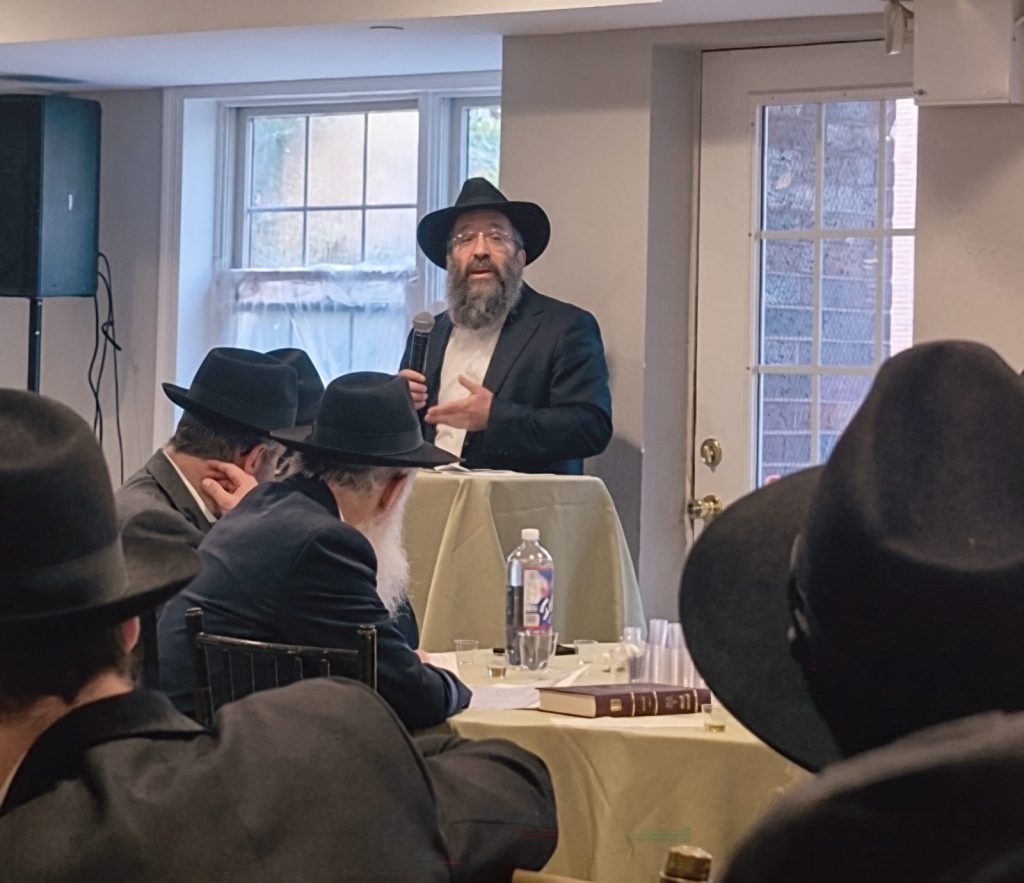
You’re a graduate of Oholei Torah, and Yiddish is your mother tongue. It’s actually easier today for Hebrew readers: the letters in Yiddish have already been translated into Lashon Kodesh, but the letters in Lashon Kodesh no one has yet translated into Yiddish…
Completely true! The Lashon Kodesh of the letters was difficult for me, and it took time until I learned it. But I trained myself according to my father’s rule: don’t get stuck. When abbreviations appeared, I wrote them down and kept going. Sometimes also a line from the Gemara or a Medrash, the plain meaning of a passage I couldn’t get to the bottom of—I made a small mark. When I finished a volume, I’d call my cousin, Rabbi Yitzchok Tenenbaum, Rosh Yeshiva in Morristown, and say to him: “This page, that page—please explain this passage to me.” In the last ten years, since WhatsApp became such a useful tool, it’s become simpler. I have a few knowledgeable friends, and when I get stuck I send a picture with a small note—and within minutes I get an answer. But specifically on this point it’s worth noting: in the morning I try very hard not to touch the phone for the first hour and a half after waking up. When I’m learning in the morning and hit a question, I don’t grab the phone to take a picture, because the moment you touch the phone—there’s a message, there’s another reply, and you’re already somewhere else. So I write it on a small note, and send it afterward.
And the learning itself, always in the morning?
For me it “works” best in the morning. But if for some reason I didn’t manage—I take the sefer with me wherever I go, and try to finish over the course of the day. Sometimes it only ends at night, but it ends.
Seeing What the Rebbe Is “Involved In”
You’ve read until today some fifteen thousand letters—from leading the Jewish people’s affairs worldwide to concern for the details of a single Jew’s life. What does this comprehensive reading do to the way you look at the Rebbe and his leadership?
There are a few points here: when you learn the letters in order, by year, you simply see what’s “burning” for the Rebbe at that time. There’s a period where you see a great many letters about the mivtzaim, a period for Shleimus HaAretz, a period for conversion and “Mihu Yehudi,” shlichus, “Aseh Lecha Rav,” and so on. The Rebbe of course answers all the other matters in parallel, but there’s a thread running through everything, and you can really feel it. Many times, following a letter, I need to open the Sichos Kodesh to check what was said at the farbrengen of those days, because the Rebbe notes in the letter: “As was discussed this past Shabbos,” and if you really want to understand the response, you have to check the sicha itself.
An example?
Take, for instance, a letter from the 12th of Kislev 5750 to Rabbi Pinchus Feldman, who had written that he needed chizuk. The Rebbe writes there sharply: “If everything said this past Shabbos Kodesh (and the r’ad [main points] of the farbrengen before that) didn’t strengthen him—I don’t know what will strengthen him,” and adds: “and note that this is the Shnas HaMem”—the fortieth year, the time when one is given “a heart to know,” to know the Rebbe simply. The moment you read a response like that, you run to the farbrengens of those same Shabbosim: what was said there? What happened? This kind of learning gives real life to matters concerning the Rebbe—what was happening then, and what’s demanded of us.
What did you learn about the connection between the Rebbe and the Chassidim, the askanim, or Jews from around the world?
That’s maybe the greatest thing of all. You see what people wrote to the Rebbe and how they wrote, what troubled them, and on the other hand—the Rebbe’s special attention to each one, whether a mashpia, a rosh yeshiva, a businessman, a doctor, and so on. With each one the Rebbe corresponds in his own language, about what he needs. You see tangibly Chazal’s words about Moshe Rabbeinu, who could “walk according to the spirit of each and every one.” Many times I see a point in a letter and say to myself: I have a friend dealing right now with exactly this issue—this point will speak to him. And I send him the letter. Once I saw a letter written to someone from a very small town in Canada. At exactly that time a new shliach had moved there. I sent him the letter, and the shliach reacted with astonishment: “I never knew the Rebbe even knew of Jews living here.” That gave tremendous life to that shliach, who was just taking his first steps there.
“Omar Rav Nechemia”
R’ Nechemia Deitsch relates:
Summer of 5754, a few weeks after Gimmel Tammuz. I went as a counselor to a summer yeshiva in Italy, run by Rabbi Gershon Mendel Garelik, shliach and rav of Milan. That summer he told us he was organizing the letters he’d received from the Rebbe—a binder with about two hundred and twenty letters. At the end of the summer I asked him for copies of the letters, to distribute to the counselors.
At an event held that same night, Rabbi Garelik got up and told over: “I didn’t know what to do. I’d heard that since Gimmel Tammuz people were writing to the Rebbe and placing the letter in a volume of Igros Kodesh [the practice hadn’t yet spread among Anash at that point]. I don’t have Igros Kodesh here in the mountains—but I have ‘letters’ of my own.” He put on a hat, wore a kapote and gartel, and decided to ask the Rebbe: give it out or not? He opened the binder, and in the first letter that opened before him appeared the words “Omar Rav Nechemia”—words that don’t appear in any of the other two hundred and twenty letters. He saw this as a clear answer from the Rebbe, and gave me a copy of the letter. ■
The Story of a Letter
On one of his first Shabbosos on shlichus in Toronto, Rabbi Nechemia Deitsch walked into one of the small shuls that had survived downtown from earlier generations. In those days there were two or three old Orthodox shuls downtown, with a small minyan of elderly men and bachurim.
Between the tefillos, one of the mispallelim turned to the visitor: “Why does Lubavitch need to come here?” But before he could answer, an elderly Jew of about seventy stood up. “If you want to know why Lubavitch came here,” he said to the questioner, “let me tell you what Lubavitch is.”
The Jew, R’ Sholom Langer, grandson of the Stretiner Rebbe, began his story: Sunday morning, 11 Shevat 5710. He, Sholom, was walking past a newsstand, and on the front page a headline stood out: the Lubavitcher Rebbe had passed away. He bought the paper and brought it to his father, R’ Shlomo, son of the Stretiner Rebbe. His father looked at the headline and sighed: “Oy vey. If the Lubavitcher Rebbe has passed away—that’s a sign Chaim Silver is going to leave this world.”
“What’s the connection?” the son wondered. Here the father told him a story that had happened eight years earlier: in 5702 (1942). Chaim Silver, a Jew from Toronto, fell seriously ill. He lay in the hospital unconscious, and the doctors had given up hope. His wife came to R’ Shlomo Langer with a request: your father is the Stretiner Rebbe, perhaps you have the power to bless my husband? R’ Shlomo answered her: “I am not a Rebbe. But in Brooklyn there recently settled the Lubavitcher Rebbe. If you’d like, I’ll call there to ask for a blessing for him.”
R’ Shlomo called 770 and related the matter to whoever answered—apparently the Rashag. A short time later a response came back in the name of the Rebbe Rayayz: Yeshivas Tomchei Tmimim had recently been founded in nearby Montreal. If the family would commit to giving a thousand dollars to the yeshiva, it would be a merit for the patient’s recovery, and one angel of a hundred is not the same as one of a thousand.
A thousand dollars in 5702 was a fortune; for comparison, the entire 770 building had been purchased just a few years earlier for thirty thousand dollars! The patient’s brother, his business partner, refused firmly to give such a sum. But the wife ruled: “This is my husband,” and the money was sent to the yeshiva in Montreal. A few days later Chaim Silver opened his eyes, sat up slowly in his bed, and went on to recover fully, until he stood completely on his own feet.
“Now,” R’ Shlomo Langer concluded to his son, holding the morning paper from 11 Shevat 5710, “that blessing was indeed from the Lubavitcher Rebbe. If the Rebbe has passed away…” And indeed, a few weeks later Chaim Silver fell ill and passed away.
Almost exactly fifty years had passed since that morning, and now the son, R’ Sholom Langer, stood in the middle of the small shul in Toronto and concluded, in Yiddish: “Dos iz Lubavitch [= this is Lubavitch]!”
The Letter Waiting Beneath the Bookmark
The young shliach, Rabbi Nechemia Deitsch, had heard a Chassidishe story firsthand, but didn’t know what he was meant to “take” from it.
The next day, Sunday morning, he sat down for his regular learning seder: ten pages of Igros Kodesh every day, starting from the page marked by his bookmark. He opened the volume, and the first letter on the page was addressed to… R’ Shlomo Langer of Toronto.
Wonder of wonders—in 5724 (1963), R’ Shlomo Langer had put into writing the story of the Rebbe Rayatz and Chaim Silver and sent it to the Rebbe. The letter on that page was the Rebbe’s response to him, dated 3 Marcheshvan 5724. The Rebbe thanks him for “the story you wrote regarding my father-in-law, the Rebbe, leader of our generation,” and emphasizes that “the blessings of tzaddikim endure forever and take effect.”
That same day the shliach called R’ Sholom Langer: “The story you told over Shabbos—your own father wrote it at the time to the Rebbe, and the response was printed in Igros Kodesh. Come see what the Rebbe answered him.” The following Shabbos they sat and farbrenged over it together, and then discovered that in Volume 7 of the Igros Kodesh of the Rebbe Rayatz there are two letters to the Silver family:
In the first letter, the Rebbe writes to the patient that he was glad to receive word that his condition had improved, and regarding his decision to donate to Tomchei Tmimim in Montreal—the Rebbe related the following story: one of the Chassidim of the Rebbe Rashab fell seriously ill, and wrote a pa’n (pidyon nefesh, a petition for blessing) to the Rebbe with a promise that when he recovered from his illness he would give a generous donation to the Tomchei Tmimim yeshiva in Lubavitch. The Rebbe Rashab blessed him, and added: “Regarding his promise to the yeshiva, it is better that he fulfill it promptly, so that Hashem will be, so to speak, in his debt to send him a recovery, rather than his being in Hashem’s debt.”
In the second letter, the Frierdiker Rebbe thanks them for having sent the donation, and notes especially that they sent it with their son, who traveled specially to Montreal—since there is no better way to educate a child than that.
To be continued
Beis Moshiach #1518 • א׳ אלול תשפ״ו • pp. 12-19
© 2026 Beis Moshiach Magazine. All rights reserved.
This article originally appeared in Beis Moshiach #1518. You are welcome to share it with friends and family by email or in print, provided that you do not change, add to or omit any part of it, you credit the author and Beis Moshiach, and you include a link to archive.bmoshiach.org (written out in full in printed copies).
To republish this article in a newspaper, magazine, book or website, please request permission in advance at [email protected].