Short On Sight, Not On Solutions
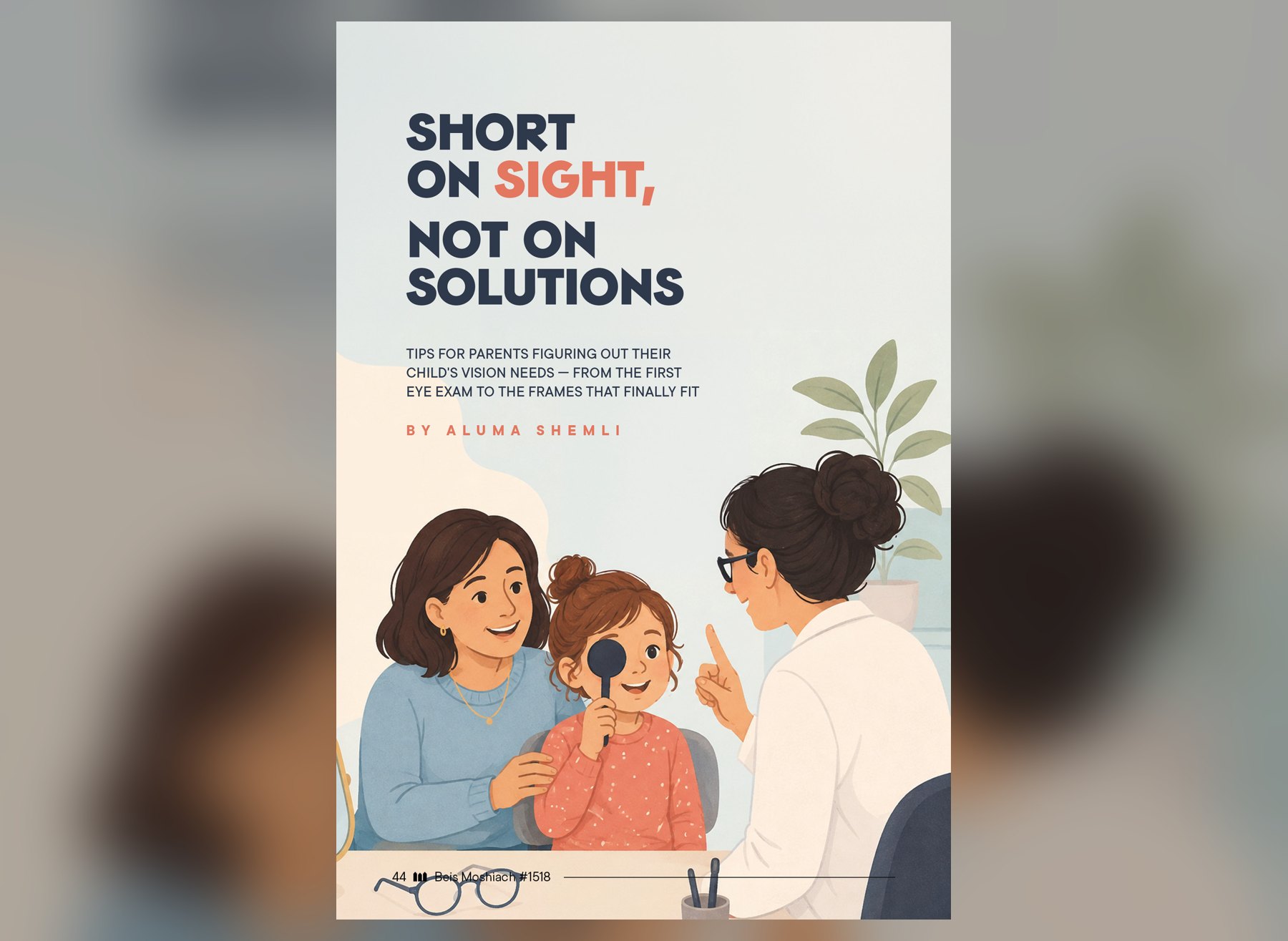
Tips for parents figuring out their child’s vision needs – from the first eye exam to the frames that finally fit.
Forty years ago, nearsighted children who wore glasses were called “Four Eyes” Today, kids wearing glasses are a familiar sight, and every classroom has several of them. Eye doctors say genetics plays an important role in this phenomenon, and that children of nearsighted parents have a higher chance of needing glasses. Computers and screens, it seems, are also contributing significantly to the rise in the number of children who need glasses.
There’s another reason for the rise in glasses-wearing, a positive one: growing awareness and early diagnosis. Vision monitoring for children now begins as early as the well-baby visits, and problems are usually caught early. Sweet babies gazing out through their glasses with wise little eyes are no longer a rare sight.
Glasses are much more than a visual aid, they’re part of a child’s everyday experience, and they affect concentration, confidence, and development. In this article we’ll talk about nearsightedness in children. Two mothers of bespectacled kids, Malka from Gush Etzion and Esti from Yerushalayim, will share their experiences, along with professional tips from expert Sarit Tahori, who runs a vision-improvement center.
Glasses for Concentration
“My Dovid was quite the troublemaker. He could barely pay attention in cheder,” Malka begins. “At home, when we’d review the material with him, he knew it well, and it seemed like he’d grasped the reading just fine. But in class he couldn’t sit through a full lesson, and the rebbi felt he wasn’t absorbing the material well enough.
“Eventually we were referred for an attention and concentration evaluation. We found it hard to believe that was the problem, because at home Dovid was a very calm child but since he was our oldest, we got anxious and rushed to the pediatrician. The doctor, patient and experienced, asked to first run vision and hearing tests. Only if those came back normal would we move on to the evaluation. The result was startling. It turned out Dovid could barely see at a distance. In class he couldn’t see the board, and he’d get up to check what was written, losing his concentration.
“The day he got his glasses, he looked at himself in the mirror, stunned. ‘I never noticed I have so many freckles!’ He touched his cheek… My heart ached that I hadn’t noticed sooner, and I thanked Hashem and the pediatrician, the good shliach, who spared him unnecessary evaluations and found the real problem.”
“My husband and I have worn glasses since we were very young, and our kids are following in our footsteps,” Esti joins the conversation. “One by one, in second or third grade, they join the ranks of the glasses-wearers. When our Batya was in preschool, our pediatrician recommended a vision test before she started first grade, and it turned out she really did have poor vision. Boruch Hashem we checked! Who knows how she would have managed learning to read until we figured out she just couldn’t see well!”
Is that moment, realizing your child needs glasses, hard to swallow?
Malka says that it wasn’t easy for her. “Dovid is a good-looking kid, and I felt like glasses would make him less handsome. It was hard for me to picture him stuck with those plastic frames for the rest of his life. The one thing that comforted me a little was thinking that a kid with glasses beats a kid with attention problems.
“At first I was ready to take out a loan and pay for laser surgery to try to solve the problem, but a quick check revealed that such surgeries aren’t performed before age eighteen. Once we walked into the optical shop and I saw the huge selection of frames, and tried some on with Dovid, I actually enjoyed it—he looked so sweet, like a little professor…”
Esti was far less rattled. “We’re a family of glasses-wearers, why would one more pair of glasses scare me? The issue with Batya is different: glasses don’t survive more than three months with her… it’s so discouraging! Sometimes she comes home from school without them, and only when I ask where they are does she notice she’s not wearing them. Other times she steps on them getting ready in the morning… There’s an organization in Yerushalayim called ‘Mishkan HaRe’iyah’ where large families can order a pair of glasses there once a year at a low price. I buy her glasses there, and when they break I use the benefit through the health fund, also once a year, and then I go hunting for deals—two pairs for two hundred shekels or something—until a year passes and we can buy at a discount again…” [Ahava Vision in Williamsburg is helpful for those living in New York, with free prescription glasses that are fully covered by eligible insurance plans like Medicaid.]
Do other kids ever make fun of your child for wearing glasses?
“Not at all,” Malka laughs. “Quite the opposite. Several mothers have called to tell me their kids are actually jealous and want glasses too… like the joke about the kid trying to convince his mother to buy him glasses: ‘Mommy, you see that little black dot up there on the ceiling? Well, that’s the thing, I don’t see it!’”
Esti hesitates for a moment. “No one really made fun of her, but the first few days at school were hard for her. She complained that girls kept asking her questions about the glasses and what she could see. Well, she was also the first kid in first grade to wear glasses; today there are already several. And she goes through glasses so often that people barely notice when she has a new pair.”
Any good advice for mothers of kids with glasses?
Malka: “Sometimes the teacher or rebbi tells us our child is straining to see the board, and we rush him off to the optometrist, hurrying to buy glasses. It’s important to first take him to an eye doctor who specializes in children, who’ll do a thorough, professional exam, with dilating eye drops, to make sure there’s no more serious eye problem. Did you check? Everything fine? Take the exact prescription the doctor measured and go with it to the optical store.
The eyes are so delicate and sensitive, and when it comes to vision, it’s not worth trying to save time or effort.”
Esti: “Before you spend hundreds of shekels, find out what benefits you’re entitled to. Through most health funds, kids can get glasses once a year for free or at a very large discount. There are also organizations that help large families with this purchase. Even if you’ve checked and don’t have that benefit (or you’ve already used it), it’s still worth doing some comparison shopping first. That way you can save lots of money.”
There’s Another Way
Sarit Tahori, director of the “Center for Eye Health and Vision Improvement,” explains vision development and the effect of glasses, and offers some important tips:
Newborns don’t see well at first. Their vision develops gradually over the years. The fastest development happens in the first eight weeks of life, and even so, vision continues to stabilize over the first several years. At a young age, it’s important to wear glasses according to the doctor’s instructions so as not to disrupt normal development.
Vision doesn’t depend on the eyes alone. A significant part of the process actually happens in the brain. The eye and the brain are inseparably linked and influence each other. Brain development affects vision, and of course vision also strongly affects children’s brain development.
This understanding also gives us real hope because whatever is connected to the brain can be improved and corrected. It’s commonly believed that a nearsighted eye is a done deal, and that we just have to wait for the prescription to stabilize, deteriorating further and further in the meantime. But that’s a mistake. Most vision problems can be corrected through special exercises and changes in how we use our eyes.
The Role of Glasses
When we hear about eye exercises to improve vision, we mistakenly think we first have to throw away our glasses. After years of putting on our glasses right after washing our hands in the morning and not taking them off until after the bedtime Shema, the idea of removing them terrifies us so much that we give up before even trying. Who can afford to walk around half-blind all day?
But there’s no need to give up our glasses, or our children’s glasses. They’re an amazing tool designed to help us see what we otherwise couldn’t. So what’s the problem with glasses? That they become just another body part. Use glasses to see, and take them off when they’re not needed. A mother comes home from work and settles onto the couch with a cup of coffee, listening to all the sweet stories the kids collected for her during the day—why would she need glasses right now? When a child is running wild in the yard, playing tag, blowing soap bubbles, why glasses?
Glasses give us a sense of control. We want to see perfectly at all times. The problem is that they weaken our visual system. We stop moving our eyes side to side, fixing our gaze straight ahead. We stop exercising the eye muscles, and sometimes we don’t even blink.
Always Ask Why
When a vision problem is discovered in a child, we rush to buy glasses to overcome it. But before we even decide how to act, we should ask ourselves why. Why aren’t the eyes working well, why can’t they see far away?
There’s a theory, never actually proven, that vision problems are hereditary. In practice, we do see that parents with glasses often have children with glasses. But the reason isn’t necessarily genetic. A bad habit ingrained in the parent—for example, walking hunched over instead of lifting the gaze forward and into the distance, gets passed on to the child, who also ends up looking down at the ground. So the vision problems that developed in the parent because of poor posture end up developing in the child too.
Our eyes are part of the body, and just like the rest of the body, in order to function well they need movement, relaxed and unclenched muscles, and proper blood and oxygen flow. Many kids in our generation, the screen generation, don’t move their bodies enough, don’t get out into open spaces, and don’t look into the distance. They spend most of the day indoors between four walls, reading books at best, or, worse, staring at screens.
To support our children’s healthy vision, we should offer them everything nature already offers anyway: running, playing wild in open spaces, developing a wide field of vision, and looking off into the distance. And let’s not forget the sun! Sunlight is a wonderful gift for our eyes. Studies have shown that children who aren’t exposed to sunlight are more likely to develop nearsightedness. We were born to be in the sun, and we should get our children used to playing, running, and enjoying the sun and certainly not covering their eyes with sunglasses…
Natural food also has a major effect on vision. White sugar and white bread are harmful to the eyes, while vegetables and fruits, of every kind and color, are very beneficial. Our eyes need plenty of vitamins to maintain healthy vision. Good sunshine, vegetables and fruit, open spaces—all the treasures Hashem has given us in abundance—we can pass them on to our children to support their healthy vision, and not only their vision.
“My Eyes Are Dimmed From Grief”
One of the things that greatly affects our vision is our emotional state. It’s not for nothing that Dovid HaMelech said, “My eyes are dimmed from grief.” Anger, mental tension, and sorrow immediately affect vision. They contract the muscles around the eyeball and prevent proper blood and oxygen flow to the eye.
One of the interesting studies conducted by William Bates, the father of the method of exercises for improving vision, dealt with this very subject. He examined children’s eyes during stress and during relaxation, and actually identified the muscle contraction during stress and the resulting blurring of vision.
Often, children who suffer from nearsightedness are more sensitive children, sometimes a bit lacking in self-confidence and vulnerable. We can help them by improving their self-confidence, giving them responsibilities at home in roles they’re capable of performing, and lots of positive feedback.
Also, gentle, pleasant massages around the eye socket, temples, forehead, back of the neck, and shoulders relax and release blood flow to the eyeball.
With A Good Eye
A few things every mother can do at home with her children, without pressure, to improve their vision: Go outside, into the light and open spaces. Let the children enjoy the sun, the light, develop spatial vision, and look into the distance. Play ball games and running with them. A ball activates the eye muscles to look far away, upward.
Help the children release their muscles. Let them roll on the floor, put on music and dance with them. If they enjoy it, especially the little ones, tickle them. Today’s children sit too much and barely move.
Create time without glasses. When going out to the garden, when sitting to drink something warm together on the porch, it’s good for the eyes to rest a bit from the endless strain, from the rigidity, and start to move.
Get the children used to sleeping in darkness. Our eyes need to rest from the constant strain, at least during the night hours.
A nice and easy exercise that can be done together in an enjoyable way with the children is called “palming” (cupping). Sit around the table, elbows resting on cushions placed on the table to prevent pain or pressure. Place the palms of the hands over the eyes, shaped like a dome, as if creating a dome sealed from light. It’s important that the eye be in darkness, but that nothing presses on it. During these minutes, while the eye is in darkness, relaxed and resting, do a calming activity together. You can sing songs you love together, or Mommy can tell a soothing story. It’s important that the story not be scary, so that the eye can also rest emotionally.
When a child doesn’t see well, we’ll take care of him the way we know how, as good mothers. We’ll take him to the doctor and buy him glasses. We’ll also take care of everything that helps his eyes see better: outdoor activity, sun, release of muscles and emotions, and we’ll get him used to using glasses when he needs to, without being dependent on them.
Hatzlacha rabba, may you always see well!
Beis Moshiach #1518 • א׳ אלול תשפ״ו • pp. 44-48
© 2026 Beis Moshiach Magazine. All rights reserved.
This article originally appeared in Beis Moshiach #1518. You are welcome to share it with friends and family by email or in print, provided that you do not change, add to or omit any part of it, you credit the author and Beis Moshiach, and you include a link to archive.bmoshiach.org (written out in full in printed copies).
To republish this article in a newspaper, magazine, book or website, please request permission in advance at [email protected].