Where the Rebbe’s Directives Became a Cheder
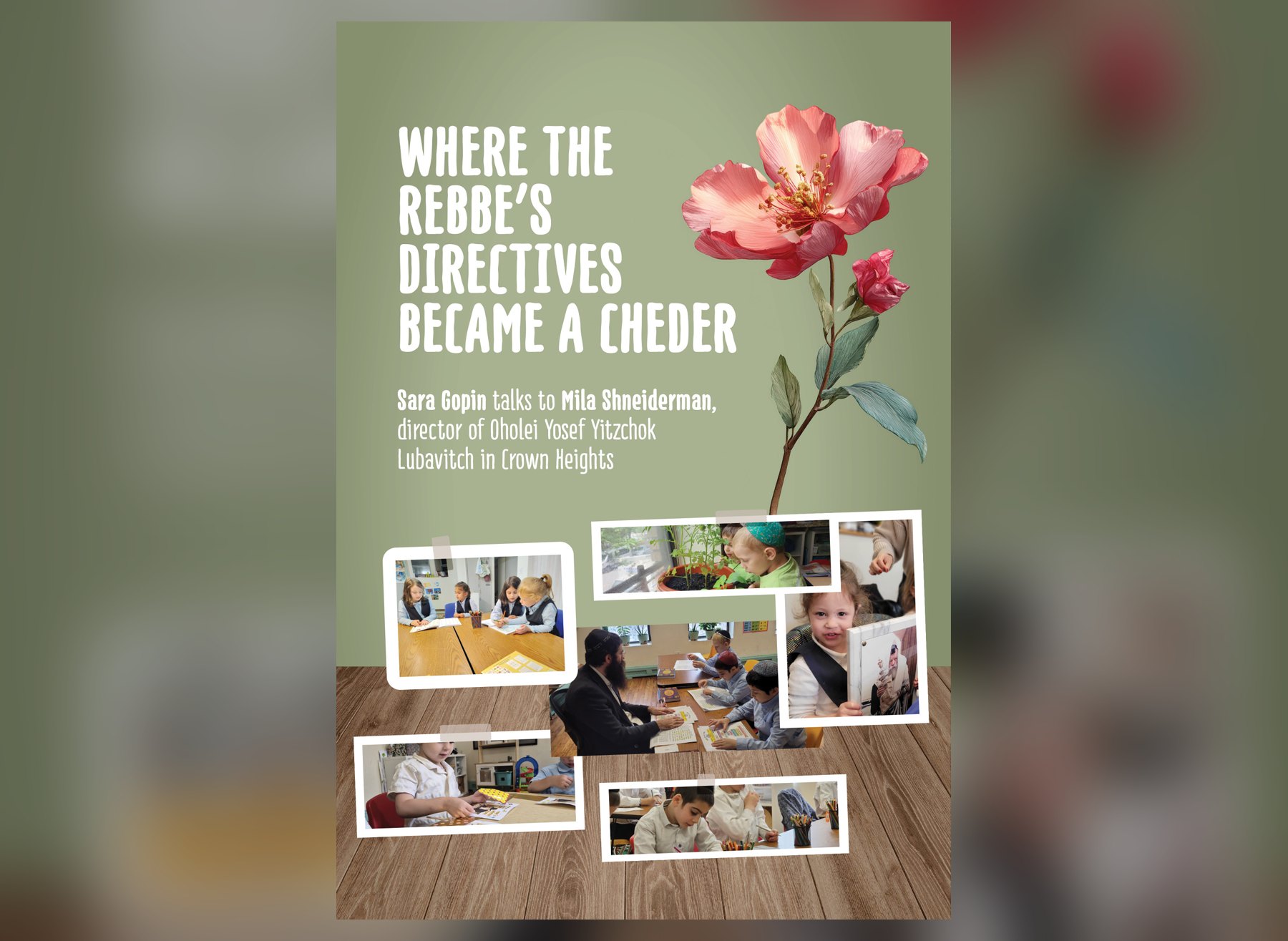
Sara Gopin talks to Mila Shneiderman, director of Oholei Yosef Yitzchok Lubavitch in Crown Heights.
My interview with Mila Shneiderman, director of Oholei Yosef Yitzchok Lubavitch in Crown Heights, gave me new insight into chinuch—not only as education, but as a living shlichus.
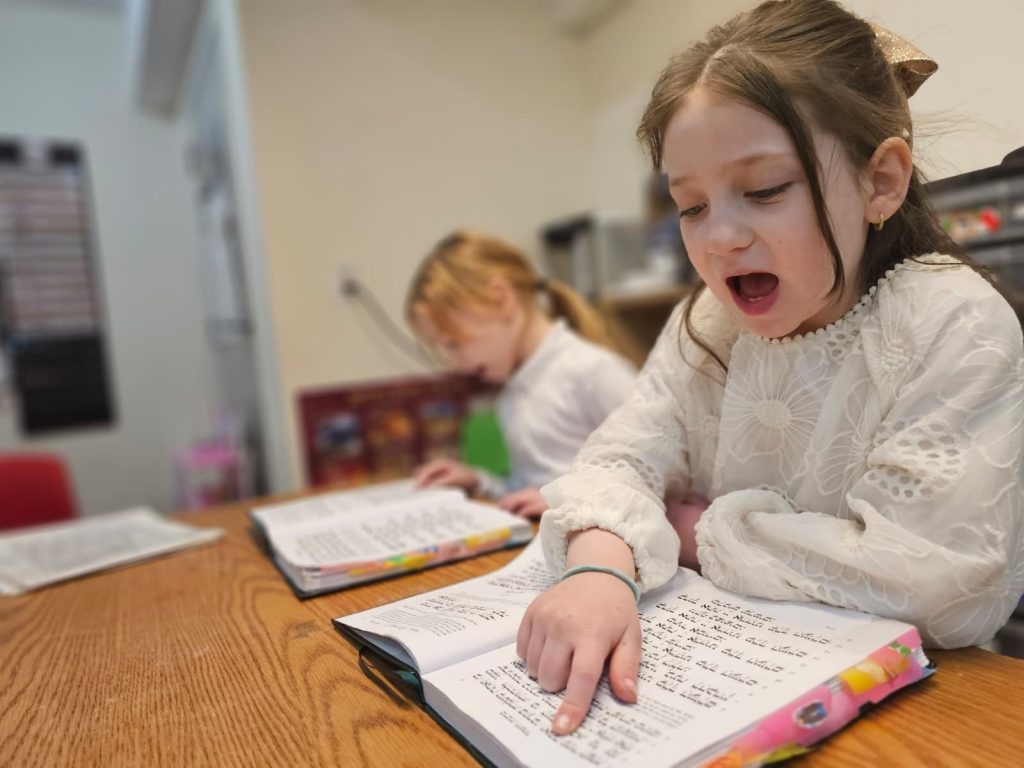
Oholei Yosef Yitzchok is a cheder for boys and girls, in separate divisions, from the age of two until thirteen. The classes are intentionally small, with no more than twelve children in a class. As soon as I walked in, I felt the warmth and intimacy of the place—a calm, home-like atmosphere where every child is cherished.
“On numerous occasions I’ve received directives from the Rebbe to obtain a teacher’s license, and even to open a school,” she begins. “But the push to finally do so was the loss of our third child when he was nineteen days old. Throughout the pregnancy the Rebbe sent me letters of encouragement, and a directive to name him Yosef Yitzchok.
“His sudden passing was a shock for our entire family. After his passing, the Rebbe’s directives on chinuch took on a much more concrete meaning for us. Opening a cheder was no longer something theoretical, it became our shlichus, and we named it Oholei Yosef Yitzchok Lubavitch.”
Before we discuss her approach to chinuch, I ask Mila to tell me about her background. “I was born in Samarkand, Uzbekistan, in a Bukharian family,” she shares. “I’m the youngest of five children. We kept basic Jewish traditions, such as kashrus, Shabbos and the Yomim Tovim.
“As soon as the walls of communism fell, shluchim from America and Eretz Yisrael came to work with the youth. When I was eleven, I was introduced to Bnei Akiva, and also to Chabad Lubavitch, and I enjoyed the activities they had to offer.
“My father, Neryo Borochuff, z’l, was a well-established businessman who later became the gabbai of the shul. He was deeply connected to the Rebbe and always carried a photo of the Rebbe in his pocket. When I was sixteen, he passed away.”
After a contemplative pause, Mila continues, “That same year, I graduated high school and had my first teaching job. The local shaliach asked me to teach a class of fourteen-year-olds in our Jewish learning program. I was only two years older than they were, so at first I felt unsure. But with his encouragement, I agreed. I taught them Jewish tradition and Hebrew language. I absolutely loved the experience! Whenever I’m given an opportunity, I dive in and do it. But never at the expense of losing sensitivity. A child is not a project. Every child has an inner world, and you have to feel where he is standing.” Even then, Mila’s approach to chinuch was already forming.
“The next year we moved to America, at first to Boro Park, where two of my older sisters already lived, and eventually to Crown Heights,” she shares. “One day, as I was exploring different places in New York with my older sister Mazoltuv, we ended up on Kingston Ave. We were very excited to recognize 770 from the picture on the tzedaka pushkas in our house in Samarkand.
“We met a group of girls who showed us around, and told us about the Rebbe, Chabad, and Machon Chana. One of them took our phone number and invited me to come to Crown Heights for Shabbos. It was the Shabbos of Yud Shevat, and the farbrengen was very uplifting. The whole experience of being in Crown Heights for Shabbos was fascinating. I was deeply touched by the farbrengens, and especially by hearing Rabbi Yehuda Kalman Marlow ob’m speak.
“That year, I decided to study at Machon Chana. I was there for two years as a student, and then another two years as a dorm counselor. I love learning Torah, especially Chassidus. I find in Chassidus a tremendous treasure—something deep, alive, and endless.” She adds, “My maternal grandfather was a mekubal, and from childhood I had a deep appreciation for the study of Nistar.
“I married Reb Mottel Shneiderman, from Samara, Russia, who became a baal teshuva at a very young age. Our wedding was on Gimmel Tammuz. My husband is the co-founder and co-director of the cheder. It is our shlichus together.”
A “Home Away from Home”
“As someone who loves to learn and do new things, I’ve had all kinds of jobs,” Mila continues. “But if I do not feel depth and purpose in what I’m doing, I move on.
“While I was getting my undergraduate degree in Jewish Studies and Education, I assisted teachers in different classroom settings. The material being taught was holy and beautiful, but I often felt that something was missing in the way it was reaching the children. It seemed that they were not always being helped to connect to the learning in a personal way,” she explains. “The knowledge was there, but the child and the knowledge remained separate.
“Torah and Chassidus cannot be treated only as intellectual subjects. They have to be alive, relatable, and nourishing to the child’s neshama. This became one of the foundations of my chinuch philosophy: true chinuch means that Torah does not remain outside the child—it becomes an essential part of the child’s inner world.”
She adds, “There is a misconception among many educators that too much warmth will weaken a child, and that if a child feels fully accepted, he will become spoiled and lose discipline. I see it exactly the opposite way. Warmth doesn’t mean the absence of boundaries; it is the emotional foundation that allows boundaries to be received. When a child feels seen, safe, and valued, he does not become weaker. He becomes more settled, more receptive, and more capable of growth.”
After receiving her master’s degree in Early Childhood and Special Education, Mila worked through an Early Intervention Center, and as a Special Education Itinerant Teacher in various yeshivas. “I worked with infants, toddlers and school-age children with developmental delays. It gave me a tremendous understanding of how children develop, and what helps the developmental process to unfold. I saw that growth is not only academic, it is emotional, sensory, physical, relational, and spiritual. Learning is a creative process, and a child cannot truly learn when he is emotionally stressed or in survival mode. When he feels safe and is relaxed his mind opens to learning.
“Shortly after the birth of my fifth child, I began working with a girl with special needs in my home. Soon other mothers asked to send their toddlers, and a small playgroup formed. The girl that I’d taken in, at first, had been selectively mute, and after a few weeks in my home she began talking. She felt comfortable. It was not like being in an institution. It was warm. It was home. For me, this was a revelation. I saw how much children need warmth.”
In 5770, Mila officially opened a preschool. She shares, “I rented a basement on Carroll Street and hired one assistant. We had ten children, between ages two and five. I value the multi-age approach and incorporated elements of it into our teaching. Older children learned patience and responsibility; younger children gained language and confidence. For academic activities, the children were divided into smaller groups according to their needs.
“I designed the preschool to be very inviting, using calming colors. I brought an aquarium and plants, and hung cheerful curtains. The children loved feeding the fish and watering the plants. For me, these details are not decoration, they are chinuch. Everything was at the children’ s height, since I wanted them to feel ownership and responsibility. I purchased wooden toys because they are natural to touch and provide a more pleasant tactile experience. The room itself expressed a message to the child: you belong here, and are capable of caring for your surroundings.
“The preschool gradually expanded into a cheder, which is now in its sixteenth year. I can see that it has shaped children who are relaxed, understand their value, are bonded with the Rebbe, and are proud to be Yidden.”
Chinuch Al Taharas HaKodesh
“Rather than learning being mostly frontal, I believe that children need to be active participants in their learning,” Mila emphasizes. “We create different workstations in the classrooms, and the children rotate between them. The structure is there, but within that structure the child has choices. The ability to choose is very empowering. It helps the child feel valued, responsible, and connected to his own learning. My goal was always to raise children who become independent learners.”
For Mila, this is closely connected with the cheder’s foundation of chinuch al taharas ha’kodesh. She says, “The Rebbe speaks clearly about the negative effect of secular studies for Jewish children. Torah is the emes, and the blueprint of the entire world. Everything a child needs in order to develop properly and succeed in life is found in Torah. When a child masters the basic skills through Torah learning, he is not ‘missing’ tools, he is gaining tools—but they are being built through kedusha.
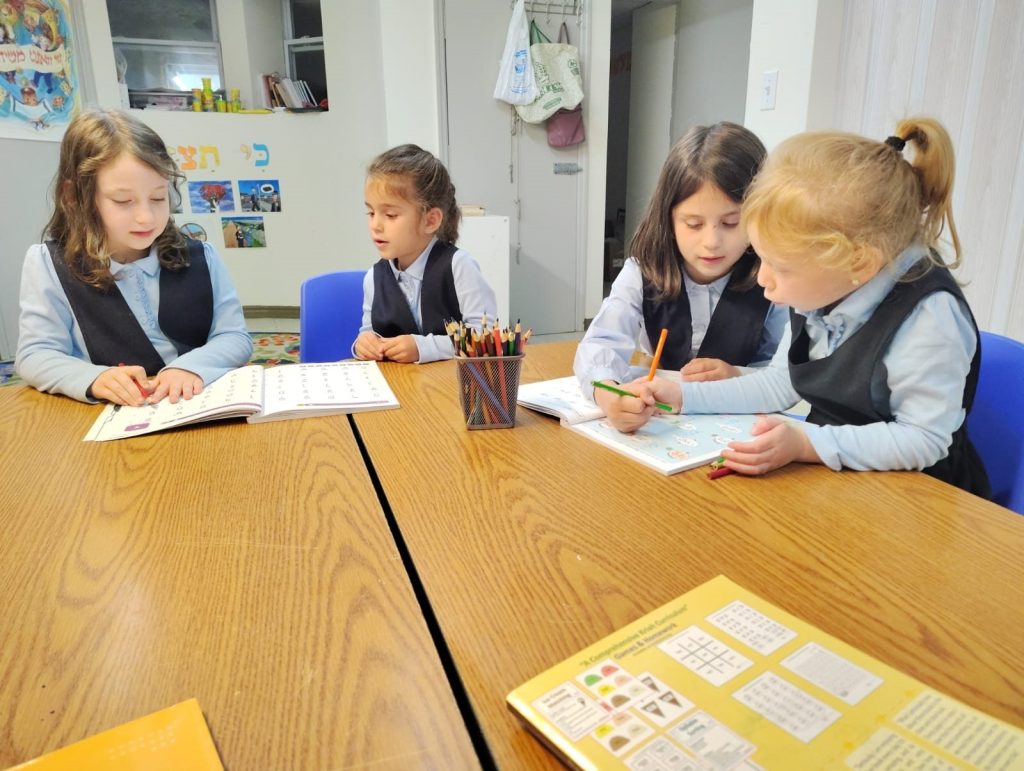
“One practical example is language development. At OYYL, strong emphasis is placed on mastery of Loshon HaKodesh, especially through the CVS Chumash Vocabulary Program. It gives children a deep foundation in shoroshim, shimushim, and sentence structure.
“When the foundation of language is taught properly, with intentional learning strategies, the child develops language skills that will later enable him to pick up English naturally. The skills transfer, because he has learned how language works. Whereas if a child is taught mainly through rote memorization, he may know how to repeat information, but it will be a struggle for him to transfer his skills to learning a second language.
“Yet the matter of chinuch al taharas ha’kodesh goes much deeper,” Mila concludes. “In the formative years, which the Rebbe says continue until Bar Mitzva and even later, the child’s mind is fluid. He is just beginning to process information, and to form his way of thinking, his inner associations, and his subconscious view of reality. We want the wisdom of Torah to be the child’s subconscious guide, the prism through which his mind is shaped. When secular studies, or ideas that are not aligned with Torah, enter the child’s mind during those formative years, they do not remain only as information, they shape how the child views the world. On a subconscious level, he begins absorbing the way the outside world perceives reality, and is influenced by it. But when a child’s foundation has been properly built, through undistracted Torah immersion, it is solid. Later in life, when he needs to learn practical knowledge or a profession for parnassa, he will not be affected. He will illuminate the world as a Yid.”
Mila adds an important chinuch message:
Children are created to learn through real life experiences. They need to touch, build, bake, draw, run, climb, turn the pages of real books, play with friends, help their parents, and create with their own hands. These simple experiences are not just activities; they build the child’s senses, imagination, patience, confidence, and emotional connection.
When children become used to constant screen stimulation, especially from games and fast-moving videos, the brain begins to crave those quick dopamine rewards, and with increasing intensity. This is where dopamine addiction becomes a real concern. Once a child becomes used to instant excitement, the slower, deeper experiences, such as reading, learning, playing creatively, helping at home, or having a real conversation, feel less attractive.
That is why children need a home and classroom environment filled with real experiences: art, music, reading books, cooking, movement, nature, conversation, and meaningful time with parents and friends. Even when screen time is kosher, it cannot replace the slower, richer experiences that enable a child to become grounded and connected. By restricting screen time, we are not depriving children, we are giving them the gift of childhood.
Beis Moshiach #1519 • ח׳ אלול תשפ״ו • pp. 38-42
© 2026 Beis Moshiach Magazine. All rights reserved.
This article originally appeared in Beis Moshiach #1519. You are welcome to share it with friends and family by email or in print, provided that you do not change, add to or omit any part of it, you credit the author and Beis Moshiach, and you include a link to archive.bmoshiach.org (written out in full in printed copies).
To republish this article in a newspaper, magazine, book or website, please request permission in advance at [email protected].