The Parents Who Never Said No
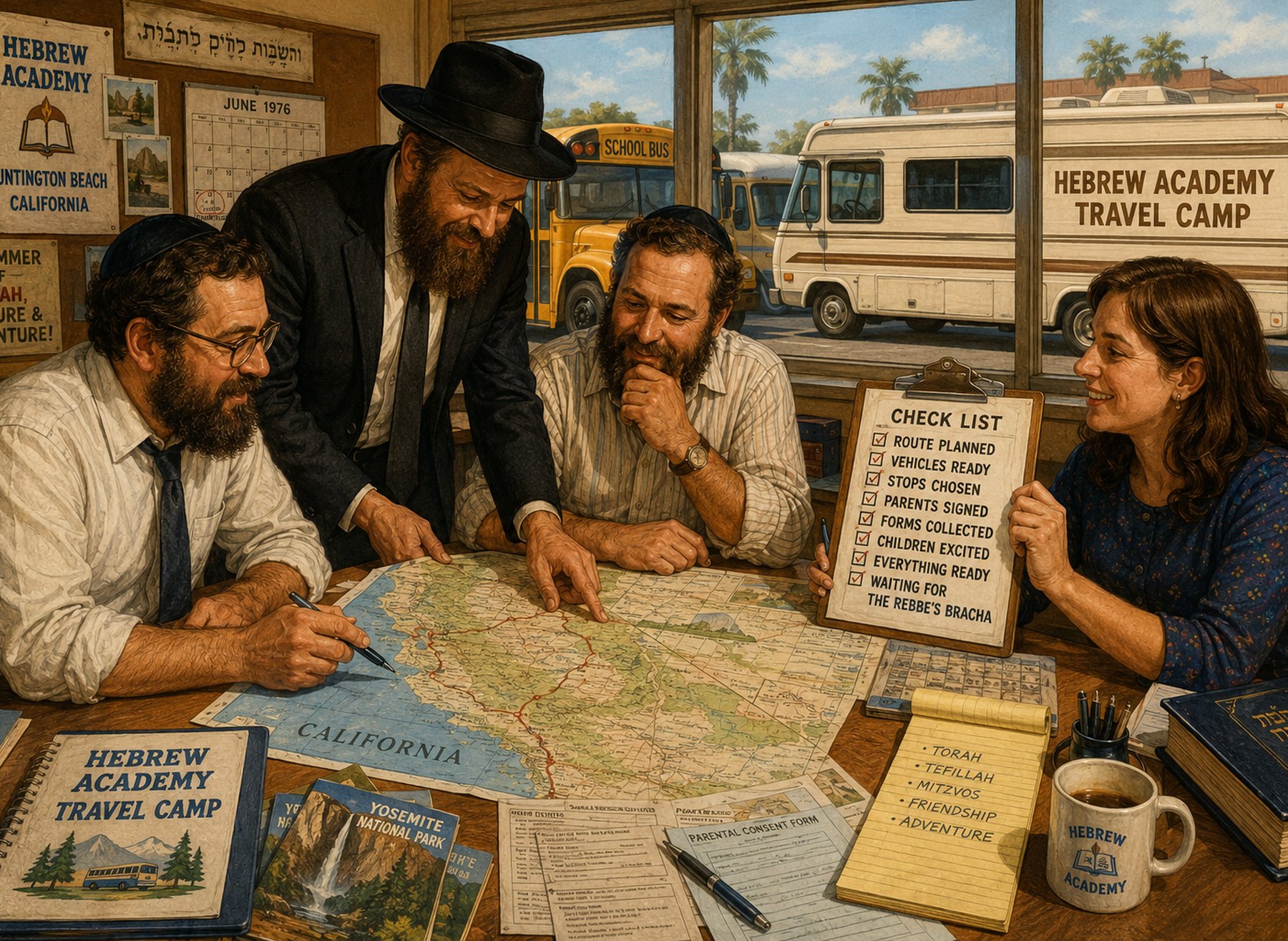
By the beginning of the summer of 5736 (1976), almost everything was ready.
Maps of California were spread across the tables at the Hebrew Academy in Huntington Beach. The route to Yosemite National Park had been planned.
School buses and RVs were being prepared. Beautiful stops had been chosen, parents had signed the forms, and children were already counting the days.
It was going to be the adventure of the summer.
There was only one thing missing.
A bracha from the Rebbe.
Rabbi Yitzchok Newman, a shliach of the Rebbe and the longtime dean of the Hebrew Academy, knew how important that bracha was. The school was doing wonderful work. Many of its students came from Jewish homes where the families were not yet keeping many mitzvos. During the school year, the children learned Torah, celebrated the Yomim Tovim, made brachos, and discovered how special it was to be a Jew.
But summer vacation worried the teachers.
For weeks, the children would be away from their classrooms, their Jewish friends, and the warm Yiddishkeit that surrounded them at school. Would all that inspiration slowly fade?
The school’s leaders held meeting after meeting until they came up with an exciting solution: a Jewish travel camp.
Just a little history over here. For kids nowadays, going to camp has pretty much become standard. Summer camps were still kind of new in the 1970s, and a travel camp was almost unheard of. Instead of sitting in a regular camp all summer, the children would travel through California. They would see mountains, forests, and some of the most beautiful places Hashem created. Along the way, they would continue learning Torah and strengthening their Jewish identity. It would be three beautiful weeks of summer spent traveling through California, all while strengthening their Jewish identity.
The parents loved the idea. The kids were even more excited.
Soon, children were registered, trip locations were secured, and every detail seemed to be falling into place.
Rabbi Newman sent the Rebbe a letter describing the program and asking for a bracha. He was sure it would come quickly.
Then he waited. And waited some more.
No answer came.
He contacted the Rebbe’s office. Another letter was sent, and he was assured that it would be placed near the top of the enormous pile of mail the Rebbe received each day.
More time passed.
Still, there was no answer.
The departure date crept closer.
Everyone knew that if the Rebbe did not respond, there had to be a reason. It was not always clear. It was not always understood. But one thing was certain: there was definitely a calculation behind it. Still, for the people planning this program and putting all that time and effort into it, no response was certainly not the answer they were looking for. It offered no clarity and, if anything, left everyone far more anxious about what was to be.
Each morning, Rabbi Newman probably hoped that this would be the day a response arrived. Each evening, he went home with the same question: Why had the Rebbe not answered?
The children were ready. The vehicles were nearly ready. The parents were expecting the trip to begin.
But Rabbi Newman did not want to move forward without the Rebbe’s guidance and bracha.
Finally, only days before the travel camp was supposed to leave, Rabbi Newman flew across the country to New York. It was around Yud-Beis and Yud-Gimmel Tammuz, a special Chassidic Yom Tov.
“I am going to get guidance directly from the Rebbe,” he said. “We have to understand what is going on.”
He entered 770, Chabad World Headquarters in Crown Heights.
Almost immediately, Rabbi Binyomin Klein, one of the Rebbe’s secretaries, hurried over.
“Rabbi Newman, perfect timing,” he told him. “A response just arrived from the Rebbe.”
Rabbi Newman’s heart must have jumped. At last!
He hurried to see the answer. Perhaps it would be a beautiful bracha for the travel camp. Perhaps the Rebbe would wish the children success on their California adventure.
But when Rabbi Newman read the response, he froze. The Rebbe was not giving his approval for the local travel camp.
The Rebbe wanted the children sent across the country to a fully observant overnight camp on the East Coast—Camp Gan Yisrael.
Rabbi Newman could hardly believe it.
Across the country? New York?
In 1976, flying was far more unusual and expensive than it is today. Sending a group of children thousands of miles away would cost much more than taking them on a California trip. The children would be far from home for weeks.
And there was another problem.
These families had chosen the Hebrew Academy because it offered their children a strong Jewish education without demanding that the parents immediately change their entire way of life.
They had agreed to an exciting travel program nearby. They had not asked for a fully observant overnight camp on the other side of the country.
Camp Gan Yisrael in New York seemed way out of the question and certainly not the type of camp they would send their kids to. He was not even sure if the kids would be interested in going. The whole idea seemed totally crazy, but how would he explain this to the Rebbe? And, of course, how could he think he knew better than the Rebbe?
Rabbi Newman could already imagine the worried questions.
How much will the plane tickets cost?
Who will watch the children so far from home?
What if they are uncomfortable in such a religious environment?
In his mind, the answer was obvious. The parents would never agree.
Rabbi Newman went to Rabbi Chodakov, the Rebbe’s chief secretary, and explained the situation. Rabbi Chodakov suggested that he put all his concerns into another letter to the Rebbe.
So Rabbi Newman sat down and wrote a very long letter with all the details and all the concerns.
He described the cost, the distance, and the kind of families the school served. He explained that the California program had been designed especially for them. He could not understand how he was supposed to persuade these parents to send their children across the country for a fully observant Jewish camp experience, far more intense and serious than they were probably ready for.
He sent the letter in.
This time, the answer came quickly.
It contained only six words:
“Betach lo sha’al af pa’am achas.”
“Certainly, you did not ask them even once.”
Rabbi Newman stared at the words.
The Rebbe was right.
Rabbi Newman had thought about every possible problem. He had heard all the parents’ objections in his imagination. He had already decided what they would say. But not one parent had actually said no. It was all totally in his mind.
He had never asked.
Not even once.
The plane tickets were still expensive. The camp was still far away. The children would still be entering a much more observant environment than their families were used to.
The Rebbe had not made any of those obstacles disappear.
Instead, the Rebbe had removed one obstacle that Rabbi Newman himself had created: his certainty that the answer would be no.
Rabbi Newman returned to California.
Now came the part that frightened him most. He approached the families one by one and told them about the new plan. He explained that their children could fly to the East Coast and spend four weeks in Camp Gan Yisrael, surrounded by Torah, davening, kosher food, Shabbos, and Jewish life from morning until night.
Then he waited for their answer.
The first family agreed.
Rabbi Newman asked another family.
They agreed too.
He went to the next family, and then the next.
Yes.
Yes.
Yes.
Every single family agreed.
The parents deserve to be remembered. They were willing to trust the school, stretch beyond what felt familiar, and give their children an opportunity they had never imagined. Their courage did not look dramatic that day. It looked like signatures, packed suitcases, plane tickets, hugs, and a brave goodbye at the airport.
The parents Rabbi Newman had been so certain would refuse were willing to say yes to something far greater than expected.
That summer, the group boarded a plane and traveled from California to Camp Gan Yisrael on the East Coast.
For four weeks, they lived inside a joyful world of Yiddishkeit. Torah was not only something they studied during school hours. It filled the entire day. It was in the songs they sang, the brachos they made, the friendships they formed, and the special feeling of Shabbos in camp.
Then summer ended.
The children returned home, and life continued. The California travel camp had never taken place.
At the time, their parents probably believed they had simply agreed to one unusual summer experience.
They could not have known how far that one “yes” would travel.
Years passed. The children grew up.
Virtually every child in that group eventually built a fully Jewish life.
One became a shliach of the Rebbe himself in California and spent decades inspiring thousands of Yidden. His children also became shluchim. Rabbi Newman later shared that the family’s work led to hundreds of Jews gathering around Shabbos tables.
Another camper became a respected Torah scholar who knew the entire Gemara by heart. The children of another became scholars and teachers who helped explain and record the teachings of the famous beloved posek Rabbi Moshe Feinstein, one of the greatest Torah authorities of the generation.
Think about it.
Hundreds of people making Kiddush on Friday night.
Children growing up with Torah.
Families serving as the Rebbe’s shluchim.
A lamdan carrying the words of the entire Shas in his mind and heart.
All of it grew from one summer camp experience—a summer that almost never happened because Rabbi Newman had answered a question he had never asked.
The miracle was not that the tickets suddenly became cheap or that California moved closer to New York. The challenges did not disappear. The miracle was that the Rebbe saw what was hidden inside those parents and children—and helped Rabbi Newman see past his certainty that the answer would be no.
Rabbi Newman saw families who might not be ready. The Rebbe saw Yidden with neshamos ready for more—generations of Torah, Shabbos, and mitzvos waiting behind one simple question.
Sometimes we do the same thing.
We are afraid to ask someone for help because we are sure they will say no. We are afraid to apologize because we are sure the other person will not forgive us. We are afraid to invite another Jewish child to do a mitzva because we decide they will not be interested.
The Rebbe teaches us: Do not answer for someone else.
Ask.
Try.
Believe in another Jew.
And believe that Hashem can open doors we do not yet see.
One question can lead to one “yes.”
One “yes” can change a summer.
One summer can change a life.
And one Jewish life filled with Torah and mitzvos can bring light to hundreds of homes—and bring the entire world one step closer to Moshiach.
All because of six unforgettable words:
“Certainly, you did not ask them even once.”
Beis Moshiach #1521 • כ״ב אלול תשפ״ו • pp. 56-59
© 2026 Beis Moshiach Magazine. All rights reserved.
This article originally appeared in Beis Moshiach #1521. You are welcome to share it with friends and family by email or in print, provided that you do not change, add to or omit any part of it, you credit the author and Beis Moshiach, and you include a link to archive.bmoshiach.org (written out in full in printed copies).
To republish this article in a newspaper, magazine, book or website, please request permission in advance at [email protected].