Painting Zaidy’s Dream: Expressions of a Searching Soul
I met Miriam Karp through my Chassidus in Color WhatsApp chat. I was deeply touched by her expressive paintings, which are full of color, movement and soul. She explains, “I try to share intimate moments in Yiddishe life, the love of our holy land, and to make it very real and personal.”
Finding Spirituality in the Place I Least Expected
“I grew up in suburban Detroit,” she begins. “Our family had a strong cultural Judaism, but no spirituality. We celebrated holidays, enjoyed Yiddish humor and food, but there was no mention of Hashem. Faith and religion were viewed as crutches.
“Even as a child I pondered existential questions, and this search dramatically increased as a teen. While spending extensive time in nature I had powerful mystical experiences that convinced me that there was some kind of deeper level of life, a universal consciousness, energy and purpose.
“I was ravenously hungry to discover what this force was and intensely searched in the New Age and hippie counterculture. I attended an alternative liberal arts college within the University of Michigan, but found no satisfying answers.
“After two years I left college to work on an organic farm, seeking that deeper harmony. I then traveled out west, trying out various intentional spiritual communities. I sensed that there was a right way to connect with and serve this universal power, but nothing quite seemed to fit. Feeling stuck, I entered art school to try to express the soul and light that I was driven to uncover. But the right path still eluded me.
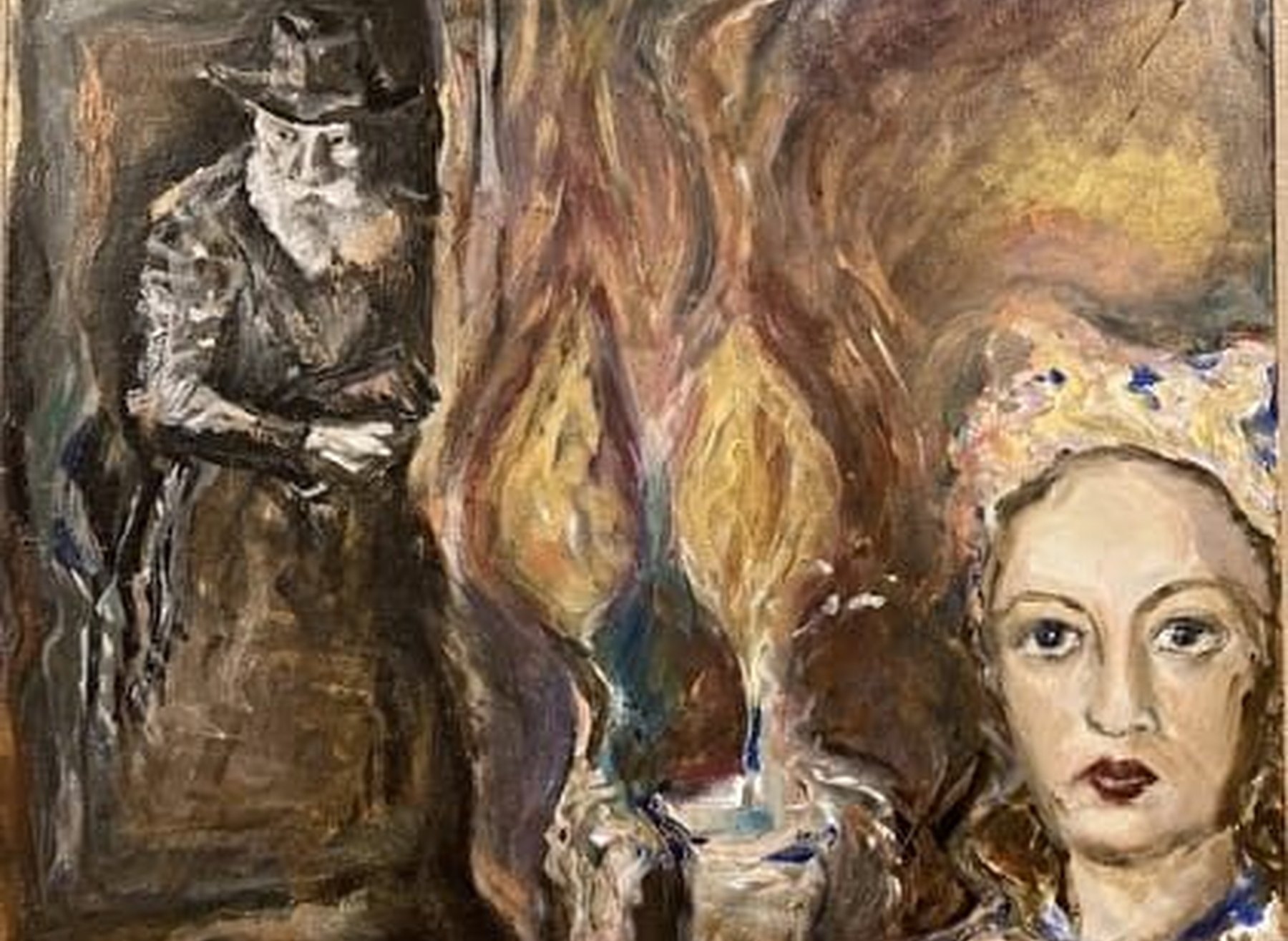
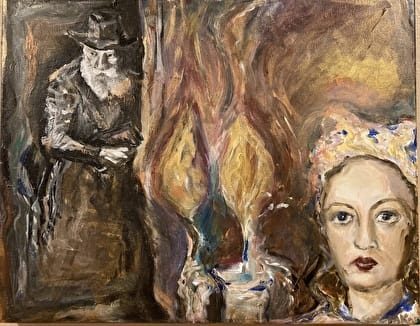
“One night I lit a candle and broke down, crying, ‘I know You are there, I want to be close to You!’ That night I had a powerful dream. My Zaidy was lighting a candle, with a chain of Sages trailing back into the past.
The Dream I Decided to Paint.
“Looking for ideas, I found an illustrated Haggada. The passuk ‘Those that sow in tears will reap with joy,’ grabbed me. I’d thought of being Jewish as guilt-filled and mournful, but this passuk expressed the hidden joy I had also sensed. I copied each Hebrew letter and headed back to the studio.
“When I shared the painting, a recent baalas teshuva in the class realized that I was Jewish. She was not my type, in her neat skirt and stockings, while I was splattering paint in my ripped overalls. She kept nudging me to go to the Chabad House with her on Shabbos. Reluctantly, I finally accepted.
“When we entered the apartment of the shluchim Rabbi Chaim Levi and Bella Goldstein something totally unexpected hit me. I felt a radiance, a kedusha. Startled, I realized that maybe this was actually what I’d been looking for.
“Over the next few months I slowly grew, studying and spending time with Bella and her sister-in-law, shlucha Esther Goldstein, and eventually going to Bais Chana and then Machon Chana. An exciting time of coming home and deeply connecting with Chassidus followed. A year and a half later friends introduced me to my bashert and I married Rabbi Yankel Karp.”
A Balancing Act
“We were excited to build our home, find our shlichus, and share the treasures we were so fortunate to encounter,” Miriam shares. “We’ve been working in chinuch, and here in Cincinnati for 28 years. My husband taught in the day school, and I was teaching preschool and in Hebrew schools.
“Twenty years ago my husband founded his own organization, Jewish Education for Every Person, ‘JEEP,’ that provides personal support to precious Yidden in recovery and facing other challenges.
“I continued to juggle caring for our growing family B’H, teaching and JEEP community work, and my painting. The same underlying intent fueled it all: nurturing neshamos, and expressing and sharing light.
“I also started writing for Chabad Houses, for Chabad.org, and for other publications. When I share my struggles and thoughts, in a down-to-earth and sometimes humorous way, others relate and are strengthened.” I’ve read Miriam’s articles, and found her honesty and authenticity extremely healing.
“I needed to complete a degree for my job, and developed an individualized MA in Creative Jewish Expression, taking a deep dive into writing, painting, and studying Chassidus on creativity,” she continues. “For my thesis I wrote a book, ‘Painting Zaidy’s Dream: memoir of a searching soul.’ I wanted to build a bridge, to share my inner search and offer a window into our unique and sometimes misunderstood world.
‘In recent years I’ve trained to become a chaplain. I listen, hold and share people’s pain and fear, but also try to see, nurture and reflect back the light and power of their neshamas, life stories and resiliency.
“My art is a dance between light and dark, like my work as a chaplain. I squint my eyes and highlight the light, then go back and emphasize the shadows, which makes the light shine more intensely. And mistakes are opportunities to dig and keep going until a newer, deeper image or understanding emerges.
“Walking into a hospital room or a client’s home is similar to facing a blank canvas: overwhelming, unknown, but full of infinite possibilities. When I’m humble and open to the process, not coming with a formula to create an image or support someone with a pre-determined agenda, the magic happens. I can feel the creative power and healing of Hashem flow through me as we create a healing space together in our encounter; and the strokes and colors flow intuitively and take on a life of their own. There are needed skills and techniques in art and effective chaplaincy, but there’s so much more.”
There’s no doubt that Miriam puts her heart and soul into every one of her roles, and I ask her how she does it. She responds openly, “ I really view art as a parable for life. We have to show up, try, trust our deep intuition, and let Hashem guide us. We each have unique gifts, vision and the healing touch that the world needs to bring us to Geula.”
Miriam’s website is Miriamsoulart.com
Beis Moshiach #1522 • pp. 42-43
© 2026 Beis Moshiach Magazine. All rights reserved.
This article originally appeared in Beis Moshiach #1522. You are welcome to share it with friends and family by email or in print, provided that you do not change, add to or omit any part of it, you credit the author and Beis Moshiach, and you include a link to archive.bmoshiach.org (written out in full in printed copies).
To republish this article in a newspaper, magazine, book or website, please request permission in advance at [email protected].