From Vitebsk to Freedom (2)
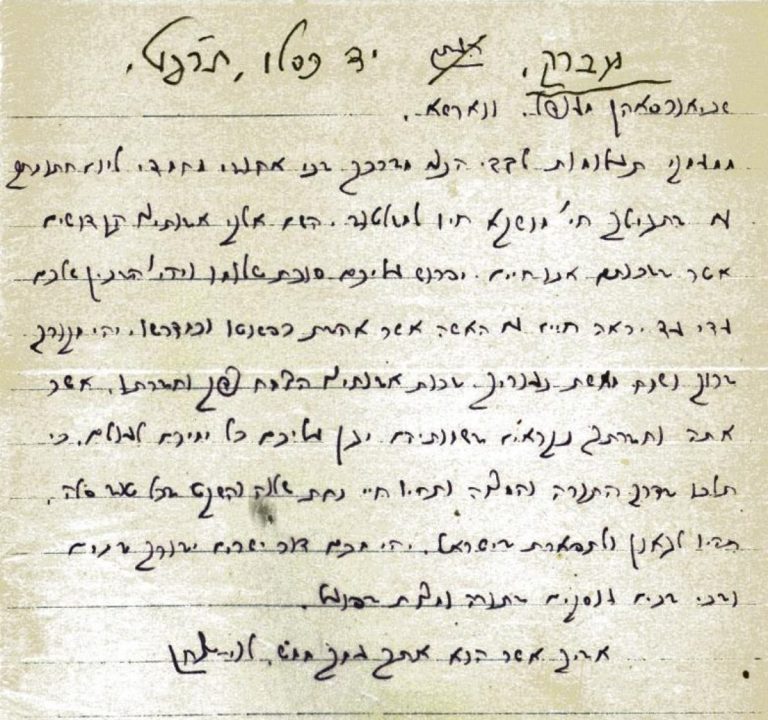
Previously: A dishonest man changed a letter written by the Mitteler Rebbe, making a few thousand rubles look like more than a hundred thousand! Using the forged letter, the Rebbe’s enemies accused him of plotting against the Czar. Government officers searched his home and ordered him to travel from Lubavitch to Vitebsk for questioning. But instead of treating him like a criminal, the officers showed him great respect. As the Rebbe traveled in his own wagon, crowds of Jews and non-Jews came out to greet him. Now the procession had reached Dobromisl, where the Rebbe continued teaching Chassidus as though nothing had happened.
At about three o’clock, the wagons reached Dobromisl. “We will go straight to the main shul,” the Rebbe’s son announced. The Rebbe went into the cheder sheini, the smaller room beside the main room of the shul, and told the Chassidim to daven Mincha, the afternoon tefilla. Afterward, he delivered a maamar, a teaching of Chassidus. It was announced that the journey to Liozna would continue after Shacharis, the morning tefilla, the next day.
Messengers hurried ahead to let the next towns know when to expect him. Early Monday morning, Reb Gavriel Yaakov, a Chassid from Vitebsk, reached Liozna. He found the townspeople and hundreds of visiting Chassidim waiting for the Rebbe.
Reb Gavriel Yaakov told them what had happened. The officers were treating the Rebbe respectfully, allowing him to use his own wagon and letting the Chassidim travel with him. Upon hearing this, the Chassidim from Vitebsk who were waiting in Liozna immediately sent a messenger home. He was to tell the Chassidim there the news and ask them to speak to the minister. Perhaps the Rebbe could stay in a private house, daven with a minyan, and continue teaching Chassidus. A minyan is a group of at least ten Jewish men who daven together.
Then another messenger arrived, looking worried and confused. Everyone feared that something terrible had happened. “The Rebbe is all right,” he explained. But there was troubling news. The accusers had expected the arrest to shame the Rebbe. Instead, the journey was becoming a victory parade! They had gone back to the minister with another complaint.
“The Chassidim must have bribed the officers!” they claimed, accusing them of paying the officers to bend the rules. “They are treating him like a king instead of a prisoner!”
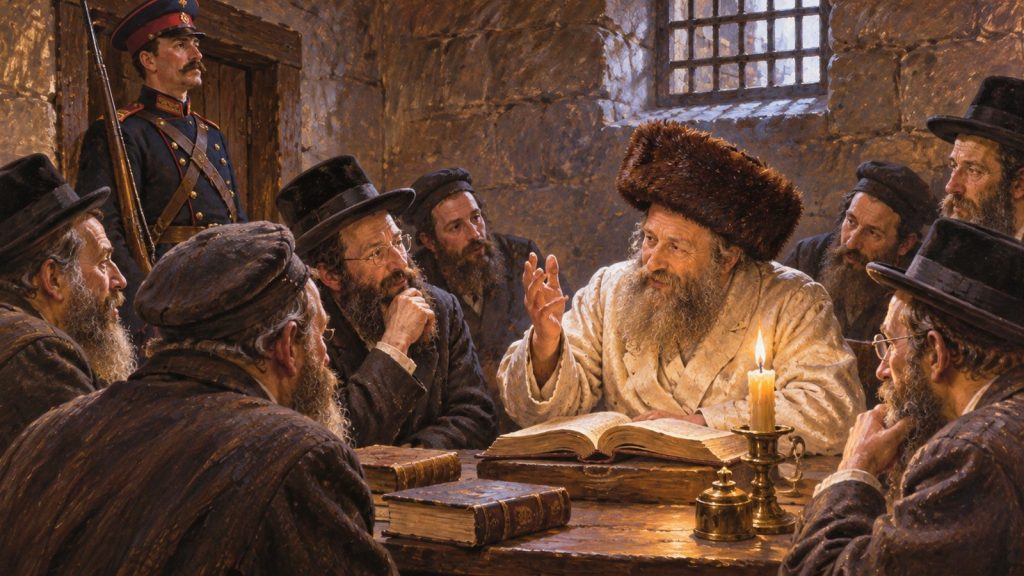
The minister became furious and immediately sent a rider on horseback with a sealed message. The Rebbe was to stay that night with the officers. Only his son and three people of his choice could remain with him. From then on, he would have to travel with the officers in a guarded wagon instead of his own. Anyone else who tried to accompany him to Vitebsk would be harshly punished. There would be no exceptions. He would not be allowed to stay in a private house in Vitebsk, either. He would be put into a general prison cell with other prisoners.
The Chassidim in Liozna were thrown into a panic. Nobody knew what to do or what was happening back in Dobromisl. The Rebbe was supposed to have arrived hours earlier. They waited, but the procession never appeared. Night came, and still there was no sign of him. At four o’clock in the morning, the group from Vitebsk finally gave up waiting, hired a wagon, and returned home.
There they found thousands of people waiting eagerly. Chassidim had come from Horodok, Nevel, Beshenkovitch, Polotzk, and other towns. They had heard that the Rebbe had taught Chassidus along the way and had been greeted with great honor. Thousands lined the road from Liozna to Vitebsk, hoping to join the procession. Their excitement grew as they waited. The men who had just returned could hardly bring themselves to tell them that there would be no great procession after all.
As evening fell and the Rebbe still did not appear, the waiting crowds became frightened. After dark, more travelers arrived and explained what had happened. The Rebbe had been kept in a private house in Liozna under armed guard. Nobody was allowed in or out. That morning, two heavily guarded wagons had slipped into Vitebsk without being noticed. While the crowds were still waiting for the Rebbe to arrive, he was already a prisoner in their city.
At nine o’clock that night, the Chassidim finally heard from someone who had seen him. Dr. Heibenthal, a doctor who was friendly with the minister, had pleaded for better conditions. The minister had agreed to move the Rebbe, his son, and the three chosen Chassidim out of the shared prison cell and into a separate room in the central police station. The doctor had visited them there and given the Rebbe medicine for a fever he had developed on the journey. That was all the news the Chassidim could get.
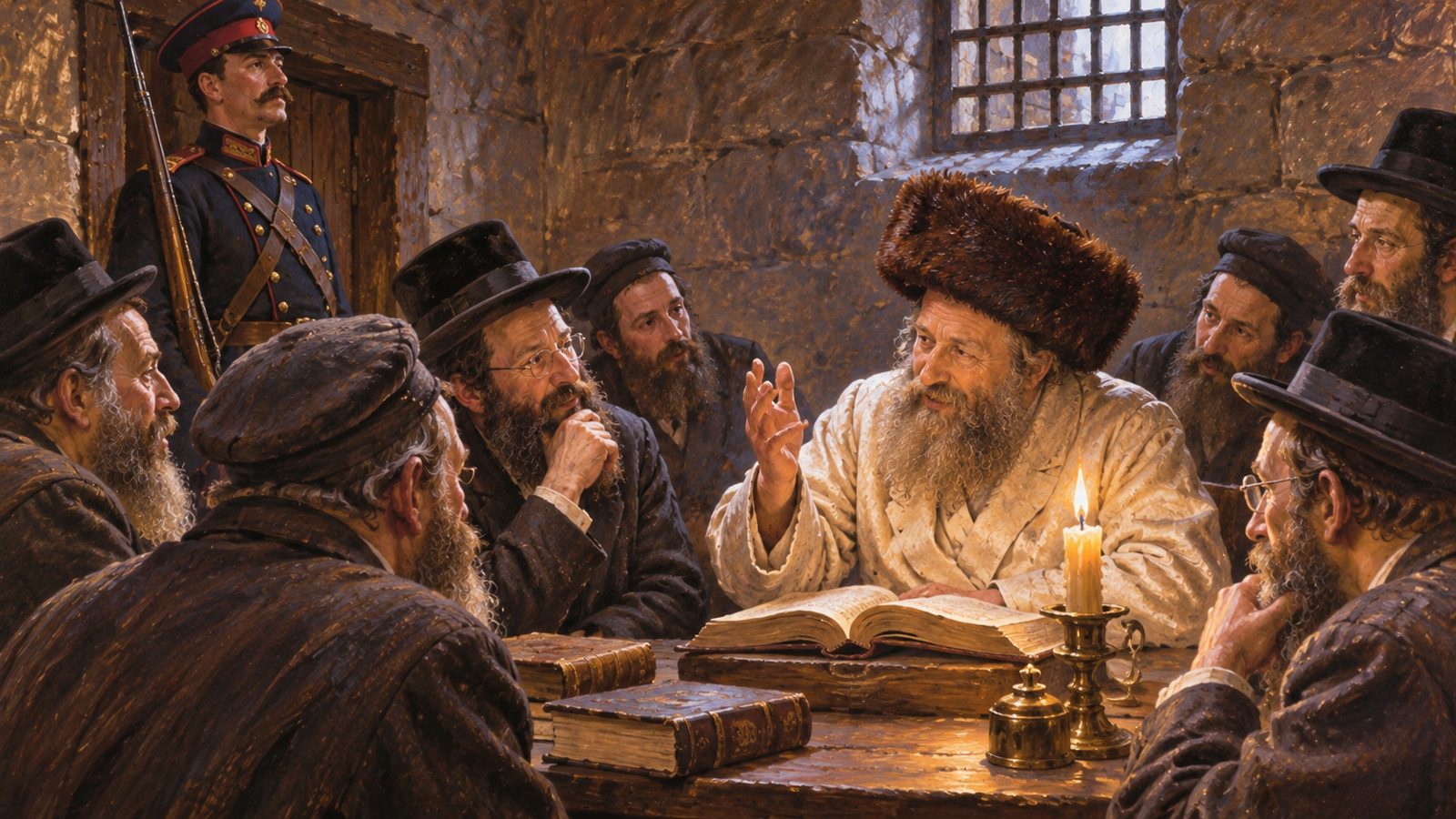
For two long weeks, no further news came from the police. The Chassidim could not visit their Rebbe. Twice a day, food could be brought to the police station. One of the three Chassidim imprisoned with him would come to the door with an armed guard, take the food, and return the dishes from the previous meal. Neither he nor the person delivering the food was allowed to say a word or make a sound.
Imagine standing so close to someone who had just been with the Rebbe and being unable to ask even one question! Was the Rebbe feeling better? Did he need anything? The Chassidim begged Dr. Heibenthal to help again. At first, the case was too sensitive for him to do more.
Then, on Thursday, the sixteenth of Cheshvan, the doctor called together several leading Chassidim. He had good news.
Two days earlier, a gathering had been held at the minister’s home. Among the guests were two princes, Lubamirsky and Tzekret. Both knew the doctor and had heard about the Mitteler Rebbe. The doctor had asked them to speak to the minister about how beloved the Rebbe was among Jews and non-Jews and what a holy, righteous person he was. The princes did so. On Wednesday, they returned to speak about him again.
Their words helped. “The minister will allow twenty people to visit three times a day for davening,” the doctor told the Chassidim. “And twice a week, fifty people will be allowed in to hear Chassidus!” That Thursday morning, the minister had told the doctor that two princes had spoken so well of the Rebbe that he was allowing these visits. He did not even realize that the doctor had arranged for them to speak to him!
On Friday, the office of the interior minister made the official announcement. The Chassidim could visit! Within an hour, they held a raffle to decide who would get the limited places. The first twenty chosen went in for Shacharis. Another twenty came for Mincha, and groups were chosen for Maariv, Kabbalas Shabbos, and Shacharis the next morning. Fifty chosen Chassidim would hear the Rebbe deliver a maamar after Mincha on Shabbos. The Rebbe was still under guard, but they could once again gather around him to daven and learn.
Meanwhile, the investigation continued. The case depended on the papers taken from the Rebbe’s home and the letter to Reb Pinchas Reizes. The minister needed to have the Hebrew papers translated into Russian. The accusers insisted that the Chassidim could not be trusted. They claimed that anyone chosen to translate would be bribed to leave out words that made the Rebbe look guilty. Only a leading opponent of Chassidus from Vitebsk, one of their own group, should be allowed to do it, they said.
The Chassidim were worried. What if the translator added a few words to make innocent records sound suspicious? Baruch Hashem, he translated them honestly. The papers were accounts of tzedaka for poor Chassidim in Eretz Yisrael. Sending this help was perfectly legal, but the Chassidim were still worried that money sent into the Sultan’s lands could be misunderstood.
The altered letter was an even greater problem. There was no way to prove that the kuf had been added. The Rebbe knew the truth, but his accusers insisted that the huge amount was what he had written. It was his word against theirs. How would the minister decide whom to believe?
First, the minister met privately with the Rebbe, who explained where the money had gone. His father had many Chassidim in Eretz Yisrael who were extremely poor. They depended on the money sent from Russia to survive. This was help for needy Jews, not money to pay the Sultan to fight a war.
As for the letter, the Rebbe agreed that he had collected a large amount during his journey to Lubavitch years earlier. But it was nowhere near 104,000 rubles. The extra hundred thousand had been added. The money he had actually collected was meant to help his family.
The minister was greatly impressed by the Rebbe and was beginning to believe him. Before deciding, however, he ordered the Rebbe and his accusers to face each other. He wanted to hear what they would say in one another’s presence.
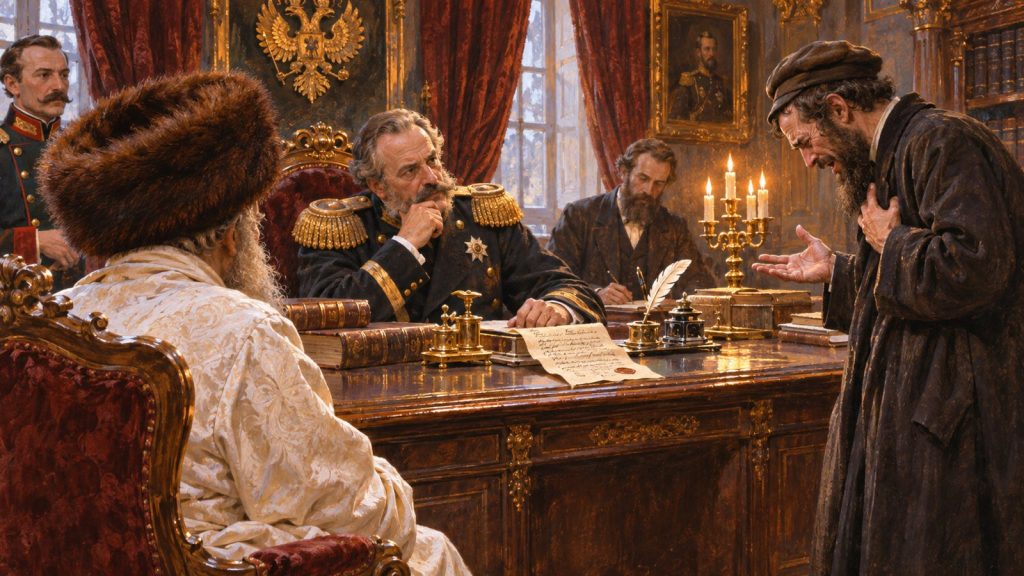
For the meeting, the Rebbe arrived in a royal wagon fit for a king. Dressed entirely in his special white Shabbos clothes, he looked like a malach, an angel. The Chassidim were nervous. Would the minister be angry to see a prisoner arriving with such dignity? As soon as he saw the Rebbe, the minister offered him a chair and spoke to him respectfully.
Then the accuser entered. The Rebbe immediately challenged him. “You made up these accusations because of a personal grudge,” he said. During the discussion, the man slipped. While answering, he addressed the Mitteler Rebbe as “Rebbe.”
The Rebbe turned to the minister. “You see, he accuses me of being a liar and a traitor, yet he still addresses me as ‘Rebbe’ because he knows the truth and the accusations are all lies.”
The accuser became confused. He stumbled over his words, unable to finish a sentence. Finally, the minister told him that he had heard enough. The Rebbe left the meeting victorious and with great honor. Still, the order freeing him had not yet come.
On Shabbos, the ninth of Kislev, the Rebbe was delivering a maamar called “Ata Echad.” Suddenly, he stopped. “Make room,” he said. “Der Tatte is duh!” In Yiddish, these words mean, “My father is here!” He was speaking of the Alter Rebbe, his father, who had passed away years earlier.
The next day was Sunday, Yud Kislev, the tenth of Kislev. The Rebbe sent his daughters to the governor with a letter. When they reached the office, they burst into tears. “Please let our father go home!” they pleaded.
The governor read the letter. Then he told them to calm down. “Your father is going to be released today!” he assured them.
By the time the daughters returned, the guards had already received orders to leave. It is told that the messengers announcing the release arrived just as the Rebbe was saying the words “Pada v’shalom nafshi” in Tehillim. These words mean, “He redeemed my soul in peace.” They appear in chapter 55, part of the Tehillim said on the tenth day of the month.
Now the words were coming true for the Rebbe himself. After all the accusations, worry, and waiting, he was free.
The guards left, and Chassidim hurried in to see their Rebbe. Once again, they could gather freely to hear him teach Chassidus. The Rebbe sat down and delivered a maamar in public. That same day, he left Vitebsk to return to Lubavitch.
One added letter had brought so much trouble. Yet throughout it all, the Rebbe had continued learning and teaching Torah, while the Chassidim kept doing whatever they could to help him. Now Hashem had brought their Rebbe out of imprisonment. On Yud Kislev, they could gather around him freely once more and give thanks for his geulah, his release.
Source: Adapted from “The Arrest and Liberation of the Mitteler Rebbe,” A Chassidisher Derher, Kislev 5779, pages 14-21. The article cites Otzar Sipurei Chabad, volume 5, page 253 onward. Dialogue has been adapted for young readers.
Source details: The article gives both twelve and thirteen years for the time since the move to Lubavitch, so this retelling uses “years earlier.” It describes limited gatherings for Chassidus during imprisonment before referring to the first public maamar in months. This retelling distinguishes the limited gatherings from the free public gathering after release.
The article does not explain its shift from a room in the police station to a “house” at the release, so no move has been added. Government titles follow the article without assuming that each title refers to the same person. “Starasta” is retained as the article’s designation for the village leader, without assuming whether it is a personal name or an official title.
Beis Moshiach #1531 • 10 Kislev 5787 • י׳ כסלו תשפ״ז • pp. 56-59
© 2026 Beis Moshiach Magazine. All rights reserved.
This article originally appeared in Beis Moshiach #1531. You are welcome to share it with friends and family by email or in print, provided that you do not change, add to or omit any part of it, you credit the author and Beis Moshiach, and you include a link to archive.bmoshiach.org (written out in full in printed copies).
To republish this article in a newspaper, magazine, book or website, please request permission in advance at [email protected].