The Kuntres the Rebbe Edited Himself
A Kuntres 50 Years Old That’s Still Relevant And Active
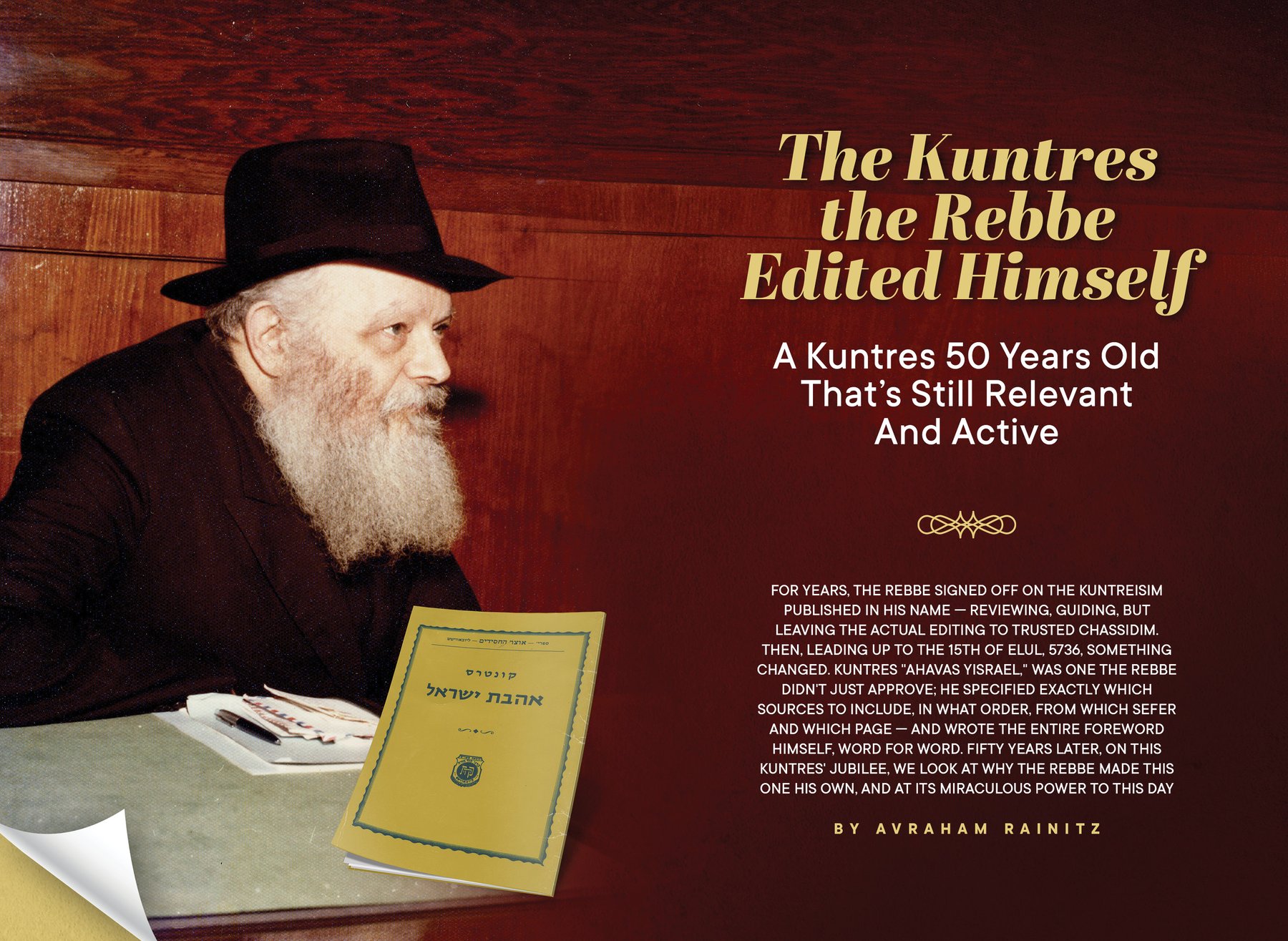
For years, the Rebbe signed off on the kuntreisim published in his name - reviewing, guiding, but leaving the actual editing to trusted Chassidim. Then, leading up to the 15th of Elul, 5736, something changed. Kuntres “Ahavas Yisrael” was one that the Rebbe didn’t just approve; he specified exactly which sources to include, in what order, from which sefer and which page - and wrote the entire foreword himself, word for word. Fifty years later, on this kuntres’ jubilee, we look at why the Rebbe made this one his own, and at its miraculous power to this day.
There are two Chassidim, Rabbi Dovid Nachshon and Rabbi Shmarya Harel, who worked together side by side for over twenty years in the shlichus work of Chabad’s Mitzvah Tanks, spreading Yiddishkeit throughout Eretz Yisrael. One focused on the on-the-ground activity, and the other took care of management and resources. It was a long-standing partnership that bore abundant fruit.
At a certain point, for various reasons that made it difficult to continue their joint work, their paths separated. That step left both of them with a deeper pain than they had expected. Nearly twenty years passed with almost no contact between them. “People who used to be the closest to you and that time passes - it’s very hard,” Rabbi Nachshon would later recount. “We gave our lives to the shlichus, we committed to go all the way together in everything…” Two partners, who had set out on a shared journey rooted in one faith, remained for many long years each in his own world.
Until one year, close to Erev Yom Kippur, Rabbi Harel picked up the phone to call his old friend. “I said I would send him a request for forgiveness, in case I had wronged him.” Rabbi Nachshon’s response surprised him: between two old friends, a generic apology isn’t enough; the matters needed to be clarified and worked through properly. The two met, sat together for many hours, aired what was on their hearts, and found - listening, understanding, and the beginning of renewed closeness.
And at that very time, right after they had taken this step from below (isarusa d’l’sata) - a process was set in motion for them from Above (isarusa d’l’eila):
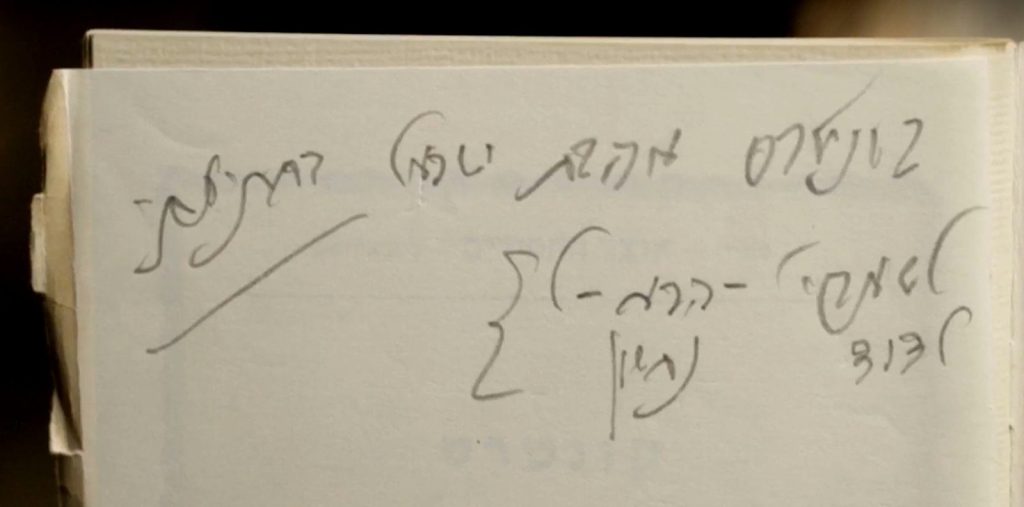
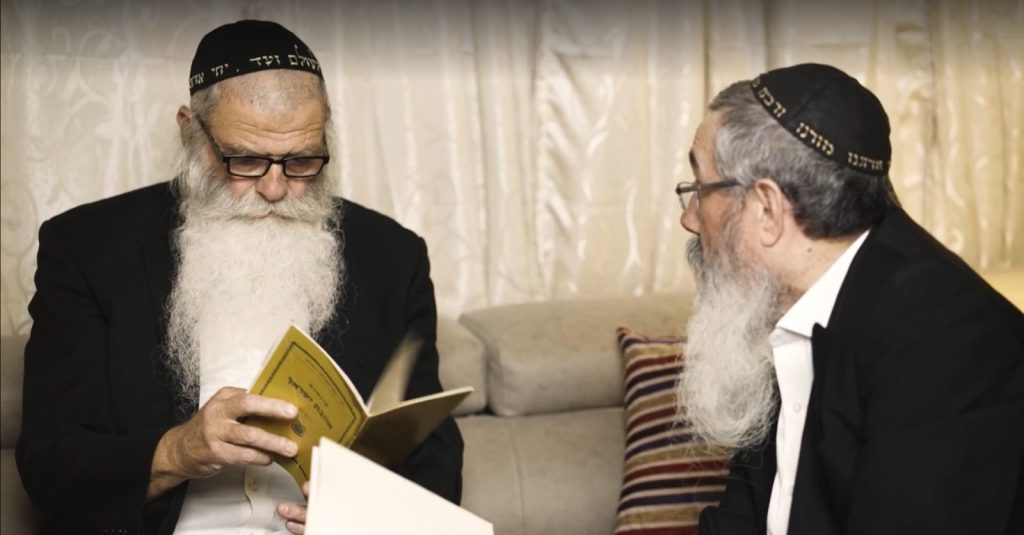
A friend of R’ Nachshon surprised him with a discovery: two original copies of the kuntres “Ahavas Yisrael” were found, together with a note in the holy handwriting of the Rebbe MH’M, reading: “The kuntres Ahavas Yisrael with my signature - for Shmarya Harel, for Dovid Nachshon” - and next to the two names, a line connecting them.
No one knew for how many years the note had been hidden away, or why in practice the kuntreisim never actually reached them at the time. But now, just when the two of them, on their own initiative, had begun to mend the rift - it was revealed that the Rebbe had “taken care of” this matter decades earlier.
“Ahavas Yisrael is no easy undertaking,” says R’ Dovid Nachshon. “You can say nice words, ‘I love you,’ but that doesn’t always obligate you… sometimes you have to break yourself a little, and decide to take the step anyway.” And R’ Shmarya Harel sums it up: “It shows how the Rebbe manages everything even today, truly every single detail.”
Whoever holds this kuntres and leafs through it will be holding a not-very-large kuntres, printed with a modest cover exactly fifty years ago (a yovel), on the 15th of Elul, 5736 (1976). It contains pesukim, maamarei Chazal, and a collection of teachings from the holy Baal Shem Tov down to our Rebbeim, ending with the entry “Ahavas Yisrael” from “Sefer HaArachim - Chabad.” All revolving around one point: the mitzva of “Love your fellow as yourself.”
How did this kuntres come to be? Why specifically then, in Elul 5736, did the Rebbe depart from his usual practice and personally edit this kuntres? And to whom else did the Rebbe give the kuntres with his holy signature? About this, and more, in this article.
The Kuntres the Rebbe Edited Himself
Even before ascending to the position of Nasi, the Rebbe, then the son-in-law of the Rebbe Rayatz, was already directly responsible for editing kuntreisim of Chassidus. As chairman of the “Otzar HaChassidim” editorial board and the Kehot publishing house, he was the one who actually edited, from A to Z, the kuntreisim of sichos and maamarim published under the name of the Rebbe Rayatz, as well as many other sefarim. Every word, every citation, every footnote passed under his holy hands before being published.
When he accepted the nesius, the publishing system naturally changed as well. As the years passed, the Rebbe appointed learned and knowledgeable Chassidim to edit the various sefarim and kuntreisim. Others did the work of preparing for print while the Rebbe would proofread the material, give general guidance on what was appropriate and what was not, and finally sign, in his holy handwriting, the date on the “Foreword” (Pesach Davar).
Until the summer of 5736.
Leading up to the 15th-18th of Elul, something happened that hadn’t happened in many years: the Rebbe did not settle for general guidance, but instructed in remarkable detail and precision exactly which sources to include in the kuntres, in what order, from which sefer and from which page. The Rebbe was personally involved in the very stages of editing. And in the end - he wrote, entirely by himself, from beginning to end, the entire “Foreword” of the kuntres, word for word.
Rabbi Shalom Yaakov Chazan, who today serves as a member of the Otzar HaChassidim editorial board at Kehot Publications and edits Beis Moshiach, and who, just then, was setting out in the world of publishing, related: “In those years, there were two people involved in publishing sefarim on behalf of the Rebbe: Rabbi Aharon Chitrik, who worked on publishing ‘Or HaTorah,’ and the secretary Rabbi Yehuda Leib Groner, who from time to time received an instruction from the Rebbe to publish a certain sefer and worked on it. Usually, he would find a bachur or yungerman suited to it, to help him. Back then, my friend Reb Yitzchok Sassover helped Rabbi Groner with these things, and when he was asked to work on publishing the kuntres ‘Ahavas Yisrael,’ he asked me to join and help. That’s how I merited that this would be the first kuntres, of many afterward, that I was involved in.
“In practice, our role was very technical. Rabbi Groner sent everything to the print shop to be typeset, and we had to proofread the typesetting. At the time we thought that, like with all the kuntreisim, there was general guidance from the Rebbe here too, and Rabbi Groner did the work of compiling and editing.
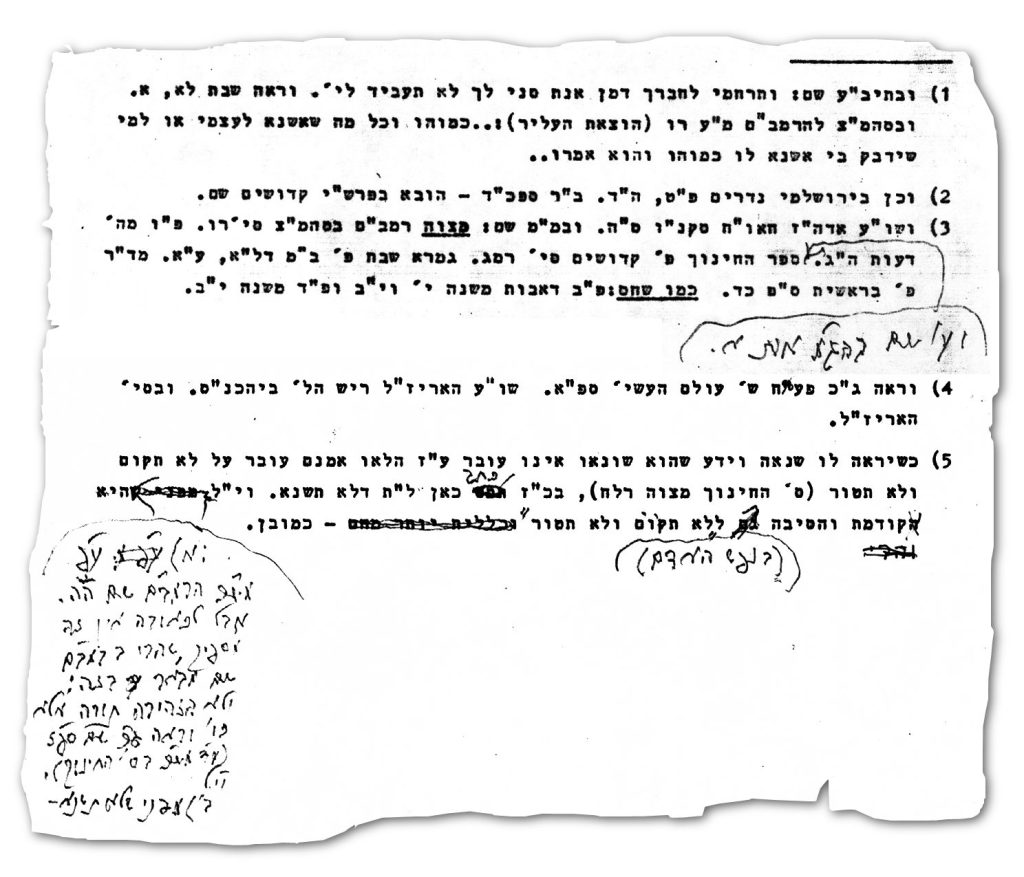
“Only years later did the Rebbe’s manuscripts and markups begin to come to light, and it became clear that the Rebbe had from the outset written the entire plan of the kuntres. In the first stage, Rabbi Groner located the sources and typed them up on an ordinary typewriter. When he brought these pages in to the Rebbe, the Rebbe wrote at the top of the page: ‘The order,’ and further down wrote several instructions regarding the order of editing - for example, that the first five paragraphs should be on a page of their own.
“The Rebbe also instructed that afterward a whole entry about the Baal Shem Tov be added, based on what appears in the biographical Sefer HaToldos of the Baal Shem Tov, edited by Rabbi Glitzenstein. Likewise, the Rebbe instructed that chapter 32 of Tanya be added, including the Tzemach Tzedek’s notes on it, as well as the mitzva of ‘Ahavas Yisrael’ from the Tzemach Tzedek’s own work, Derech Mitzvosecha. As an addition, the Rebbe instructed including his father’s, Rabbi Levi Yitzchok’s, commentary, as well as the notes on Tanya published in Rabbi Korf’s sefer, Likkutei Biurim B’Sefer HaTanya.
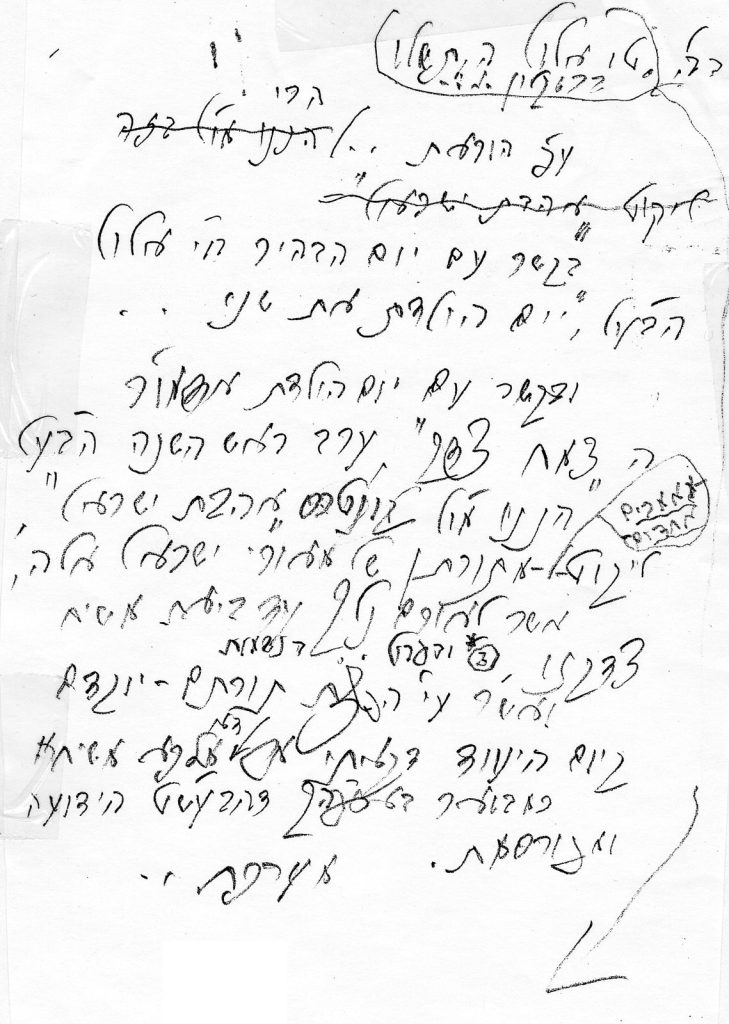
“The Rebbe specified exactly which pages to take the pisgamim from (154–155), and emphasized not to copy the wording of the sayings from there, but specifically from the source in the sichos. And to bring the sayings along with the notes found in the sources. On this the Rebbe added a few more notes in his holy handwriting.
“At the time, Rabbi Groner wanted to note this in the Foreword, and after typing up the entire text the Rebbe had written in his own holy handwriting, he added a line stating that the Rebbe was the one who edited the kuntres, and had also seen fit to add several notes and source references. However, the Rebbe instructed that the fact that he himself had done the editing be omitted, and so the Foreword was written only to say that the Rebbe shlita, saw fit to note several comments and source references found at the bottom of the page.’”
A Campaign Whose End Was Rooted in Its Beginning
Of course we cannot know why the Rebbe chose to invest himself specifically in this particular kuntres, but it can be noted that this kuntres was published leading up to Chai Elul 5736, and at that very Chai Elul farbrengen, the Rebbe announced the last in the series of the Ten Mivtzaim, Mivtza Ahavas Yisrael.
This is how the Rebbe defined the campaign: “Simply put: one must go and proclaim, explain, and act, with each and every Jew - that the passuk, ‘Love your fellow as yourself’ is directed at each and every Jew individually; and the effort in this must be such that the listener also arrives at ‘Love your fellow as yourself,’ by explaining to him that every single Jew is ‘himself, his own flesh’!… And through explaining this out of one’s own ‘Ahavas Yisrael,’ the words will surely take effect. And in the same vein regarding ‘Mivtza Ahavas Yisrael’ - that this campaign encompasses all the [other] campaigns and surpasses them all. As Hillel said: ‘This is the whole Torah, and the rest is commentary.’”
As to the importance of this tenth campaign, the fact that even though it was the last of the Ten Mivtzaim, at every farbrengen and every occasion when the Rebbe urged Anash to act on the Ten Mivtzaim, the Rebbe listed “Mivtza Ahavas Yisrael” first on the list, before all the others, attests to its significance.
Not a Chiddush But a Revelation
Immediately upon the kuntres’ publication, Rabbi Yehoshua Dubrawsky published a comprehensive review in the Chabad women’s worldwide magazine Di Yiddishe Heim. Below is a sample of what he wrote: “Whoever opens the kuntres discovers right away that it does not open with a ‘Torah chadasha.’ It opens with the simplest pasuk there is: ‘Love your fellow as yourself,’ and immediately afterward, the words of Rabbi Akiva: ‘This is a great principle of the Torah.’ And right after that, so there would be no room for any calculation, any ‘maybe I’m still allowed to hate a little’ - the famous statement of Hillel HaZaken is brought, said to that convert who asked to learn the whole Torah while standing on one foot: ‘That which is hateful to you, do not do to your fellow - that is the whole Torah, and the rest is commentary; go and learn it.’
“This is the point the kuntrus seeks to clarify, and to which the teachings of Chassidus add an entire layer of depth: the tremendous greatness of Ahavas Yisrael was already proclaimed by Hillel HaZaken and Rabbi Akiva, even before Chassidus was born. What the teachings of Chassidus add is the answer to the question: why? In what way exactly is Ahavas Yisrael ‘a great principle of the Torah’? How is it, in fact, ‘a great foundation in the service of Hashem’ (in the words of the Tzemach Tzedek in his Derech Mitzvosecha)?
“The answer, as brought in the kuntres from the Tanya and from the writings of the Tzemach Tzedek, is both simple and profound: the souls of all Jews are united at their source. ‘We all have one Father’ - not merely in a figurative sense, but literally; the souls are bound to one another at their root, and it is only the bodies that separate us. Someone who sees his body as his true ‘self,’ and regards the soul as merely secondary, can never truly love another Jew, because everyone looks out first for his own body. But someone who knows that the soul is what’s essential can love wholeheartedly, because spiritually we are truly one.
“The Tzemach Tzedek compares this to a single whole body, made up of many organs, all of which are nourished by the very same bloodstream. When one organ hurts, the whole body feels it. In this way, and even more so, the souls of the Jewish people are united: the physical body conceals this fact, but on the level of spiritual chayus, one G-dly life-force flows through all. This is the reason we are required to accept upon ourselves the mitzva of Ahavas Yisrael specifically before tefilla because one cannot truly accept the unity of G-d in the recitation of Shema, unless the soul is whole and its wholeness depends on our being truly ‘one people.’
“And there is also another point, human and simple: ‘That which is hateful to you, do not do to your fellow’ is also explained this way: the thing a person hates most is having his flaws exposed. And just as a person’s self-love covers over his own faults in his own eyes, so too his love for his fellow Jew should cover over that person’s shortcomings, even when they are obvious and clear. ‘Love covers all transgressions.’ And just as we ask Hashem to cover over our sins out of His love for us, so must we treat one another.
“All of these,” concludes Rabbi Dubrawsky’s column, “are but ‘drops from the sea’ of the meanings of Ahavas Yisrael, which one can go on and on drawing from the kuntres.”
A Kuntres Bearing the Rebbe’s Handwritten Signature
Several months passed, and on Shabbos Parshas Vayeishev, Yud-Tes Kislev 5737, the day of liberation of the Alter Rebbe, the Rebbe announced the revival of an old custom “from the days of the Alter Rebbe”: that in every place there should be a mashpia - and a female mashpiah for women and girls.
The Rebbe did not content himself with a general call. In places where mashpiim had already been appointed, he asked that they carry out their work properly and with zerizus. In places where none had yet been appointed, he called upon them not to delay. He emphasized that one who is privileged to be a mashpia is privileged with the “merit of the public,” a merit greater than any other - “He is worthy and makes the public worthy.”
But something was still missing. What, in fact, makes someone a worthy mashpia? One can know halacha, one can know niggun, one can know how to explain a sugya, but what makes a person someone whom another can trust, open up to, and before whom reveal the “ailments of the heart” - that is something entirely different.
The answer came about three months later, on the eve of Chof-Ches Adar 5737. In a special sicha, the Rebbe connected the two ends with just a few words: Since the foundation of the entire Torah, its influence and its results, is based upon “You shall love your fellow as yourself,” as the Alter Rebbe explains in Chapter 32 of Tanya, it is therefore understood that the mashpiim and mashpios must be permeated with Ahavas Yisrael to an even greater degree and with even greater intensity, based on a deep knowledge and awareness of this concept.
“And therefore,” the Rebbe declared, “they should print, bli neder, the kuntres Ahavas Yisrael in a special edition for the mashpiim and mashpios.”
Here the Rebbe added something remarkable: “As a practical matter,” the Rebbe said, “those who have already been appointed as mashpiim and mashpios, and have already begun carrying out their responsibilities… will receive the kuntres with my signature on each kuntres.”
And since everything must be properly organized, anyone who had been appointed a mashpia by a group of people (at least three Jews), and particularly anyone who was already properly engaged in the role, was asked to submit his name, address, and the name of the place or people who had appointed him to the secretariat. After the kuntres was printed, it would, bli neder, be sent to him bearing the Rebbe’s signature.
A short time later, the kuntres was printed and the Rebbe personally took care of distributing it to official mashpiim, as well as to those who were involved in influencing others in one way or another (in addition to those who received it through the secretariat or by mail).
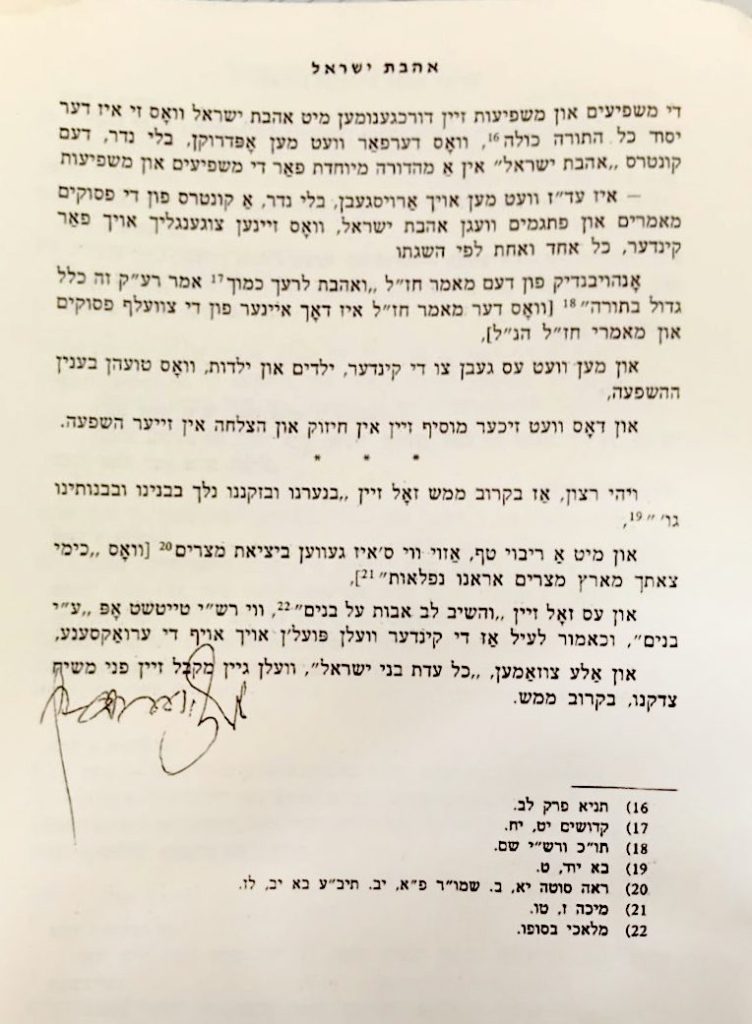
For example, Rabbi Aharon Gold of Kiryat Gat related that he received the kuntres together with a general-personal letter, at the bottom of which was written: “With blessings for success in his appointment as mashpia, and enclosed herewith is a kuntres given to the aforementioned [mashpiim], and for good news.”
In addition to those who received the kuntres by mail, there were those who were privileged to receive it directly from the holy hands of the Rebbe.
Rabbi Yeshayahu Herzl, for example, related in an interview with Beis Moshiach that on Sunday, 8 Teves 5738, he entered the “Gan Eden HaTachton” together with his son for a yechidus. Suddenly, the Rebbe pulled the kuntres Ahavas Yisrael from the siddur from which he had davened Mincha just a few minutes earlier.
“I am giving you the kuntres,” the Rebbe told him in Yiddish, “because you are a mashpia, in addition to being a Rav - mit mayn chasima un mit alle brochos vos iz do dortn” [= “with my signature and with all the blessings that are there”].
A Signature Discovered at the End
The Rebbe generally signed the kuntreisim at the conclusion of the sicha about mashpiim, which had been added to the end of the kuntres in its special edition for mashpiim. In some of the kuntreisim, the Rebbe’s signature can be seen next to the words “mekabel zayn p’nei Moshiach,” even though there is plenty of blank space at the bottom of the page.
The story of the Chassid, Reb Reuven Dunin, is particularly interesting. He received the kuntres from the Rebbe, as a mashpia, just before his flight to Eretz Yisrael. On his way to the airport, he looked for the Rebbe’s handwritten signature on his kuntres, and to his astonishment, he could not find it.
Naturally, this caused him considerable pain. But while he was still on the airplane, he made a Chassidishe hachlata. He realized that this sadness actually stemmed from yeshus and that the purpose of the kuntres was not to boast about possessing the Rebbe’s holy signature, but rather to learn it in order to put its teachings into practice.
He immediately began studying the kuntres carefully, spending a long time going through it page by page. And when he reached the final page, he discovered, to his great excitement, the Rebbe’s holy handwritten signature displayed there, at the very end of the kuntres, precisely where he had not expected to find it.
“This Is for Your Wife”
There was also an unusual story that was not connected to the appointment of mashpiim but has a significance of its own.
Rabbi Moshe Teleshevsky, the Rebbe’s chazzan, was at that time in the midst of producing a new record under the “Nichoach” label, a project that normally required three or four months of work, but this time, for various reasons, had to be completed in just five weeks.
“We worked around the clock on its production,” he would later recall.
After he submitted the record to the Rebbe, he was informed that the Rebbe wanted to see him in “Gan Eden HaTachton.” He waited there, not understanding why he had been called, until the Rebbe emerged from his room carrying a package of kuntres Ahavas Yisrael.
The Rebbe asked how many people had participated in producing the record.
“About seventy people,” he replied.
The Rebbe began distributing a kuntres to each member of the choir and orchestra. But when he handed Rabbi Teleshevsky the first kuntres, he said to his surprise: “This is for your wife.”
R’ Teleshevsky says that only afterward did he understand the depth of the gesture. The Rebbe, who of course knew that a husband who had spent five weeks immersed day and night in producing the record had not been very available at home, found a way to express, without saying another word, his appreciation to the wife.
It was a private, personal gesture of consideration, delivered wrapped in a kuntres devoted entirely to love of one’s fellow.
Provisions for the Journey of Shlichus
The kuntres intended for mashpiim - mature people with experience, who had already established a name and position in their communities - unexpectedly also found its way into the hands of the youngest people imaginable.
On Tuesday, the 17th of Teves 5738, the talmidim-shluchim to Yeshivas “Ohr Elchonon-Chabad” in Los Angeles waited for the Rebbe in the “Gan Eden HaTachton” after Mincha, together with the Rosh Yeshiva, Rabbi Ezra Binyomin Schochet.
The Rebbe entered his room and then emerged carrying several copies of kuntres Ahavas Yisrael and a package of dollars. He gave it to them, saying: “All of you need to be mashpiim.”
Similarly, on Rosh Chodesh Iyar 5738, at the conclusion of a yechidus in the “Gan Eden HaTachton” with the student-shluchim to the yeshiva in Migdal HaEmek, the Rebbe told them:
“To connect this immediately with a special practical matter: Since each one of you needs to be a mashpia, I will give each of you a kuntres Ahavas Yisrael, which was printed especially for the mashpiim, and which I signed at the end of the kuntres. You should utilize this with joy and gladness of heart, in a manner of continually increasing and adding light.”
The young shluchim who left that same year for Australia likewise heard the same message from the Rebbe in his words of blessing and farewell:
“Since all matters are based upon Ahavas Yisrael… therefore I will give each of you a kuntres Ahavas Yisrael, which is given to the mashpiim, since your task is both to learn for yourselves and to teach others.”
In each of these distributions, the same point recurs: The Rebbe made no distinction between an older rabbi, a busy chazzan, and a twenty-year-old yeshiva bachur leaving home for the first time.
In the Rebbe’s eyes, they were all being sent on precisely the same mission, to reveal love to a Jew whom they did not yet know. And every one of them, without exception, received exactly the same tool for the journey: a small kuntres about Ahavas Yisrael.
The Edition Intended for a Prime Minister
One of the most historic visits by a senior Israeli figure to the Rebbe’s room was the visit of Israeli Prime Minister Menachem Begin in the summer of 5737 (1977). The preparations for the visit were extensive - most of them behind the scenes - and one fascinating detail received almost no publicity.
A few days before the highly publicized visit, Rabbi Zalman Chanin, director of the “Vaad L’Hafotzas Sichos,” received an urgent phone call from the Rebbe’s secretary, Rabbi Yehuda Leib Groner. The Rebbe had instructed him to print approximately 30–50 copies of the kuntres Ahavas Yisrael in a special, elegant edition.
The Rebbe gave precise instructions, including several Russian terms that Rabbi Groner did not know and therefore needed Rabbi Chanin’s help to understand: “The name of the kuntres, ‘Ahavas Yisrael,’ should be printed on special, beautiful paper, with a dignified velvet cover. The color should be dark blue or a somewhat lighter blue; it does not matter but on thicker paper, so that it will be apparent that this is a cover. The letters on the cover should be embossed in gold, as in ordinary books with hard covers. And on the spine, a decorative cord with a fringed tassel at the end, to enhance the external appearance.”
Rabbi Chanin went out to find the materials. He approached R’ Rafael Gross of the Gross Brothers printing house, who took him to one of the major paper merchants. He returned to 770 with samples, which were presented to the Rebbe. The Rebbe himself selected the type of paper for the pages of the kuntres and the type of paper for the binding.
Only then did the Rebbe reveal the reason to Rabbi Groner: the kuntres was being prepared in honor of Mr. Menachem Begin’s visit, and the cover would read:
“Special Edition - 2 Menachem Av 5737.”
Normally, such a small quantity would have been printed on a simple photocopy machine. But because the Rebbe wanted a regal appearance, Rabbi Chanin persuaded the printer to use high-quality printing presses.
The kuntres was produced, in his words, “very mechubad.” When it was brought to 770 and presented to the Rebbe, he was very pleased and remarked, “Zeyer shein!” [= “Very beautiful!”]
He even gave Rabbi Chanin one copy, saying: “Dos iz schar tircha” [= “This is for your efforts.”]
Exactly what happened afterward remains shrouded in mystery to this day.
Rabbi Chanin himself, who was not present in the room during the visit, does not know for certain whether the elegant kuntreisim were actually distributed to Begin and his entourage.
Over the years, however, it was reported that on the Friday of that same week, the Rebbe sent a delegation of Chassidim - Rabbi Chodakov, Rabbi Shlomo Aharon Kazarnovsky, and Rabbi Binyamin Gorodetsky - to visit Begin at his hotel.
Before leaving, they briefly entered the Rebbe’s room, and when they came out, Rabbi Chodakov was holding a box.
After Shabbos began, between Mincha and Kabbolas Shabbos, the members of the delegation again entered the Rebbe’s room and each received a kuntres Ahavas Yisrael from him.
According to the account, the box Rabbi Chodakov had been holding contained kuntreisim from that special edition intended for the Prime Minister and his associates.
The Rebbe’s Pain at the Lack of Response from the Mashpiim
Years passed. The signed kuntres continued to be given from time to time to another mashpia. But apparently the Rebbe had expected a much greater response and when that failed to materialize, he expressed his pain at a Shabbos farbrengen, Parshas Bo, 5743:
“When, several years ago, there was discussion about appointing mashpiim in every place,” the Rebbe said, “I wanted to add encouragement and urgency to this matter, and therefore… I announced that I would sign these kuntreisim with my own signature and give them to each and every one of the mashpiim. And from then until today, except for ‘a select few,’ no one has asked to receive this kuntres together with my signature!”
The Rebbe did not merely note the fact; he pointed to the paradox:
“When it concerns a letter bearing my signature in connection with the birth of a son or daughter, then they ‘make a great commotion’: How is it possible that they still have not received a letter of blessing bearing my signature? Yet regarding this matter, when I myself offered to give the aforementioned kuntres with my signature, except for ‘a select few,’ no one asked!”
The Rebbe quickly found a favorable explanation: Perhaps each person knew in his heart how difficult it was for him to genuinely commit himself to the work of influencing others, and therefore refrained from requesting a kuntres that would obligate him.
But behind that limud zechus (charitable interpretation), one could hear the pain in the Rebbe’s words: The most precious thing a Chassid could have asked for, the Rebbe’s handwritten signature on a kuntres about Ahavas Yisrael, was hardly being requested at all.
Another six years passed. Perhaps in the spirit of the Rebbe’s repeated teaching that, in truth, every Jew is a shliach of Hashem to influence the world, the Rebbe surprised the Chassidic community.
On the night following the auspicious day of 11 Nissan 5749, the Rebbe’s 87th birthday, without any prior announcement, the Rebbe began personally distributing to all the Chassidim a copy of the kuntres Ahavas Yisrael with a yellow cover, from the printing that had remained since 5737, but without the Rebbe’s handwritten signature, together with a dollar for tzedaka.
Even those responsible for the publication were surprised. Within a short time, the entire supply of bound kuntreisim at the location was exhausted.
They hurriedly brought another box of kuntreisim that had not yet been bound. When those too ran out, the Rebbe continued standing and giving each person three dollar bills for tzedaka.
If in 5737 a person required an official appointment by three Jews in order to merit receiving the kuntres, then in 5749 the Rebbe effectively made every Jew standing there a mashpia.
There were no longer any exemptions. The responsibility to love every Jew and influence him or her for the good rests equally upon each and every one of us.
Ahavas Yisrael - Toward the Geula
It is impossible to conclude an article about Ahavas Yisrael without addressing its clear and evident connection to the Rebbe’s work of preparing the world to greet Moshiach Tzidkeinu.
Already in the very first sicha in which the Rebbe accepted the leadership of Chabad, he established:
“When there is Ahavas Yisrael, ultimately one reaches love of Torah and love of Hashem… and through this, the Geula will also come.”
As mentioned, ever since the Rebbe announced the Mivtza Ahavas Yisrael campaign, he placed it at the top of the list of the Ten Mivtzaim.
But beginning in the summer of 5751, the Rebbe revealed a new dimension of the mitzva of Ahavas Yisrael.
The Rebbe said that after nearly two thousand years of exile, during which we have worked to rectify the baseless hatred that destroyed the Beis HaMikdash, the matter has already been rectified.
From this point onward, Ahavas Yisrael rises to a much higher level. In the Rebbe’s words:
“The emphasis on Ahavas Yisrael is as a taste of, and even an introduction to, the true and complete Geula, which is connected with the point of unity that transcends division… by virtue of the yechida aspect that exists equally within every Jew, which is a spark of the soul of Moshiach, the general yechida.”
And finally, a call to the menahalim of mosdos:
This yovel should be an opportunity to introduce the kuntres Ahavas Yisrael into regular study in yeshivos and schools, as Rabbi Chodakov, the Rebbe’s secretary, once said in a telephone conversation in which he conveyed the Rebbe’s instructions to Rabbi Ephraim Wolf:
“Kuntres Ahavas Yisrael should not merely be left on the shelf; it should be studied and practiced.”
Certainly, it would be worthwhile, if only in honor of this yovel, to consider ways of making its profound content accessible, in language and formats appropriate for every age group, so that even the youngest students can absorb this foundational principle of the teachings of our Rebbeim from an early age and grow up with it.
This yovel, the 15th of Elul 5786 (2026), is the obvious opportunity: to open the kuntrus once again, learn it, and become - each person in his or her own place and according to his or her own level - that mashpia whom the Rebbe asked each and every one of us to be, until the full hisgalus of the Rebbe, Melech HaMoshiach, teikef u’miyad mamosh.
Beis Moshiach #1525 • כ״ח תשרי תשפ״ז • pp. 22-33
© 2026 Beis Moshiach Magazine. All rights reserved.
This article originally appeared in Beis Moshiach #1525. You are welcome to share it with friends and family by email or in print, provided that you do not change, add to or omit any part of it, you credit the author and Beis Moshiach, and you include a link to archive.bmoshiach.org (written out in full in printed copies).
To republish this article in a newspaper, magazine, book or website, please request permission in advance at [email protected].