Generating Geula, One Gem at a Time
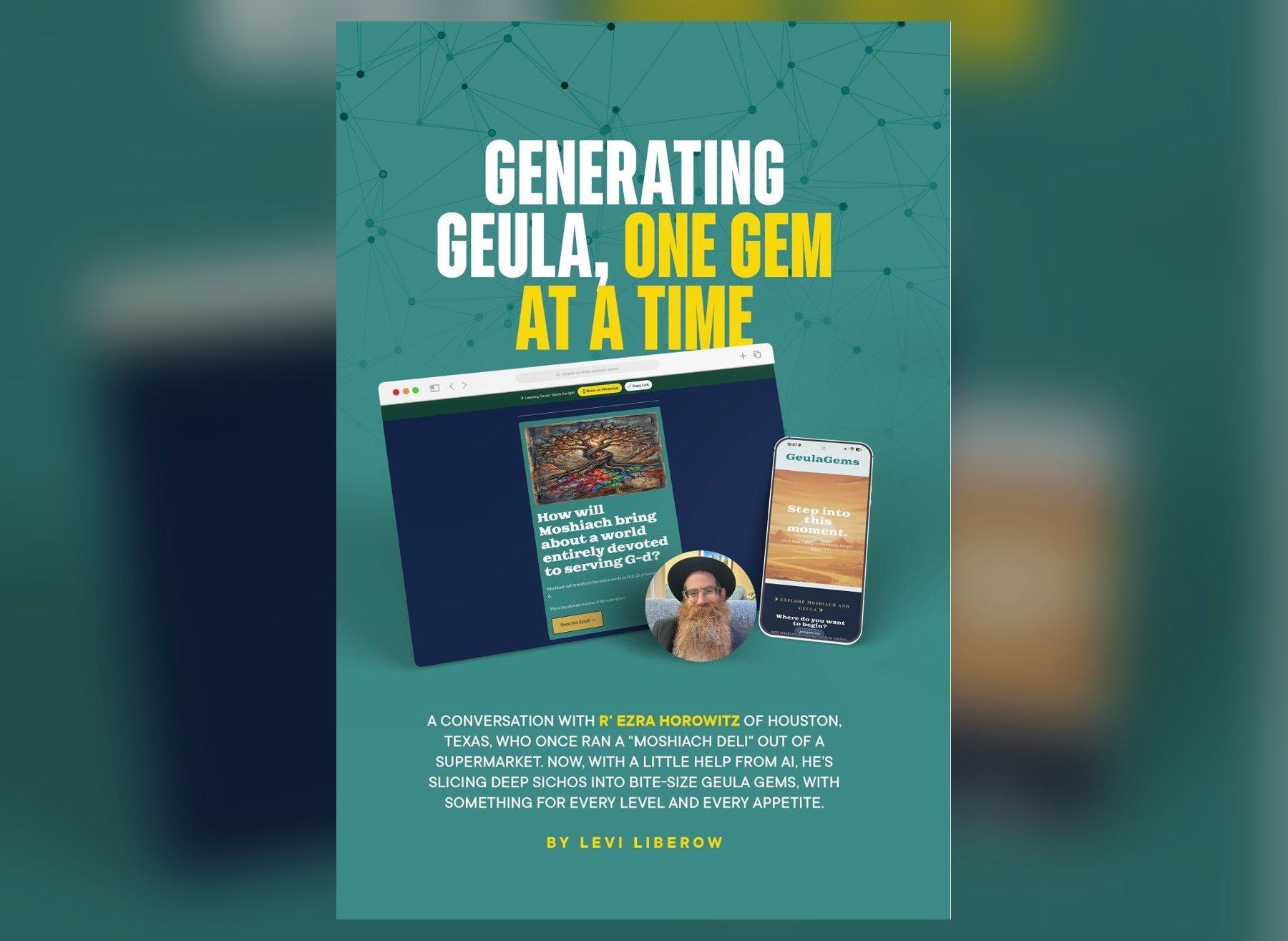
A conversation with R’ Ezra Horowitz of Houston, Texas, who once ran a “Moshiach deli” out of a supermarket. Now, with a little help from AI, he’s slicing deep sichos into bite-size Geula Gems, with something for every level and every appetite.
The customers at the kosher deli counter inside the Houston supermarket came for sandwiches and cold cuts. Some of them walked away with something else: a short idea about Geula, shared by the young man behind the counter, who had quietly decided to turn his workplace into what he called a “Moshiach deli.”
Today that same young man, Reb Ezra Horowitz, is building GeulaGems.org, a website designed to make inyanei Geula u’Moshiach accessible in a short, clear and interactive format, with different levels for people coming from very different backgrounds. For many people, these are subjects they’ve heard about far more than they’ve actually learned. GeulaGems is built for the person who simply wants to open the Rebbe’s sichos, understand what Geula means, and begin living with it.
In this conversation, Horowitz discusses his own gradual journey into the subject, how GeulaGems developed, and what he believes it actually means to “live with Moshiach” in everyday life.
Finding My Way In
Levi Liberow: Tell us a little bit about your background and how you came to Chabad.
Ezra Horowitz: I grew up in Irvine, California. My father had become close to Chabad, so I grew up around a Chabad House, but personally I wasn’t very interested in Yiddishkeit. Even though Chabad was around me, I really didn’t know much about the Rebbe or about Chabad itself.
I had some camp counselors growing up who gave me my first real taste of Chabad. Then, after my father remarried, my stepmother pushed me to go to yeshiva, and before tenth grade I went to yeshiva in Los Angeles.
I came in without much of a background in learning, and I started learning sichos with the shluchim there. At first I would actually write down the Yiddish as we went along. By the next year, I was already learning sichos myself and teaching them to others. Then I started learning Tanya and Chassidus more seriously, and that was really what got me excited about Chabad. What really pulled me in was simply learning Chassidus.
At that point, though, I didn’t have any particular koch (Yiddish for passion) in inyanei Geulah u’Moshiach. There were shiurim in yeshiva and I went to them, and over the summers I worked as a counselor and learning teacher in camps with a strong emphasis on Moshiach. So I was definitely exposed to it, and I appreciated the passion, but I wasn’t yet fully at home in the subject.
The question I wrestled with most was the Rebbe being Moshiach. Within Chabad there are sincere differences on this matter: how central it should be when teaching the subject, and how openly it should be expressed. I had grown up mostly among people who were more reserved about it, so it wasn’t something I was used to. It wasn’t a theological objection. I simply hadn’t found my own way in yet.
My real koch came much later, when I was invited to a shiur given by Rabbi Zvi Homnick. What struck me was who was in the room. There were people with Yechi yarmulkes, and there were plenty of people without them. It was a real mix, and everyone was there for the same reason: they genuinely wanted to learn the subject. Rabbi Homnick was simply learning the sicha seriously and showing how the ideas the Rebbe was speaking about were real and relevant to a person’s life. That had a big effect on me. It showed me that inyanei Geula u’Moshiach belong to anyone willing to open a sicha, learn what the Rebbe is saying, and try to understand what it actually means.
From a Deli Counter to a Website
LL: So how did that eventually turn into something you wanted to share with others?
EH: At the time I was already married, baruch Hashem, and raising a family. I was working in a kosher deli inside a regular supermarket in Houston. At a certain point I decided, almost as an experiment, to turn it into what I called a “Moshiach deli.” People would come in, and while working I would speak to them about different ideas of Geula and Moshiach. I really enjoyed it.
Later, my job changed and I had more free time, and I came across the Greeting Moshiach podcast by Levi Polachenko and Simcha Fish. I started listening, and the more I listened and learned, the more the whole subject became real to me. The difficulty was that I was living in a place where there wasn’t really an environment around me where I could express all of this. I had this growing koch in Geula and Moshiach, but not necessarily a place to put it.
Then, after Rabbi Tzvi Kogan, hy’d, the shliach in the United Arab Emirates, was murdered, there were all sorts of initiatives being done l’ilui nishmaso, and I felt there should also be something specifically connected to inyanei Geulah u’Moshiach in his memory. So I started a WhatsApp channel called GeulaGems, where I would share short ideas. It stayed fairly small, but people were enjoying the material.
Sometime afterward, my mashpia suggested that I open a website where I could put up my Torah thoughts. I already had all this material from the GeulaGems channel, so I began putting it online. At first it was really just a simple website.
Then I went to a course on AI, and that changed the whole project. I’m not a computer person, and suddenly I had the ability to do things with the website that I never would have been able to do on my own. That was really when GeulaGems.org began developing into something much bigger.
Meeting People Where They Are
LL: What does GeulaGems.org offer that isn’t already out there?
EH: One thing I wanted was for the material to be short. There is a lot written on Geula and Moshiach, but much of it is very long. I wanted to be able to take deep ideas and present them in a short, clear way, so that someone could learn something real without having to sit down to a long article every time.
I also wanted the site to be interactive. There are quizzes, and the idea is that a person shouldn’t just read something and move on. He should actually be engaging with what he is learning.
And another major point is that I want people at very different levels to feel comfortable using the site. The Rebbe asked that everyone learn inyanei Geulah u’Moshiach. If someone isn’t comfortable starting with the question of the Rebbe being Moshiach, he shouldn’t lose out on the learning itself. The door should be open wherever a person is holding.
So I’m building the site in different levels. Someone can start with very basic material, without even needing to know the Hebrew terminology. The next level introduces the Hebrew terms with explanations, and from there it can move into more advanced material.
The idea is that someone should be able to come onto the site wherever he is holding and move forward from there. It shouldn’t just be a collection of articles. It should be a journey through the subjects of Geula and Moshiach.
LL: Some readers might get the impression from what we’ve discussed so far that the Rebbe’s identity as Moshiach is central to the whole subject. How do you explain that?
EH: The Rebbe’s message is that everything is done and Moshiach is ready. So naturally, the focus is on Moshiach himself. That’s a big deal in Yiddishkeit: we don’t only believe in a redemption, we believe in Moshiach. The Rambam says that whoever doesn’t believe in him, or doesn’t await his coming, denies the Torah itself.
Because we believe in a human Moshiach, Jews have always identified a potential Moshiach in every generation. In every era there is someone who is fit to be Moshiach, and that faith has always been part of how Jews awaited the Geula.
The chiddush of our time is that this took a big step forward. The Rebbe said that the Moshiach of the generation has been revealed. So we’re holding at a stage where we can’t really avoid the subject anymore, however thorny it may seem. And if it’s explained properly, people can relate to it like anything else in Torah. It just needs to be transmitted faithfully and thoughtfully.
The Rebbe spells this out in the Dvar Malchus of Parshas Vayeira 5752. He points out that we already have the hisgalus of Moshiach and, based on the Chasam Sofer, clarifies that this means Hashem has already appeared to Moshiach and sent him. That is foundational for the whole shlichus of kabbolas pnei Moshiach.
On the site itself, I don’t add my own hergeishim, my own original ideas. Everything comes straight from the sichos, and it’s all checkable if someone wants to look it up. The one exception might be the gem “Can Anyone Today Really Be the Jewish Messiah?” It has a little of my own angle, but it’s still pretty straight out of the sichos.
What I’ve found is that people get so caught up in whether the Rebbe is Moshiach that they overlook the main point: we’re living in that time right now. That’s what I want people to take in.
So yes, it’s very central. But it should never stand in anyone’s way. That’s the whole idea behind the site: wherever you’re ready to begin your journey, start from where you are, and keep going from there.
LL: Who is using the site so far, and what’s next for GeulaGems?
EH: What makes me happiest is that a lot of new visitors go straight to the Start Here page. That page is designed to give people a starting point and set them off on the journey. That was always the idea behind the site. I didn’t want it to be a place where you read something and move on. I wanted people to begin wherever they are and keep going, one step at a time.
That’s also why many of the gems include check-ins, where the reader can pause and reflect on his own personal connection to what he just learned. Seeing people actually use the site that way tells me it’s working.
The individual gems that get shared around also bring in a lot of traffic. Someone sends a short idea to a friend or posts it in a group, and that becomes the doorway for a new reader.
I’ve also added a dedicated section on Besuras HaGeula, the Rebbe’s message that the redemption is imminent in our time. To me, that’s the heart of the whole thing, and I wanted it to have its own place on the site.
Going forward, I want to make the site easier to navigate, with clearer categories and better search, so people can find exactly what they’re looking for. I want to build out more interactive material, because learning sticks when you engage with it. And I want to develop the kids’ section much further, so children can grow up with these ideas as something natural. The goal throughout is for Moshiach to feel real, and for people to genuinely want him. And of course, the main thing we want to achieve is the hisgalus of the Rebbe, Moshiach Tzidkeinu, now.
Living With Geula
LL: You’ve spoken about learning inyanei Geulah u’Moshiach. But what do you actually want a person to walk away with?
EH: The main point is that it shouldn’t just remain something you learn. The Rebbe says that the main nekuda (point) of inyanei Geula u’Moshiach now is to live with it.
And in order to live with something, you first have to know what it is. If you don’t know what the world is going to look like when Moshiach comes, how are you supposed to begin living that way now?
For me, a lot of it means learning to look at the world differently. You can look at the world simply the way it appears to you, or you can try to look at it the way the Rebbe tells us it really is.
Take something like AI. A person can look at it and say that it is terrible, that technology is destroying everything. Or you can look at what it allows us to do: how much more Torah can be learned and spread, and how many things can now be accomplished that weren’t possible before.
GeulaGems itself is an example of that for me. I’m not a computer person. I could never have created a website like this on my own. The fact that these tools now exist and allow me to do something that I simply could not have done before is, to me, itself part of seeing Moshiach in the world. It is about seeing what can be done with the tools that Hashem has given us.
The Rebbe also speaks about the fact that there is the Eibeshter, there is you, and there is also the world. The world isn’t simply something that we are supposed to run away from. It is something we are supposed to work with and elevate.
So if a person really lives with Geula, then wherever he finds himself, he starts asking: What am I supposed to do here? How can I use this place or this situation for something good?
Even something as simple as making a wrong turn can be looked at differently. Instead of just getting frustrated, you can recognize that there is hashgacha pratis and ask why you ended up here.
When Moshiach comes, we are going to see Elokus openly. The idea is that we can already begin training ourselves to see the world that way now. The Rebbe says that we are already in the process of Geula, and what remains is for us to open our eyes.
That is really what I want the learning to lead to. Not just knowing more about Moshiach, but beginning to live differently because of it.
A Taste of GeulaGems.org
Will Moshiach Announce “The Time of Your Redemption Has Arrived” Outside of Israel?
At the time when Melech HaMoshiach comes he will stand on the roof of the Beis HaMikdash and announce to the Jewish people “Humble ones, the time of your redemption has arrived” (Yalkut Shimoni Yeshaya remez 499)
The Rebbe provides a clear and detailed explanation of the true meaning behind this cryptic Medrash.
Once the Third Beis HaMikdash is fully revealed and descends to our world, the need for Moshiach to formally announce to the Jewish people “The time of your redemption has arrived” will no longer be necessary, as we will witness it with our own eyes.
Therefore, we are forced to say that the announcement originates from Moshiach’s current exile location, where he awaits the time when he will redeem the Jewish people, establishing there a mini Beis HaMikdash, which closely resembles the Beis HaMikdash in Yerushalayim.
This mini Beis HaMikdash serves as a prelude to the future, permanent Beis HaMikdash, which will initially appear there and then be transported to Yerushalayim alongside all the Jewish people. ■
Special thanks to Moshe Kesler for his help in facilitating and preparing this interview
Beis Moshiach #1529 • כ״ו חשון תשפ״ז • pp. 20-23, 35
© 2026 Beis Moshiach Magazine. All rights reserved.
This article originally appeared in Beis Moshiach #1529. You are welcome to share it with friends and family by email or in print, provided that you do not change, add to or omit any part of it, you credit the author and Beis Moshiach, and you include a link to archive.bmoshiach.org (written out in full in printed copies).
To republish this article in a newspaper, magazine, book or website, please request permission in advance at [email protected].