The Train Stopped in Albany
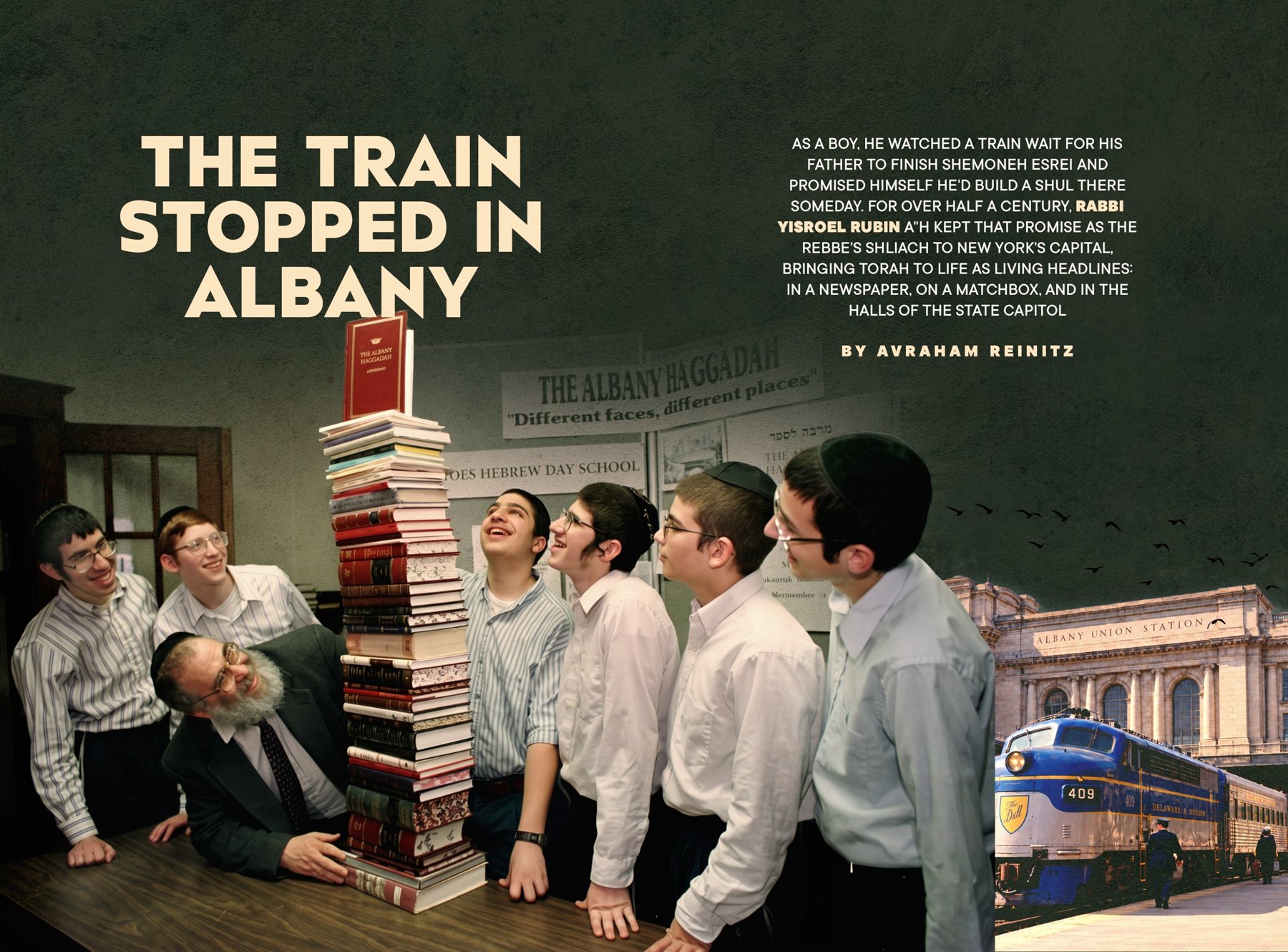
As a boy, he watched a train wait for his father to finish Shemoneh Esrei and promised himself he’d build a shul there someday. For over half a century, Rabbi Yisroel Rubin a”h kept that promise as the Rebbe’s shliach to New York’s capital, bringing Torah to life as living headlines: in a newspaper, on a matchbox, and in the halls of the State Capitol
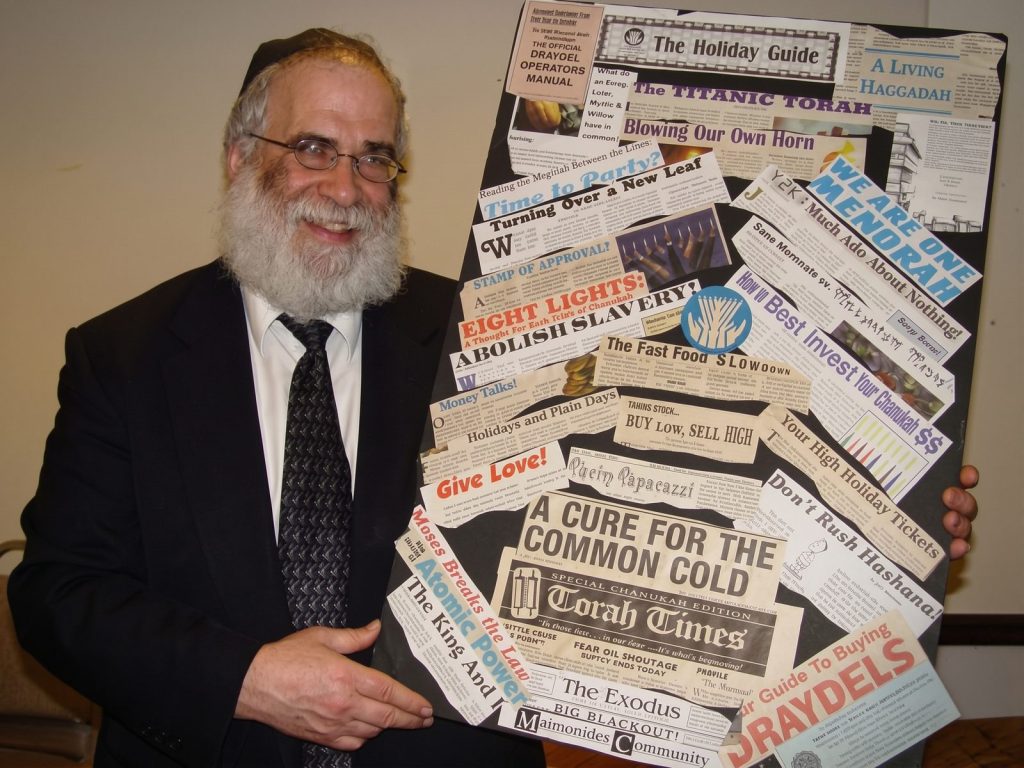
The old duplicating machine finally went quiet. On the table lay stacks of pages from the past few weeks, still smelling of stencil ink. Across the top of each page was the paper’s name, TORAH TIMES, in a “New York Times” font, with a running issue number in the corner. Yisroel Rubin, a bachur among the students of 770, squared the edges of the pile with an editor’s care. Then his hand stopped on one issue. Issue number six.
It was the issue for Parshas Toldos. Like all its predecessors, it presented the parsha as breaking news, with journalistic headlines and reports “from the field,” plenty of humor alongside sharp analysis, so that kids would want to read it. That was how the idea was born over the summer at Camp Gan Yisroel in Montreal and how it continued after the vacation as a weekly publication for Jewish schools. The Toldos issue also included a joke about the constipation that struck Avimelech when he took Sarah.
A teacher from Flatbush Yeshiva read it and did not smile. He was not the only one. Several other rabbis responded, and the criticism made its way back to the young editors: it was disrespectful, they argued, to present the stories of the Torah in a journalistic style, with a wink. Yisroel Rubin absorbed the criticism, and it worried him. But one thing worried him more than anything: what would the Rebbe say?
After all, the Rebbe himself had been a partner in this paper from the beginning. When the first issues were sent to him, he replied that the paper was nicely written, but it needed a name that more people would understand. When “Torah Times” was suggested, he liked the name. And not only that: the Rebbe contributed six hundred dollars to cover the printing of the first six months. And now, an issue that had provoked criticism?
He decided to wait. For several weeks he sent the Rebbe nothing. The issues piled up, and when a respectable stack had accumulated, he submitted them all at once, without issue number six. “I figured that if one page was missing from an entire stack, it wouldn’t be noticed,” he later said.
The Rebbe’s answer came, short and succinct: “Number six is missing.”
Three words, and a whole world in them. “It was clear that the Rebbe was following closely what we saw as a simple production by bachurim,” Rabbi Rubin related. “Knowing that the Rebbe read every issue, and, as I heard later, that Rebbetzin Chaya Mushka did too, gave me the strength to continue the venture despite the criticism.”
* * *
This small story contains much of the character of Rabbi Yisroel Eliezer Rubin a’h, the Rebbe’s shliach to Albany, capital of New York State, for more than fifty years. He was a man of ideas. To him, the Torah was not an ancient chronicle but “living news,” to be presented in the language of today: in a newspaper, on a matchbook, in an article for the local paper, or at a Tu B’Shevat table in the corridors of the Capitol.
But alongside this creativity there was a simple awareness: everything passes before the Rebbe’s eyes. Even a one-page newsletter. And the Rebbe, for his part, showed him a special warmth that accompanied him over the years: a handwritten “t’ch” (thanks and appreciation) for Shabbos candle matchbooks, a phone call from the secretariat saying that the Rebbe had enjoyed his article, a letter for the five-year celebration that he reread every year, and an extra dollar for his father together with the sentence: “I know that Yisroel is in Albany.”
“My Heart Was Hot Within Me”
Yisroel Eliezer Rubin was born in 5708 (1948) in Brooklyn, to Rabbi Moshe Rubin and his wife Mrs. Yocheved Miriam, daughter of Reb Shmuel Backman. In his childhood the family moved to Montreal, Canada, where he spent his youth. His father, Reb Moshe, was a Chassid of the previous generation. He studied at the Tomchei Tmimim yeshiva in Otwock, Poland, and in 5700 (1940), as a yeshiva bachur, was among the Jews who were saved from the Holocaust by way of Shanghai. In Montreal he served for over fifty years as a shochet and bodek, and as a mashpia in the city’s Chabad community.
What was engraved most deeply in his children’s memory was his davening. “In the shul everyone saw him davening for hours,” they later wrote, “but only we, his children, had the zechus of hearing our father’s emotional morning brachos at home, in the early morning hours.
Reb Moshe loved every bracha and said it with great personal warmth, aloud and with deep intention, “like Neilah at the height of Yom Kippur.” The passuk engraved on his matzeiva is: “My heart was hot within me, while I was musing the fire burned; I spoke with my tongue” (the initials in Hebrew spell Chabad…).
In tefilla Reb Moshe felt at home, and he always had all the time in the world for it. For that reason he was late for almost everything else and the driver who took the shochtim to work called him “the Mumbling Rabbi.” Years later his son Yisroel made him a bumper sticker in the style of the American stickers “I’d rather be fishing” or “I’d rather be surfing”: “I’d rather be praying.”
R’ Rubin told a story about one of those prayers that stayed with him all his life. When he was a boy, he traveled with his father by train from Montreal to New York, and the train stopped at the Albany station. Reb Moshe, who was of course in the middle of davening, took advantage of the stop to stand for the Shemone Esrei. Looking for a quiet place, he went out to stand on the bridge between two train cars. There he prayed in his usual way, wrapped in his tallis, swaying and singing, seeing and hearing nothing. It turned out that these very two cars were due to be uncoupled at that station: one continuing to New York, and the other not. The train crew gathered around and watched the strange sight. The boy Yisroel stood beside his father, mortified. Finally he gathered his courage, approached the workers, and explained that his father was praying and would finish very soon. In his heart he, too, prayed that his father would hurry up and finish. But R’ Moshe did not hurry, and the train crew waited until he was done.
“I remember saying to myself,” he later related, “’there should be a shul here, so that he won’t have to daven on a train car again. And if there isn’t, I’ll build one myself!’”
He studied at the Tomchei Tmimim yeshiva in Montreal. One of the teachers who stayed in his memory was Reb Yehuda Chitrik, who was a Chassid of three of our Rebbeim, the Nesiim: a precise and exacting man, a treasure trove of memories, and a wonderful teacher.
Another central figure in his childhood was the mashpia Reb Peretz Mochkin, a wise and beloved Chassid, warm and full of humanity. The boy Yisroel attended his farbrengens together with his father, even though he was younger than the students. One Pesach, Reb Peretz held a farbrengen on the niggun of “B’mashmanenu al yehi razon” from the tefilla for dew. According to him, the yeshiva years are “the fat” of life, and one must store up spiritual wealth from them for the years to come. Half a year later, in the days of Elul, the boy peeked into the classrooms on the second floor, where the tmimim had retired to extend their davening. In several of the classrooms he heard that same tune being quietly hummed. He never forgot that sight: this is what a farbrengen that truly sinks in looks like.
He finished his yeshiva studies in 5727. But he found the turning point in his path of learning in New York, at one farbrengen of the Rebbe: “I remember standing at the Rebbe’s farbrengen, a young boy visiting New York,” he related. “I strained to hear, and hung on every word.” This was at the farbrengen of Yud Shevat 5725. The Rebbe delivered a siyum on meseches Makkos, and spoke at length about the story that closes the mesechta: Rabi Akiva laughing at the sight of the ruined Mikdash while his colleagues weep. “The Rebbe’s voice was full of emotion, and I couldn’t believe my ears,” R’ Rubin related. “I had never heard Torah presented from so many angles. The Rebbe analyzed who the people in the story were, what the relationships between them were, and how all this connected to their teachings. This method led him to ask questions no one had asked and to give answers no one had given. For me it was a turning point.”
From then on this stood at the center of his life: to bring the Torah to life, to see the people behind every topic and the story of their lives.
“The Giants Have Been Wiped Out!”
In the summer of 5730, Yisroel Rubin was appointed as learning director at Camp Gan Yisroel in Montreal. The question that preoccupied him was simple: how do you make children enjoy the time they spend learning Torah?
The answer was born from the message he absorbed at the Rebbe’s farbrengens. “The Rebbe instilled in us hundreds of times that the Torah does not come to document ancient history but to give instructions for our lives, here and now,” he related. “So every day I put out a one-page ‘newspaper’ describing the events and personalities in that day’s Chumash portion. I wrote it in a journalistic style, as if it were breaking news. For the name of the paper, I used the font of the ‘New York Times.’”
The paper was called “The Daily Chitas.” Together with his friend Reb Shmuel Greisman, he wrote it with humor, in language the children knew. Referring to Moshe Rabbeinu’s victory over Sichon and Og, for example, the headline read “The Giants Have Been Wiped Out!” The “Giants” were also the name of a well-known baseball team, and the kids enjoyed it.
The paper was printed on an old duplicating machine with stencils. “By the end of the summer we had sixty pages,” he related. “I stapled them together and sent them to the Rebbe.”
What was planned as a project for one summer did not end with the vacation. When they returned to the city, the two friends continued to print the paper once a week and distribute it to Jewish schools. From then on, as already told, the Rebbe accompanied the paper step by step. In response to receiving the paper, the Rebbe wrote: “The paper is generally well put together and should be easy to distribute, except that apparently it is not known or publicized at all. It also needs a name that will be understandable.”
The Rebbe circled the words “The Weekly Sedra” and wrote: “Not understandable at all, as this is the name of the sedra. I will mention it at the tziyun.”
In another response, when they wrote that they wanted to publish every week, the Rebbe wrote that “once every two weeks will suffice (at least at first),” and also that it should be “in a way that does not interfere with their studies.” The Rebbe also instructed them “to look over and correct before printing.”
On their proposal to send the paper to individual children, the Rebbe wrote that “it is not their concern at all,” and regarding their suggestion to send many copies to yeshivas, the Rebbe circled the word “many” and wrote “a few” in its place. And on what they wrote, that the paper was enclosed, the Rebbe wrote: “And thanks. I will mention it at the tziyun.”
“The Rebbe’s brachos and encouragement are what pushed me to continue all the way,” said R’ Rubin.
After receiving semicha, he married Rochel, daughter of Rabbi Yechiel Michel Piekarsky, on 3 Tammuz 5731. After the wedding he began learning in the kollel for married students under the auspices of the Rebbe’s secretariat, and his wife taught at Beis Rivkah.
“We Need to Make a Revolution in Albany!”
The story of the shlichus to Albany began even before Rabbi Rubin had heard of it, with a small group of high school boys. In 5732, several Jewish boys were studying at Albany’s high school, looking for a way to connect more deeply to the heritage of their forefathers. One bus trip to Crown Heights changed their lives, and upon their return they bonded with an elderly Chassid who was then living in the city: Reb Isser Brikman.
Reb Isser was a warm, down-to-earth Chassid of the previous generation. He was born and raised in Russia, was steeped in the teachings of Chassidus and its customs, and served as a shochet in Albany. He lived in the apartment above the shtiebel “Shomrei Torah” on New Scotland Avenue, the same shul where R’ Rubin would later serve as rabbi. For the boys, Reb Isser became a guide. At one farbrengen he said to them a sentence they never forgot: “We need to make a revolution in Albany!”
Shortly afterward Reb Isser left the city, but the call remained. Feivel Chandler and his friend Reb Yisroel Bindel asked the Rebbe to send a shliach to Albany. The Rebbe sent R’ Yisroel and his wife Rochel Rubin. Those same boys helped the young couple get there, and they arranged their first apartment in the city.
They arrived in Albany on Sukkos 5735 (1974). This was the city where the train had once stood for a quarter of an hour, until his father finished Mincha. The young shliach was twenty-six years old, and was now responsible for Chabad activity throughout eastern New York State.
Already that first year, a “Kosher Wagon” opened downtown, alongside it a kosher pizza and falafel restaurant. That same year he also began operating on the campus of the State University (SUNY), and in 5736 the couple purchased a small house on the corner of Fuller Road, near the university. Thus “Shabbos House” was founded, the Chabad center for students, which operates to this day.
By 5739, the activity was already growing and expanding. Gemara and Chassidus classes opened at the community high school, an anti-missionary campaign called “We Never Lost It!” was launched, and in the neighboring city of Troy the first Chabad House was established, under the direction of Leibel and Elisheva Morrison. Reb Isser Brikman’s revolution was under way.
Thanks for the Matchbook
In late 5734, the Rebbe called for a Shabbos candle-lighting campaign. A few days before moving to Albany, R’ Rubin sat in the Frankel shul on President Street in Crown Heights, pondering the new campaign. “Suddenly it occurred to me that matchbooks are easy to distribute, and also a means of advertising,” he related. “In those days smoking was common, and in most restaurants and stores there were free matchbooks on the counter, often with advertising on them. Why not advertise Shabbos candles on them?”
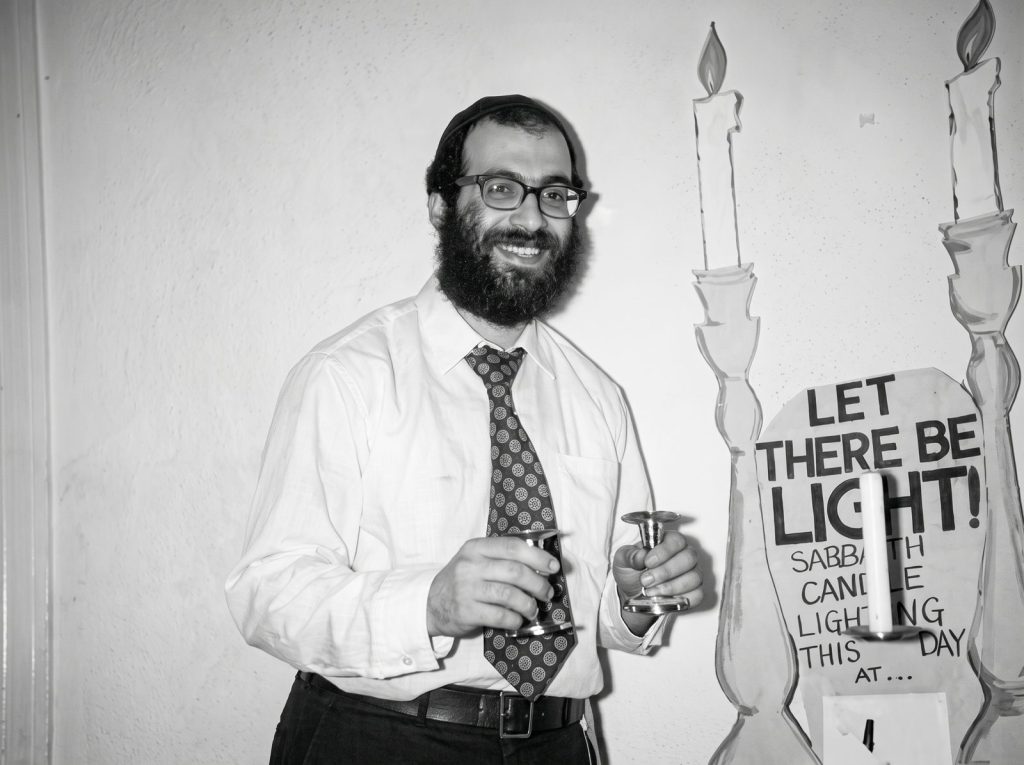
When he arrived in Albany, he approached Mr. Leo Pfaff, a local community figure and owner of a company that manufactured just such products. An artist who lived in the city then, Sarah Miriam Levinson, drew an illustration for him in simple lines: a mother and daughter, in front of them two large candlesticks and one small one, “as the Rebbe strongly encouraged.” The matchbooks were printed again and again, both for Albany and for Chabad Houses elsewhere, about fifty thousand boxes in all.
Soon afterward a general-and-personal letter from the Rebbe arrived. In the margin of the general letter the Rebbe added two letters in his own handwriting: “t’ch.” “That was the Rebbe’s short way of saying that he was pleased with the matchbooks,” R’ Rubin felt.
The story did not end there. About half a year later, before 11 Nissan 5735 (1975), the Rebbe’s birthday, the phone rang in Albany. On the line was Rabbi Groner from the secretariat: did he have Shabbos candle matchbooks ready now? The Rebbe wants to distribute them.
Quickly, 3,000 boxes were printed, bearing the words “Shabbos Kodesh Candles” and the date 11 Nissan 5735. The Rebbe marked some of them in his own handwriting and gave them to several activists whom he called into his room (Rabbi Dovid Raskin, Rabbi Yosef Wineberg, Rabbi Yaakov Hecht, Rabbi Leibel Groner, and Mrs. Sternberg), to spread the Shabbos candle campaign.
The matchbooks were only the first in a long series of creative mitzva campaigns, each of which drew on whatever was occupying the public at that moment. There was a shofar ad starring Bart Simpson, Tu B’Shevat with “Pac-Man” and “the California Raisins” and “Ninja Turtles.” There were tzedaka boxes in the shape of a Coke can, tefillin mirrors, “Enjoy the Torah” stickers, and Rosh Hashana honey in medicine bottles, and the anti-missionary campaign “We Never Lost It!”
The ideas did not stay in Albany. For more than ten years, shluchim across America used the “Holiday Guide” newspapers he wrote and distributed, and more than fifty editions were published.
Half a Pair of Tefillin by the Bonfire
This was at the beginning of the shlichus in Albany. News reached the Rebbe’s secretariat about a commune left over from the sixties, somewhere in central New York State. According to reports, there were quite a few young Jews there, its leader was also Jewish, and strange customs were practiced there. Rabbi Chodakov picked up the phone to Albany and asked the young shliach to go and see what could be done.
The Rubins then had an old, large, secondhand car that had almost no heat. They bundled up their little son and set out on a long journey in a cold winter, in days when there was no electronic navigation system. Somehow they found the place. Their son later said it was like entering a parallel universe: a cluster of round tents in the style of Mongolian nomad yurts, and people wandering around in the dead of winter in remarkably little clothing. Some introduced themselves by names like “Sun” or “Humility.”
R’ Rubin asked to speak with the leader. They told him he could go in, but the leader was in the middle of a vow of silence. He entered the tent and found the man sitting cross-legged by the fire. On a low table beside him lay a Hebrew book. Attempts at conversation led nowhere. The man kept his silence.
R’ Rubin asked him if he would like to put on tefillin. The man pondered at length, and finally nodded. The rabbi wrapped the arm tefillin on his arm. When he bent down to the bag to take out the head tefillin, the man leapt from his place and began to dance around the bonfire, with only the arm tefillin, without a word, with tremendous enthusiasm and intensity. Rabbi Rubin stood stunned. When the man calmed down a little, he removed the tefillin and left the tent, before the rabbi could put the head tefillin on him. After a few more short conversations with other members of the cult, the couple returned home.
More than ten years later, in the sukka of his home in Albany, a guest who had come from Israel sat and passed along an indirect greeting. From certain descriptions R’ Rubin understood that it was the leader of that commune. The man had returned to Judaism and to observing mitzvos, and now uses his power of influence to teach Torah. Over the years several more “regards” arrived from members of the commune, which disbanded shortly after his visit.
“The Vayeitzei– Vayishlach Letter”
In the winter of 5740, Albany was preparing to celebrate five years of Chabad activity in the capital region. They set the dinner for a Sunday, between Shabbos Parshas Vayeitzei and Shabbos Parshas Vayishlach. Then a letter arrived from the Rebbe, addressed “To all participants in the fifth anniversary celebration,” and dated Rosh Chodesh Kislev 5740. “To our surprise,” Rabbi Rubin related.
In the letter, written in English, the Rebbe drew a lesson from the weekly parsha. In Parshas Vayeitzei, the Rebbe wrote, Yaakov Avinu leaves his parents’ home and goes out into “galus.” His heart is full of worry about what each day will bring for him and for the family he is destined to establish, but Hashem’s promise strengthens him. In Parshas Vayishlach he returns home with his family, blessed spiritually and materially, after even his sworn enemy has become his friend: “whole” in every respect.
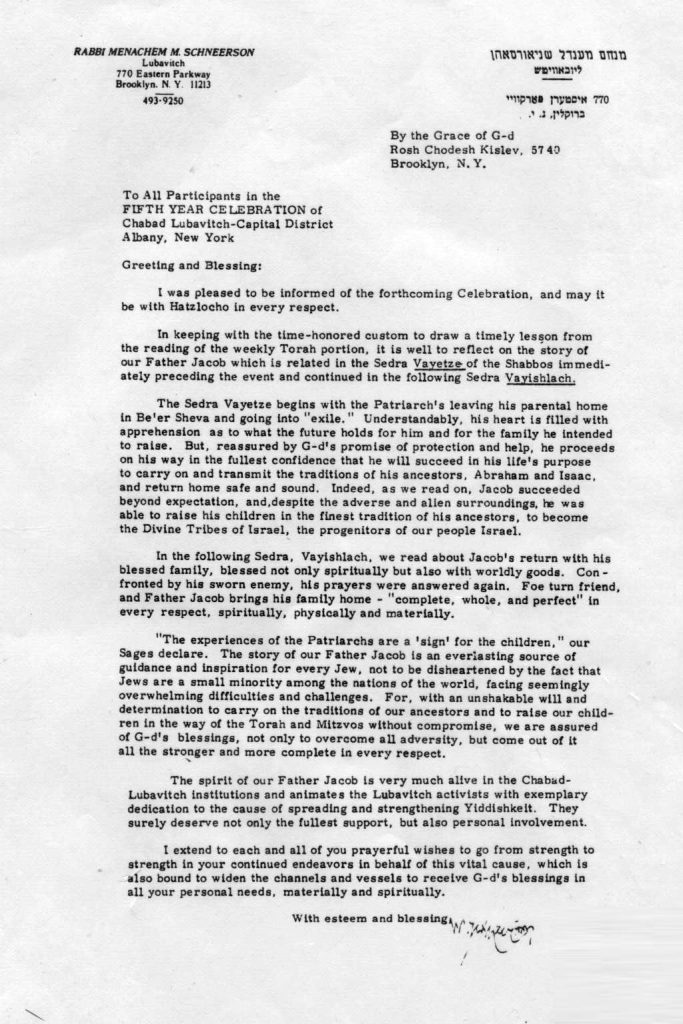
“The letter was addressed to all the dinner participants,” R’ Rubin related, “and still I felt that the Rebbe was describing my own personal struggles. Every sentence in it is dear to me and full of meaning for me, and I see how the Rebbe’s words, in all their details, fit our situation here.”
After that, he read the letter before the community every year. In Albany it is affectionately called the “Vayeitzei–Vayishlach Letter,” and it is read every year as if it were newly sent. The fiftieth-anniversary celebration, in Kislev 5785, was deliberately set for that same Sunday between Vayeitzei and Vayishlach, exactly forty-five years after the letter.
Around that time, R’ Rubin submitted to the Merkos L’Inyonei Chinuch detailed surveys of the Jewish population and institutions in about twenty communities in upstate New York.
The response from the Rebbe’s secretariat was unequivocal: a mikva must be built, and specifically in Troy.
R’ Rubin pushed back. Only about two thousand Jews lived in Troy. Perhaps another city was more suitable? Rabbi Chodakov stood his ground, and said the matter was one of pikuach nefesh. And when R’ Rubin initially considered a rented building for a Chabad House in the city, Rabbi Chodakov remarked to him that a mikva cannot be built on rented land. The mikva in Troy was completed in 5740 (1980).
“Moshiach: Part of the Agenda”
R’ Rubin’s starting point for his whole path in Torah was from that same farbrengen where he heard the Rebbe explain Rabi Akiva’s reaction to the desolate Har HaBayis: “Total destruction and ruin can lead davka to complete Geula.” This idea, that from the darkness itself light grows, recurred again and again in his writings.
In the 1990s he published an article in the local Jewish newspaper titled “Tisha B’Av Has Two Sides.” In it he presented the day of destruction also as a day of hope, based on that same passage at the end of meseches Makkos. Soon afterward Rabbi Groner from the Rebbe’s secretariat called him: the Rebbe had enjoyed the article very much. Years later his son wrote that it is easy to understand why. The article reflects the Rebbe’s way, i.e. to seek the good within the bad and the presence within the absence.
In the Haggada too, on which he worked for many years, he arrived at the same point. In his Marbeh Lesaper, the Albany Haggada, he examines the story of the five Tannaim who reclined in Bnei Brak all night, and concludes with a commentary on the eternity of Moshiach. When the talmidim came to tell their teachers that the time for the morning Shema had arrived, he wrote, they did not mean to stop the discussion. “On the contrary, they continued the message and the shlichus of their teachers. They understood that it was their teachers’ talk of Geula that enabled them to see the light. It opened their eyes to the dawn of a new day, after the dark night of exile.”
But the Geula did not remain with him a scholarly idea. In a short piece he published on the Chabad Albany website, “Nine Questions About Moshiach,” he addressed the ordinary reader, and answered his questions in a direct manner. Is belief in Moshiach an escape from reality? “No. We don’t live out of suitcases. Judaism is realistic, down-to-earth and lives in the here and now. We plan ahead normally, even while knowing that our current situation is waiting for Moshiach to arrive imminently.”
Is now the time? “We certainly hope so. It can happen anytime, but the earlier the better. Events indicate that the time is ripe, and we should try to realize the potential.”
What can I do about it? “Do more mitzvos, because every mitzva brings the redemption closer. Learn Torah for greater Moshiach awareness – so that Redemption is in popular demand. May it come speedily in our days! “
And in an article he wrote during the Chanuka, under the title “Pray for the Peace of Jerusalem,” he connected the Geula with the Rebbe’s warnings against concessions in Eretz Yisrael. “The Rebbe was right,” he wrote. “With the same foresight, the same conviction, and the same force with which he came out against the ‘peace process,’ the Rebbe declared emphatically that we are in the advanced stages of the ‘process of redemption.’” He did not ignore the skeptics, who mocked and said that Moshiach is not realistic in our times, and even claimed that such ideas endanger Chabad’s activities. Against them he set the Rebbe’s directive: “To yearn and pray for the complete redemption, to learn about it and to prepare for it spiritually.”
At the first Kinus HaShluchim after Gimmel Tammuz, many spoke about how to go on. Rabbi Rubin stood and cited the Gemara in meseches Rosh Hashana. Once Rosh Hashana fell on Shabbos in Yavne, and the Bnei Beseira asked to discuss whether to blow the shofar. Rabban Yochanan ben Zakkai said to them: “Let us blow, and afterward we will discuss it.” “In times of crisis, we must move forward,” said R’ Rubin. “The good deeds must continue. The questions and discussions can come afterward.”
He shared these words again with his son recently, as an idea for his weekly column. The next day he was hospitalized.
School, Government and Books
In 5740, R’ Rubin was one of the founders of the Hebrew school “Maimonides” in Albany. His wife, Morah Rochel taught there from the day it opened and later headed it as principal. When the New York State Senate gave them official recognition in 5778 (2018), the resolution stated that R’ Rubin’s creative style and broad vision are evident in all of the school’s programs, inside the classroom and beyond.
Two concepts stood at the center of his educational path: relevance and connection. “He saw G-dliness, ideas, and connections everywhere,” his son testified. For years he taught Gemara to high school girls. This was a directive he had received from the Rebbe many years earlier, and he held on to it even in recent years, when it had already become difficult for him.
R’ Rubin headed the network of shluchim that kept growing in eastern New York State. By the Jubilee year, in the capital region alone there were already about a dozen shluchim and Chabad Houses, among them the Simon, Morrison, Lauber, and Kramer families, several members of the Rubin family itself, and many more along the Hudson Valley.
Albany’s uniqueness is that it is the capital of New York State. Already in 5739, R’ Rubin began hosting a fruit table in the Capitol building every Tu B’Shevat, at first in a side room or in the office of one of the legislators. “We are here to take care of everyone’s Jewish needs in Albany,” he said. “We are here for their personal growth.” Legislators who needed to say Kaddish knew that he would organize a minyan for them. Chabad also made sure to affix mezuzos in offices and to obtain kosher food for the elected officials and their guests. “I take care of their needs like any other part of our community,” he said. The only difference: those who taste his Tu B’Shevat cake are the ones who decide the fate of the entire State of New York.
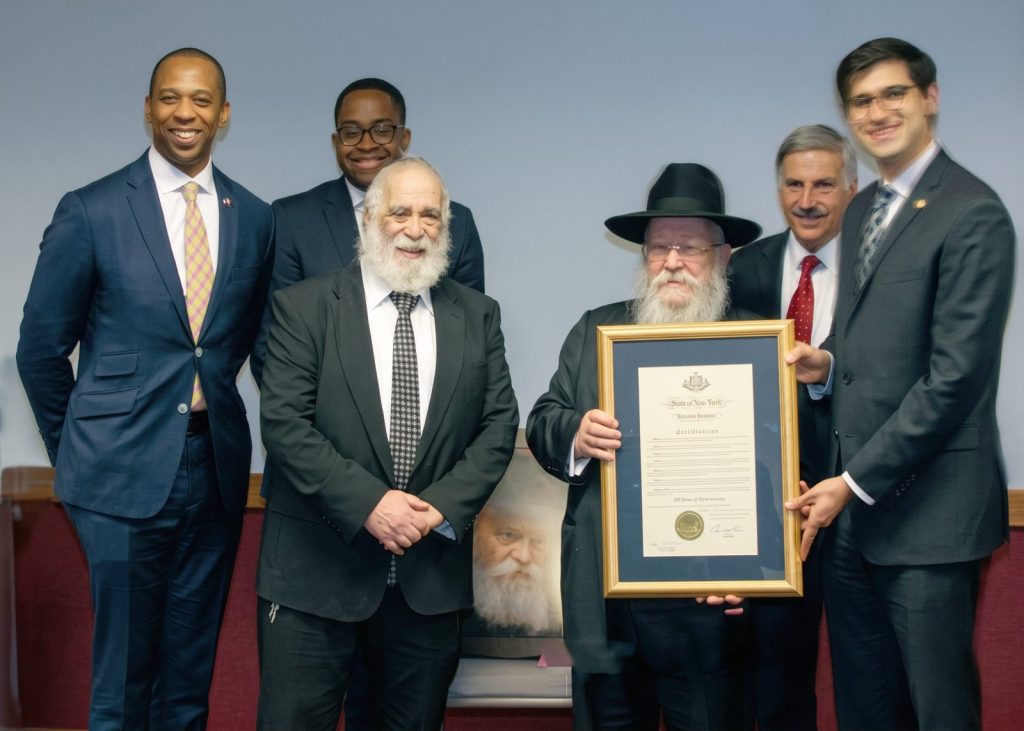
On Tu B’Shevat 5766 (2006), in recognition of his activity over the years, R’ Rubin was chosen to deliver the invocation in both houses of the legislature. That year, for the first time, the fruit table was set up right at the entrance to the assembly hall.
His great love was Torah writing, where his brilliance in Torah was evident. His Marbeh Lesaper, the Albany Haggada, was ignited by a question he threw out to his students: “The Sages talked all night, but what exactly did they say? Let’s get a ‘protocol.’ Let’s investigate their lives, to know more about them and understand what really happened that night in Bnei Brak.” From the life stories of the five Tannaim he sought to understand their words, just as he heard from the Rebbe at the farbrengen on Rabbi Akiva.
“They say that with two Jews there are three opinions,” he explained, “and looking at the Exodus from different angles is the spice of the story, and it is what gave life to their Seder.” The book received approbations from Rabbi Yisroel Meir Lau, Rabbi Adin Steinsaltz, Rabbi Mordechai Eliyahu, Rabbi Pinchas Hirschprung, and Rabbi Aharon Soloveitchik.
On Pirkei Avos he wrote Shem Avosai, and another analytical book on ethics and morals according to Pirkei Avos. Over the years he published dozens of pamphlets of Torah insights called “Hirhurei Torah,” and wrote hundreds of articles on the Jewish holidays and Jewish life in the local and national press. He was also a member of the steering and editorial committee for the curriculum of the Rohr Jewish Learning Institute (JLI).
He was a researcher. For years he conducted research and interviews on the Yeshivas Chachmei Lublin. In 5774 (2014) he launched a fundraising campaign for a documentary film called “The Jewish Miracle of Shanghai,” about the Jews who were saved from the Holocaust by way of Shanghai. One of them was his father, Reb Moshe, who was then a yeshiva bachur.
52 years, to the day
The holiday of Sukkos, and Simchas Torah in particular, was his Yom Tov. Veteran members of the “Shomrei Torah” shtiebel remember his many “l’chaims” on these days. “He had ‘the joy of Torah’ in the literal sense,” said his son. “Real joy in the study of Torah. It was his passion, his love, the center of his life.” He shared this love with his wife as well. The two loved to learn together, and passed on the love of learning to their entire household.
In the summer of 5782, R’ Rubin suffered a stroke. Despite his health difficulties, he did not cease teaching and writing. “Learning and teaching Torah were always the center of his life and his shlichus,” his family members wrote, “even in his last years, during his illness.” He continued to work on “Hirhurei Torah,” continued to write a weekly column, and remained involved in the leadership of the school and the shluchim.
On the night of this past Shemini Atzeres 5787, right after Hoshana Rabba, exactly at the close of the Sukkos holiday on which he had arrived in Albany, he returned his soul to its Maker. He was seventy-eight years old. These were fifty-two full years of shlichus, to the day. His son found an allusion to this in the wording of the verse about Shmuel HaNavi, “and he returned there ad olam,” and Shmuel lived, after all, fifty-two years… He was laid to rest in Albany on Monday, Isru Chag Sukkos, in the city where he had worked all the days of his shlichus.
He leaves behind his wife and partner in the shlichus, Rebbetzin Rochel Rubin and their children: R’ Menachem Mendel, Shabbos House at the University at Albany; R’ Abba, Saratoga Springs; R’ Yosef Yitzchok, Clifton Park; R’ Shmuly, Union College in Schenectady; Mrs. Devorah Leah Mathless, Albany; Mrs. Rivka Cohen, Manchester, England; R’ Ephraim, Brooklyn; R’ Nachman Simcha (Simmy), Albany; Mushka, Brooklyn; R’ Motti, Colonie. He also leaves grandchildren and great-grandchildren, and his sisters Mrs. Rochel Zaklos (Detroit), Mrs. Esther Chanowitz (Montreal), and Mrs. Sarah Yuzewitz (Brooklyn). His daughter, Mrs. Esther Cohen, wife of the shliach Rabbi Menachem Cohen in Manchester, passed away during his lifetime.
Many of his children are on shlichus in the same region to which he came with his wife more than fifty years ago: in Albany, Saratoga Springs, Clifton Park, Schenectady, and Colonie. Exactly as the Rebbe once wrote to him: Yaakov Avinu goes out alone, with a heart full of apprehension, and returns with a large family, “whole” in every respect.
The family asks that anyone who has memories and stories about Rabbi Rubin send them to: [email protected].
Beis Moshiach #1528 • י״ט חשון תשפ״ז • pp. 14-25, 35
© 2026 Beis Moshiach Magazine. All rights reserved.
This article originally appeared in Beis Moshiach #1528. You are welcome to share it with friends and family by email or in print, provided that you do not change, add to or omit any part of it, you credit the author and Beis Moshiach, and you include a link to archive.bmoshiach.org (written out in full in printed copies).
To republish this article in a newspaper, magazine, book or website, please request permission in advance at [email protected].