The Shepherds’ Front Line
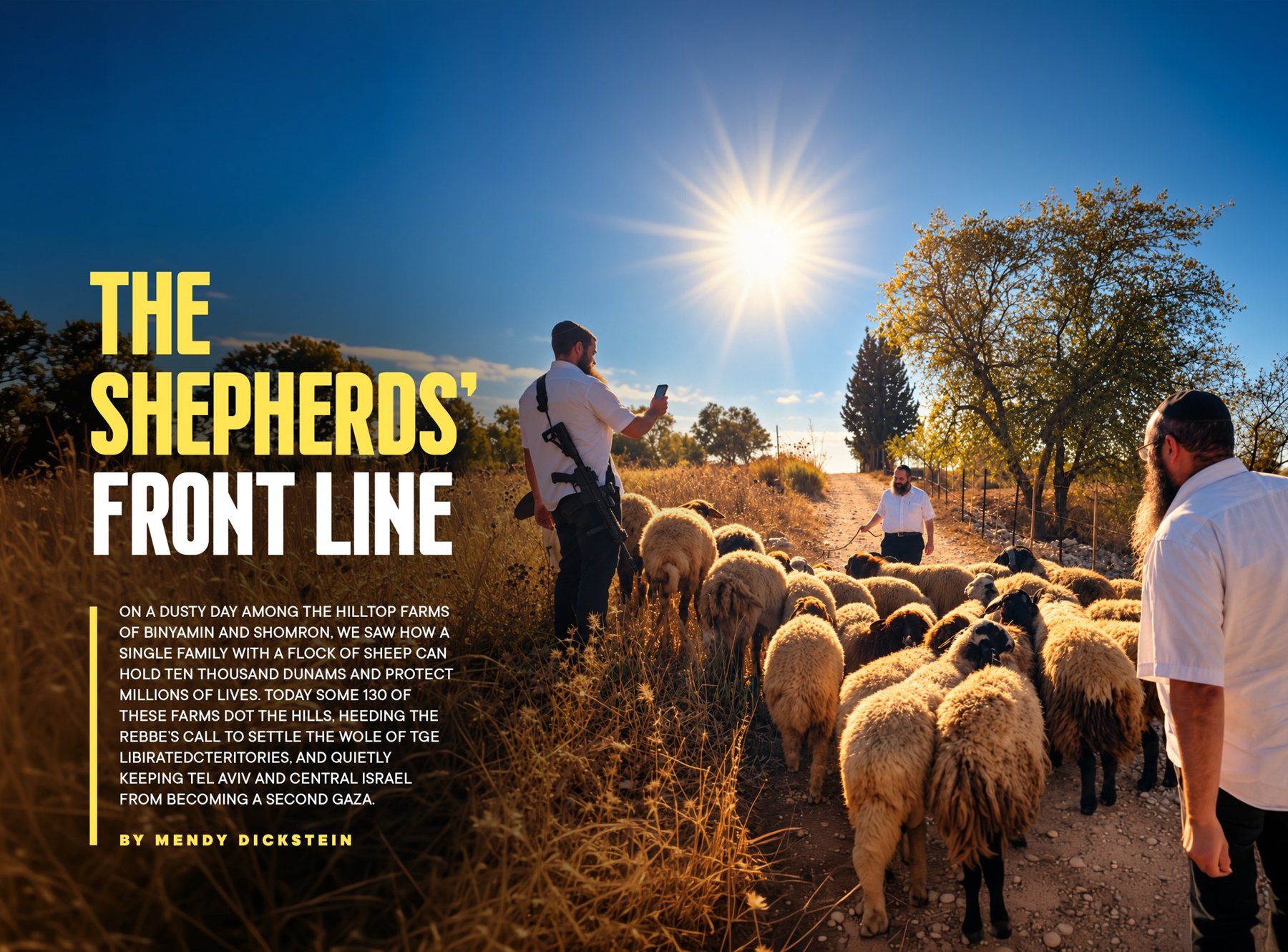
On a dusty day among the hilltop farms of Binyamin and Shomron, we saw how a single family with a flock of sheep can hold ten thousand dunams and protect millions of lives. Today some 130 of these farms dot the hills, heeding the Rebbe’s call to settle the whole of the liberated territories, and quietly keeping Tel Aviv and central Israel from becoming a second Gaza.
“Do you see that hill? Five years ago there was nothing on it. Today there’s a family on it, calmly raising an entire flock of sheep, and a shul.”
Rabbi Shneur Sandroy says this in a quiet, almost offhand tone, lifting one hand from the steering wheel and pointing through the open windshield at a brown hill rising before us. Dry thorn bushes slope down its sides, and a white cloth tent flutters at the summit. “Do you know what it means when a family with a flock is on the hill?” he asks, his voice rising. “It means that family becomes the exclusive controller of at least ten thousand dunams, more than three times the size of Kfar Chabad.”
That’s an astonishing figure. We’ll expand on it later, and it has a broad connection to the massacre on Simchas Torah in the Gaza envelope, whose third anniversary was marked this week.
Spoiler: these farms save us every day from a similar massacre in central Israel, hayo lo tihyeh [may it not happen].
Educators in the Field
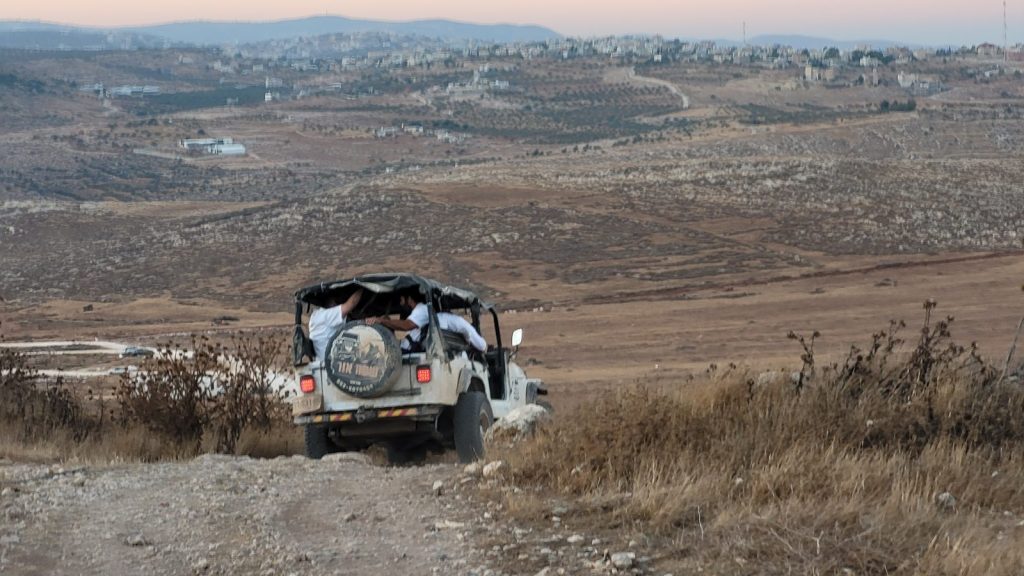
The old blue jeep with the peeling lettering “Shetach Ohr” on its hood, keeps climbing a dusty dirt track, a cloud of white dust trailing behind it and blurring the colors of the sunset.
On the hard benches of the jeep sit seven teachers and educators from the Chabad Talmud Torah of Holon, in shirts that were white before they absorbed the dust of the roads. One passenger, sitting near the open doorway, carries a long weapon on his shoulder, a quiet reminder that this pleasant outing passes through territory unlike any other in Eretz Yisrael.
What I didn’t know when I boarded the jeep at the start of that day was how much this winding road, between stone hills and fields of dry thorns, is in fact the seam line of Israel’s security. Herds of brown cattle lay beside the path, chewing their cud peacefully, rock hyraxes darted among the stones, and on the horizon, each time the jeep climbed a little higher, more and more inhabited hills came into view, each with a tent, a caravan or a lone shack.
This outing took place as part of a team-building day for the staff of the Chabad Talmud Torah, headed by Rabbi Yehoshua Shimoni, who wanted to give the teachers and educators a completely different experience from the usual: not a standard fun day with activities and competitions, but a direct encounter with the settlers who actually hold, with their very feet, the vast areas of Yehuda and Shomron.
“We wanted the teachers to see things with their own eyes,” R’ Shimoni explained when the whole team gathered at midday at the entrance to the Binyamin region before setting out. “There is an enormous difference between giving a class about the settlers’ mesirus nefesh and seeing it up close, touching it, hearing it from the people who live it.”
And so, one fine day, the team members climbed into two old, rugged jeeps whose thick tires began to crush the dirt tracks that would lead us, over the coming hours, deep into the Binyamin territories.
R’ Shneur Sandroy, who led the group behind the wheel throughout the day, is no stranger to the area. He belongs to a veteran Chassidic family, part of the “Mitzpeh Moshiach” community near Yitzhar, an outpost established in the early 2000s by Anash during a period of a severe wave of terror that struck the region.
As a mashgiach in a yeshiva, he works with bachurim who combine Torah study with an active presence in the field, and he knows all the hills, paths and the people living on them, almost every one by name. “Every hill here is a story in itself,” he said as the jeep climbed uphill, smiling a quiet smile beneath his mustache. “The only question is whether you have time to hear them all.”
130 Farms Creating Facts on the Ground
Our first stop is the “Seven Shepherds” farm, located in the heart of the Binyamin region, not far from the roads leading toward Shiloh and Ateret. Even before we arrived, we could see from afar the flock of dozens of brown and white sheep standing on the hillside, grazing peacefully. We were welcomed by a young man, Maor Har-Noy, wearing a straw hat and with a sunburned face, one of the farmers. “Do you see this pipe?” he asked, pointing to a black water pipe winding along the dirt path. “Until not long ago, I had to drive several kilometers every day to bring water in barrels. Now there’s permanent infrastructure here. It may sound trivial, but to us it means the government recognizes us, that we’re no longer a temporary outpost that will be dismantled one morning.”
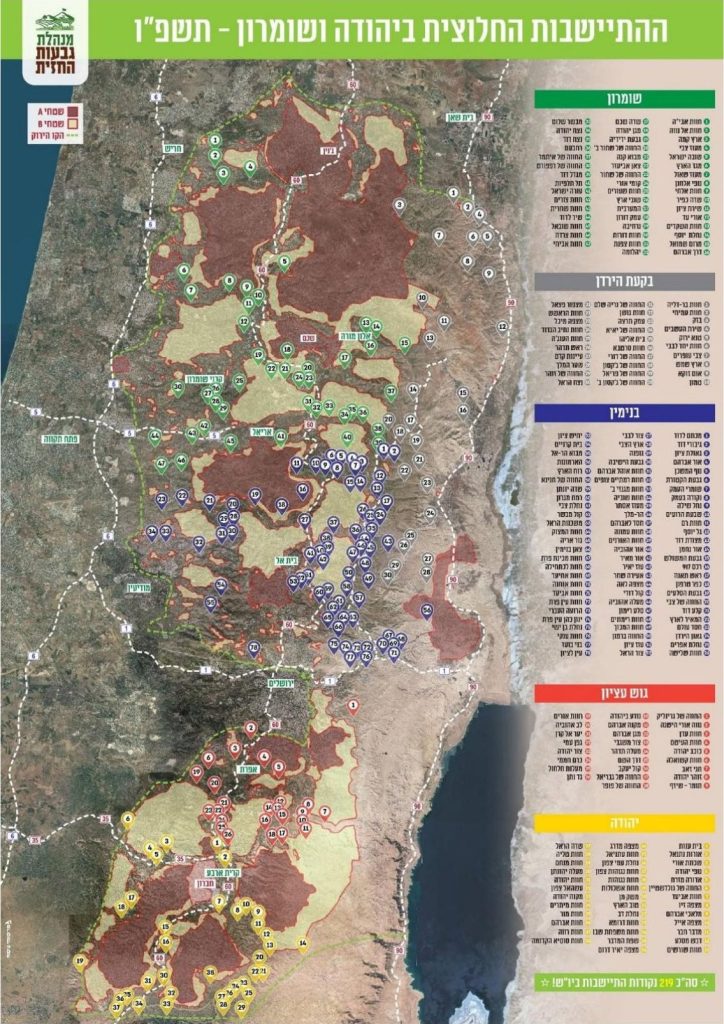
“Seven Shepherds” is one of dozens of agricultural-pastoral farms that have been established in Yehuda and Shomron over the past decade. According to estimates given to us during the tour, the number of such farms across the region now reaches about 130. Together they spread over a huge area of hundreds of thousands of dunams, an area that until four or five years ago was mostly completely ownerless, that is, in the hands of the Palestinian enemy.
This isn’t classic settlement with permanent homes and red tile roofs, but a new-old model: a family or group of young men goes up to a place and sets up a small base including a tent, a caravan, and a pen for sheep and cattle, and from that base begins to graze and cultivate the surrounding area. “Every such farm has a flock,” Maor explains, stroking the back of one of the sheep. “Every morning we release the flock to pasture, and they eat the grass in the surrounding area. That way, every area the flock reaches becomes ours. The real conquest is done with the feet.”
What looks like a pastoral, almost innocent idea turns out to be a carefully considered strategic move. The hills on which the farms sit control major traffic routes and prevent free passage between Arab villages in the area and lands of Eretz Yisrael that were previously completely ownerless. Sandroy, who stopped the jeep for a moment and got out to look eastward, pointed to the chain of hills stretching to the horizon. “Look at this,” he said quietly. “A few years ago this area was one nobody controlled. Today, every hill with a farm on it is in effect a lookout post and a presence.”
Angels of Peace: A Farm That Became a Settlement
From “Seven Shepherds” we continued east toward a farm that underwent something rare: it’s an unrecognized outpost that became an official settlement by government decision. “Malachei HaShalom” is located in the east of the Shiloh bloc, between Kochav HaShachar and the depths of the Shomron desert. The farm is named for two victims of terror: Malachi Rosenfeld Hy”d of Kochav HaShachar, who was murdered in a shooting attack on the Alon road, and Shalom (Shuli) Har-Melech, Hy”d, who was also murdered in a shooting attack. The name itself, “Malachei HaShalom,” combines the names of the two martyrs and recalls the piyut recited every Friday night in Jewish homes.
The farm, which began as a small training base in 5777 (2016-17), grew over the years, and from it were born additional satellite farms in the area, among them the farm we intended to visit later, “Gal Yosef.” In the winter of 5783, Malachei HaShalom received official recognition from the government. The small farm has grown over the years, and about twenty families now live there, about ten of them still in caravans. It also has a new library and an active shul.
But behind this flourishing also lies deep pain. “Come, I want to show you something,” R’ Sandroy says to us, turning toward a new stone building engraved with: “Beis Medrash Nachalat Binyamin, in memory of the holy youth Binyamin Achimeir, Hy”d.” He stood there a moment in silence. “Fourteen-year-old Binyamin went out to graze the sheep he loved so much, right here, not far from us. He didn’t come back.” His voice broke for a moment. “His family and the whole community decided that the answer to the murder is not to retreat but, on the contrary, to strengthen the place even more. In the place where he grazed his sheep, another satellite farm has now risen.”
“Whoever Comes First, It’s His”
From Malachei HaShalom we drove toward “Gal Yosef,” one of several satellite farms that sprouted from the mother farm between 5780 and 5783 (2019-2023). Behind every turn in the dirt track another hill appeared, and on every hill another sign of Jewish presence: a tent, a water tank gleaming in the setting sun, and sometimes an entire family who came out of their “container” to greet us with a jug of cold water.
“Look how close they are to each other,” Rabbi Sandroy explains. “That’s exactly the idea. Not a single farm sitting alone, but an entire continuum. Each farm sees the next, and together they form a full line of defense.”
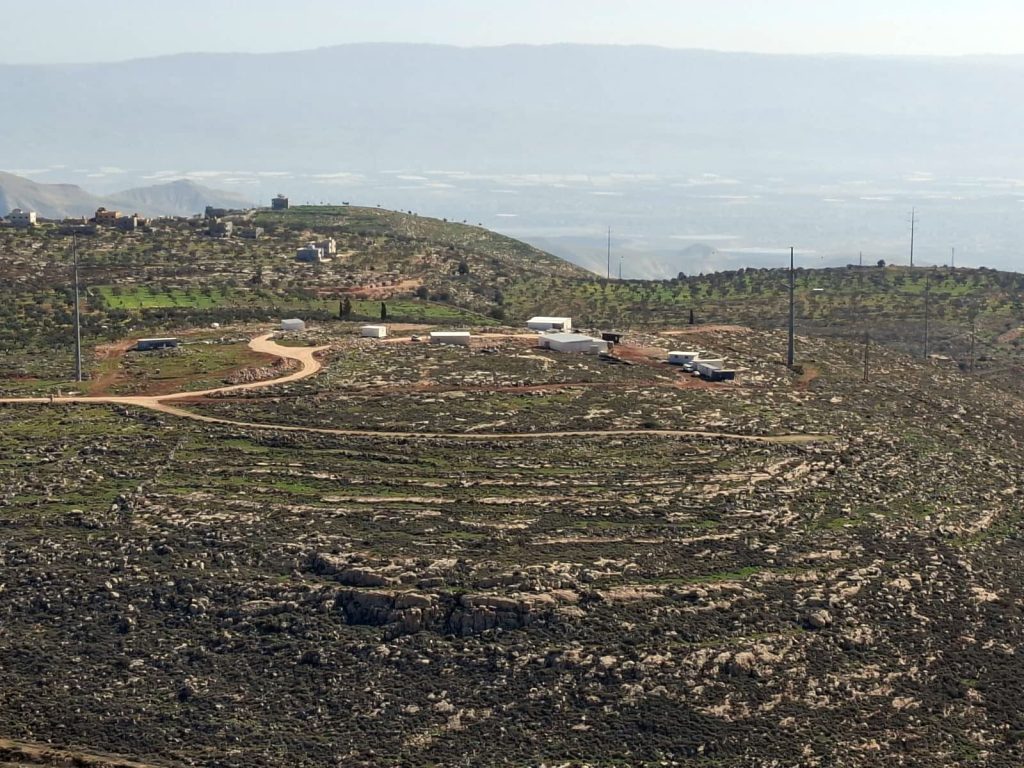
Next to one of the pens we met a young man, Yehuda Holstein, still drenched in sweat after bringing back a flock of black goats from pasture. “In this season we go out with the flock every morning before dawn,” he says. “Some days you meet Arab shepherds with their own flocks. Whoever gets to the area first, the pasture is his for that day…” He illustrates with a quiet simplicity that touched the heart: “We don’t come for war. We come to live here, raise a family, work the land. But if the area is empty, someone else will fill it, there’s no vacuum. So we fill it first.”
As we stood there, a group of black goats passed by us, led with enviable confidence by a young boy on a donkey. One of our escorts said: “Here’s an illustration of the verse ‘and a little child shall lead them.’ It’s not a metaphor, it’s happening right here, right now.”
A View from the Hilltop: No Vacuum
The fourth and last stop of the day is the “Migdal Dovid” farm. Migdal Dovid was established on the 30th day after the fall of Dovid Libi, Hy”d. The farm is located at the foot of the settlement of Migdalim, above the Councils Junction connecting three regional councils: Binyamin, Shomron and the Jordan Valley. The farm oversees broad areas connecting Shomron to the Valley, creating a continuum of farms along Route 5 that continues to the Alon road. One family lives on the farm, along with unmarried brothers who are partners in it.
The sun had already tilted westward, and evening sounds stretched over the sandy slopes. We stood on the hilltop, and the view that opened before us, a chain of mountains sweeping east toward the Jordan Valley and west toward the center of the country, left all of us speechless.
“From this hill you see everything,” Rabbi Sandroy said quietly. “Whoever sits here controls not just the hill itself but the entire surrounding area. That’s exactly why the army understood (albeit only in recent years) that you must never leave such hills empty, not even for one day.”
Among the temporary structures a few small children played, with curly peyos, running between buckets of water and containers of chicken feed. One of the mothers, who came out to meet us with a baby in her arms, said: “People sometimes ask me whether I’m not afraid to raise children here. I tell them I’m more afraid of the future if we weren’t here.”
A Stone’s Throw Between Terrorists’ Villages and Israel’s Cities
A week after this trip, I did another leg of the “farm tour” that was part of fulfilling a dream of mine. While running errands in Petach Tikva, I found myself with a free hour and decided to pop over to the “Shir LeDovid” farm, which is eight and a half minutes (by the clock!) from where I was.
It’s unbelievable that this is how things are, but a very short distance from the heart of the country, from Gush Dan, the Shefelah and toward the Sharon, an area where over two million Jews live, there is an area upon which war is waged every day. The farms and their heroic residents are saving, with their own bodies, the millions of Jews living throughout the country.
But this time there is good news: the full backing given to them by the right-right government that has just ended its term. Without getting into the politics of election eve, it appears that Minister Bezalel Smotrich, who is in charge of settlement in the Defense Ministry (a post he was initially mocked for insisting on, without understanding the depth of his intention), together with his party colleague Ms. Orit Strock, the Minister for Settlement Affairs, carried out a revolution on the ground that is rare in the annals of Eretz Yisrael. No less important, they did it not like thieves in the night, but with the backing of the government of Israel. The Prime Minister allowed them approval for nearly all the plans they sought to carry out.
And back to the farm, which sits right on the seam line. The area itself is stunningly beautiful, and looks light-years away from the modern residential towers of Rosh HaAyin and Petach Tikva and from the skyscrapers of Tel Aviv stretching across the background as far as the eye can see.
But the soothing sight conceals the reality behind it. The beautiful area where I stood was ownerless land through which thousands of Palestinians crossed the separation barrier daily (and nightly) toward Rosh HaAyin, the cities of Gush Dan and the Sharon, in the spirit of “may the land be easy to conquer before them.” No, not all came only for “straw and chaff business” [i.e., trivial commerce]. Many also came to kill and to harm, hl’t.
They could have, we said, because the new farm, established just a year ago, now controls the entire stretch. The shacks, made of light building materials, themselves separate the hostile villages of Deir Ballut, Rafat and Zawiya from Israel’s cities. “Before we got here, just a year ago, the area was a real highway,” said the farm’s owner, Elchanan Lerner, who welcomed me gladly and told me that every day he makes sure to learn Tanya and every Shabbos from the “Chassidishe Parsha.” “Bedouin smugglers were smuggling illegal workers from here into Israel and weapons here. Now it’s all stopped.”
He pointed west. On the horizon, the cities of central Israel were clearly visible. Today he sits on a commanding hill from which they can be seen. Whoever controls this hill controls the entire area; whoever controls the area blocks the main smuggling route, and whoever controls the smuggling route controls the space through which thousands of armed and “uninvolved” terrorists could blow up and smash the fence, storm toward the cities of the center and bring about a massacre that would make the previous Simchas Torah massacre look small in comparison, rachmana litzlan.
A Quiet Revolution of Enormous Scope
What we saw on those tours is not a local, marginal phenomenon but part of a broad revolution taking place day by day over the last four to five years. Yehuda and Shomron comprise nearly six million dunams, yet the veteran, established settlements actually hold only about three percent of this area. What has changed in the past four years is the establishment of more than a hundred farms, each of which holds grazing land of ten thousand dunams and up. Adding all the grazing lands together, it turns out the farms alone now control more than a million dunams. A real revolution!
“Until a few years ago we practically had to sneak around at night to put up a tent or a shack,” R’ Sandroy tells me. “Today the situation is completely different. Last year a historic government decision was adopted recognizing dozens of new settlements. A large number of the farms you saw today are already in the process of becoming official. That means permanent water and electricity connections, it means the army is obligated to protect the place, and it means that even if, G-d forbid, a different government someday takes office, it won’t be easy to evacuate a recognized, official settlement.”
On the way back to the center, I asked R’ Sandroy about the personal price that he and his family pay. He was silent for a long moment.
“I won’t tell you there’s no risk. Each of us knows exactly what happened to Binyamin Achimeir, Hy”d. But I think of it this way: if we aren’t here, someone else will be. The only question is who.”
He gazes at the darkness that had already fallen over the hills. “The teachers who came today asked me the same question. I told them: teach your children that there’s a difference between fearing a risk and running away from it. We don’t run away,” he stresses emphatically.
This is really the essence of everything we saw during the day: not a heroic tale of distant, obscure bravery, but a quiet, daily choice repeated with every sunset and sunrise.
When we reached the main road, we passed a sign pointing to the settlements “Shiloh,” “Shvut Rachel” and “Ancient Shiloh.” Beneath it was another sign directing people to the Shiloh Winery. We also passed a new vineyard, young saplings planted in rows on the hillside.
The director, Rabbi Shimoni, sums up the day in one short sentence: “We came together to foster bonding among the teachers. We left with something much bigger, a reminder that this land doesn’t protect itself.”
“Seven Shepherds,” “Malachei HaShalom,” “Gal Yosef” and “Migdal Dovid,” the places we visited are only a tiny part of what is happening today in Yehuda and Shomron. Dozens of families, some of them, like R’ Sandroy and his community, including Chabad Chassidim, have chosen to take on this enormous role.
Faith in Every Sheepfold Built
The Rebbe MH’M spoke many times about the importance of settling every inch of Eretz Yisrael. Exactly 49 years ago, on motzoei Shabbos of Bereishis 5738, the Rebbe spoke with great emotion about the importance of taking hold of territories in Eretz Yisrael: “…And since ‘the deed is the main thing,’ it is mainly actual settlement that matters,” said the Rebbe. “There is no need to announce it loudly and with noise and commotion… One should know that this is done on the shlichus and with the power of the Holy One, blessed be He, whereby validity is added to the settlement, and with regard to this power there is no room for obstacles at all, G-d forbid.”
Perhaps this is the most correct way to understand what we saw today, not just a story of bitachon and heroism but a story of practical emuna which is expressed with every sheep pen that is constructed, every water pipe which is laid, and every Jewish child who is raised on a hill that just a few years ago was desolate.
“Because of the double and redoubled darkness of exile, people fear and surrender to ‘the sound of a driven leaf,’ from a non-Jew,” the Rebbe added in that same sicha. “Even though with sound reasoning one knows that it is only ‘the sound of a driven leaf,’ which is double and redoubled darkness within the darkness of exile itself.
“…As for what has been until now, ‘one does not cry over the past.’ And from here on, may it be G-d’s will that ‘a spirit from on high be poured upon them,’ so that not only will they not interfere, but they will even help the Jewish people settle in all the territories of Eretz Yisrael, and that they not postpone it to a later time but do it immediately, ‘in one hour and on one day,’ for this will greatly increase the success.”
The farms are the buffer between the terrorists and Israel’s cities. Had the public continued to be indifferent, or had the left continued to rule over the regions of the land, it would only be a matter of time before nests of terrorists would burst in a stampede into the cities of the center and slaughter thousands and tens of thousands, hl”t.
So yes, the continued strengthening of the settlements depends on the outcome of the upcoming elections. Every G-d-fearing Jew, every Chabad Chassid, must do everything so that Jewish control in Yehuda and Shomron only grows stronger and becomes entrenched, to protect the welfare and security of all the residents of the Holy Land.
A personal friend, a Chabad Chassid who recently visited northern Shomron, wrote me his impressions. “The Chomesh area, the region between Shechem and Jenin, was until recently the most ‘Judenrein’ area, meaning without any Jews at all. Thanks to the fact that the right-wing ministers keep pushing, the settlements of northern Shomron were reestablished: Chomesh, Sa-Nur, Ganim, Kadim and seventeen more new settlements throughout this area between Shechem and Jenin. From some of these places Jews were expelled during the great expulsion, and some are new points that until now had no Jewish settlements at all. Their purpose: to settle the land in order to bring true security to the inhabitants of Eretz Yisrael. This is a huge tract, two and a half times the size of the Gaza Strip, yet until today not even one Jew lived in it! Can the magnitude of the event unfolding right now be grasped? Everything is changing rapidly before our eyes.”
By the way, the words “massacre” and “October seventh” are the pair of words mentioned most often on our journey, and not by chance. The Simchas Torah massacre is what indirectly caused the greatest Jewish flourishing that Yehuda and Shomron have ever experienced. The settlers, the government and the army also understood that only settlement on a massive scale will prevent the next massacre.
The founder of one of the farms told me that the regional brigade commander came to visit him and see the development of his farm from up close . He told him with undisguised pride that he, the brigade commander, had helped establish many farms. “Something like this never existed here before,” says the farm’s founder. “In the past, brigade commanders helped us in secret, and some of them harassed us. Today they understand that we are the shachatz [protective vest] of Eretz Yisrael, and they are happy to help us. Their ‘commander’s spirit’ comes from the ‘commander’s spirit’ of the political leadership.”
Either way, every thinking Chabad Chassid understands on his own the immense importance of coming out on election day and influencing the security of the residents of Eretz Yisrael. Chabadnikim are a devoted public, but that’s not enough. We need one hundred percent turnout at the polls. The ink has barely dried on the change in the situation in Yehuda and Shomron, and under no circumstances can the left come to power, G-d forbid! If that happens, everything achieved with great effort and the sweat of our brows, on a historic scale, could, G-d forbid, be nullified.
When I got off the jeep at the end of that night, tired and covered in a thick layer of dust, I knew one thing clearly: these hills, whose names most of the Israeli public doesn’t even know, are an inseparable part of the great story unfolding here on the soil of Eretz Yisrael during these very days.
The Rebbe Calls for Settling All Parts of Eretz Yisrael
At one point, the Rebbe encouraged settlement in all parts of Eretz Yisrael. In two letters (notes) that the Rebbe wrote, he raises points explaining the possibility and the necessity of settlement:
a) The uproar and pressure that arose over the establishment of the five settlements would not have been any greater had settlements been established along the entire border.
b) Proof of all this: It is known to everyone (including Washington, Moscow, and the Arab capitals) that nuclear weapons are being produced in the Holy Land, that they already exist in actuality, and that they have been added to from time to time over many years. At first, they wanted to stop and cancel all this, and they applied pressure, etc. But when they were answered immediately and decisively that all of this would continue, the pressuring parties were content with an official denial that it is real, and the pressure stopped.
Moreover, some of the countries that applied pressure assist in this production in various ways, and have done so for several years.
* * *
There is great astonishment and distress that all this has not been done until now, and it is urgent to do it as soon as possible. This is all the more so given the fact that all this can be done in a completely legal manner. For according to the law as it currently stands, the aforementioned settlement can be carried out in its full scope, in practice, and literally in a single day, if they decide on it and issue an order to fulfill it immediately and at once. Only two people are needed: the Prime Minister and the Minister for Settlements.
And even if on the day after, they would be required to discuss it in a meeting of the entire government and in various committees of the Knesset, etc.—after the deed has been done, surely the tempers will eventually calm down completely. This is especially so when everyone sees the enormous enthusiasm of the overwhelming majority of the Jewish people in Eretz Yisrael and abroad, once they immediately hear of their settlement. But, as mentioned, it should be done without any uproar, without any publicity, etc.
(From the sicha of Motzoei Shabbos, Parshat Lech Lecha, 5738 — edited)
49 Years Since the Sichas Kodesh: Settle All the Territories of the Land of Israel!
From the pasuk, “To your seed I have given this land,” we learn that although there are gentiles who contest the belonging of certain parts of Eretz Yisrael to the Jewish people, and even claim “You are robbers” —nevertheless, they are not to be taken into account. Furthermore: the existence of those who contest is temporary and only for appearances, whereas inwardly and in truth, they too know that the entire Land of Israel, within its borders, belongs to the Jewish people.
But in order to reveal this, there must be “Arise, walk through the land, through its length and breadth”—settling all the territories of the Land of Israel, and especially those territories that are being contested.
This settlement must be as it was with Avrohom Avinu (for “the deeds of the fathers are a sign for the children”), who, when he walked through the Land of Israel, built an “altar to the Lord.” Therefore, in all those places we must establish a Beis Medrash and a mikva. Through this, it will be openly seen that “To your seed I have given this land,” and the nations of the world too will acknowledge it.
And even if for a short time there will be a situation of “The nations rage and the peoples mutter,” they must know that the truth is (and they themselves know it) that this is — as the end of the passuk says, “in vain.” The reason they behave in a manner of “raging” and “muttering” is only because they want to fulfill their obligation in someone’s eyes.
But in order for it to be seen openly that the nations of the world also know that (the “raging” and “muttering”) is “in vain,” the Jewish people must show that when they say the entire Land of Israel belongs to them, they truly mean it.
And it goes without saying that one should not cause, G-d forbid, pressure from the nations of the world through the strange policy of settling only in certain specific locations. For through this policy, it is shown that the claim of the contesters is being taken into account! There is no reason, in logic or in reality, to distinguish between settling these few points and settling along the border and the territories—for that same “raging” and “muttering” of the nations exists either way, to exactly the same degree.
When they truly raise the banner, there will be no difficulties at all. Since “To your seed I have given this land”—“I have already given.”
And since “the deed is the main thing,” what matters primarily is the actual settlement. There is no need to announce it loudly, with noise and commotion. All the more so, one should not boast that “my power and the might of my hand have made me this wealth”; on the contrary, besides the fact that this is not true, it may also, G-d forbid, spoil things.
One must know that this is being done on the shlichus and with the power of the Holy One, blessed be He—which adds strength to the settlement—and with regard to this power, there is no room for any obstacles whatsoever, G-d forbid.
And when we go in this way, not only will the nations of the world not contest it, but on the contrary: it will bring about “Praise the Lord, all nations; extol Him, all peoples, for His kindness has overcome us”—that even the “nations” and “peoples” will say and praise, openly and for all to see, that “His kindness has overcome us,” and that the Lord’s kindness has strengthened over “us,” and they will assist the Jewish people.
And as is proven from this very fact that (to our wonder and astonishment, mixed with great distress) to this day they have not yet settled all the territories of the Land of Israel—even though such conduct is contrary to sound reasoning.
Beis Moshiach #1527 • י״ב חשון תשפ״ז • pp. 12-23
© 2026 Beis Moshiach Magazine. All rights reserved.
This article originally appeared in Beis Moshiach #1527. You are welcome to share it with friends and family by email or in print, provided that you do not change, add to or omit any part of it, you credit the author and Beis Moshiach, and you include a link to archive.bmoshiach.org (written out in full in printed copies).
To republish this article in a newspaper, magazine, book or website, please request permission in advance at [email protected].