The Doctor and the Dream
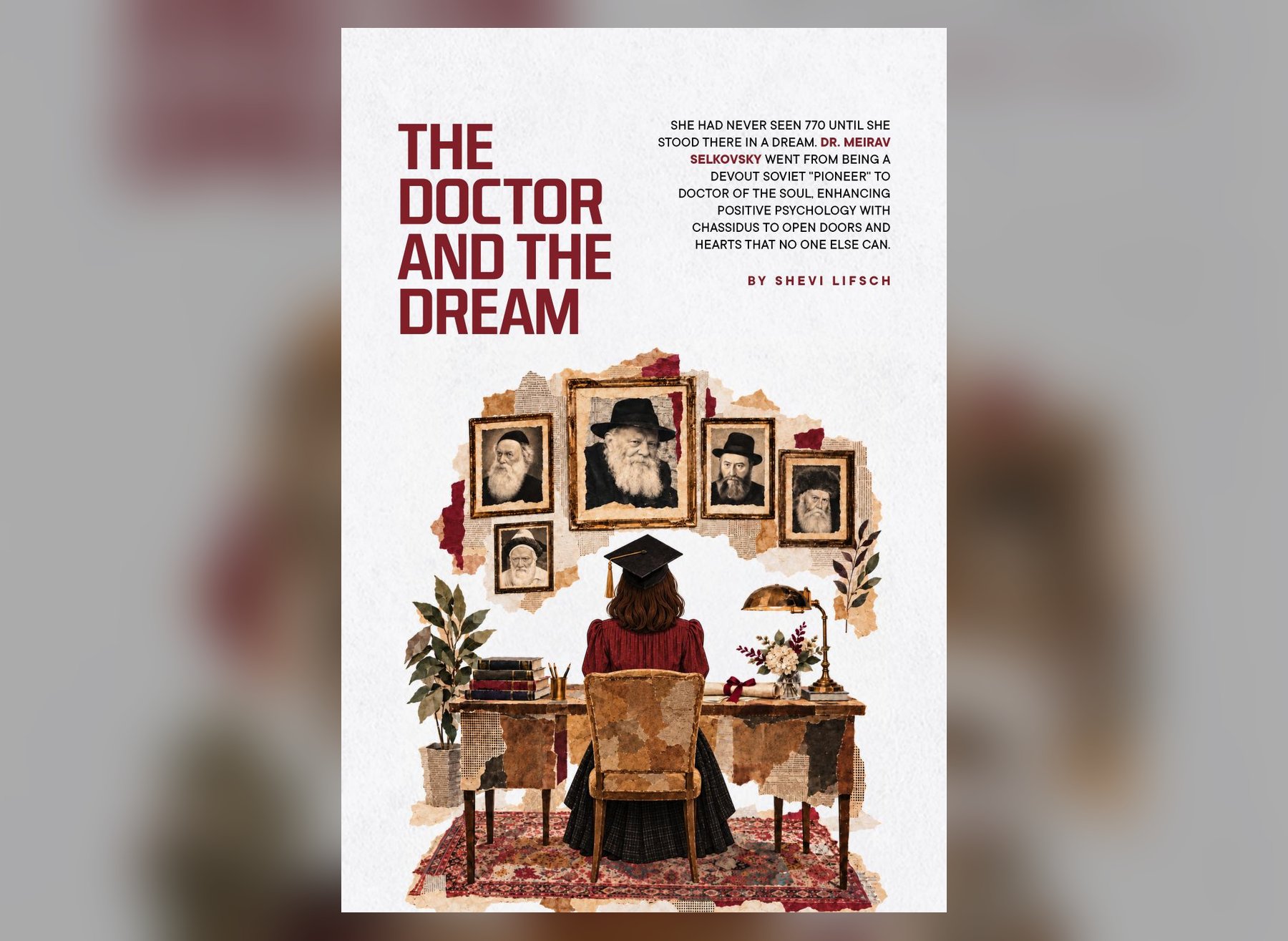
She had never seen 770 until she stood there in a dream. Dr. Meirav Selkovsky went from being a devout Soviet “Pioneer” to doctor of the soul, enhancing positive psychology with Chassidus to open doors and hearts that no one else can.
I first met Dr. Meirav Selkovsky about 15 years ago. It was at a Chanuka Yom Iyun where she gave a fascinating lecture on relationships. I remember sitting in the audience and immediately feeling that something about her captivated me. She was full of humor, sharp and candid, and she managed to enthrall an entire hall. Since then, our paths have crossed many times. I was privileged to have her on the faculty when I studied for my master’s degree in parent guidance, and today the circle closes as I have the privilege of teaching her daughters in Bnei Brak. Through her daughters I see up close how everything she teaches is not just theory. It is all alive, relevant, and clearly well implemented within the home itself.
Meirav is a rare combination that is hard to find these days. On one hand, she is an academic, a doctor of education, an expert in positive psychology, a personal coach with a thriving clinic, a professional, and above all a Chassidic woman of the highest caliber. On the other hand, I have never met a person more direct, honest, and down-to-earth. She shares from her personal life without filters or masks, and that is probably the secret of the charm that turns every lecture of hers, like the one she gave at our Chabad House, into a special experience.
But her personal story is no less fascinating than her degrees. She grew up in the Soviet Union, had a difficult time as a teenager, and made a 180-degree turn into the world of Torah, mitzvos, and hiskashrus to the Rebbe MH’M. I sat down with her for a conversation about the road she has traveled, about psychology and Chassidus, and about the work that never stops for a moment.
You grew up in a different world and had a fascinating journey. Please tell us about it.
“You know, it amazes me to think that everything that happens to us, once in a lifetime, leads us to the present moment, so that we become who we were meant to be. Ever since I was a little girl, I went out on ‘mivtzaim’, except these were ‘Soviet mivtzaim’ in a communist country. For example, a campaign to collect paper or metal for recycling as part of the activities of the ‘Pioneers’, a Soviet youth movement. I was shaped with a passion of faith in great ideals and stirring values. I was raised to act in order to change the world for the better. I received my initial form of who I am today, it’s just that over time the purpose of that form was revealed. It’s like a computer: there is hardware (the physical components) and there is software, which needs a version update.
“I grew up in a country that believed in the Party and in the leader of the moment, who kept changing. My great-grandmother ate kosher, baked her own matzos for Pesach, and was a believing woman, whereas I grew up into disconnection and lack of knowledge.
“My spiritual transformation began in Israel, following a special soul journey of my mother a’h, and there is a whole article on the Hidabroot channel about the path my family took. I crossed many borders in my life: the border of Ukraine for the sake of Israel, the border of disconnection for the sake of connecting to my roots and becoming a baalas teshuva, the border of being an at-risk teenager without a matriculation certificate toward academia and completing three degrees with honors. All the strengths and discoveries I gathered along the way allow me today to help other women cross borders in their own lives: to move from despair to fulfillment, from a sour relationship to a fulfilling one, from lack of faith in themselves and the world to faith in the Creator and breaking through walls toward their dreams.
“I once invented a metaphor to explain to myself why we have challenges in life. I imagined that G-d creates us in the form of a key. Still without any shape, completely uniform. And then, with infinite love and the most personal approach there is, He begins to shape us: here He breaks, there He bends, here He scratches… That is how we receive our unique form, and then there are doors and hearts in the world that only we can open.”
Reaching the Rebbe in a Dream
Can you tell us how you came to Chabad and tell us a special miraculous story with the Rebbe that you experienced along the way?
Meirav: “It’s truly strange to think how I grew up without the Rebbe, and now I can’t grow except with the Rebbe. Basically, I have no logical explanation for it except that I was privileged to be chosen and was simply drawn with an enormous force, stronger than me, to be part of something great, to belong to the Rebbe Nasi Doreinu.
“I can tell you about something that, for me, is an open miracle. After I became religious, it took me a while to get to Chabad. I was fortunate to meet a special Rebbetzin and mashpiah, Sari Halperin, a shlucha in Holon who began inviting me to Tanya classes. Although I thanked her politely and didn’t come, she kept inviting me for a year and a half, without getting upset or alarmed that I was ‘voting with my feet’, showing that I wasn’t interested. She probably knew well that every Jew is interested in getting closer to G-d, and gave me time. And once I did come, I stayed, and slowly I began to learn.
“Even before that happened, she told me that her husband was flying to the Rebbe, and said that if I wanted, I could write and ask for a bracha. At that time I was in the middle of writing my doctorate, a big and complex project that brought me to an anxiety attack every week. I was frightened and lost, and the idea that I could receive a bracha for success gave me hope. So I wrote to the Rebbe asking for a bracha for writing my doctorate.
“Two days after Rabbi Halperin left the country, I had a dream. I saw myself standing in a special and somewhat strange place, looking at what was happening as if from above. I saw hundreds of Chassidim below, and I didn’t understand what I was seeing. Suddenly I saw the Rebbe approaching me, in the air. He stood next to me, and in the dream I began to ask him to bless me with success with the doctorate, in those words. He pondered for a few moments and then said calmly, ‘All right, we will help you,’ and walked away.
“I woke up with great inspiration and wonder. I was filled with joy and confidence. The road was still challenging, but with a different spirit. And indeed I finished the degree with honors. About two years later, a Chabad periodical came my way, and for the first time I saw 770 from the inside. I nearly fainted when I realized that this was the place I had seen in the dream, without ever having seen it physically before. I had been standing in the women’s section (which is why I saw the Chassidim from above), roughly opposite the Aron Kodesh. When I was privileged to fly to the Rebbe, I went and stood in the spot where I had stood in the dream. My soul connected to the Rebbe and was drawn to 770 beyond any logical explanation. I simply became a part of it, in one moment.”
A Chassid Is Like a Grape
“Sometimes I think that being a Chassid is a process, like the process of making wine. First, the Rebbe ‘picks’ you. Every single grape, every single Chassid, is carefully chosen. The Rebbe looks at you with his loving eyes and takes you to himself. Then the crushing process begins, like in Tishrei at 770. You are crushed, you are broken, sometimes you are bombarded. But one thing is certain: you change shape. And then, just when you think it’s time to rest, it turns out that the fermentation stage has arrived. You stew in your own juice, absorbing and releasing, again and again. Until you change essence. You used to be round, whole, full of yourself. And now you have shed every familiar form and become something new and special, the thing that causes the secrets of your soul to come out, to be revealed, and to reveal the true you. You become what is used to make Kiddush Hashem. Maybe now you can be a Chassid.”
Meirav’s description of the winemaking process leaves me pensive. The transition from rigid, achievement-oriented academia into Chassidic bittul is not a given. I remember how I came on my birthday to 770 in Kfar Chabad, partly to learn and daven, and saw her guiding a group of girls there. I was impressed by her chayus. She stood and explained the building to them just like a born Chabadnik who had hiskashrus instilled in her from the cradle. This connection, which radiates in every direction, is translated in her into action and shlichus.
Everyone Is a Shlucha
So it all began with meeting the shlucha from Holon. How did you yourself become part of the shlichus network, and how is this work expressed today?
Meirav: “We are not official shluchim, but as I understand it, no one is exempt from this title, even if they are not officially registered with Tzach. The aspiration is to be a shliach wherever you are. And I’ll give an example:
“On the 28th of Nissan this year there was a very powerful broadcast of the Chof-Ches Nissan convention, very inspiring. And when I honestly asked myself whether I had done everything I could, the answer was quite clear. I made a good hachlata to fulfill an old dream, to teach Shaar HaBitachon. I teach many subjects and always try to incorporate kedusha into them, to teach them from a Chassidic perspective. But usually that is a wrapper; at the center stands adolescence, viewed through Chassidic eyes. At the center are psychological theories of development, which are passed through a filter of holiness. So I truly dreamed of putting G-d at the center and teaching about Him… if one may say so.
“I told myself it could be an excellent idea to start a class like that in Ashdod, where I teach at ‘Beit HaMorah’, and surely one of my students would help me. I picked up the phone to one of the students, a particularly sweet one, and she was so happy about the idea and said, ‘Sure, I’ll publicize it right away! Only…’, she reminded me, ‘I’m not from Ashdod. I’m from Netivot.’ Oops… I told her that if by Divine providence I had spoken with her, I would come to Netivot. But I had made a good hachlata to teach Shaaar HaBitachon in Ashdod… so another class was opened in Ashdod as well.
“These are two completely different populations! In Netivot there are lovely women from the community of Rav Abergil, wonderfully connected to the Rebbe. Teaching them ‘Shaar HaBitachon’ in light of Chassidus (I rely heavily on the recommended book by Rabbi Arad) is a real delight! Each time a large group of nearly 50 women comes, and it is simply a celebration.
“In Ashdod, entirely different types of women come to the class, mostly Gerrer Chassidim. And the challenge there is to bring the Rebbe into the class in a subtle way. Boruch Hashem, I get to see with my own eyes what it does to a woman when she is connected to pnimiyus ha’Torah. There isn’t a single week in which I don’t receive feedback about how their lives are changing for the better. In every class I feel a deeply moving sense of shlichus and hashpaah!”
Be Who You Want Them to Be
Meirav’s ability to take a lofty divine idea and make it accessible to two such different populations is exactly what makes her a fascinating educator. But the real chochma is not only to lecture outside, but to bring it inside, into the home, to the children.
In the past I was privileged to study parent guidance with you, and today I teach your daughters… Can you give readers a few practical tools for chinuch and for life: how do you connect children to the Rebbe, so that they feel a personal connection?
Meirav: “I think the most practical tool for chinuch is to be the person you want your children to become in the future. You want them to live Geula? Be crazy about it! You want them to live meaningful lives? Give them mountains of meaning and make them meaningful within the home. You want them to live the Rebbe? Make it as personal as it gets!
“I remember that one year I had a transportation crisis with my son. He was maybe in fourth grade. At the beginning of the year there were always very stormy interactions with the carpool, i.e. fights. After a week or two some kind of social hierarchy would be established and everyone would calm down. That year the adjustment period had already passed, but the fighting continued in the yard of the cheder once they arrived. I made it clear and told my son that this was intolerable and that in two days I would come to the cheder to go through the classes, write down the names of the boys and the names of their mothers, and travel to 770 in Kfar Chabad to write to the Rebbe, who would ‘take care of’ his Chassidim!
“On the morning when I was already getting ready to go, my son says: ‘Ima, it’s not necessary. We worked it out.’
‘How did that happen?’ I asked. And he told me that he found words to calm things down and stop the violence. Wow, I was surprised! ‘What happened that this is what you chose to do?’ I asked. He lowered his eyes and answered: ‘I was ashamed before the Rebbe…’ It was a moment of nachas; I felt that the Rebbe was ‘his,’ personal.”
Truly moving. And how do you personally manage to be doing, giving, and working all your life, without burning out or sinking?
Meirav: “In general, I believe that our children and students are the best shluchim to connect us and keep us vibrant in our avodas Hashem. I teach in informal education at Beis Rivkah and this year I finished a bit disappointed. Last year I was in great spiritual heights with my students, and this year I couldn’t replicate it. It would have been very comfortable to think that maybe something was wrong with the students, yeridas ha’doros, and so on, but when I looked inward, I saw clearly that my students demand dynamism, movement, keeping pace with the progress of the generation, and not that the generation is declining.
“I simply can’t allow myself to replicate successes; you have to create them anew each time. Children don’t forgive us for recycled education… And I’m excited and curious about the coming school year, to see what kind of person, what kind of teacher, what kind of ‘Chassida’ I am going to be in order to be relevant and meaningful, and not some educational ‘alte zachen’ (old stuff)…”
Beis Moshiach #1530 • ג׳ כסלו תשפ״ז • pp. 42-46
© 2026 Beis Moshiach Magazine. All rights reserved.
This article originally appeared in Beis Moshiach #1530. You are welcome to share it with friends and family by email or in print, provided that you do not change, add to or omit any part of it, you credit the author and Beis Moshiach, and you include a link to archive.bmoshiach.org (written out in full in printed copies).
To republish this article in a newspaper, magazine, book or website, please request permission in advance at [email protected].