When the Zeidy Cries More Than the Baby

A boy who defied his mother; a man whose wife said, “Don’t come home”; and a homeless Jew who wanted to be named Esav… From summer camps in Russia to living rooms that never let a rabbi in, veteran mohel Rabbi Levi Yitzchok Heber has seen Jews give everything for a bris. What is it about this mitzva that no Jew can resist? He shares stories from thousands of brissin.
On the morning after Yom Kippur this year, a Jewish man, a father of a family, walked into the home of Rabbi Levi Yitzchok Heber. Rabbi Heber had already been the mohel for his two sons. This time the man came for himself.
“I knew him as a ten-year-old boy at Camp Gan Yisrael in Russia,” R’ Heber recalls. “A refined boy who learned well and did everything he was asked. Only one thing terrified him: the bris. He came to camp one year and a second year, and we saw it was impossible.”
The years passed. The boy from Russia became a father in the United States, and his connection with the mohel never broke. “He invited me to perform the bris of his son, during Covid. Afterward he called me again, for the second son. His children wear yarmulkas and tzitzis and attend religious schools and you can’t tell them apart from any other religious child. But the father has no bris. Does anyone know? No one. And I, gently, stayed in touch with him.”
Before this past Rosh Hashana, R’ Heber sent him a message, as he does every year, trying to inspire him for the new year. The reply was that in a few months he would be ready. “That was already a big step forward. He had limited it to months. I wrote back: why a few months? Rosh Hashana, a new year. Then he started asking: how much time off work does it take? How painful is it? When I heard the questions, I realized he was about to make a decision.
“I waited thirty-three years for him to come. And on the morning after Yom Kippur he came to my home. I have a room where I perform adult brissin. He was happy, elated, with a feeling that is hard to describe.”
R’ Heber paused for a moment, then formulated the sentence that would come up again and again throughout the conversation: “Jews truly want a bris mila. Sometimes there are obstacles and delays, there are fears, but in the end they do it. Sometimes American mothers tell me: ‘Maybe we should wait until the child grows up and decides for himself.’ I tell them: True, he will do it. But he will have complaints: why didn’t they do it at the right time, and why does he now have to go through a much longer and harder process.”
Rabbi Levi Yitzchok Heber, son of Rabbi Shmuel Heber of Crown Heights, is one of the busiest mohalim in the Jewish world: thousands of brissin for infants and adults, in Crown Heights and in the far corners of the earth. He is the founder of the “International Bris Organization,” which flies mohalim to places that have none and funds brissin for families who cannot afford them, and he is among the heads of the annual mohalim conference held during the Kinus HaShluchim. He shares special bris stories with us.
“We Weren’t Prepared For This”
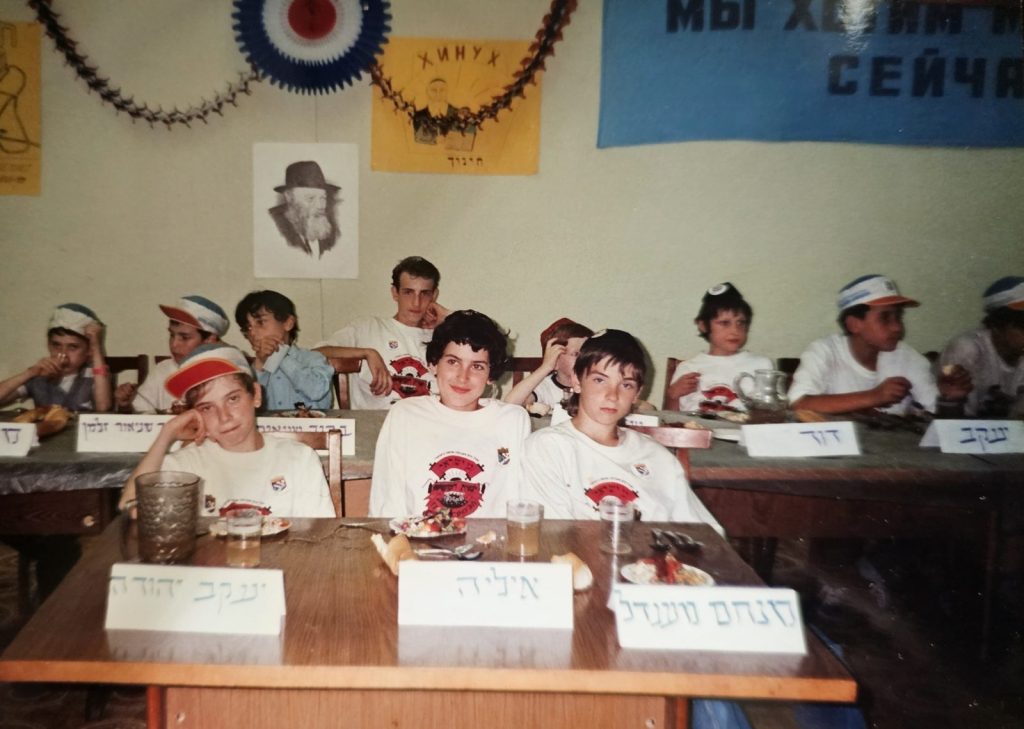
In the summer of 5750, a group of tmimim was sent to run camps in Russia. The Iron Curtain was already beginning to crack, and Heber, a young bachur, was one of the people in charge of the camp.
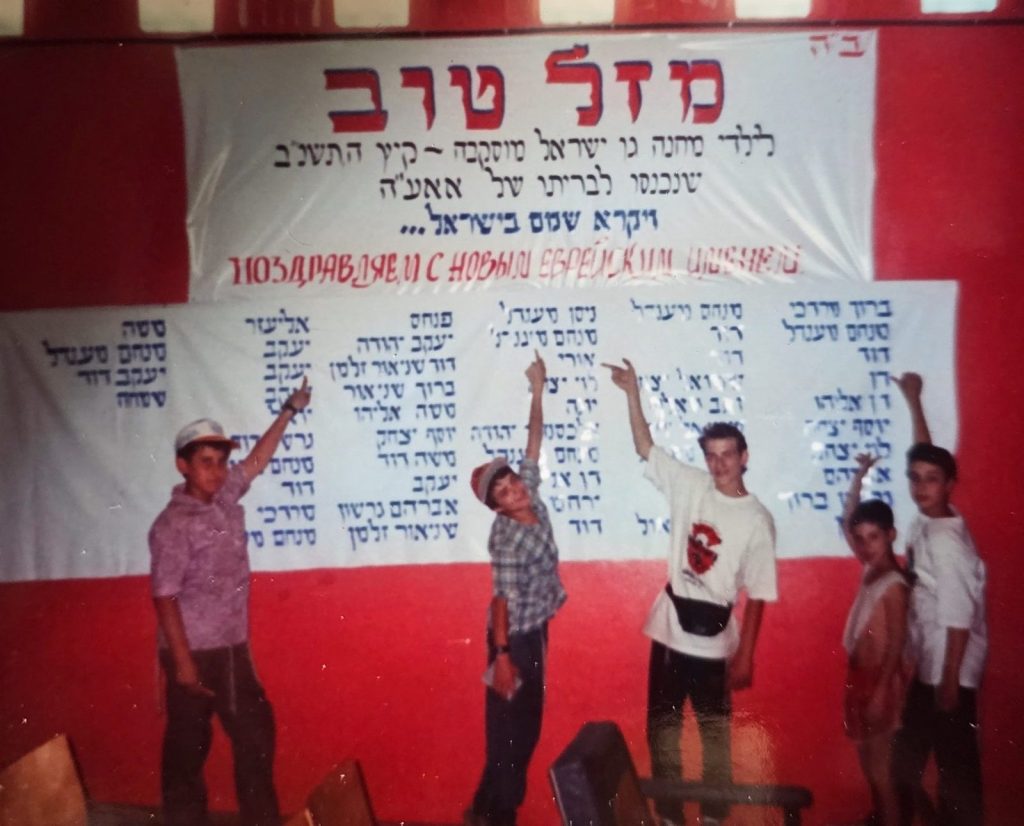
“We equipped ourselves with everything a camp needs, and we knew we had to add things a regular camp doesn’t need: yarmulkas, tzitzis, mezuzos, tefillin. But there was one situation we weren’t prepared for, that not a single child had a bris. It was a complete surprise. We understood that besides the job of educating them and instilling warmth of Yiddishkeit, there was another thing to work on here. But we had neither the knowledge nor the preparation.”
At that time a Chassid named Rabbi Avrohom Genin was active in Russia, who had organized underground brissin in the years when the regime was at its peak. Now he joined the effort: he brought a Russian doctor who arranged everything and performed the brissin himself.
“What affected me most powerfully was the mesirus nefesh of the children. Teenagers who hadn’t learned the alef-beis, and they simply wanted to do what G-d asks of them, even to the extent of a bris. Remember, this was a camp, so after the bris there were no games and no pool… And the bris itself wasn’t done with the fine anesthetics available in the United States. Where does this strength come from? It showed me that this mitzva touches the very essence of the neshama. It isn’t about understanding, or learning, or anything else.”
“And after the essence of the soul shone within them, we saw how they changed. They had already crossed the most important threshold, so what was it for them to eat kosher? Or to put on tefillin?”
In the following years he returned to Russia already knowledgeable and equipped. “In the second and third years the brissin were much better organized. At first mohalim came from America to help, then they left, and I continued on my own.” He traveled there five years in a row. “And now I perform brissin for the children of those who were in the camp. And there are already brissin for the grandchildren.”
The First Mila Knife
He bought his first mila knife in Eretz Yisrael on his grandfather’s instructions. “My grandfather, Rabbi Yisroel Tzvi Heber, was once sent on a shlichus to Romania. He was a shochet, and he also learned mila so he could perform brissin there. On my way to Russia I passed through Eretz Yisrael to meet him. When he heard I was learning mila, he said to me: go to such-and-such a store and buy yourself equipment, a knife and everything needed for mila. I told him: But I’ve only just begun learning, I haven’t gotten to the practical part yet. ‘Buy it. You’re going to Russia, you should have it,’ he said, and added, ‘Buy the best, and tell the seller I sent you.’ With kabbolas ol, I bought it.”
That same summer a mohel from the U.S. came to the camp. “He began to circumcise, and suddenly I noticed that his knife wasn’t sharp enough. I said to him: I’m the camp director, and you can’t continue with this knife. He replied: This is what I have. I said: First of all, I have a stone for sharpening. And second, I have a high-quality mila knife.”
[I had also learned shechita from my grandfather, Rabbi Yisroel Shimon Kalmenson, the Rebbe’s shochet, so I had a stone for sharpening knives. Incidentally, he encouraged me to learn mila.]
“He was in shock,” Rabbi Heber laughs. “I took out the knife and said, This is my knife, and I will do the bris. You stand on my right and arrange everything, and I will do the mila. That was my first bris.”
He had acquired the fundamentals of the profession even earlier in New York, from the renowned mohel Rabbi Avrohom Cohen a’h, the famous “Romi” Cohen, a former partisan and one of the great mohalim in the U.S., who performed the adult brissin for the F.R.E.E. organization for Russian immigrants. “I learned from him, I went with him, I accompanied him everywhere, but I didn’t get to do a bris. When I returned from Russia and told him I had performed brissin, he was very happy.”
The Rebbe Asked: You’re Going Too?
On the Shabbos before the trip he received mashke from the Rebbe at a farbrengen, and on Sunday he passed by at the dollar distribution. “We were a group of bachurim, and I was third in line. Rabbi Groner told the Rebbe that this group was traveling to Russia for camp. The Rebbe gave to the first, to the second, and when my turn came he asked: ‘Du forst oich in camp?’ (You’re also going to camp?) I answered yes, and I had no idea why the Rebbe singled me out.”
The answer came that very night. “I was supposed to fly before everyone else, to prepare the camp. I arrived at the airport, and there was a mistake in the visa. In America you write the month first and then the day, and in Russia it’s the opposite. It turned out my visa only took effect a month later. They told me: you can’t fly, they won’t admit you. Someone had to fly to Washington and fix the visa so I could travel with everyone. And I felt that the Rebbe’s question was the bracha, that everything would be all right.”
They summed up that summer for the Rebbe in more than a report. “We told the children to write to the Rebbe. Each child wrote in Russian that he had a bris, that he had a bar mitzva. Besides our report, we brought the Rebbe hundreds of pages from the camp children. And we heard afterward that some children received a reply from the Rebbe about their bar mitzva.”
In the year 5753 an idea occurred to him. “I heard that the Rebbe watches videos of shluchim’s activities. We put together a twenty-minute tape of all the camp’s activities and submitted it through Rabbi Binyomin Klein. A few days later Rabbi Klein told me that he had shown it to the Rebbe, that the Rebbe was pleased, and that he would watch it again. Then he began asking me questions about the video and I realized he had been present when the Rebbe watched it.
“In the tape you can see the children washing their hands for ‘hamotzi.’ We didn’t have washing cups, we had regular cups. You see a child wash one hand, then hold the cup in his sweater and wash the other hand. Rabbi Klein asked: What is this? How did you teach them to do this? And I understood. A child who doesn’t know how to read the alef saw what the counselors do and did exactly as they did. For him, putting on tefillin and washing a hand like that are the same thing. It’s all HaKadosh Boruch Hu. That is Yiddishkeit.”
The Bris, the Slap, and the Smile
“There was a boy who truly wanted a bris. But he was an only child, and his mother was afraid and didn’t give him permission. Absolutely not. Every Sunday she would come to visit the camp, and we tried to speak with her, but there was no one to talk to. The boy was at camp one year and another year, and in the second year he reached bar mitzva age. We held a party for all the children, and then he came and said: Now I’m thirteen, and I can decide for myself. I want a bris! We knew that a week earlier the mother had said no. But we took the risk and performed the bris.
“Usually, when parents arrive, we tell them mazel tov and sometimes the father hears and says: I want one too, and then we do the father, and the grandfather as well. But here the boy asked that we just don’t tell her. Everyone knew to keep quiet. She came, he tried to act normal, and the visit passed peacefully. After two or three weeks he could no longer keep the secret, after all, she’s his mother. I was there when he told her, and I saw the reaction with my own eyes. She gave him such a slap that his glasses flew off. She told him ‘Don’t come home,’ and ran out of the camp.
“We did everything we could to calm the boy: Don’t worry, you’re here with us, and we will always take care of you. But we truly didn’t know what would happen. A week later the mother came back… after all, she’s a mother. They worked it out.”
The happy ending of the story took place in America. “Many years later he called me and invited me to his wedding. I came, and his mother told everyone that her son is religious thanks to the Rebbe and Chabad, thanks to me and thanks to the camp. A year later he called with the news: I have a son, and I want you to perform his bris. I came, and his mother was there. I approached her and asked: Do you allow me to perform a bris for your grandson? She smiled. She understood what I meant.”
“Don’t Come Home”
“Avrohom Avinu was the first to make a bris and we laud him for this because he ‘opened the channel.’ But sometimes one can be inspired by Jews in our own generation.
“An older Jewish man, married, called me. He wanted a bris but was very afraid. I arranged a meeting with him just to talk, without a bris. I explained, and in the end he decided: Thursday, at a Chabad House an hour from here. I arrived with all the equipment, looked at him, and his face told me he was seriously traumatized. I asked: Is everything all right? And he said in a trembling voice: Before I left the house my wife found out I was going to have a bris, and she said to me: If you do a bris, don’t come home. I told him: The decision is yours, and I’m here to help. If you need time to think, take it; the desire must come from you. The shliach told him: I have a room, go in, think, we’ll wait. Meanwhile we said Tehillim for him. I asked if his wife was Jewish. He said: No. I thought to myself: may Hashem help him. After a while he came out of the room and said: I want to do the bris.
“After I finished the bris, I told him: That’s it, you’re already circumcised. And you can see the light on the face. Everyone who goes through this has a light. With him I saw only a little light, but also a different reaction, a lot of worry about the future. He said: I don’t know where I’m going back to. And I had completely forgotten about it. During a bris I’m totally immersed in the holy task, and that point flew out of my head. And suddenly it came back: he has nowhere to go back to! He has a bris, and his wife won’t take him home.
“Then I thought to myself: Avrohom Avinu was ninety-nine, true. But G-d spoke to him directly. And he had Aner, Eshkol and Mamrei, the allies of Avrohom, who encouraged him, and surely Sarah Imeinu also encouraged and supported him. Now consider this Jew: G-d didn’t speak to him directly. There’s no one to encourage him. His wife isn’t with him, he has nowhere to return to, and he decides to have a bris! This is mesirus nefesh on top of mesirus nefesh. And who is he? He didn’t learn Chassidus, he’s not at a level of understanding in the matter. It’s the essence of the soul, which doesn’t want to and cannot be disconnected, and he wants a bris at any price.”
“I Can Find You a Greater Hunter Than Esav”
“Rabbi Groner once told me that when he would report to the Rebbe about a bris and the name given to the baby, the Rebbe would ask: ‘A nomen noch vemen?’ (Named after whom?). Once, when they said the name wasn’t after anyone, the Rebbe named a Chassid who had that name. This means there is great importance to the person after whom one is named. So when it comes to names, I try to make sure they are normal names.
“Recently I had a story with a forsaken, homeless Jew whom a shliach of the Rebbe in his area brought close and brought to his home for Rosh Hashana. Then it came out that he didn’t have a kosher bris. I checked, and told him: In your situation, hatafas dam bris isn’t enough. You need a bris. He thought for a moment and said: Yes, I’m ready.
“I asked: What name do you choose? He answered: Esav. He had read that Esav was a hunter, and he likes hunting. And he also heard that actually Esav’s soul was good… I tried suggesting other names, but no, he specifically wanted Esav. I asked him: Your point is hunting? Yes. I can find you a more expert hunter than Esav, and there’s something good in it too. Who? Zev (Wolf). ‘Zev yitrof’ (the wolf will prey), a wolf is also a person who preys on good things. He lit up, and his name is Zev.”
The oldest man R’ Heber has circumcised was eighty-seven:
“In Chicago, at the Chabad House of Rabbi Shmuel Notik of the F.R.E.E. Organization, I performed a bris for an eight-year-old boy. And what’s interesting is that I also circumcised his father, his grandfather and his great-grandfather. It started with the grandfather, then the father, then the great-grandfather, and finally the boy. Not on the same day, it took time.
“In Russia we learned, until the bris has happened, it hasn’t happened. In a religious family, when a baby is born you know there will be a bris. With adults, the Satan works so hard that until it happens you can’t be sure it will. You schedule for Monday, and motzoei Shabbos they call: suddenly he’s sick, suddenly he has to fly. The Satan tries to delay even the mohel. But, thank G-d, I see miracles, and the statistics are beyond nature. I would arrive at the airport, and on the arrivals and departures board almost all the flights were canceled because of weather. Except mine. In certain periods I flew very frequently, and my flight was never once canceled. Miracles upon miracles.”
Today he flies less; the “International Bris Organization,” which he founded in 5771 (2011), locates mohalim, many of them shluchim, flies them out, and covers the costs for families who cannot pay. “We have a mohalim conference during the Kinus HaShluchim. Many mohalim come and encourage one another.”
“Yesterday the Boy Had a Bris”
“Many times I need to persuade parents to have a bris. Shluchim refer such cases to me. There was one such family on a small island, and just then Covid broke out. We arranged a mohel, but the father, a non-religious Israeli, specifically wanted a doctor. There’s an issue with Israelis in that in Israel there are doctors certified to perform mila, so when Israelis come here, they’re sure that here too a doctor performs a bris. In America it’s the opposite: doctors hire mohalim. If he’s a doctor he’s not a mohel, and if he’s a mohel he’s not a doctor.
“I told him: Wait, I’m sending a mohel. He insisted: ‘I want a doctor.’ Meanwhile the skies closed, and anyone who flew had to quarantine for two weeks. I told him: I’ll send you a religious doctor who’s willing to quarantine for two weeks to perform the bris. Then he said he specifically wanted a doctor licensed in their area. For everything I said, he found a reason to delay. Until he reached the point where he said decisively: I’m not doing a bris for him. When the boy grows up, he’ll decide for himself.
“It hurt very much. Each time I called the mother: when can we do it? The father doesn’t want to. A year, two, three, four. What can be done? But I don’t give up on them. Before Rosh Hashana this year I wrote to the mother: Shana tova. I’m here, ready and willing whenever you need. She didn’t answer. A week later, still before Rosh Hashana, she wrote me: ‘Yesterday the boy had a bris.’”
“I called the grandmother to find out. The boy, who was six, went to Chabad’s Gan Yisrael camp in Canada and somehow heard about the bris and realized that he didn’t have one… He began asking at home why he doesn’t have a bris, and demanded answers. He knew it would hurt, and nevertheless he demanded of his father to give him a bris. The father tried to convince him not to, but the boy insisted, and the father could no longer say no. Rabbi Yisroel Goldstein, a local mohel and shliach, performed the bris after the camp ended. At age six it isn’t easy; he’s no longer young enough not to understand, and not yet old enough to grasp. But he did it with inspiring heroism.”
When the Doctor Says “No” and the Mohel Says “Yes”
Parents aren’t the only ones who need persuading. Sometimes it’s doctors. “There are times when the doctor says a bris can be done, and the mohel has to say it’s forbidden, because according to halacha it still can’t be done. And there are times when the doctor says it’s forbidden, and the mohel has to say it’s permitted. It’s a great responsibility. Jaundice, for example: for doctors, high jaundice isn’t a problem, and according to halacha it’s forbidden. When the parents aren’t religious and the doctor said one thing and the mohel said another, whom will they accept? The doctor knows, you’re just a rabbi. But if you speak with them and with the doctor in their language and in detail, they realize you know exactly what you’re saying, and they agree to wait until the jaundice passes.
“And there’s the reverse: sometimes the child needs to undergo a medical procedure in six months, and the doctor, who doesn’t want the child to go through two procedures within half a year, asks to combine them and says they must wait. But a bris isn’t surgery; you can have the bris, and the medical procedure after six months. So I tell the parents: here’s a senior pediatric urologist, ask him. I arrange an appointment for them with Prof. Jeffrey Stock, head of the pediatric urology department at Mount Sinai Hospital in New York. Usually there’s a wait of several weeks for an appointment with him, but for questions like these he agrees to see them almost immediately. In ninety percent of cases he says: no question, the mohel can perform the bris.
“At the mohalim conventions that we organize, big doctors and rabbanim come and speak about new things a mohel needs to understand and know,” adds R’ Heber, and reveals: “I’m writing a book on medicine for mohalim so they’ll have medical knowledge and know how to talk with doctors in cases like these.”
“I’m the Baal HaBayis Here.”
Most brisim take place in the family’s private home, and when R’ Heber walks into a house he doesn’t feel like a guest. “I heard from the son of the mohel Rabbi Gutman Baras that the Rebbe told his father: when you enter a house to perform a bris, you are the baal ha’bayis. That’s how you should feel. So I arrive and tell them to move a table, move the chairs. I’m the master of the house here. I don’t come in gently and discreetly, ‘let’s do the bris and run.’ No. You need to put on tefillin, it’s part of the ceremony. The mother needs to light candles. There’s no mezuza here? You need to put up a mezuza! And they accept it respectfully. Sometimes these are families who would never let a rabbi into their home, and here I am walking in.
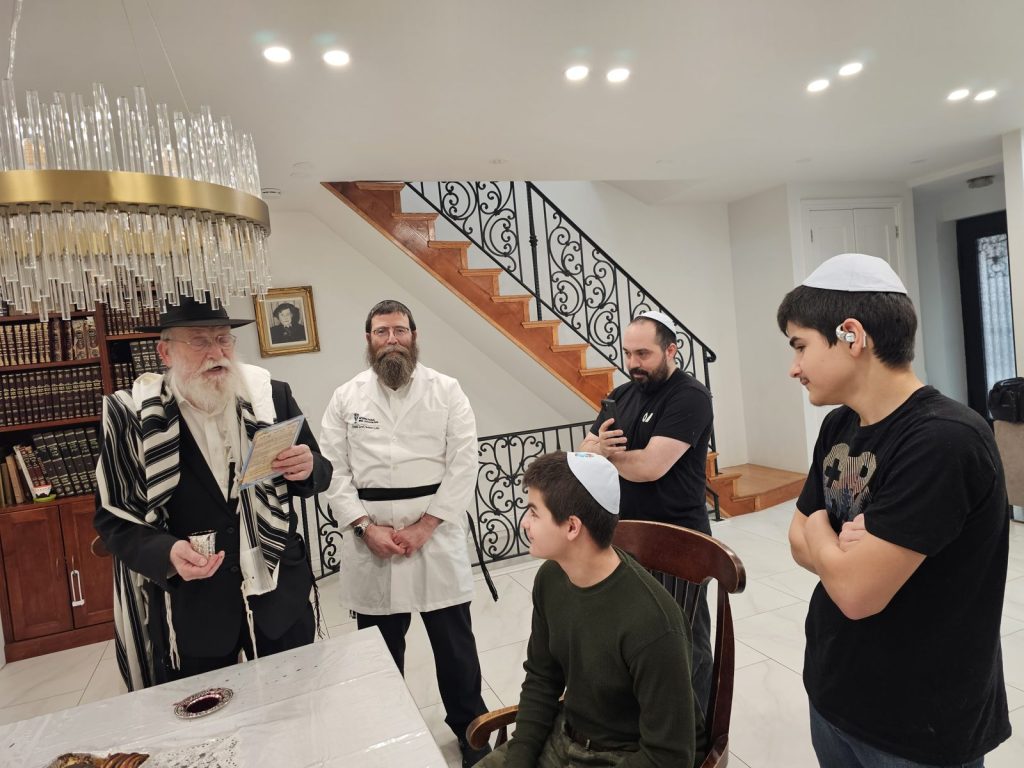
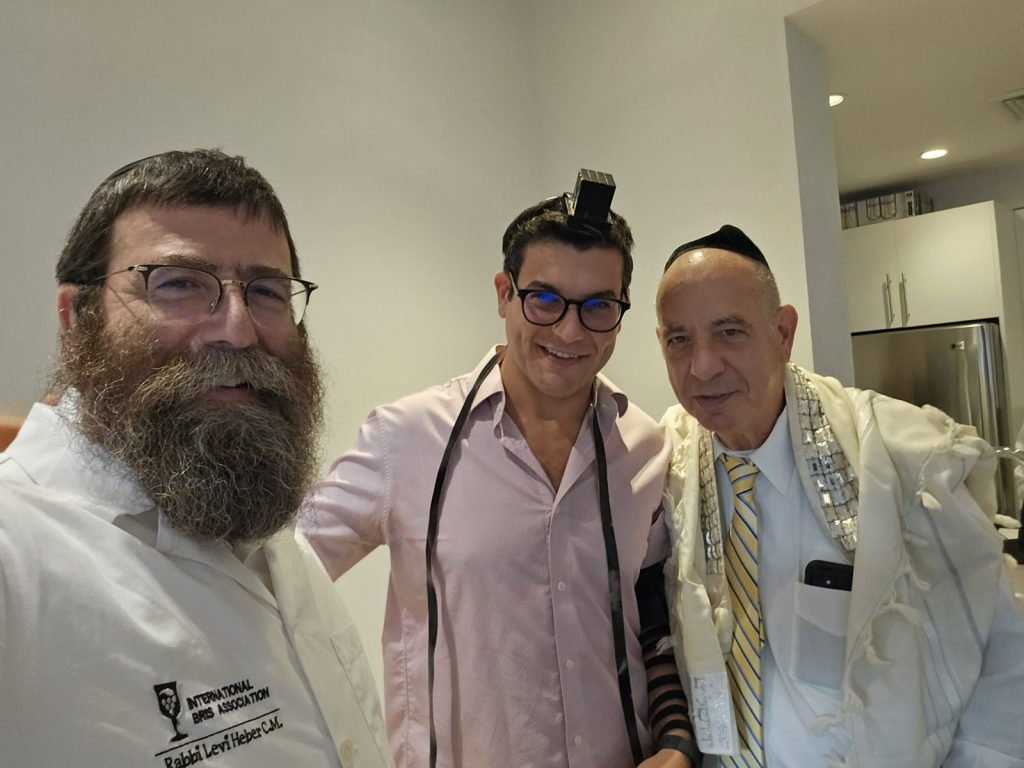
“I just came from a bris at the home of someone with nothing Jewish in it. I talked with them about Shabbos candles: you now have another child, the mother needs to illuminate his mazal, and the way to do that is to light Shabbos candles and think of him. How could she not do it? And she called after Shabbos to thank me. Sometimes I say this in the phone call before the bris, and when I arrive they’re already showing me the candles, and the grandmother says: I gave her the candlesticks I had from my mother. This is a mitzva that opens the door, the heart, the soul.” For every bris he brings mezuzos to put up in the home if needed, and the sandek and the father put on tefillin.
The Sandek Who Cries More Than the Baby
“A grandfather who doesn’t put on tefillin? I tell him: You’re the sandek, you want the bris to be a success? This is preparation for the bris. And sometimes I detect who’s going to be difficult for me: brazen Israelis who prepared for you to say ‘tefillin’ and for them to say ‘no.’ So I bring them into the process gently: You’re the grandfather? Come, sit in the chair, I want to see that it’s comfortable for you. Here’s the pillow, this is how you hold the child. Comfortable? Yes. Now get up, you need to put on tefillin. I don’t ask whether he wants to. First he sat on Eliyahu’s chair, and once he’s already listened to you, will he suddenly say no? One man said: I’m a Jew in my heart. I told him, you don’t do a bris in the heart, you do a bris in practice. And sometimes I ‘threaten’ as a joke: either you put on tefillin, or we do a bris on you. When it comes down to it, everyone puts them on.
“And then you see something wonderful and moving—that same man who a moment earlier refused to put on tefillin starts crying as he holds the child. You’ve broken the kelipa. He thought he was protected, that all this was only for the child, that G-d is not for him. Suddenly he put on tefillin after telling himself he’d never do it, and he’s holding the child on Eliyahu’s chair, and starts crying more than the baby.
“I tell everyone: how do I know the bris was a success? When the father or grandfather cries more than the baby. One man told me: I haven’t cried since the Yom Kippur War. After what I saw there, I thought I would never cry. And he cried like a baby. And the child, not so much…
“For every bris, even with people not connected to Chabad, I bring a letter from the Rebbe and tell them this is an auspicious time for blessings, and this is a blessing from the Rebbe. And I put the Rebbe’s picture under the pillow. I feel that the Rebbe is present, helping, being mashpia, and granting success to the bris and to the parents.”
Even doctors aren’t immune. “Today I performed a bris, and the grandfather, a surgeon, a great expert, was the sandek. After the bris he said to his daughter: They do it much better than we do. Once there were twins, and the father, a surgeon, said to me: Maybe I’ll do it? I said: Of course, it’s your mitzva. I’ll do the first one, you watch, and you do the second. After the first bris I asked him: nu? He said: After seeing what you did, with such speed and expertise, there’s no way I’m doing it. My wife would kill me…”
“Who’s the Hypocrite Here?”
R’ Heber’s stories keep coming without pause… “Not long ago a woman called me: ‘Do you remember you were at our house ten years ago, at my son’s bris? You talked with my father. What did you say to him?’ I asked: What happened? She said: Since then he’s a different person. He puts on tefillin.
“I remembered: it was a bris on Shabbos. The shliach couldn’t come, and I was the only Chabadnik in a home that wasn’t Shabbos-observant. The grandfather, an Israeli who had come from Israel, was the sandek. After the bris I stayed for Kiddush and the meal, since what else did I have to do on Shabbos, and I started in with the grandfather: What’s your story? It turned out he had been in yeshiva when he was young, then went to the army and left everything. I started talking to him about going back to putting on tefillin, and his daughter said to me: there’s nothing to talk about with him. And he said: I don’t want to be a hypocrite. I don’t believe, so don’t tell me to put on tefillin.
“I said to him: You came from Israel to be the sandek for your grandson. You sat in the chair, you held the legs of a crying child, and you were ready for blood to be drawn from him for G-d’s sake. And not just ready, you held him down with force. Blood, from the child. And from yourself, three minutes a day, to put on tefillin and pray that this child will have ‘that your days and the days of your children may be increased,’ no? Who’s the hypocrite here? From him you demand, and from yourself you don’t? That’s the biggest hypocrite of all!
“And now the daughter calls after ten years to tell me: since the bris my father is a different person. A bris is a time when you can touch the neshama.”
Sometimes what’s needed is diplomacy. “A couple in New Jersey, an Israeli father and an American mother. I put tefillin on her father, who was supposed to be the sandek. Then the baby’s father told me: A friend of mine has arrived, and I want him to be the sandek. Why not the father-in-law? Because his own father told him the sandek has to be religious. I went into the room to check on the baby, and the parents were in the middle of an argument: he said, my friend; she said, absolutely not, my father. And both turned to me. I knew that whatever I said, one of them would be angry. I said: Truly, your father is right. He immediately said: You see? You don’t understand anything. I said: But! I just put tefillin on the grandfather. Now the grandfather is a tzaddik. What does a tzaddik do? Puts on tefillin. Whether he’ll put them on tomorrow is not our business. Right now he put them on, right now he’s a tzaddik, and he fulfills exactly what your father said. Shalom al Yisrael.”
The Only Chabadnik in the Room
During the years when the New York City government tried to restrict the practice of metzitza as prescribed by halacha, R’ Heber stood at the forefront of the struggle together with Rabbi Avrohom Cohen and with mohalim and askanim from all circles. “We worked with Satmar then. They had a kinus and asked me to speak. I told them about a non-religious woman who said to me: ‘Do the bris accounting for the situation.’ She didn’t even know exactly what the fight was about, but she wanted me to do it the way the Reform claim…
“I explained to her: Your child and the rabbi’s child are both Jewish children, both pure. There’s no secular and no religious, no Sephardi and no Ashkenazi at that age. There’s G-d and there’s the bris, and for everyone it’s the same. After me a Satmar Chassid stood up and said he now had an answer to a question that had been bothering him: why is it specifically at a bris that Chabad and Satmar work together? Because this is a mitzva in which there’s no difference at all.”
After the struggle was resolved, a special kinus of askanim, rabbanim, and mohalim took place. “We beat the government, but the brouhaha had weakened the bris, and they wanted to discuss how to strengthen it. I arrived a few minutes late and found chaos. Someone had asked a question, they had no answer, and because of that they couldn’t continue. When I came in they said: maybe the Chabadnik can help. I was the only Chabadnik. And the question: what is this meeting for? The weakening is among those who don’t keep Shabbos. What do we care about them? We don’t hold meetings about the fact that those who are mechalel Shabbos don’t eat kosher. I asked them to repeat the question, I couldn’t believe it. Every Chabad boy would laugh at such a question, but these are rabbanim and askanim.
“I told them three things. First: who doesn’t keep Shabbos, the father? What does that have to do with the child? This child keeps Shabbos exactly like your child! Second: why do we hold a bris on Shabbos? Because the bris is greater than Shabbos. And who is ‘mechalel’ Shabbos for the bris? The mohel. You! Not the child. Third: the Alter Rebbe writes in Kuntres Acharon that in all the mitzvos, out of mutual responsibility, one must help one’s fellow. But the bris is more than that: if the father doesn’t circumcise his son, the court is obligated to circumcise him. This is our mitzva. Then I added: by all means, hold meetings about kashrus and Shabbos too, but at least start with the bris. And baruch Hashem, the Chabadnik gave them a reason to continue.”
The Children Are Proud of Their Father
At home too, mila is a family matter. “Baruch Hashem, I have three sons who perform brissin. Real mohalim. And sons-in-law too: one is a shliach in Carolina and performs many brissin there, and one in Philadelphia who learned how and circumcised his own children. Apparently it’s because they grew up in a home where they see the stories, the hashgacha pratis, the children, the parents.
“Even my daughters share the feeling of shlichus. When I have a bris in Manhattan on Shabbos, a walk of three and a half, four hours, they want to come with me. Where else does a child get three and a half hours with their father, without a phone, without anyone interrupting? Pure attention. And they grow up with the chayus of everything going on around them, seeing how a person agrees to put on tefillin, asks questions, gets answers.
“Many times I’m not home on Yom Tov. If the children aren’t excited by this zechus the way I feel it, they’ll feel that I’m leaving them, that it’s a burden. So sometimes I take a child with me, sometimes two. My son went to a shliach for the Yomim Tovim, and the shliach said to him: do you remember that twelve years ago you were here with your father for a bris? And he remembered. They need to feel that when their father leaves, it’s a zechus. And those who stay home don’t feel sorry for themselves but are proud: Tatty went to do a bris.
“A mohel comes back in the evening to daven in shul and nobody knows what he went through that day. He saw Eliyahu, sometimes miracles. People put on tefillin, were moved. Three hours here, two hours there, and at the end of the day: ‘Hello, everything’s fine.’ It’s a secret. Only someone who goes around with a mohel sees how much Elokus is revealed.
“To this day, when someone twenty, thirty, fifty years old comes, lies down on the table, and is ready to have a bris, I’m moved all over again. Sometimes they say to me: thank you for coming, for going to the trouble. And I answer: As hard as it is for me, I prefer to stand rather than to lie down…”
“Eliyahu Ha’Navi Is Here”
The Rebbe demands that everything be infused with preparing the world for Geula. A mohel stands every day, at least once, beside the chair of Eliyahu, the herald of Geula. What does that look like from the inside?
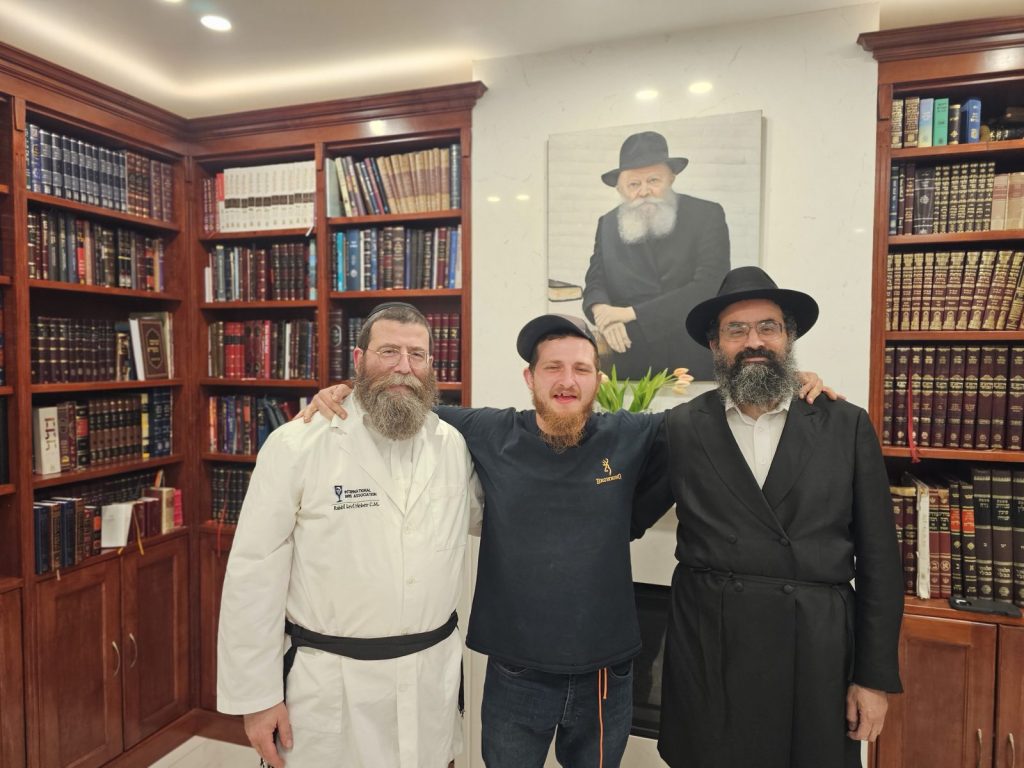
“When we do a bris, we give them the background: Eliyahu HaNavi is with us right now, here is Eliyahu’s chair. That speaks to them very much, they are moved and it gives them chizuk.
“I grew up here in the neighborhood, and it’s engraved in my blood that all the mivtzaim and everything the Rebbe did, everything has to be infused with the point of bringing the Geula. And at a bris, nobody can say no to you: Eliyahu HaNavi is here, you need a mezuza, you need candles, tefillin. All the mivtzaim can be carried out at a bris. You enter homes that don’t let rabbis in, you enter the hearts of Jews who think their hearts are closed and sealed, and you open their hearts.
“Chazal expound on the pasuk ‘And I said to you, “In your blood, live,” and I said to you, “In your blood, live””—in the zechus of the blood of mila our forefathers were redeemed from Mitzrayim, and in the merit of the blood of mila they will be redeemed from this final galus.”
Rabbi Heber adds:
“It says that before the Geula there will be a weakening in the mitzvos, like tefillin, except for the mitzva of mila, because they accepted it with mesirus nefesh, and therefore it stands by them. And we see this! What does a person who doesn’t keep Torah and mitzvos, doesn’t eat kosher, doesn’t go to shul, have to do with calling a mohel? Yet, ninety-nine percent call on their own. It’s the essence of the soul.”
And until Eliyahu HaNavi rises from the chair prepared for him at every bris and announces the good news, R’ Heber continues preparing the home to welcome Moshiach: a mezuza on the door, candles on the table, tefillin on the grandfather’s arm, and one more Jew in the bris of Avrohom Avinu.
Beis Moshiach #1531 • 10 Kislev 5787 • י׳ כסלו תשפ״ז • pp. 12-23, 35
© 2026 Beis Moshiach Magazine. All rights reserved.
This article originally appeared in Beis Moshiach #1531. You are welcome to share it with friends and family by email or in print, provided that you do not change, add to or omit any part of it, you credit the author and Beis Moshiach, and you include a link to archive.bmoshiach.org (written out in full in printed copies).
To republish this article in a newspaper, magazine, book or website, please request permission in advance at [email protected].