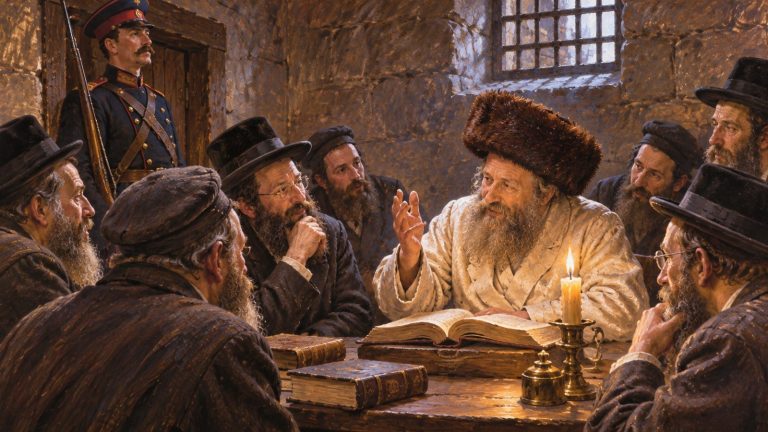
Uncensored: Why the Rebbe Defied the IDF Censor
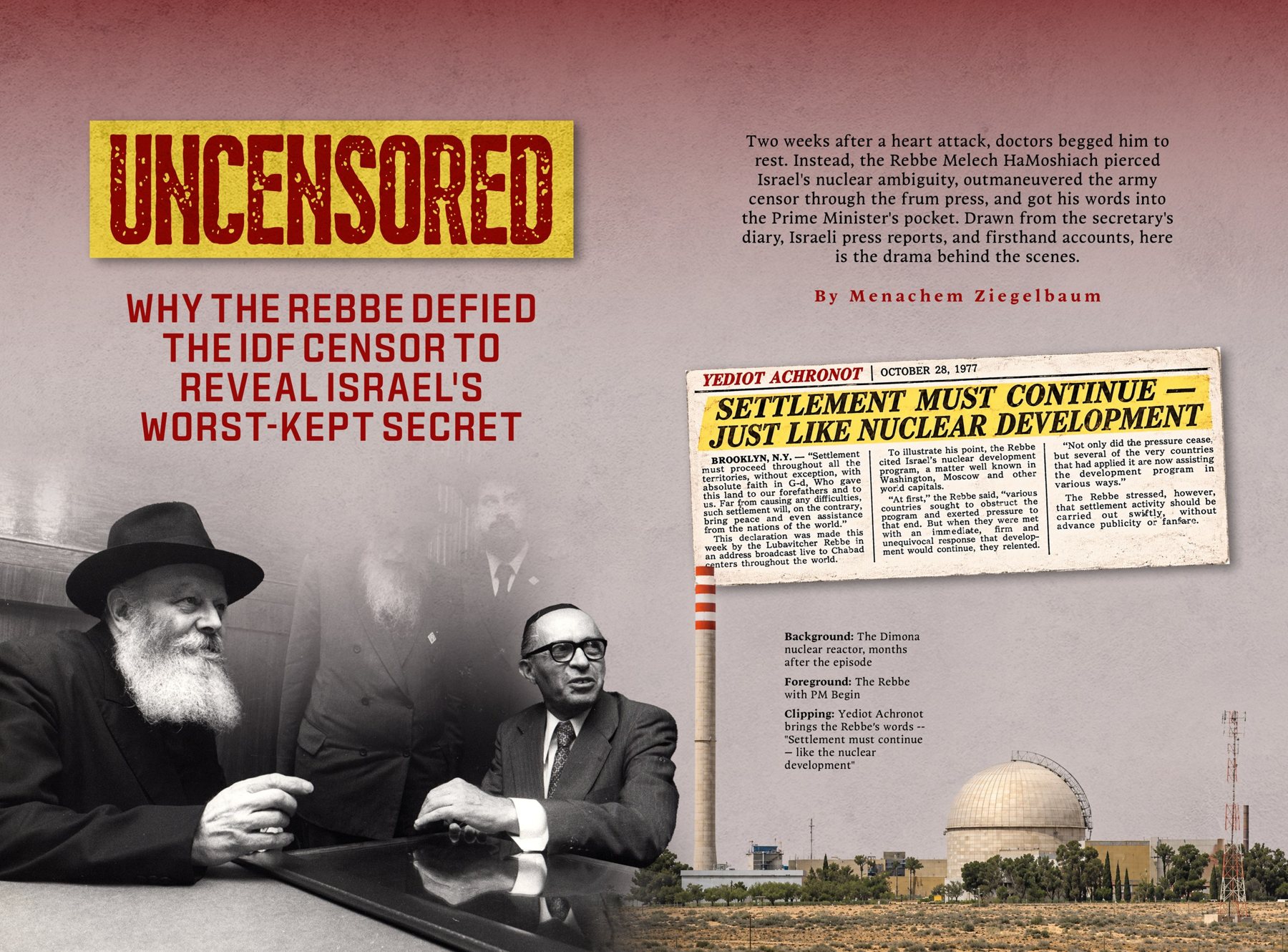
Two weeks after a heart attack, doctors begged him to rest. Instead, the Rebbe Melech HaMoshiach pierced Israel’s nuclear ambiguity, outmaneuvered the army censor through the frum press, and got his words into the Prime Minister’s pocket. Drawn from the secretary’s diary, Israeli press reports, and firsthand accounts, here is the drama behind the scenes.
Why the Rebbe defied the IDF censor to reveal Israel’s worst-kept secret
Motzoei Shabbos Kodesh, Parshas Lech Lecha, 5738 (1977). Maariv took place in the Rebbe’s room at 7:00 in the evening, followed by Havdala. At the end of Havdala, the Rebbe smelled the wine in which the candle had been extinguished, dipped his little finger in the wine, and placed a little on his eye.
Immediately afterward, the Rebbe lay down to rest for a short while. His heart was weak during this period following the cardiac event he had undergone, and the doctors in attendance urged the Rebbe to let his heart rest as much as possible. Despite the early hour, the light in his room was turned off.
But not much time passed, and at 7:50 the Rebbe rose from his bed, the light was turned on again, and the Rebbe put on his sirtuk and hat in preparation for the weekly farbrengen.
In the Lubavitch of winter 5738, something new ensued: a farbrengen on Motzoei Shabbos. Since this was shortly after the health incident on the night of Shemini Atzeres, the Rebbe remained in his room throughout the entire period of recovery and convalescence. Despite his condition, the Rebbe did not give up his custom of farbrenging on Shabbos. The solution that was found: a farbrengen on Motzoei Shabbos from his holy room, with the entire audience listening through the sound system.
So the Rebbe rose from his bed and prepared for the farbrengen. In the coming hour, the Rebbe would deliver a maamar and two sichos kodesh in place of the farbrengen of Shabbos day.
“We have already spoken several times regarding the names of the sedras,” the Rebbe begins; “for the name of each sedra brings out the content of the entire sedra.”
In the first sicha, he speaks about the parsha and timely matters. Afterward, he begins reciting the maamar “Lech Lecha Mei’artzecha,” and after it the Rebbe continues with another sicha devoted to shleimus ha’aretz. The Rebbe begins by explaining the passuk, “To your offspring I have given this land,” a statement made in the manner of a covenant, without the possibility of change.
Here he spoke at length about the need to settle as many of the conquered areas as possible with Jewish residents, and he practically implored the leaders to encourage the establishment of a long line of settlements in order to protect Israel’s borders and prevent a possible withdrawal.
Downstairs, in the large zal and in the adjacent small zal, masses of Chassidim stand and listen to the sichos. Oh, how much they had learned to appreciate the greatness of the occasion in which they merited to hear divrei Elokim chaim emerging from the Rebbe’s holy mouth.
True, the Rebbe is secluded in his holy room, yet on the other hand, his voice is heard clearly, not only throughout the 770 building, but in the ears of all Chassidim around the world, who connect to hear the Motzoei Shabbos farbrengen…
The farbrengen ends at ten past nine on Motzoei Shabbos. The Rebbe turns to the doctor with a wide smile, as if apologizing: “I went over the time by only nine minutes”… The doctor nods his head. He already understands that the patient sitting before him is not like all patients. The doctor examines the Rebbe and finds that everything is in order. The doctor, Dr. Resnick, takes the opportunity to explain to the Rebbe why the doctors request so strongly that the Rebbe rest with extra rest in these weeks: the heart is now undergoing a process of recovery, which will affect the quality of its functioning for the coming months and years.
The Rebbe washes his hands for the Melave Malka meal, and at 1:15 at night he returns to rest. The Rebbe’s rest lasted only three hours, as he hurried to rise at 4:15 before dawn.
The faithful secretary, Rabbi Groner, hardly left the Rebbe’s side throughout the entire period. He enters the inner sanctum to make sure the Rebbe has everything he needs.
The Rebbe asks him to tell Berke Wolf in Eretz Yisrael to delay the publication and distribution of the sicha that was delivered tonight, as he regularly did.
The Rebbe adds that there is a passage which, for various reasons, he did not want to say during the sicha, but now he asks to add it as a note to the sicha. The content of the addition will be conveyed shortly so that it can be incorporated into the sicha. Rabbi Groner nods and glances at his watch. He knows he must urge the “menichim” (the transcribers) to complete preparing the sicha as quickly as possible.
This article reveals new layers in an obscure episode that unfolded at this time, 49 years ago, as recorded hour by hour, in real time, in the personal diary of the secretary who stood at the Rebbe’s side throughout the entire recovery period.
The days: the days of the frenzy over the “peace agreement” with Egypt, a few days before the “historic visit” of Sadat, president of Egypt, to Eretz Yisrael. Talk of handing over territories “in exchange for peace” is heard in loud tones, the Arabs raise their heads and present demands, while on the Israeli side there is weakness and loss of direction. A frenzied rush to win the favor of the gentiles, an imagined fear of “what will they say,” without doing anything to prevent the general clearance sale.
In that destructive negotiation, the cursed idea of an autonomy plan for the Arabs in Yehuda, Shomron and Gaza began to be heard. The demands were not only about Sinai, but also about all the territories of Yehuda and Shomron. The Rebbe, who waged the war of Hashem to prevent the disaster, spoke every week in very sharp terms against the agreements taking shape. Despite his health condition, the Rebbe instructs to do everything possible to strengthen Jewish control over all areas of Eretz Yisrael.
The Rebbe’s words were regularly published in the Israeli press which showed great interest in the words of the Nasi HaDor. The one who took care of this was Chabad’s spokesman at the time, R’ Berke Wolf a’h.
Running through all these sichos like a thread was the clear directive that specifically concrete action in everything connected with strengthening shleimus ha’aretz would hasten and bring about the Geula.
The Rebbe continued to conduct a multi-faceted political campaign. On Thursday, 8 Cheshvan, even though he was fasting (BaHaB), the Rebbe inquired several times whether the fact had already been published that President Jimmy Carter had regretted the agreement with Moshe Dayan, and even wondered why they were making a secret of it.
At first no one knew what the Rebbe meant. Only afterward did it become clear that the Rebbe was referring to a secret agreement that had been written and signed between Foreign Minister Moshe Dayan and President Carter, which was then called “the full agreement,” appended to the “working paper” ahead of the peace conference planned for Geneva. It was a diplomatic secret.
A few days earlier, Dayan had met with Carter following a joint US–USSR statement, from which it emerged that the US was accepting the Arab position ahead of the Geneva conference. After a difficult conversation between them, Carter agreed that alongside the “working paper,” the “full agreement,” which contained aspects in favor of the Israeli side, would be attached.
After Dayan read the secret “full agreement” aloud in the Knesset, its content leaked to the press and the secret became public. As a result, the Arab states pressured Carter, and he backed away from the secret understandings he had signed with the Israeli government.
Dayan, for his part, presented the “full agreement” as an Israeli achievement, but in practice found it hard to digest the fact that Carter had reneged on the understandings. For this reason he refrained from bringing the matter to the public’s attention. The Nasi HaDor, sitting “at the king’s gate,” knew everything that was happening, and he asked to publicize the news of the US withdrawal from the agreement. It was important that the residents of Eretz Yisrael know the bitter truth…
And indeed, the next day, Friday, 9 Cheshvan, it began to be published in the Israeli press, with the journalists, then as now, trying to soften Carter’s bitter retreat.
The Proof from Dimona
Let us return to that Motzoei Shabbos Kodesh of Parshas Lech Lecha with which we began.
As mentioned, the Rebbe spoke at length about the necessity to settle all the territories of Eretz Yisrael at once, certainly those areas disputed by the nations of the world. Here are a few brief summary points:
To settle all the areas of Eretz Yisrael, especially the areas that some contest… in all those places they should build a place of Torah and a place of tefilla, and also a mikva… And even if for a short while “nations rage and peoples murmur,” the truth is that they themselves know that it is (as the verse concludes) “in vain,” and that they “rage” and “murmur” only because they want to fulfill an obligation toward someone. Only so that it should be openly seen that the nations of the world, too, know that it is nothing but “in vain,” must the Jews show that when they say that all of Eretz Yisrael belongs to them, they truly mean it, and, needless to say, not to invite, G-d forbid, pressure from the nations…
And when they go in this way, not only will the gentiles ultimately not contest… but on the contrary, it will bring about “Praise Hashem, all nations, laud Him, all peoples, for His kindness has overwhelmed us, etc.,” and they themselves will assist the Jews with all the assistance that Jews need from them now, by virtue of being currently in exile. (Free translation from the edited Yiddish sicha, Likkutei Sichos vol. 20, p. 311.)
The first light of dawn began to shine over Brooklyn. People did not hurry to get up for work, since it was Sunday, an official day off. The leader of Klal Yisrael was in his room in Brooklyn, but his heart was in Eretz Yisrael, a heart worried and anxious over what was happening there.
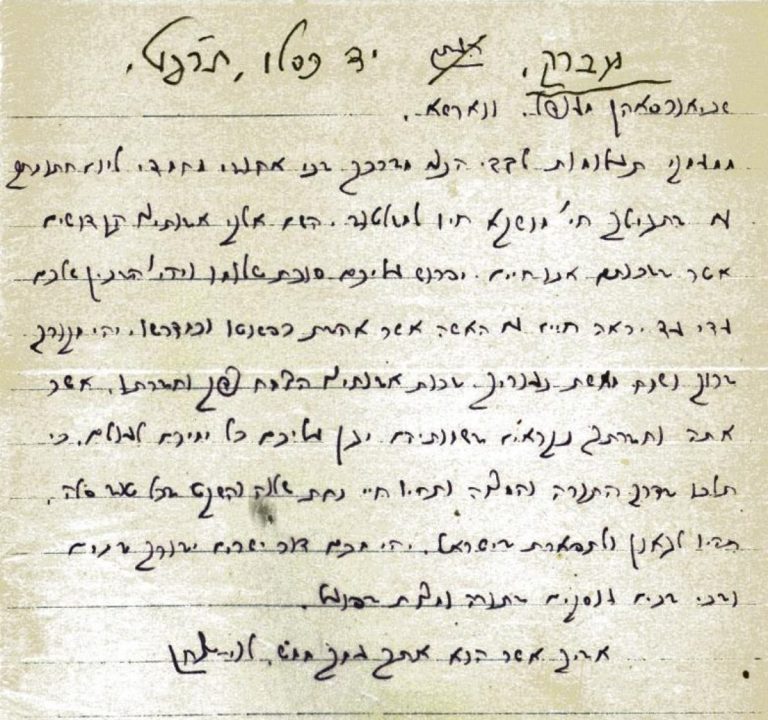
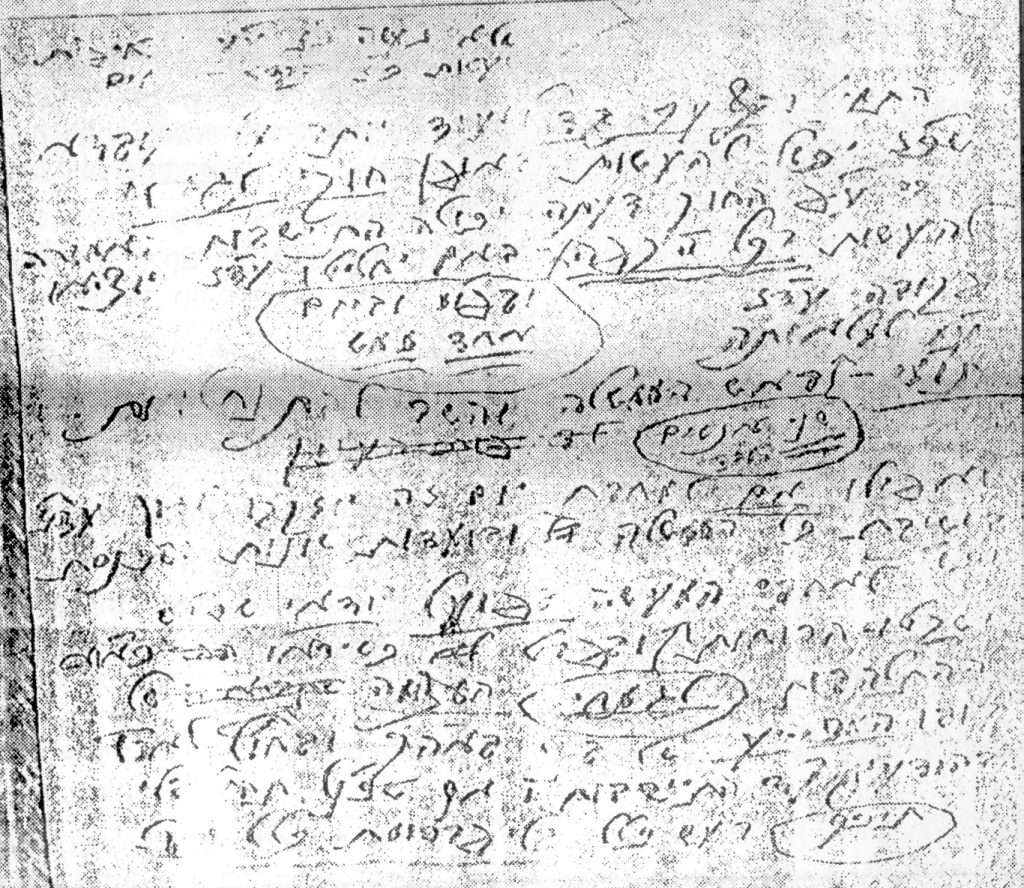
After Shacharis in his room, the Rebbe takes the pencil and writes two notes that he wanted to add to the sicha delivered the previous night. These are words written only now and intentionally not said last night in the sicha. It is not hard to understand, then, that every word is weighed and measured on a scale, rich in meaning.
A) The noise and pressure that arose over the establishment of the five settlements would not have been greater had settlements been established along the entire border.
The Rebbe urges the establishment of Jewish settlements along the entire border, and thereby reducing the level of noise and pressure expected from the nations of the world.
The pencil keeps running across the page, and in the following lines the Rebbe drops a “bomb!”
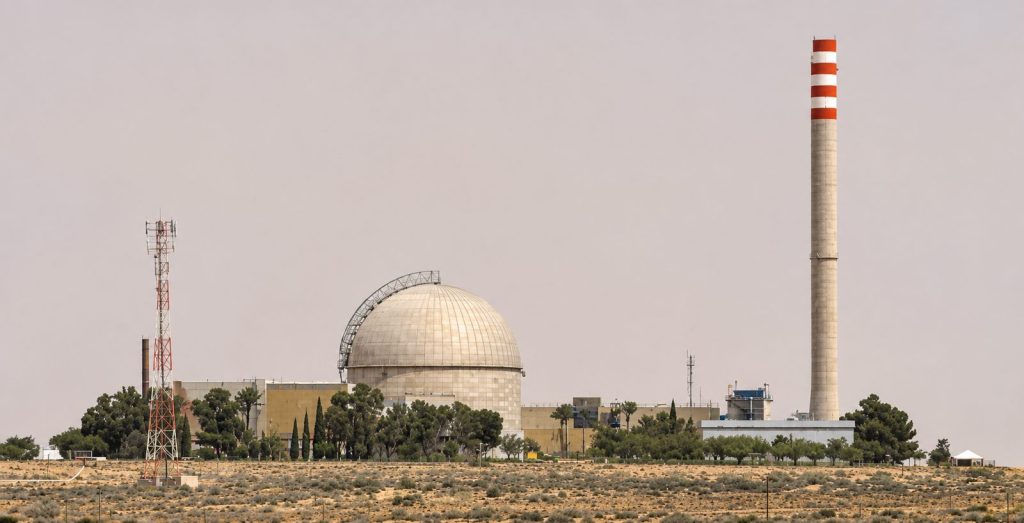
B) Conclusive proof of all this: It is known to everyone (including Washington, Moscow, and the capitals of the Arabs) that nuclear weapons are being manufactured in the Holy Land, that they already exist and have been added to from time to time over many years. At first they wanted to hold up and cancel all this and applied pressure, etc., but when they were answered immediately and resolutely that this would continue, the pressure-applying parties contented themselves with an official denial that any of this exists in reality, and the pressure ceased.
And furthermore, some of the states that applied pressure assist in this manufacturing in several ways, and have done so for several years.
“Bomb” we wrote, and indeed the Rebbe dealt with a “bomb,” and not just any, but a nuclear bomb…
The Rebbe cites support for his view that if the Israeli government establishes facts on the ground, even if the nations of the world rage, their rage will gradually diminish, exactly as happened with the atomic bomb that “already exists and is added to from time to time over many years.”
For decades the Israeli government has maintained an official policy of nuclear ambiguity, under which it guards its nuclear secrets and deliberately chooses neither to confirm nor deny the existence of nuclear weapons in its possession. Silence.
The ambiguity is necessary. On the one hand, whoever needs to know will know that Israel holds nuclear weapons and that it is unwise to start up with it. On the other hand, by not admitting it, the government is not bound by nuclear treaties and is not subject to any international supervision. Whoever needs to know knows. And whoever doesn’t will guess.
And here the Rebbe officially announces that Israel has had a nuclear bomb for several years, and that it is even “added to from time to time”…
The Rebbe goes on to write a few more lines formulating the Israeli government’s position regarding the settlement of the territories, out of a desire to fortify the security of the residents of Israel, and finishes the additions he wished to make.
The Rebbe looks at the writing once more, and instructs his faithful secretary, Rabbi Groner, “to telephone Berke and convey the additions to him, and that he should translate and write it in their style [a style suited to newspaper publication], and try to have it printed in the newspapers,” in the words of the secretary in his diary.
The secretary asks whether to also convey the addition to the printers who are engaged in printing the original sicha, and the Rebbe answers with an absolute no: “That’s all I’d need, that they should print this here. This is only for there (Eretz Yisrael). Later I will decide what to do regarding here.”
Rabbi Groner left the holy presence, entered the secretariat room, and immediately phoned R’ Berke Wolf to read him the addition.
R’ Berke, as a faithful soldier, stands ready to write down every word that is now read to him over the phone. This was long before the era of fax machines or instant messaging programs. The secretary read and R’ Berke stood and wrote.
Berke is silent. He immediately grasps how explosive this is.
Berke expressed his opinion to the secretary that it would not be wise to give this to the Israeli news agency “Itim” (= United Israeli Press). “I don’t think the censorship will agree to print this,” he explains to Rabbi Groner. “If the censor sees this item, he will immediately instruct the entire press not to print it under any circumstances.”
“And what do you suggest doing?”
A slight hum. “I suggest not giving it to the news agency, and at this stage I’ll pass the material directly to the editorial offices of the two main newspapers, Yediot Acharonot and Maariv, where I have good connections, in the hope that the censorship won’t catch the publication. After they print it, it will be easier with all the rest,” he proposes.
Rabbi Groner receives the Rebbe’s consent to the journalistic tactic, with the Rebbe adding, out of full familiarity with the Israeli press scene: “Surely [the newspaper] Shearim will print the above without changes”…
The Secret Remark That Jolted the Censorship
From here on we follow the diary of the secretary, Rabbi Groner, who exclusively documented the entire storm that erupted behind the scenes. In the following excerpts the secretary describes the reaction of the censorship in Eretz Yisrael, which forbade the Israeli press from publishing the Rebbe’s words, along with the vigorous contacts conducted by Chabad activists in Israel with the censorship in order to carry out the Rebbe’s instruction.
The Rebbe’s written additions were passed on to R’ Berke, and already the next morning, Monday, the Rebbe asked to find out what was happening with it.
The secretary hurried to phone R’ Berke. The latter related that the censor of Yediot Acharonot, who sits permanently in the newspaper’s offices, had forbidden publishing the Rebbe’s words because of their absolute confidentiality.
And what about Maariv? Well, they did print portions of the sicha, but omitted passages that were, in their view, too sharp. Naturally, the Rebbe’s words regarding nuclear development were omitted.
The one brought in on the matter was the chief engine for all the Rebbe’s affairs in Eretz Yisrael, none other than R’ Shlomke Maidanchek, the man who, through his personal charm, wove a broad web of connections with all the politicians in Israel, right and left.
R’ Shlomke understood that a path had to be forced directly to the decision-makers. He proposed printing the sicha with the Rebbe’s additions and sending it personally to every Knesset member and minister, especially to Prime Minister Menachem Begin. The mailing would be done on the initiative of the activists in Eretz Yisrael and not in the Rebbe’s name. He believed that if he did so, it would leak everywhere anyway; one can rely on Knesset members…
The idea was brought for the Rebbe’s approval, but he refused to accept it, saying that such a thing might create the impression that Lubavitch was stirring the pot too much.
“When I conveyed this to the Rebbe, shlita,” Rabbi Groner wrote in his diary, “he said not to send it to all the Knesset members, because then [Begin] will think m’kricht iber zein kop [= that people are ‘crawling over his head’]. Better to bring it directly to the Prime Minister, to Arik Sharon [then Minister of Agriculture, responsible for settlement], and to Ezer Weizman [Minister of Defense], so that they receive the full message without censorship, and to explain to each of them in particular, since he knows (R’ Shlomo Maidanchek) their attitude toward the Rebbe, shlita, and surely they are interested in knowing what the Rebbe, shlita, said recently, with the emphasis that what is said here about nuclear weapons is not for publication at all abroad, only in the Holy Land.”
The Rebbe added that it would be worthwhile to bring it to the attention of Mr. Chaim Landau as well, who served as a minister without portfolio in Begin’s government. The Rebbe explained that some time earlier Landau had visited during the Hakafos 5737, when the Rebbe spoke with him about the conquest of Damascus, and Mr. Landau regretted that the Rebbe’s words had not been sufficiently publicized, and only for that reason had he not known about them.
Rabbi Groner went on to update the Rebbe that Berke had asked to publicize the Rebbe’s words on the radio as well, where there was indeed interest in the matter, but the censorship delayed publication. The radio broadcaster, who was eager to publicize the Rebbe’s words in full, including the details about Israel’s nuclear weapons, tried to persuade the censor to permit him to make them public, arguing that only recently a member of Congress had declared that Israel has fifteen nuclear bombs, and his statement had been broadcast on the radio. So why censor specifically the Rebbe’s words?
The censorship man replied sharply: “It is known that the Lubavitcher Rebbe receives his information from people in this country and therefore publishing his words would be regarded as a confirmation by the state, which is not the case with the words of the American congressman.”
The censorship representative did not calm down: “When the Lubavitcher Rebbe says what he says, his words are as credible as if they had come from the mouth of the Prime Minister…”
When the Rebbe heard this, he responded: “Zei chapn zich gar nit az fun dem vos m’iz dos monea milefarsem, mit dem gufa iz men modeh az s’iz emes” [= They don’t realize that by preventing publication, they themselves are admitting it’s true… i.e., that this is the best proof of the existence of the nuclear weapons].
Rabbi Groner said: “That is indeed what they said there, and precisely because the matter is true, they don’t want to publish it.”
“And if it were false,” the Rebbe replied on the spot, “they would publish it, but because it is true they don’t publish, which is the opposite of reason!”
The Rebbe’s Sicha in the Prime Minister’s Pocket
The contacts behind the scenes went on feverishly. The Rebbe wanted to break through the wall of nuclear ambiguity, to show that when the government of Israel acts, even if there are protests at first, reality is soon accepted even in the hearts of the nations of the world.
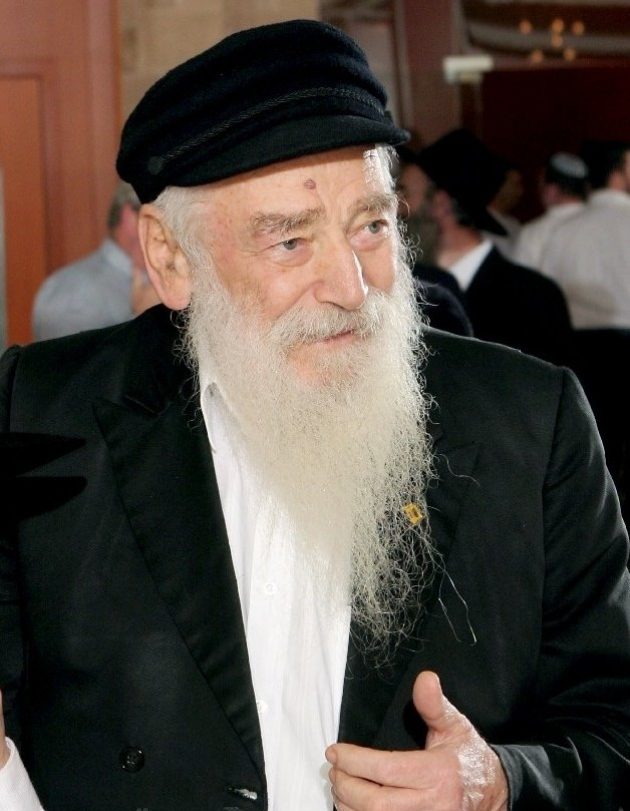
Toward evening R’ Shlomke phoned Rabbi Groner and updated him that he had been in the Knesset that day, where he met Prime Minister Menachem Begin and handed him the Rebbe’s sharp words, noting that the section about nuclear weapons would not be printed or published in the United States.
Begin nodded affirmatively and thanked him. He promised that at the first opportunity he would read the Rebbe’s words, and put the sheet into his suit pocket. Maidanchek also personally met Ministers Ariel Sharon and Ezer Weizman.
At midnight another trans-Atlantic conversation took place, between R’ Shlomke’s home in Kfar Chabad and the secretariat room. Maidanchek related that he had tried to publish the Rebbe’s words in Haaretz, but there too the censor imposed a veto.
The Rebbe therefore instructed using parallel channels: the religious newspapers. “They should endeavor to place it in Shearim, Hamodia and HaTzofeh,” the Rebbe instructed, and even asked that Maidanchek be told to pass the words on to Minister Chaim Landau as well, and to try to have the minister read the content of the Rebbe’s words on the spot, and even to raise with him the fact that the censor had ordered that it not be printed in the newspapers.
“Can such a thing be? Especially since he [Landau] complained that they didn’t write and publish in the newspaper at the time about the conquest of Damascus, and surely he will agree to print this.” The Rebbe even advised that if the censor nevertheless stubbornly held his ground, one could omit only the words “nuclear weapons,” or the single line, while the rest of the content would be published.
Rabbi Groner updated the Rebbe that Maidanchek wished to visit the head of the censorship in person, or even higher-ranking officials, to persuade them of the necessity of publication. Of course, all this would be done not in the Rebbe’s name but as his own personal initiative.
The Rebbe responded that “it would be more correct for this complaint to come from the media themselves, or from the radio reporter, or from Minister Landau, and if not from them, then he—Maidanchek—could do it.”
When Rabbi Groner phoned Berke Wolf again to pass on the instructions, the latter happily reported that the Rebbe’s words had been printed in the three religious newspapers with all the details.
“The Rebbe, shlita, was very satisfied with this,” Rabbi Groner writes in his diary.
On Tuesday the Rebbe again summoned Rabbi Groner and continued the publication efforts: now that the words had been published anyway in the religious press, one should try again to publish in the national press, “since it has already been printed anyway.”
An Israeli Commando Unit and the Hijacking of Uranium Shipments
The political campaign and the struggle against the censorship continued at full force.
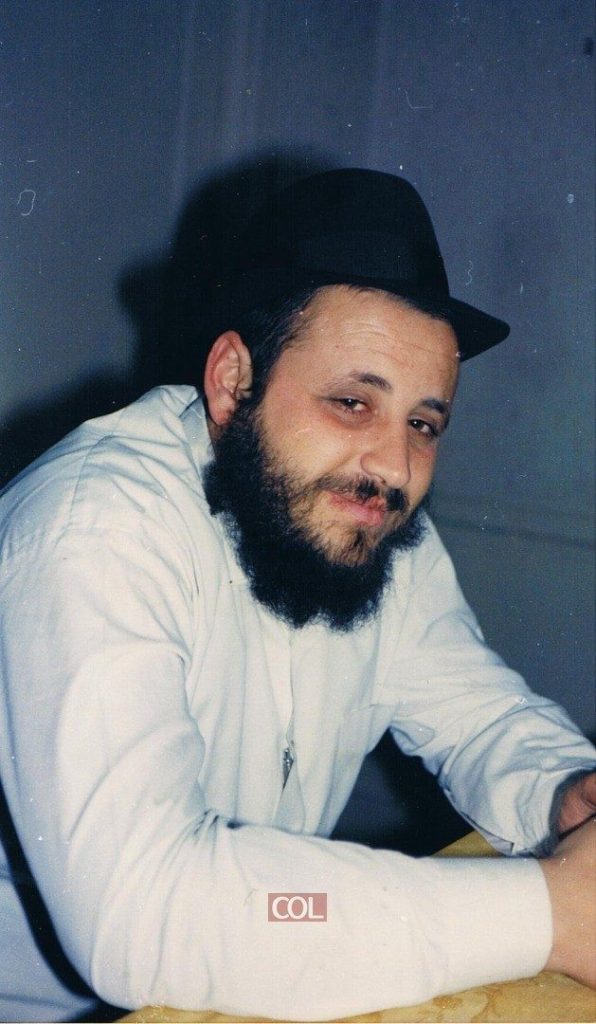
Toward the end of the week, Maidanchek and Berke Wolf made a personal visit to Mr. Shlomo Gazit, head of Military Intelligence (the censorship was subordinate to him), and tried to convince him of the necessity of the Rebbe’s words. Carrying out the Rebbe’s wish stood before them above every other consideration.
Gazit answered with a firm no. “I cannot approve publication of such things,” he said, and explained: “Everything the Rebbe of Chabad says is regarded as credible. Everyone knows he has good and reliable sources inside the government, and his declaration is equal in credibility to the declaration of a prime minister.”
After further persuasion, he agreed to show flexibility, saying that if they would agree to some small corrections, he would give an order to lift the veto.
The two hurried to phone the secretariat to receive approval which was granted immediately.
The Rebbe received a full update and even asked to urge the large newspapers so that the words would be printed as soon as possible, even the very next day.
After Mincha on Thursday of that week, the Rebbe instructed his secretary to speak again with Maidanchek or with Wolf. Here the Rebbe peeled away another layer of Israel’s atomic ambiguity and revealed new details.
“Tell them,” the Rebbe requested, as Rabbi Groner phrased it in his diary, “to tell Arik Sharon that regarding Dimona [referring to the nuclear reactor at Dimona] there were several denials, even though it is known what goes on there, but that is the procedure.
“And a greater proof than this: Simcha Dinitz [Israel’s ambassador in Washington at that time] and likewise the US State Department denied what was printed in Rolling Stone, although everyone knows that the uranium indeed existed, and that they have several bombs, a fact in reality, and one sees what was printed and said on this matter during these two days, and nevertheless they are not shaken by it, etc.”
What was the Rebbe referring to?
Well, in those days the American magazine Rolling Stone revealed that an Israeli commando unit had hijacked two uranium shipments in France and Britain in order to build a nuclear bomb with them. The magazine’s reporters even held a press conference and claimed that the American Central Intelligence Agency estimates that Israel has at least fifteen nuclear bombs, and according to unconfirmed reports as many as one hundred and fifty atomic bombs!
The Rolling Stone article caused a huge storm and it was also published in the other newspapers. But the official spokesmen of the government in Israel, as well as the US State Department, continued to deny it and clung to the government’s policy of ambiguity.
From this the Rebbe sought to prove that when the government decides to withstand international pressure, it succeeds in doing so, and even the United States aligns itself with the Israeli position.
“When they tell him about the above,” the Rebbe instructed, “it should not be in the manner of dingen [= haggling], but since it is known that there is closeness of heart, etc.”
The publication in those newspapers indeed did its work, and in Yediot Acharonot, which came out on Friday, the Rebbe’s words were presented under the headline: “Settlement Must Continue, Like the Nuclear Development”…
The report quoted the Rebbe including the proof from Israel’s nuclear weapons, but with a slight change of wording: the Rebbe had spoken of “producing nuclear weapons,” while Yediot Acharonot changed the wording to “nuclear development.”
Inside the article it said that, as proof that settlement would not bring pressure but on the contrary would hasten assistance, “the Rebbe cited the fact of nuclear development in Israel, a matter well known in Washington, in Moscow and in the Arab capitals.
“At first, the Rebbe noted, various countries wanted to interfere and applied pressure in that direction, but when they were immediately answered with a firm and absolute reply that the development would continue, they were satisfied. Not only did the pressure cease, but a number of those countries that had pressed now assist the development in various ways.”
This detail also appeared in other newspapers such as Shearim, Hamodia and HaTzofeh.
* * *
In conclusion, let us take to heart and soul: the Rebbe rests in his room, the doctors plead that he rest, yet precisely at such times the Rebbe worries. Very worried. He is not occupied with himself, but is conducting a secret battle of minds against the political figures in the government of Israel and against the military censorship, in order to save the people dwelling in Zion from wretched agreements and for the strengthening of the security of the inhabitants of the Land.
How important these matters are for our own times, when there are those who wish to cooperate with the enemies of Israel, even those within the borders of Eretz Yisrael, and how much one must struggle for the great campaign for the security of the inhabitants of the Holy Land.
Beis Moshiach #1531 • 10 Kislev 5787 • י׳ כסלו תשפ״ז • pp. 24-33
© 2026 Beis Moshiach Magazine. All rights reserved.
This article originally appeared in Beis Moshiach #1531. You are welcome to share it with friends and family by email or in print, provided that you do not change, add to or omit any part of it, you credit the author and Beis Moshiach, and you include a link to archive.bmoshiach.org (written out in full in printed copies).
To republish this article in a newspaper, magazine, book or website, please request permission in advance at [email protected].