From Bubby Sorka’s Niggun to “Yechi Adoneinu” (Part II)
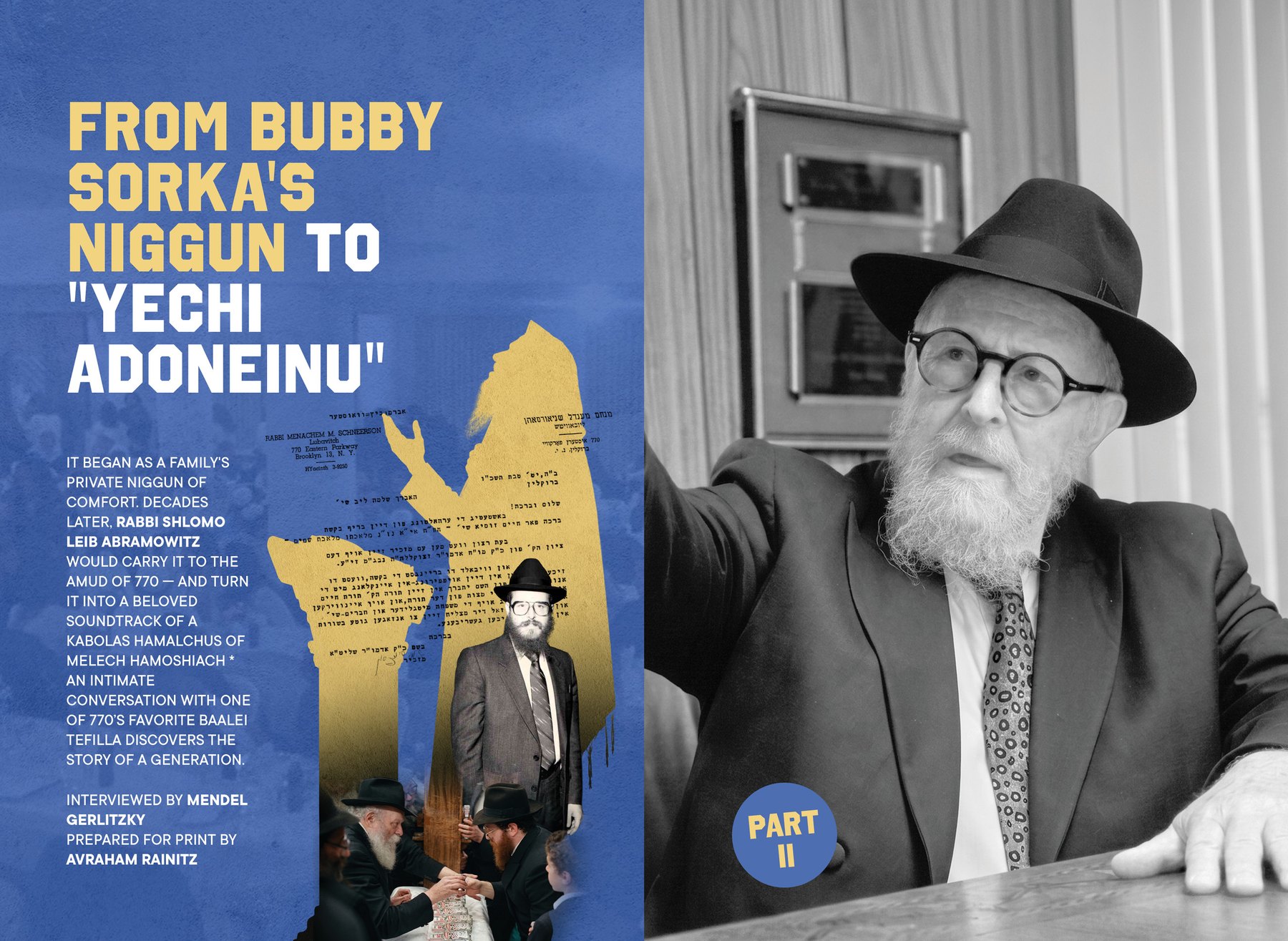
It began as a family’s private niggun of comfort. Decades later, Rabbi Shlomo Leib Abramowitz would carry it to the amud of 770 – and turn it into a beloved soundtrack of a kabolas hamalchus of Melech HaMoshiach. An intimate conversation with one of 770’s favorite baalei tefilla discovers the story of a generation.
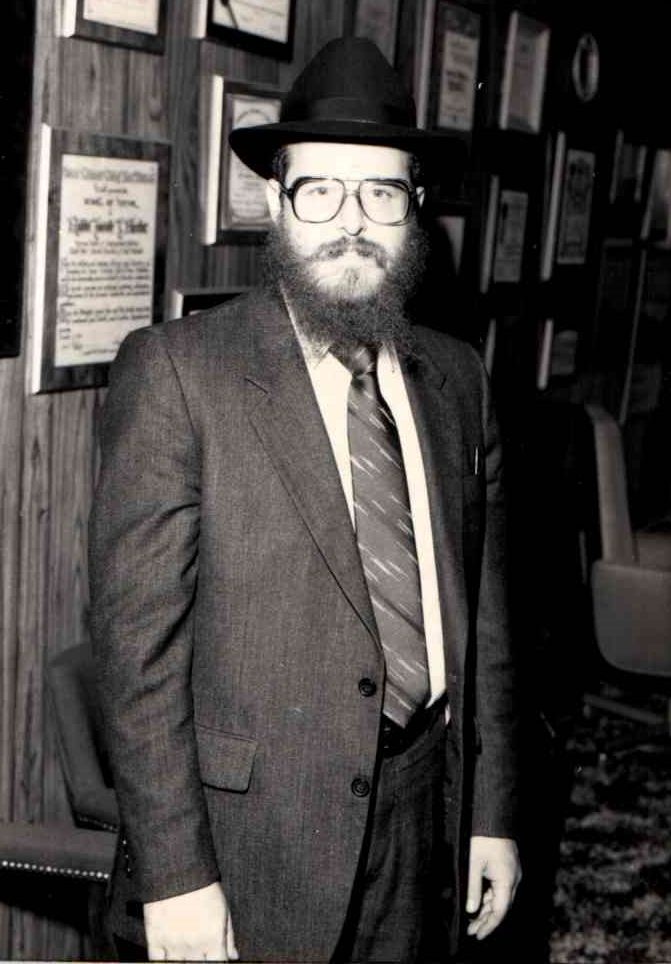
R’ Shlomo Leib Abramowitz’s davening as chazzan in 770 did not pass quietly, in every sense of the word. The young man, who was blessed with a mighty voice and extraordinary power, brought with him to the Beis Medrash an innovative and presence-filled style, very different from the familiar traditional nusach.
“One of the qualities I had was that I davened in a very strong voice,” he states candidly. “I was young, and I was one of the loudest chazzanim there. When I would approach the amud, silence would fall over the shul. There was less talking, because everyone wanted to listen.”
Before long he began developing and incorporating into the Chabad nusach his own unique touch, a combination of the style he grew up with from his father and grandfather’s home, together with a bit more personal “dreidlach.” Among other things, he also introduced tunes for “Keil Adon” and “Mimkomcha,” as well as applying the well-known tune of “Yaaleh Tachanuneinu” to “Odecha Ki Anisani.”
Many of his tunes, especially for Kabbolas Shabbos, he heard and absorbed from the Chassid R’ Velvel Konikov, whom he saw and heard in his childhood in Worcester. All of these arrived at 770 thanks to R’ Shlomo Leib.
This success, of course, did not pass without opposition. Some veteran Chassidim had difficulty accepting the new chazzan. “Who is this? He isn’t geza! Why does he sing and do it like that?” they complained again and again to the gabbaim. But once it became clear that the Rebbe was listening, and that the atmosphere in the shul was becoming more uplifted and dignified, the gabbaim knew exactly who they wanted to see by the shtender…
For Rosh Hashana 5747, the gabbaim approached the baalei tefilla and said that since over the past year the Rebbe had suffered from pains in his legs, they were asking that the davening not be drawn out too much on the Yomim Noraim, in order to ease things for the Rebbe. R’ Shlomo Leib was not at 770 for Rosh Hashana, but the night after Rosh Hashana ended, he heard the Rebbe’s secretary, Rabbi Binyamin Klein, telling his father-in-law, Rabbi Yaakov Yehuda Hecht, that the Rebbe had not been satisfied with the speed of the davening.
The next opportunity R’ Shlomo Leib had to lead the davening was during Sukkos. He remembered what the Rebbe said and davened as usual without rushing. During one of the tefillos on that Sukkos, when R’ Shlomo Leib led the Hallel, upon reaching “Ana Hashem Hoshia Na,” he cried it out in a strong, vibrant voice. Suddenly the entire congregation at 770, from east to west, responded with a powerful wave of response; people truly felt a “shturem” in the air. “Even I was startled by the intensity of the energy that was there,” he shares.
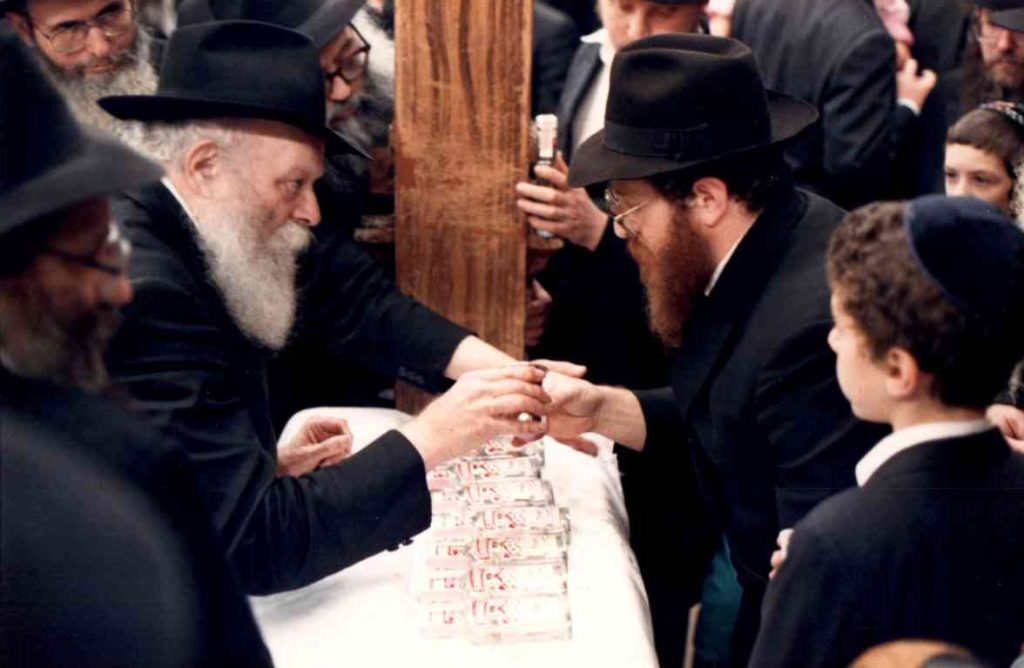
“At the conclusion of Yom Tov, during the distribution of the kos shel bracha, as we passed by the Rebbe, he looked at me with a beaming face, made a strong gesture with his hand, and said to me loudly, above the noise of the crowd: ‘Hatzlacha in chazzanus!’ and gave me a bottle of mashke. That was the first time the Rebbe explicitly referred to my chazzanus.”
The Rebbe’s $100 Bill
Reb Shlomo Leib’s success at the amud in 770 did not escape the notice of the gabbaim, especially during the period following the Rebbe’s heart attack in 5738. “Downstairs in 770 it was very noisy,” he describes the complex situation when the Rebbe would daven upstairs in his room. “But when I davened at the amud, it was much quieter. People listened, and they simply enjoyed the davening.”
The gabbai at the time, R’ Yankel Lipsker, decided to take action. He approached R’ Shlomo Leib and laid an unprecedented proposal on the table: “I’m offering you the position of being the official baal tefilla here downstairs in the shul every Shabbos, and we’re prepared to pay you” – not an offer that was generally accepted in 770, where everyone considers it a zechus to daven at the Rebbe’s minyan.
Despite the flattering offer, he decided to decline the official position. “I told him it was flattering to me, but I don’t want to be hired as the official chazzan. Still, I promised him: whenever you ask me, I’ll step up. I won’t make life hard for you.” This compromise made him the dominant baal tefilla of those years, almost every Shabbos, or every other Shabbos, he would lead Kabbolas Shabbos, Shacharis, or Mussaf.
Years later, on Chanuka 5751, the Rebbe sent the gabbaim several $100 bills as “Chanuka gelt.” The gabbaim – led by R’ Zev Katz and R’ Yehoshua Pinson, known for his beautiful handwriting, decided to dedicate one bill specifically for their chazzan. They presented him with a formal and moving letter, which R’ Shlomo Leib still guards carefully to this day, expressing that they were granting him the merit of one $100 bill from the Rebbe shlita in recognition of his service as the shul’s chazzan whenever the gabbaim requested, with blessings for material and spiritual success, signed: the gabbaim.
The Birth of the “Yechi” Niggun
The famous niggun, the one that today stirs every Chabad heart and is most associated with the words “Yechi Adoneinu” (the niggun that was originally sung as “Chayolei Adoneinu” and later converted to “Yechi Adoneinu,” not the “Yechi” niggun sung before the Rebbe in 5753), was not born as an official Chabad niggun at all, and certainly not with these words. Its roots lie somewhere in a moment of deep family sorrow.
“It happened in 5733, a year before my wedding. My father-in-law was sitting shiva with his five brothers for their mother, known in the family as ‘Bubby Sorka’ Hecht,” R’ Shlomo Leib recounts. “On that Shabbos of the shiva, there was a rare gathering of all six Hecht brothers, and they brought up childhood memories from long ago. Among other things, they recalled a certain baal tefilla, a ‘Chassidisher Yid’ with a white beard (in those years it was rare to see a Jew adorned with a beard) who, when standing at the amud in the shul where they davened, used to sing this niggun during ‘Lecha Dodi,’ starting from the verse ‘Lo Seivoshi.’ Each of the brothers remembered a different part of the niggun, but the one who remembered the tune the best was the brother Shlomo Zalman from Chicago.”
From that Shabbos, the niggun stuck to the extended Hecht family. When R’ Shlomo Leib joined the family through marriage in 5734, he discovered that the stirring tune had become nothing less than the “Hecht Family Anthem.”
The niggun’s first breakthrough beyond the family’s borders happened at Reb Shlomo Leib’s own wedding, and afterward also at a family wedding in England. “I taught the band members this tune so they would play it at my wedding. People heard it, and it started to become familiar. Everyone loved it. Every time the Hecht family gathered for events and simchas, we would sing it,” he describes with a smile. “Since it was hard to remember the opening part, the ‘introduction’ of the niggun, people would say to me: ‘Shlomo Leib, start Bubby’s niggun!’ Later I also adapted this melody for ‘Shir HaMaalos’ before Birkas HaMazon, and every time we sang it, the niggun took hold even more.”
But no one could have imagined that this family niggun would become one of the most recognized niggunim in Chabad.
The Family Niggun Enters “Lo Seivoshi” in 770
The decision to bring the “Hecht Family Anthem” into the holy of holies of the nusach ha’tefilla in 770 was not a given, but for R’ Shlomo Leib, with the musical sense and confidence that characterized him at the amud, it was clear that this stirring niggun needed to be heard. At a certain point, when he stepped up for Kabbolas Shabbos, he decided to take action. The known minhag for “Lecha Dodi” in 770 was that the chazzan would say a stanza and the congregation would repeat after him, but there was no singing. Already in his early years as baal tefilla in 770, he departed from the norm and began singing the entire “Lecha Dodi,” but this particular niggun received a place of honor only when he reached the line, “Lo Seivoshi V’Lo Sikalmi.”
The crowd in 770, already familiar with their chazzan’s musical flourishes, learned to recognize the moment. “When I would reach ‘Lo Seivoshi’ and was about to change the tune, people knew: the baal tefilla is about to sing a different niggun now.”
On one of those Shabbosos he began singing “Lo Seivoshi” with the Hecht family tune. The crowd loved it and from then on it became a tradition. Thus, tefilla after tefilla, the Hecht family’s niggun began to take root within the walls of 770. It was sung in an atmosphere of ordinary Shabbos uplift, but had not yet received the deep significance that would later be attached to it.
But the storm, as would soon become clear, was already just around the corner.
The Storm and the Geniza
From the late 1970s, the words “Chayolei Adoneinu, Moreinu V’Rabbeinu, Chayolei HaRebbe Moshiach Tzidkeinu, Hu Yolicheinu B’Tankim L’Artzeinu, Im HaMivtzaim V’Neshek B’Yadeinu, Yavo V’Yigaaleinu” began to be attached to the Hecht family tune, a song that surely every Chabad child knows.
The dramatic turning point in the niggun’s history occurred at the Simchas Torah farbrengen of 5745. After the Rebbe said in a sicha about how “every shliach must make another shliach,” the shliach in California, Rabbi Shlomo Cunin, stood up and, overcome with tremendous emotion, began singing “Chayolei Adoneinu…”
The Rebbe, who in those years had not yet approved the publication of his identity as Melech HaMoshiach, responded sharply, speaking about how people were doing things that distance Jews from Chassidus. Within his remarks, the Rebbe addressed the tune to which the words were sung, and said: “Ken zain az der niggun iz a kosher’er, ober…” (It’s possible that the niggun itself is kosher, but…).
Despite this, a few weeks later, on the Shabbos of the Kinus HaShluchim Convention for the United States, R’ Shlomo Leib approached the lectern and decided to sing the niggun in its original form, without words. To him it was clear that the Rebbe had not rejected the tune. But what was obvious to him was not clear to everyone, and there were those who mistakenly thought the Rebbe was rejecting the niggun entirely. Naturally, there were those who came to him that Shabbos with complaints, asking how could he sing the niggun that the Rebbe had rejected?!
The misunderstanding pained him greatly. “I thought to myself: it’s a shame that Chassidim don’t understand the Rebbe’s words, and invent things beyond what the Rebbe actually said.” Although he stopped singing that tune so as not to arouse resentment among those who believed the Rebbe had rejected the tune as well, the lack of understanding of the Rebbe’s words pained him.
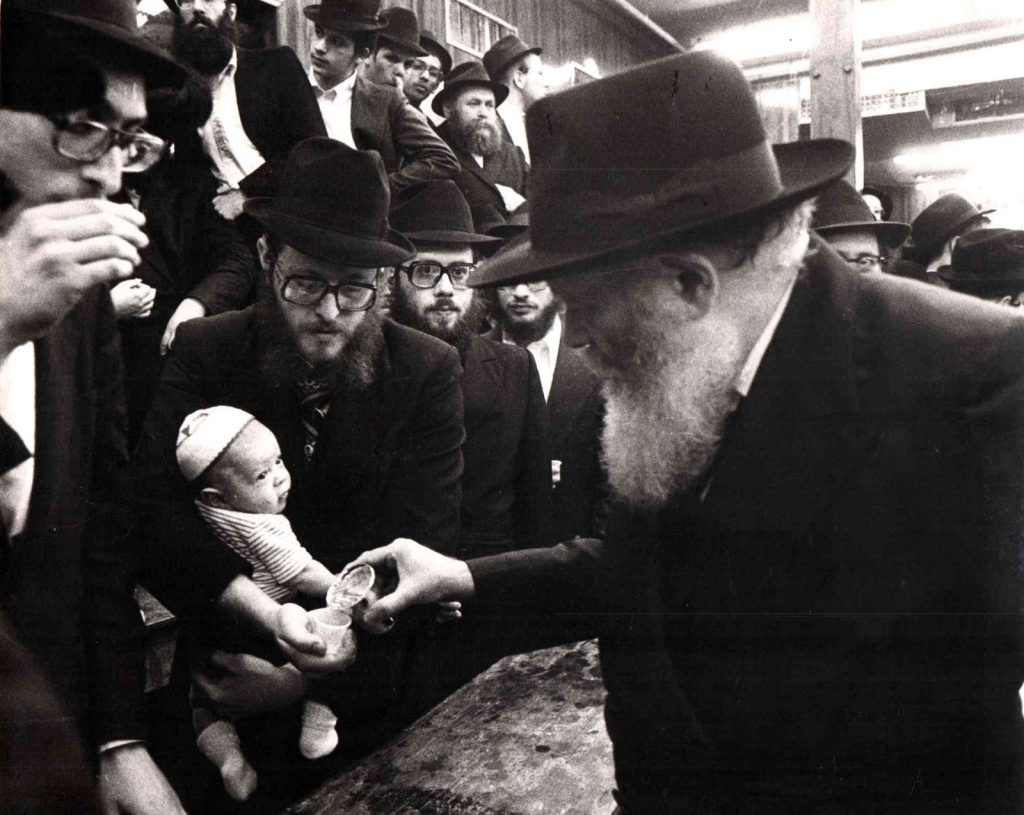
Since he was accustomed from a young age to write to the Rebbe about everything, he wrote the Rebbe a long, detailed letter. “I opened with an apology, that I didn’t want to take up the Rebbe’s time with a letter that wasn’t about important matters, but I felt obligated to explain the pure origin of the niggun.”
In the letter, R’ Shlomo Leib laid out the full history of the niggun: how it was born on the Shabbos of the shiva for “Bubby Sorka” Hecht, about that elderly Chassid with the white beard who used to sing it, and how Shlomo Zalman from Chicago turned it into the “Hecht Family Anthem.”
He didn’t stop there. He mentioned in his letter those who hadn’t understood the Rebbe’s words and claimed it was forbidden to sing this niggun anymore, adding his own perspective on the matter: “In my humble opinion, I understood that the Rebbe referred only to the words (that had been attached to the niggun), not to the niggun itself.”
He received no written reply to his letter, but the real answer came specifically at the amud, in a unique form of encouragement he received from the Rebbe. The next time R’ Shlomo Leib approached for Kabbolas Shabbos, he did not sing the Hecht family niggun, but a completely different one; and when he reached the end of the piyut, “Bo’i Kallah, Bo’i Kallah,” he prepared as usual to move on to “Mizmor Shir L’Yom HaShabbos.”
“Suddenly,” he describes animatedly, “when the words of ‘Lecha Dodi’ ended, the Rebbe began encouraging with his hand with great intensity: ay-yi-yi! This was the first time in the history of 770 that the singing continued after ‘Lecha Dodi’ had finished. From that Shabbos it became a custom in 770 that at the conclusion of ‘Lecha Dodi,’ they continue singing without words the niggun with which they had finished ‘Lecha Dodi,’ and the Rebbe encouraged the singing…”
The Niggun Revived on the Shabbos of the Shiva
Despite the encouragement he received from the Rebbe, R’ Shlomo Leib did not go back to singing the Hecht family niggun in 770. The complete restoration of the “Yechi niggun” to center stage in 770 occurred in late Shevat 5748, during the shiva for Rebbetzin Chaya Mushka a’h. On Friday afternoon, a few hours before the onset of Shabbos, the phone rang in R’ Shlomo Leib’s office. On the line were the two gabbaim, the Chassid Reb Zev Katz and the Chassid Reb Yehoshua Pinson, on a conference call.
“We want to let you know that the Rebbe, who is sitting shiva at home, will be coming to 770 for Shabbos,” they told him mournfully. “And we’re asking you to lead the davening this evening.”
R’ Shlomo Leib understood the weight of the responsibility. A Shabbos under the shadow of heavy mourning. He raised the question to them: “I normally sing during ‘Lecha Dodi.’ Should I sing tonight as well?” R’ Zev Katz’s answer was short and to the point: “Do what you want.”
That was enough for him. “I knew that if anyone had a complaint, I could always say the gabbaim told me to do what I wanted”…
The Rebbe arrived at 770 before Shabbos. The atmosphere was heavy, the community shattered and crushed. The Rebbe entered, quiet and Shabbos-like. R’ Shlomo Leib approached the amud and began Kabolas Shabbos not in his usual loud voice, but in a more subdued and gentle manner. The congregation was tense: would the chazzan sing on a “Shabbos of shiva”? Would there be singing in front of the Rebbe steeped in grief?
For R’ Shlomo Leib, the reasoning was clear, there is no mourning on Shabbos. When he reached “Lecha Dodi” he broke into melody as usual, and upon reaching “Lo Seivoshi,” he thought for a moment about which niggun to switch to…
At that moment he made the decision: he pulled out from storage the Hecht family niggun, the niggun that hadn’t been sung for several years. “I knew that the Rebbe knew this niggun had been created on the Shabbos of shiva for Bobby Sorka Hecht,” he explains. “I wanted to create a connection, to link the ‘Shabbos of shiva’ for the Rebbetzin to the ‘Shabbos of shiva’ for the mother of Rabbi Hecht; he and his brothers were so close to the Rebbe.”
He broke into the niggun and the crowd maintained a thunderous silence. When he reached the words “Bo’i Kalla,” the Rebbe began encouraging the singing with tremendous intensity. “They sang without words, just ‘ay-yi-yi,’” R’ Shlomo Leib describes. “This wasn’t ordinary joyous energy; it was an atmosphere of seriousness. Deep and piercing.”
The crowd reconnected with the niggun, and just days later, R’ Shlomo Leib heard people humming the niggun in neighborhood stores. The niggun had come home.
A Soundtrack That Crosses Continents
The spontaneous eruption on the Shabbos following Chof-Zayin Adar, and the powerful singing of “Yechi Adoneinu,” with which we opened this article, finally sealed the niggun’s status. From that moment, the tune that had been so identified with the Hecht family and with R’ Shlomo Leib’s distinctive voice became communal property. It no longer belonged to one chazzan or one family; it became the soundtrack of all of Chabad Chassidus.
“It became routine,” says R’ Shlomo Leib. “Almost every chazzan who approaches the amud in any Chabad community around the world begins singing this niggun.”
This niggun also accompanied the Chassidim through other difficult moments. R’ Shlomo Leib recalls the month of Sivan 5752, when the Rebbe was at Mount Sinai Hospital for an operation. “The hospital administration gave the yungeleit and the tmimim a brand-new wing that hadn’t yet opened, so they could stay there on Shabbos close to the Rebbe. I was told that when they were there, they also sang this niggun during ‘Lo Seivoshi,’ with the words ‘Yechi Adoneinu Moreinu V’Rabbeinu Melech HaMoshiach L’Olam Va’ed.’”
Before long, the niggun broke through the borders of 770 and Crown Heights, spreading like wildfire through Chabad houses and communities around the world. The niggun that R’ Shlomo Leib brought to 770 set out on a journey of its own, a journey crossing continents and communities, and continuing to stir hearts to this very day.
From a niggun of nechama and a small family memory, it was cast into a historical mold of anticipation, hope, and a burning, uncompromising redemptive emuna.
When R’ Shlomo Leib looks back at those moments of Shabbos uplift, at the tmimim who sang together with him, and at the Rebbe’s holy hand encouraging powerfully on the shtender, he knows that this tune, the Geula tune of Chabad Chassidim, cannot be stopped. He wishes for himself that with this tune they will go out to greet Moshiach Tzidkeinu.
Beis Moshiach #1523 • pp. 30-37
© 2026 Beis Moshiach Magazine. All rights reserved.
This article originally appeared in Beis Moshiach #1523. You are welcome to share it with friends and family by email or in print, provided that you do not change, add to or omit any part of it, you credit the author and Beis Moshiach, and you include a link to archive.bmoshiach.org (written out in full in printed copies).
To republish this article in a newspaper, magazine, book or website, please request permission in advance at [email protected].