Righteous Ruins - Chapter 23
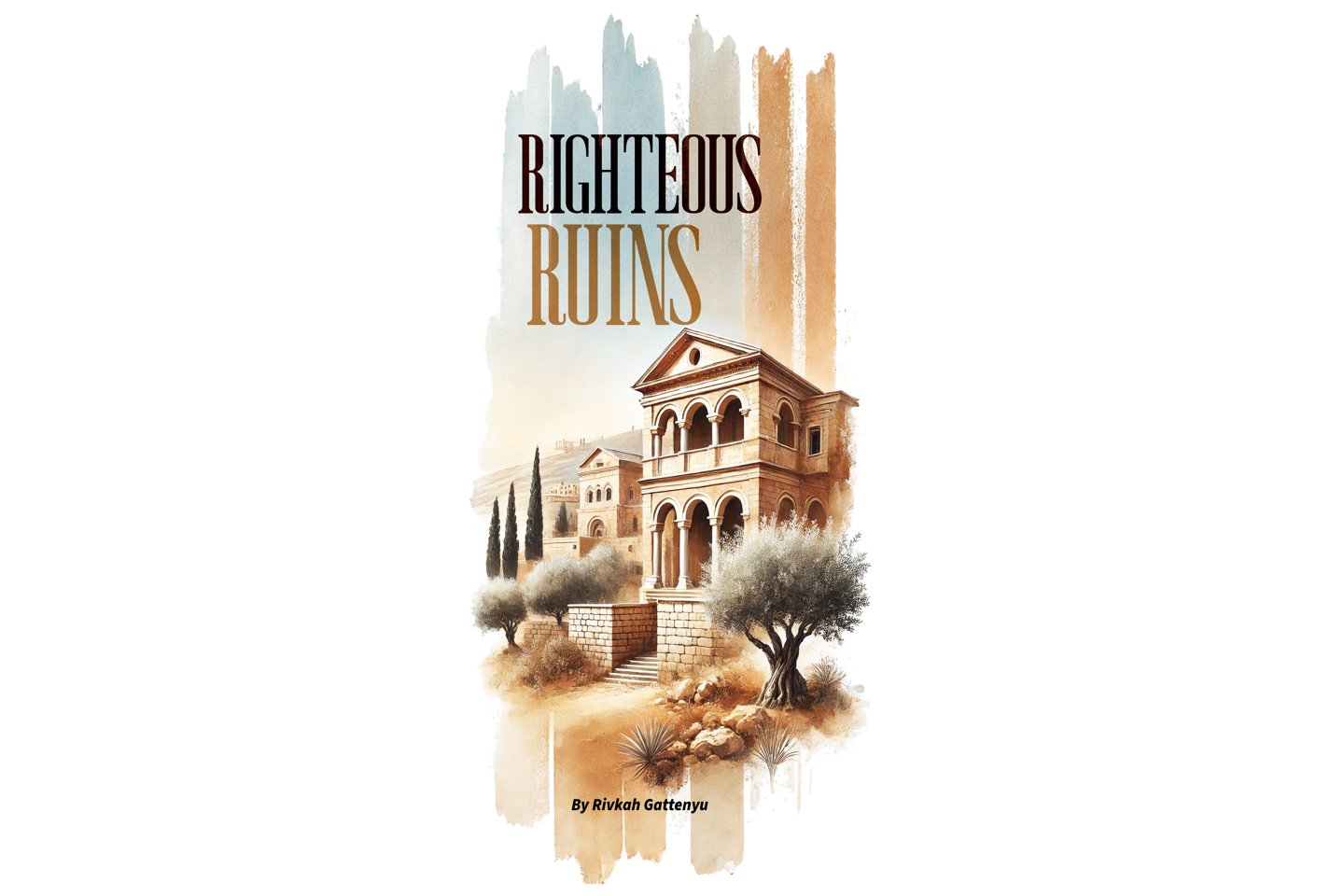
Recap: Our story takes place in the kingdom of Yehuda during the reign of Yoshiyahu HaMelech. Yehosheva was sold as a handmaiden to pay her father’s debts after his business partner Pinchas vanished with all their capital. Working alongside Zilpah in the kitchen, Yehosheva hears her tell stories from her childhood under the reign of the wicked King Menashe.
* * *
Zilpah went still for a moment, listening inwardly to words that had been etched on her heart for decades before she was willing to speak them aloud to anyone.
“Those were my mother’s last words to me. She shut the window the moment she let me go. I landed awkwardly, twisting my ankle in the fall, but I didn’t dare disobey her. Terrified, I ran to the bushes and lay there, shivering from the cold and from a fear unlike anything I had known before. I could not avoid hearing the screams and the sounds of horses all around me. Their hooves trampled everything in their path. Arrogant soldiers rode past holding swords and torches, and I lay as still as I could make myself, face pressed into the dirt.
“The last image that remains with me—the one I cannot shake loose even now, after all these years—was a soldier throwing a burning torch through the door of my house. The structure was swallowed by flames in a matter of seconds. After that, the Creator had mercy on me and I lost consciousness.”
Yehosheva had not moved. She was barely breathing, her whole attention fixed on the picture forming in her mind: a six-year-old girl lying alone in the dark and the cold, the sounds of destruction around her, unconscious and unreachable by anyone who loved her. The image sat on Yehosheva’s chest with physical weight.
Zilpah’s face showed nothing. She continued as though recounting events that had happened to someone else entirely—calmly, precisely, without a tremor in her voice or a shadow crossing her expression. Yehosheva found this harder to witness than tears would have been. She couldn’t understand how her own eyes were burning while the woman who had lived through it sat dry-eyed and still.
“That was the last time I saw any of them. My father and mother. My brothers and sisters.” She stopped. “There’s no one left.”
She picked up her knife and resumed cutting. The sound of the blade striking the board was the only sound in the kitchen—sharp, deliberate, filling the space that words had just occupied.
Then she set the knife down again and looked directly at Yehosheva.
“So. Is it really so surprising that after I recovered and grew up, I chose to stay?”
Yehosheva stared at her. “You’re here by choice? You could have left, and you chose to stay?” She heard her own voice rise and steadied it.
“What was waiting for me outside?” Zilpah replied, with the settled coolness of someone who made this calculation long ago and has not needed to revisit it. “Here I had a warm bed. A roof. People to care for and who cared for me. Even a little. Even sometimes.” The last words came out drier than the rest—a careful, deliberate reduction of sentiment to fact.
“Freedom,” Yehosheva said. The word came out quietly but carried everything she had been carrying since she arrived on the estate—every morning in the small room, every task performed under another’s authority, every memory of the life she used to know. “To be free.”
“Heh.” Zilpah dismissed it with a wave of the hand, the wave of someone for whom this particular argument is not new. “Free.”
“For two years I roamed—mountains, streets, alleyways. Eating whatever I could find: rotten vegetable peels, moldy bread, dried plant leaves. Drinking dirty water from roadside puddles when there was nothing else. I barely opened my mouth during all of it, terrified of being identified, carrying out my mother’s last instruction to the letter even when I didn’t understand why she had given it. I don’t know how I survived those two years. It could only have been the will of G-d, who watched over me without my knowing to ask.
“One day, when I was about eight—midday in summer, the sun beating down hard—I was standing at the end of the farmers’ market with my tongue stuck to the roof of my mouth from thirst. Black spots moved across my vision. After the weeks and months I had spent fighting just to stay alive, my body had reached its limit. And somewhere inside that exhaustion, a thought arrived that felt, for the first time, almost like peace: ‘Who would notice if I simply stopped? Who would care if I disappeared from this world? Everyone I loved is already somewhere better. What would be so terrible about joining them?’
“The more I sat with that thought, the quieter everything became. The marketplace noise fell back, as though it were coming from a great distance. My own breathing grew heavier. I was letting go.
“And then a hand gripped my arm. Hard. It pulled me back before I had finished leaving. My eyes opened just enough to see a blurred shape standing over me. I tried to tell her to leave me alone, that I had finally found some peace. Not a sound came out of my cracked lips.
“She didn’t leave. She sat me down and washed my face with cool water. She held my head steady and helped me drink, slowly and patiently, for as long as it took. And from that moment I didn’t let go of her hand—not because of gratitude, not even because of what she had done, but because she understood my heart without asking a single question. She kept her hand in mine and we walked together to her house. When people came toward us there, she said nothing—just motioned once with her free hand, and they went away.
“She handled me as though I were made of something fragile.” Zilpah paused. Something shifted in her face, a quiet surprise at her own words. “Maybe at that moment, I was.”
“The moment she took over, everything I had been holding came undone. I started shaking uncontrollably—the shaking I had been suppressing for two years—and I couldn’t stop. But I knew I was in the right hands. She cleaned me. She fed me properly for the first time in years. She put me to bed in a real bed, and the last thought I had before I fell asleep was that I had forgotten what a real bed felt like.
“A few days later she sat me down and said she wanted to ask a few things, but only yes or no, if speaking was difficult. I nodded. By then I already knew she was the mistress of the house, and that she had a habit of going through the markets looking for… the right people. She asked whether I was of the Jewish People. When I said yes, something flickered in her eyes. She asked whether I had any family left in the world. When I shook my head, understanding and concern came into her face. And then she asked whether I wanted to stay.”
Zilpah stopped. She looked at her hands resting on the table.
“She watched me with both hope and anxiety while she waited for my answer.”
To be continued IY”H…
Beis Moshiach #1523 • pp. 53-55
© 2026 Beis Moshiach Magazine. All rights reserved.
This article originally appeared in Beis Moshiach #1523. You are welcome to share it with friends and family by email or in print, provided that you do not change, add to or omit any part of it, you credit the author and Beis Moshiach, and you include a link to archive.bmoshiach.org (written out in full in printed copies).
To republish this article in a newspaper, magazine, book or website, please request permission in advance at [email protected].