Artwork with Simcha
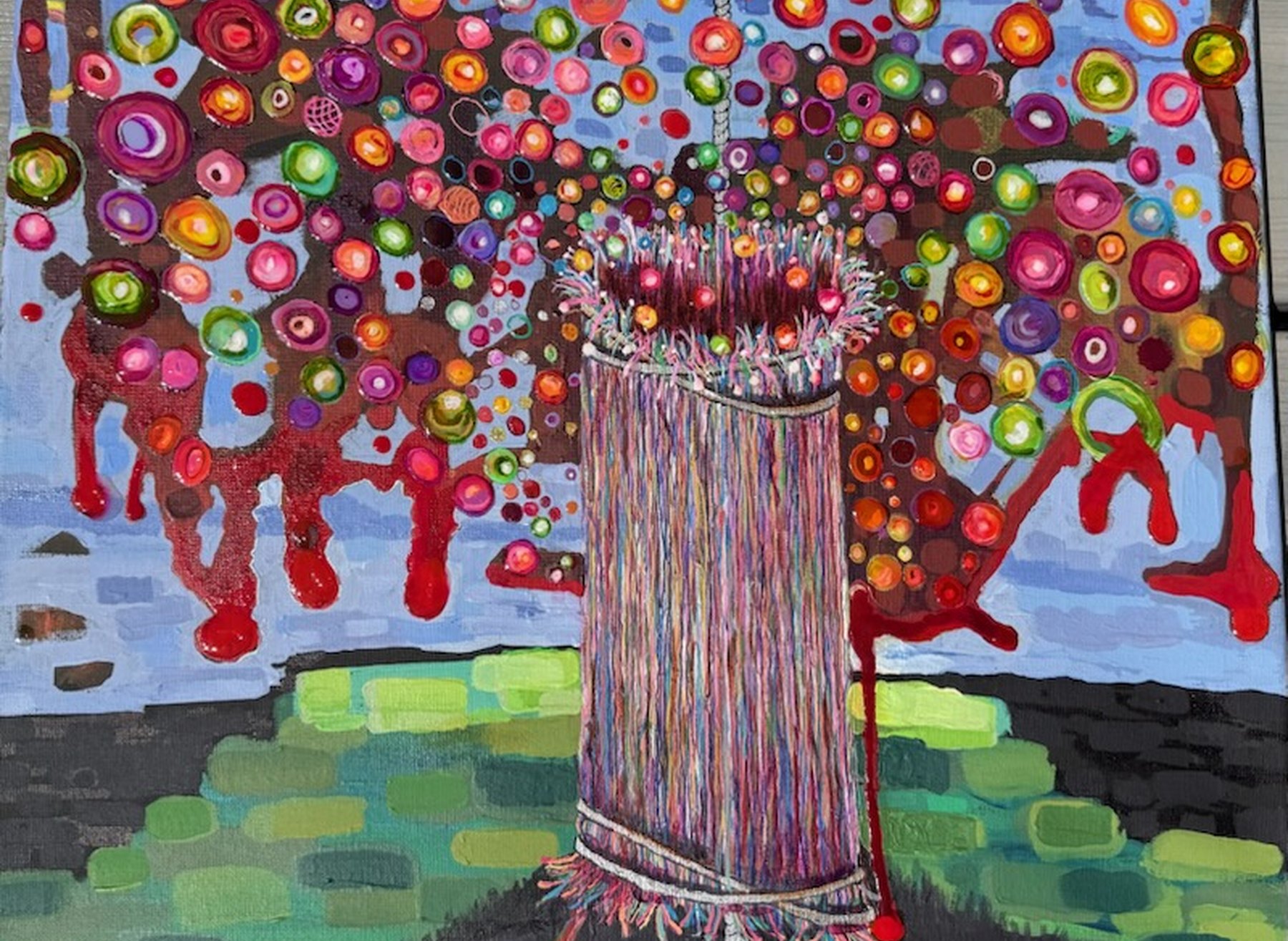
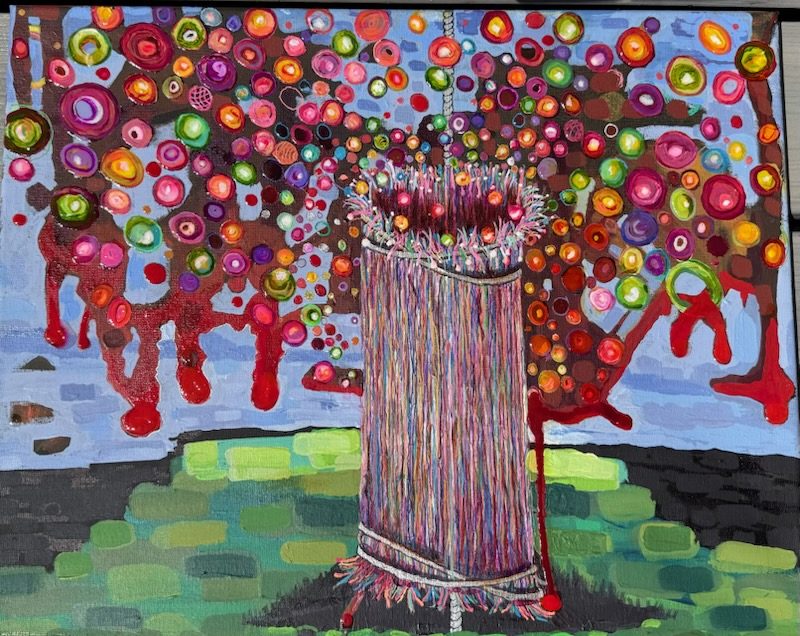
After seeing Judith Ribicoff’s bright, vibrant, colorful paintings, I wanted to get to know her. With a radiant smile, she says, “I was born in Adar, the month of simcha, and my favorite holiday is Purim! The more I feel connected to Hashem, the brighter my pictures become.”
A “Blended” Background
Judith begins, “I was born in New London, Connecticut, a historic seaport city. For the first six months of my life we lived by the Long Island Sound, and its mellow waves are soothing for me until today. I love being near water, and that’s probably why my favorite artistic medium is watercolor!
“Afterwards we moved to the Upper East Side of Manhattan. I’m drawn to nature and to the outdoors, and I spent a lot of time in Central Park. In the summers my family would go back to New London and enjoy its beautiful beaches. I always felt spirituality in nature, and never minded spending time alone, drawing and meditating.
“My father ob’m was a writer, and he was brought up in a home of politicians. His father was the first Jewish governor of Connecticut, Senator Abraham Ribicoff. They had roots in Russia, but were very assimilated. My father, who was very humble, was a spiritual person. He had a custom to read a chapter from the Tanach every day, and would often tell me what he read. I’ll never forget when he told me about the prophecy of the restored kingdom in Yerushalayim!
“My mother ob’m was born and raised in Casablanca, Morocco, in an Orthodox Sephardic family, and was one of nine children. Her father was a spice merchant. In Morocco girls did not go to school after high school, but she was a very determined woman and, as a mother of small children, earned a doctorate in psychology. I’m very proud of my parents and my ancestors. People have told me that the ‘blend’ gives a certain ‘spice’ to my personality. When I was young my mother’s family would fondly call me Feflah, which means red pepper in Arabic!
“We kept the holidays to some extent. My mother loved to cook all the traditional foods. But she was an atheist, and there would be massive theological arguments between her and my father.
“When I was twelve I began taking drawing lessons, which I continued throughout high school. I received a Master’s degree in Fine Arts. An academic degree isn’t necessary in order to be an artist, but I wanted to be an art educator too. For several years I was a middle school art teacher. I also taught groups of seniors, and I’d take them outside to scenic spots to draw and paint. I was living in Northeastern Connecticut at the time, which is a peaceful and rural area. I always felt strongly that you can’t just paint from a photograph, you have to go out and experience the beauty and majesty of Hashem’s world.”
Unexpected Turns
“I was searching for spirituality, but I never thought I would find it in Judaism. The only synagogues I ever went to were Conservative, and it felt empty there. Out of curiosity, I learned about every religion other than my own. But whenever I’d get too close, a wall would suddenly appear. It was my neshama’s way of saying, ‘No! This is not for you!’
“One day I was at a singles event in Kehilath Jeshurun, a shul in the Upper East Side of Manhattan, and Rebbetzin Esther Jungreis ob’m was speaking. I’d never heard anybody speak so passionately about Yiddishkeit before! For the next three years I attended her weekly parsha class, and drew images from the parsha as I listened. I started to get in sync with the weekly parsha, and loved hearing her female perspective on Torah. I saw that learning Torah wasn’t just a man’s world, which I believed because my mother had always complained that nobody ever explained anything in Torah to her.
“At the time I considered becoming Orthodox, but I was afraid that it would lead to clashes with my mother, who was very strong-minded in her atheistic views. I hid my yearning to have a more committed Jewish lifestyle from her, for fear that she’d think I was crazy.
“I needed a change, and moved to San Francisco, where my son Yonah was born. One day I found a pamphlet with letters in Hebrew, advertising a Jewish women’s support group. I contacted them, and saw how important it was to be connected to other Jews.
“A year later I moved to the ‘North Peninsula’ area of San Francisco. I sent Yonah to Chabad for pre-K and for Hebrew school, and we started going to the Chabad shul. It was a warm and friendly place, and we’d go there for the holidays.
“After nine years in California I had to come back to New York to take care of my father, who was at the end of his life. Yonah was ten at the time. One day my father grabbed my hand and, while looking straight into my eyes, said firmly, ‘It’s up to you to make sure that this family stays Jewish!’
“I knew that I had to keep Yonah connected, but he pulled away from Judaism after his Bar Mitzva. Yet there was a totally unexpected turn that awaited me….
“When Yonah was eighteen he walked into a music store on a Friday afternoon. A few Lubavitch bachurim were busy putting tefillin on men passing by, and he warmly told them, ‘Have a good Shabbos!’ One of the bachurim offered to lay tefillin on him, and he readily agreed. Yonah told me afterwards that as he wrapped the tefillin he felt an incredible rush of spirituality. The bachur kept in touch with him and invited him to Crown Heights for Shabbos. The next year Yonah was a full-time student in Hadar HaTorah.
“I’m the kind of mother who researches what their child is doing, and I started learning Chitas myself. It led me to taking on mitzvos, step-by-step. Every year I commit myself to an additional mitzva. Yonah and I are in this together.”
Judith pauses, and uses vivid imagery to explain how she feels, “It’s like a massive ship was turned around as it was careening towards an iceberg of assimilation. Our family was on the brink of disappearing, and I was able to bring it back on track. I feel very proud!
“Four years ago my mother passed away. My life went full circle, and I moved back to New London, where I was born. I began listening to classes that were given by Rabbi Yehoshua Gordon ob’m through chabad.org. Thousands of Jews are getting turned on to Yiddishkeit through his inspiring classes. There are classes in Chumash, Tanya and Rambam. I still listen to his classes every day, even though I’ve heard them many times before.”
Hashem Flows Through Me Into My Art
“Hashem gave me the gift of creating art, and I want it to be aligned with Yiddishkeit, and full of positivity and joy,” Judith says. “Painting is not like illustration, that has to be exact. When I receive a prompt of what to paint, the painting just ‘wanders off,’ and develops a personality of its own. It’s my way of connecting to Hashem, and allowing Him to flow through me into my art.”
She shares her message, “We are witnesses to so many miracles every day, that most people don’t even notice. The Geula energy of love, unity, peace, and complete healing is permeating the world. It’s both grounding, and elevating, simultaneously, and is bringing an explosion of creativity, illumination, and color to the world!”
After a pause, Judith adds emphatically, “Lay down your egos, and allow space to connect to Hashem! And be open to doing what He asks of you!”
Judith can be contacted at [email protected].
Beis Moshiach #1517 • כ״ד מנחם אב תשפ״ו • pp. 40-41, 49
© 2026 Beis Moshiach Magazine. All rights reserved.
This article originally appeared in Beis Moshiach #1517. You are welcome to share it with friends and family by email or in print, provided that you do not change, add to or omit any part of it, you credit the author and Beis Moshiach, and you include a link to archive.bmoshiach.org (written out in full in printed copies).
To republish this article in a newspaper, magazine, book or website, please request permission in advance at [email protected].