The Igros I Remember Best
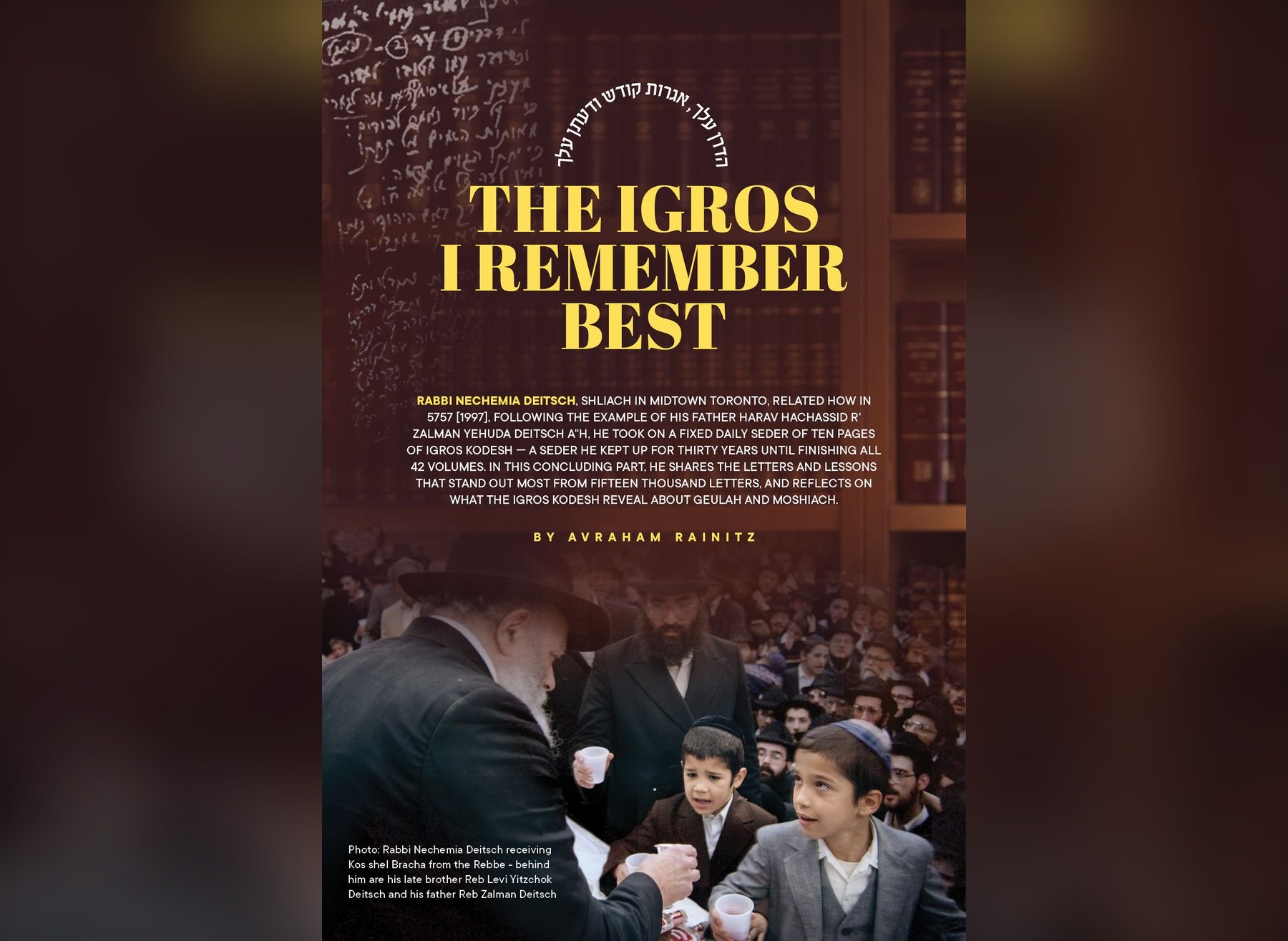
Rabbi Nechemia Deitsch, shliach in Midtown Toronto, related how in 5757 [1997], following the example of his father Harav HaChassid R’ Zalman Yehuda Deitsch a”h, he took on a fixed daily seder of ten pages of Igros Kodesh – a seder he kept up for thirty years until finishing all 42 volumes. In this concluding part, he shares the letters and lessons that stand out most from fifteen thousand letters, and reflects on what the Igros Kodesh reveal about Geulah and Moshiach.
In Part 1, Rabbi Nechemia Deitsch, shliach in Midtown Toronto, described how in 5757 [1997], following his father R’ Zalman Yehuda Deitsch a’h, he took on a fixed daily seder of ten pages of Igros Kodesh—a seder he kept up for thirty years until finishing all 42 volumes. In this concluding part, he shares the letters and lessons that stand out most from fifteen thousand letters, and reflects on what the Igros Kodesh reveal about Geula and Moshiach.
Letters Engraved in Memory
Out of fifteen thousand letters—which ones are engraved in your memory more than the rest?
One of the special letters is from the period between Yud Shevat 5710 [1950] and Yud Shevat 5711 [1951]. In France there lived at the time a Chassid named R’ Chaim Meir Minkovitch, whose father had passed away there. To make a living, the son worked as a shochet, traveling five days a week. But on his travels he had no opportunity to daven at the amud and say Kaddish for his father, and he wrote to the Rebbe of his dilemma: on one hand, he had to support his wife and children and bear the costs of his father’s funeral and burial; on the other hand, he couldn’t daven at the amud for his father. What was the right thing to do—continue focusing on parnassa, or stay home, daven at the amud, and say Kaddish?
The Rebbe answered him on the 14th of Menachem Av 5710 [1950], a detailed response, point by point. Regarding supporting the family; sources for a person’s obligation to provide for his family. Regarding participating in burial costs; sources from the Shulchan Aruch for a son’s obligation to arrange a respectful burial for his father; and regarding davening at the amud; here too, a list of sources. Both paths, it turns out, are correct and appropriate.And then comes the closing line, which R’ Deitsch quotes by heart: “And all the above is because I don’t know your standing regarding the trait of bitachon, but if you are strong in this, and search with wholeheartedness for a means of livelihood, Hashem will grant you your livelihood in a place where there is a minyan, etc., and he will be able to fulfill all that is incumbent upon him in the above matters.”
“I think about that line a lot,” he says, “because my father a’h was also a model of exactly that kind of bitachon: the knowledge that you can find parnassa wherever you are—if only you invest yourself in the trait of bitachon.”
The second letter engraved in R’ Deitsch’s memory takes us to the year 5734 [1974]:
Rabbi Moshe Dovber Rivkin, a Chabad Chassid who was Rosh Yeshiva at Yeshivas Torah Vodaas, lived near 770, at 706 Eastern Parkway. To understand his stature, R’ Deitsch prefaces with an important detail: when he passed away, his family wanted to bury him in Eretz Yisrael, and the Rebbe instructed that earth be taken from the Ohel, brought to Eretz Yisrael, and placed in his grave. Usually the custom is the opposite—earth from Eretz Yisrael is brought to a grave in chutz la’aretz—but in his case the Rebbe wanted the earth of the Ohel to be with him in Eretz Yisrael.
In his old age, Rabbi Rivkin wrote the Rebbe a short line, carrying so much painful meaning: “I am suffering weakness.” And the Rebbe answered: “Perhaps this is in accordance with the ruling regarding the porters of Mechuza (Bava Metzia 77a).” The Gemara there tells of porters who had steady work carrying heavy loads, and one day the work stopped. Those porters began to feel tremendous weakness and fatigue—precisely because they had stopped carrying the load they were used to. The Rebbe was telling him, in effect: you’re getting older and feeling weak? Stop cutting back on your activities and responsibilities—and stop feeling tired.
“That too reminded me of my father,” says R’ Deitsch. “We never once saw him walking around tired. He never fell asleep at Friday night seudos; he was always alert, and after the seuda he’d still take part in a shiur held at our house, learning a sicha of the Rebbe. Even when he wasn’t in good health, he looked to do more, not less. So whoever feels tired should think about this letter.”
The third letter, from the year 5750 [1990], “puts a few things in perspective for me,” in R’ Deitsch’s words. R’ Berel Junik a’h was among the Chassidim closest to the Rebbe—one of those who cared for the needs of the Rebbe and Rebbetzin in the innermost circle.
In 5750 [1990] he wrote to the Rebbe: since it’s a set practice that once every ten years I have a yechidus with the Rebbe, and the year 5750 has arrived—I’d like to know on what day and at what hour I can come in for yechidus. And the Rebbe answered him: “The distributing of dollars on Sunday is yechidus, along with additional tzedaka.”
“I understood then,” says R’ Deitsch, “that a time had come when we’re all equal. Even someone like R’ Berel Junik gets an answer that his ‘yechidus’ is the Sunday dollar line—like everyone, together with everyone.”
“These three letters are essentially a life-directive, showing how our lives should be conducted the right way.”
Fear of the Nations? — It All Depends on Us!
When I asked you for one letter you “live with”—a letter that accompanies you in shlichus and in life—you answered without hesitation, and even brought three.
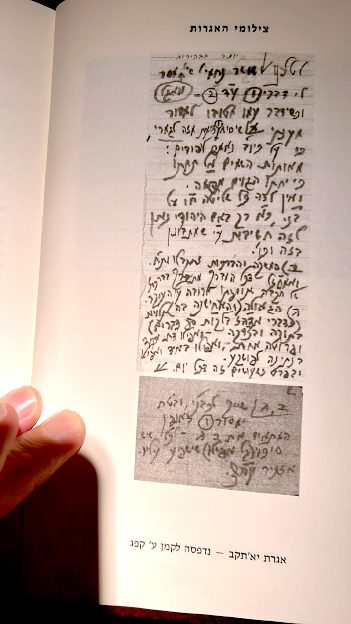
[Laughing]: Let me tell you about a letter I read at exactly the time the most recent war broke out, on Simchas Torah 5784 [October 7th 2023]. It’s a letter from the year 5741 [1981]. At the front of that volume, as in many volumes, there are photocopies of handwritten letters, and in one of them the Rebbe writes: “Telephone… that Nechemia Vogel has conveyed to me a matter regarding […], and when he speaks with him, he should kindly convey my response.” When I saw the name ‘Nechemia’ in the ksav yad kodesh—spelled the way I write it myself—it immediately caught my attention.I looked at the letter and said to myself: wait, R’ Nechemia Vogel—isn’t he the shliach in Rochester, New York? I got his phone number, called, and asked: tell me about this letter.
And what’s the story? In 5741 [1981], R’ Vogel, born in England, traveled, disguised as a tourist, to strengthen Jews in Soviet Russia. Everywhere he went people asked him: “Are you a Lubavitcher? What’s happening with the Rebbe?” One Jew asked to speak with him privately, and told him the KGB was watching him: according to him, they’d invented a device that could pick up waves in the air and read what was happening in the mind. The man lived in constant dread that they knew his every thought. He asked Nechemia Vogel: when you get to New York, please ask the Rebbe for a blessing for me—but not in a letter, because I’m being watched. He gave a bottle of “mashke” to bring to the Rebbe. Many months later, Rabbi Vogel returned to 770. By then there was no more yechidus, so he went to the office, wrote the frightened man’s story on a note, and asked for a blessing for him, and also passed along the “mashke.” The Rebbe wrote the handwritten response—not to Vogel, but to Professor Yirmiyahu Branover, instructing him to telephone and convey it. Vogel himself believes the Rebbe deliberately wrote his first and last name in full—“that Nechemia Vogel has conveyed to me”—to make clear the matter was conveyed orally, through a messenger, and not in a letter sent by mail, so as not to endanger the man. To that extent!
And what does the Rebbe answer the man? First: that he should put the matter entirely out of his mind, since regarding things like this it was said to the Jewish people, “Do not be dismayed by signs of the heavens, for the nations are dismayed by them”—and this has no power whatsoever, ch’v, over the Jewish people, except insofar as the Jew himself gives it importance by dwelling on it. Second: the mashke and the blessings were received with thanks, and our Sages taught that whoever blesses is blessed by Hashem with even more than the blessing itself. Third: the Geula (may it come speedily) depends—as the Alter Rebbe writes in Likkutei Torah, end of Parshas Devarim—on Torah and tzedaka, even one word of Torah and one coin, even alone and even given into a pushka, especially when done every day.
At the close, the Rebbe instructs that points two and three apply to all Jews, and that the man should convey them, in a fitting manner, “to anyone who has any chance (even a slight one) of being influenced by it. I will mention it at the tziyun.” In other words: the nations get frightened by signs—they see a sign, hear something, and are dismayed. But a Jew is forbidden to be frightened by it. And the Rebbe continues: this has no power at all, chas v’shalom, over the Jewish people, except if the Jew gives it importance, by dwelling on it.
And since Simchas Torah 5784 [2023] this letter has stayed with you…
I keep coming back to this point, especially since the war began, because there are a lot of people in a panic. I pass along the Rebbe’s point to them: when does a given thing gain the power to frighten? Only when the Jew gives it importance and dwells on it. It’s a letter that helps me first of all as a private individual, but it’s also a point we have to share with people.
Living Moshiach, Literally

The Rebbe says that the matter of Moshiach must be the central point in every aspect of shlichus. What have you seen regarding Geula and Moshiach throughout the letters, even from the earliest years?
First of all, the fact that already right at the start, in Volume 2, there’s an entire lengthy, deep treatise discussing Techiyas HaMeisim. When you encounter that right at the opening of the series, you grasp that this is a central matter.
And in the years 5751–5752 [1991–1992] themselves, what do you see in the letters?
Specifically on this topic a certain surprise awaited me. In the sichos, especially from 28 Nissan 5751 [1991] onward, every farbrengen is ablaze with matters of Moshiach and the miracles happening in the world. But in the letters of those same years I didn’t feel it with the same intensity. That’s partly because the letters of the later years are more in the style of short answers, straight to the point, without lengthy discussion. The main “energy” of Moshiach was in the farbrengens and the dollar distributions. In 5751 [1991] I almost didn’t feel it in the letters at all; by 5752 [1992] you already see more, because people began asking the Rebbe about these matters. And when I started reading these letters, I simply understood: different people received different answers, and in the letters you can see how it all connects.
Can you elaborate?
Here are three answers from that same period: Tzeirei Agudas Chabad in South Africa wrote that they wanted to hold a gathering emphasizing that the Rebbe is Moshiach, and the Rebbe answered: “It depends on the conditions of the place regarding this; it’s for the local Chabad to determine.” In other words, up to the discretion of the local shluchim. A month later, N’shei Chabad of New York wrote regarding a pamphlet, “Kabbolas Pnei Moshiach Tzidkeinu,” written by Rabbi Sholom Ber Wolpo dealing with the identity of Moshiach, and the Rebbe answered: “I already answered him previously that articles like this distance people from learning Chassidus—the opposite of spreading the wellsprings outward.” And three days later—three days!—a group of Anash in Lod, who had organized a shiur on the subject of the identity of Moshiach, wrote to the Rebbe: in our community there are those capable of absorbing Rabbi Wolpo and this topic, can we do this here? And the Rebbe answered: “A judge has only what his eyes see (a local rav).”
Notice the precision: to N’shei Chabad the Rebbe doesn’t write that it’s forbidden to say something untrue. The Rebbe writes that matters like this—in that particular place, for that particular audience—distance people. And in a place where the rav and the community are capable of absorbing it—on the contrary.
And today, in your own place of shlichus, how does this point translate into practice?
I’ll give you an example from recent weeks. There’s a lot of energy today around the “Project Likkutei Sichos.” Last week we learned the sicha of Matos-Masei in volume 28. There’s an extended discussion there of why Moshe Rabbeinu included half the tribe of Menashe, when only Bnei Reuven and Bnei Gad had asked. The Rebbe explains there that everything—including matters of Geula—must pass through Moshe Rabbeinu, and therefore specifically Menashe (which means “forgetting”, the shevet whose whole essence was not forgetting “my father’s house,” received his portion in the land from Moshe Rabbeinu himself. When you learn a mugah’dike (edited) sicha where the Rebbe says something about Moshiach, it’s worth also checking the unedited hanacha of that same farbrengen, because the strongest language doesn’t always make it into the edited sicha. At that same farbrengen—Shabbos Parshas Tzav 5745 [1985]—the Rebbe speaks at length about Moshiach: one might think that when meeting a “mekurav,” you first have to ask how he’s doing—how’s the family, how’s business—and only afterward, once hearts have grown closer, can you speak with him about substantive matters, and only after all that can you say to him: nu, what about Moshiach?
The Rebbe rejects this approach and says that first and foremost one must cry out “Moshiach Now!”—and cry it out to the point that the other person himself begins to cry “Moshiach Now!” And the Rebbe explains that although this seems strange, this very approach is effective—because when a person who lives and conducts himself in a completely normal way (in dress and speech) suddenly begins, with no preamble, to cry “Moshiach Now!”—it’s precisely this surprising, direct approach that works, and awakens in the other person his innermost point, revealing that truly, deep in his heart, the other person’s soul is also crying “Moshiach Now!”
How does this whole picture fit together—the different responses, the different levels of intensity, the different communities?
What I took from all this is that there are different types of people, who feel comfortable at different levels when it comes to Moshiach. Our father a’h taught us to take the Rebbe’s words literally: to truly live with the truth of Moshiach—how it can happen, and that it can happen at any moment—without taking things out of context. The only question is whether we’re ready to hear and accept it. In our family, baruch Hashem, we’re all able to take that in.
Hadran Alach
Ahead of the twentieth yahrtzeit of Reb Nechemia’s father, Reb Zalman Yehuda a’h, the family held a special event in Crown Heights, during which the son, Rabbi Nechemia Deitsch, made the siyum on the entire Igros Kodesh.
At every siyum on a mesechta we say “Hadran Alach”—and, translated: we will return to you again.
This siyum, too, already has its Hadran ready: the new edition of Igros Kodesh, which will reopen from Volume 1 and will include the thousands of letters discovered in recent years, is already in the works.
And R’ Deitsch expressed the true conclusion in the words with which he closed his remarks at the event: “With Hashem’s help this will spread throughout the entire world, and we will merit the hisgalus of the Rebbe, Moshiach Now!”
Beis Moshiach #1519 • pp. 12-17
© 2026 Beis Moshiach Magazine. All rights reserved.
This article originally appeared in Beis Moshiach #1519. You are welcome to share it with friends and family by email or in print, provided that you do not change, add to or omit any part of it, you credit the author and Beis Moshiach, and you include a link to archive.bmoshiach.org (written out in full in printed copies).
To republish this article in a newspaper, magazine, book or website, please request permission in advance at [email protected].