Regards From Edmonton
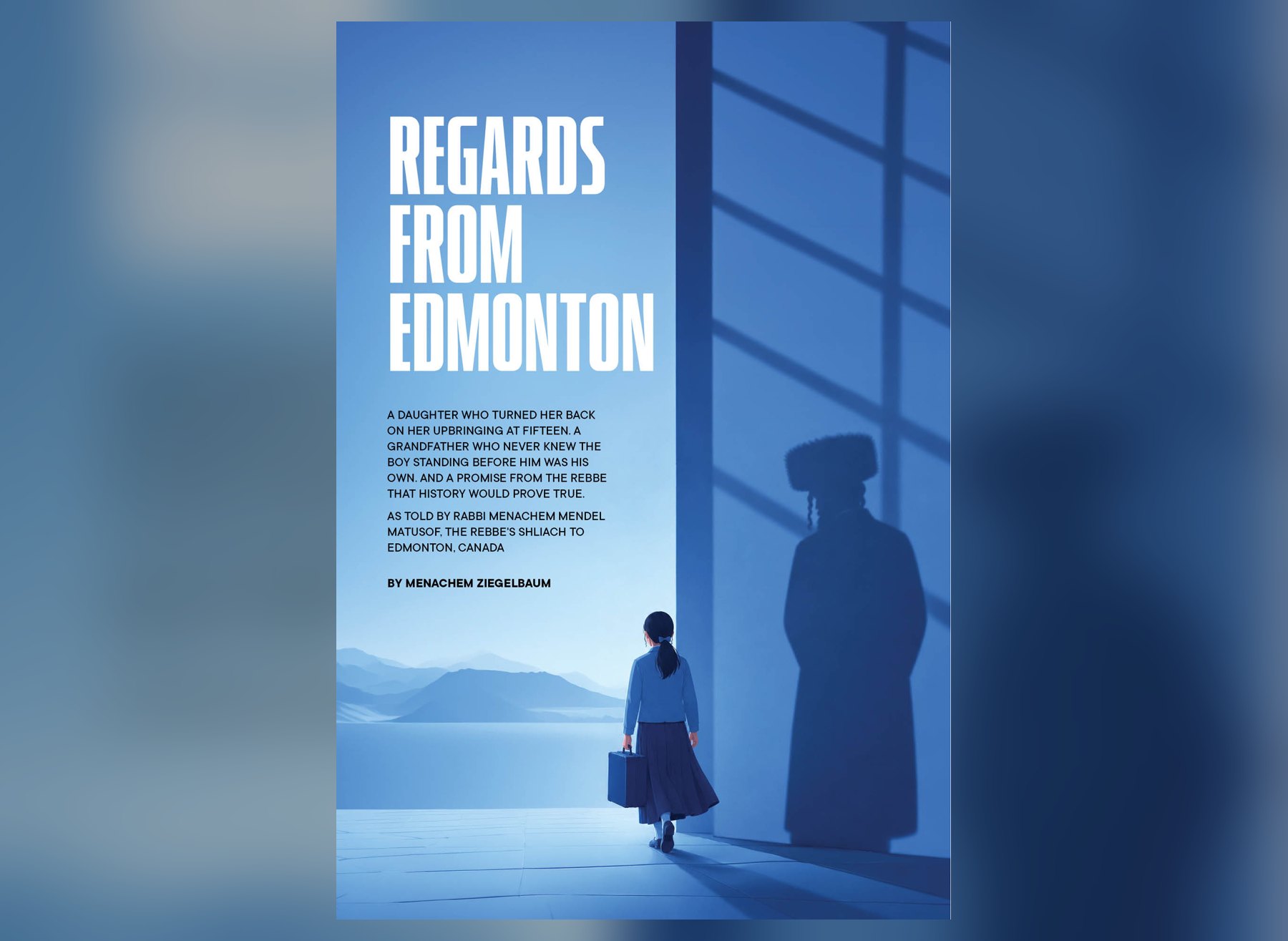
A daughter who turned her back on her upbringing at fifteen. A grandfather who never knew the boy standing before him was his own. And a promise from the Rebbe that history would prove true. As told by Rabbi Menachem Mendel Matusof, the Rebbe’s shliach to Edmonton, Canada.
I
“The boy will not undergo circumcision!” the non-Jewish father stated firmly. “If he takes this step, I will sever all ties with him forever!” he threatened.
II
Rabbi Menachem Mendel Matusof merited to be among the Rebbe’s shluchim to the province of Alberta, Canada. On the frozen frontier of his city and province, he kindles souls, lights hearts, and brings a warm Yiddishkeit into the souls of thousands of Jews.
Some time after going on shlichus, Rabbi Matusof returned to Crown Heights with the goal of stocking up on Jewish outreach materials, visiting his family, and gaining strength from the meshaleiach.
During the visit he went to the Rebbe’s secretariat to submit a report on his activities where he met the secretary, Rabbi Yehuda Leib Groner. “Rabbi Matusof,” Rabbi Groner called out happily. “Do you have regards from our friends in Edmonton?” The question, which sounded routine, referred to the city located three hours’ drive from Calgary, the shliach’s place of residence.
At that time, four wealthy brothers lived in Edmonton who were enthusiastic supporters of Chabad’s activities. Occasionally they even merited to participate in a special yechidus for major donors. Rabbi Matusof was certain Rabbi Groner meant them.
“No, I don’t mean them,” Rabbi Groner ruled out that possibility. “So who exactly do you mean?” Rabbi Matusof asked.
“Call so-and-so right away and you’ll get information from him,” Rabbi Groner instructed in a serious tone. “The Rebbe wants you to be personally involved in this matter.” Only then did it dawn on the shliach that this hadn’t been an innocent question, but a matter in which the Rebbe himself was involved.
That very day, Rabbi Matusof called the person Rabbi Groner had referred to. He lived in Toronto, and he told the shliach a complicated and painful story: his sister-in-law, his wife’s sister, the daughter of a well-known and respected rabbinic family, maintained warm, long-standing ties of friendship with Chabad and personally with the Rebbe.
Her life was full of hardship. At only fifteen, she had run away from her parents’ home, traveling to the distant city of Edmonton out of a desire to sever ties with her family and her Judaism. Eventually she married a non-Jew, and they had an only son. When her father learned of her marriage to a gentile, he tore his garment in mourning and sat shiva for a full week, as though for a daughter who had died.
Over the years there was complete estrangement between her and her parents’ family, except for a limited connection with one or two sisters who would not let despair overcome their innate love.
Eventually the couple divorced, and the only son lived with both parents in alternating shifts, torn between two completely different worlds.
“If you could help in any way, draw her closer and look after her, it would be a real blessing,” the brother-in-law told the astonished shliach.
Rabbi Matusof, understanding that the Rebbe was involved in this story, hastened to call her. He introduced himself and his position, and asked if he could meet with her. To his surprise, she agreed. They arranged to meet after he returned to Canada.
About a week later, he drove to the address he’d been given—a poor, neglected area on the outskirts of Edmonton. To his astonishment, he noticed a small, old mezuza affixed to the doorway of the house. It was a small, run-down apartment where she lived with her son. When the door opened, he was moved to see a small, familiar picture of the Rebbe.
Over the following hours, Rabbi Matusof sat with her as she recounted the complicated story of her life. She revealed to him that for a long time she had been corresponding with the Rebbe, and that he was helping her with his advice and blessings. She expressed her wish to return to her Judaism and advance in a life of Torah and mitzvos. Now, after a life journey full of hardships, she understood well the grave mistake she had made.
From then on, Rabbi Matusof stayed in touch with her, occasionally meeting for conversations of encouragement and kiruv. Slowly she returned to a life of mitzvos.
Several weeks later, the Matusof family—the shliach, his wife, and their two young children—traveled to spend a full Shabbos in Edmonton. They davened at the small local shul, and in advance invited the mother and her son to join them for the Shabbos meal at the hotel where they were staying.
The Shabbos candles burned on the table, and the whole family broke into a heartfelt “Shalom Aleichem.” The shared melody brought back in the mother a sweet feeling from the days when she used to sit at her parents’ table.
It was the first time in the boy’s life that he saw authentic Jewish life. In fact, it was the first time he had met a Jew besides his mother, and of course it was also the first time in his life that he experienced a proper Shabbos meal, with zemiros, divrei Torah, and the pure delight of Shabbos. The atmosphere touched him to the depths of his heart.
Over time, the connection with the mother and her son grew stronger. The shluchim even occasionally brought in a certain Jewish performer who held activities for the youth. No one knew that this performer had been invited because one of his staff members was the boy’s uncle, thereby indirectly strengthening his Jewish connection and drawing him closer to his roots.
Rabbi Matusof never wrote a report to the Rebbe without telling of the mother’s and son’s progress in Yiddishkeit.
His drawing closer to Judaism wasn’t a given since part of the time the boy lived with his non-Jewish father, which caused setbacks in his progress.
After about two years, the veteran shluchim brought special shluchim to Edmonton—Rabbi Aryeh Drelich and his wife. The new shluchim continued the relationship, which kept growing stronger, leading to considerable progress in observing Torah and mitzvos.
III
One year, the Siyum HaRambam was held in New York. The event took place in a large hall in Manhattan, to which were invited Admorim, well-known rabbis, and many Torah dignitaries who graced the dais of honor. Among the rabbanim sitting on the stage was that same respected Rav, the father of the daughter, who had torn his garment over his daughter who had strayed from the path.
Rabbi Matusof was present in New York at that time, and was not surprised to receive instructions from Rabbi Groner to take advantage of the occasion and approach the Rav to convey regards from his daughter.
The shliach shrugged. “I don’t know if I’ll manage to get close to the stage and reach the esteemed Rav,” he said, but Rabbi Groner repeated firmly: “Rabbi Matusof, you must go up! The Rebbe wants you to convey regards so the father will know what’s happening with his daughter.”
Since it had been stated explicitly that the instruction came from the Rebbe himself, he was happy to carry out the assignment.
Toward the end of the event, Rabbi Matusof quietly approached the Rav at the edge of the dais of honor and shook his hand. He told him he was the Rebbe’s shliach in the province of Alberta, Canada. “You have regards from your daughter,” he whispered in his ear.
It was impossible not to see the great emotion that suddenly spread across the Rav’s face. He grasped the shliach’s hands and asked in a trembling voice: “Is she frum?”
“I don’t know what exactly you mean by ‘frum,’” the shliach answered carefully, “but she is growing closer and closer to Torah and mitzvos.”
It was impossible to miss the radiant expression that came over the father’s face.
Since the path had been paved from both the father’s side and the daughter’s side, it wasn’t long before a meeting was arranged between the parents and their daughter. With tears filling her eyes, she asked his forgiveness for all the pain she had caused him, and he received her with a warm, fatherly embrace.
From then on, the connection with her family grew significantly stronger. There was only one thing the respected grandfather still didn’t know: the existence of the grandson. The family felt the time still wasn’t right to tell him about a grandson born to a non-Jewish father.
Still, the family wanted with all their hearts for the grandson to meet the esteemed grandfather, and to receive a personal blessing from him. After all, the grandfather wasn’t young, and who knew if he would still be able to get to know his grandson… They understood they would have to do this craftily, without the grandfather knowing his grandson’s true identity.
So they racked their brains and devised a plan.
Some time later, a group of non-religious young men was organized who came together to the Rav’s house to ask for his bracha. One of them was his grandson. The latter knew exactly who the dignified-looking man standing before him was, while the grandfather did not know his grandson’s identity. The grandfather spread his hands and blessed him warmly.
Some time after that, the mother asked the Rebbe whether the time had come to tell the grandfather about the grandson’s existence. But the Rebbe responded that apparently the grandfather already knew, or sensed it, but there was no need to speak of it explicitly.
IV
As the boy grew closer to Jewish life, the problem of a bris rose ever more sharply. From birth, his parents had not circumcised him. Not only that, but his non-Jewish father expressed firm opposition to it. All attempts to persuade him came to nothing.
As the time for his bar mitzva approached, they asked the Rebbe whether one could hold a bar mitzva without a prior bris, or whether one should insist on the bris first. The Rebbe’s answer was unequivocal: hold the bar mitzva, and regarding the bris—”In the end, didon notzach (we will be victorious).
And indeed, the boy’s bar mitzva celebration was held amid great joy, with shluchim from near and far, family members and friends arriving to gladden the hearts of the son and his mother.
The years passed, the boy grew up, and his mother and her family took him on trips to Eretz Yisrael, which further strengthened his connection to his Jewish heritage. The non-Jewish father did not interfere with his son’s growing closeness to the Jewish faith, remaining stubborn only in his absolute opposition to circumcision.
Over time the mother and her son moved to greater Toronto, and became an inseparable part of the Jewish community.
Five more years passed. When the son turned eighteen, he was entitled to make an independent decision even against his father’s wishes and he asked to have a bris. Following this, his relationship with his non-Jewish father was also severed.
Thus was fulfilled the Rebbe’s prophecy stated years earlier, “In the end, didon notzach.”
Rabbi Matusof also attending his wedding, which was a proper Jewish wedding. Although the esteemed grandfather was no longer alive, the grandmother and the rest of the family participated in the great celebration. The shliach was honored with a bracha under the chuppa, and later even delivered an emotional speech.
When he was introduced by the emcee as “the Rebbe of Lubavitch’s shliach,” the emcee added with great emotion that “the chassan has two grandfathers: his biological grandfather, and the Rebbe of Lubavitch”…
* * *
“This story,” concludes Rabbi Menachem Mendel Matusof, “personally gave me tremendous strength and inspiration to cope after Gimmel Tammuz. The Rebbe’s answer was given before Chof-Zayin Adar 5752, while the long-awaited bris took place after Gimmel Tammuz 5754. This story showed me how the Rebbe’s words live on eternally, and that ‘not one of your words shall return empty.’”
(Thanks are given to the student Shneur Zalman Neuman for bringing this story)
Beis Moshiach #1514 • pp. 34-37
© 2026 Beis Moshiach Magazine. All rights reserved.
This article originally appeared in Beis Moshiach #1514. You are welcome to share it with friends and family by email or in print, provided that you do not change, add to or omit any part of it, you credit the author and Beis Moshiach, and you include a link to archive.bmoshiach.org (written out in full in printed copies).
To republish this article in a newspaper, magazine, book or website, please request permission in advance at [email protected].