Drafted into Chaos
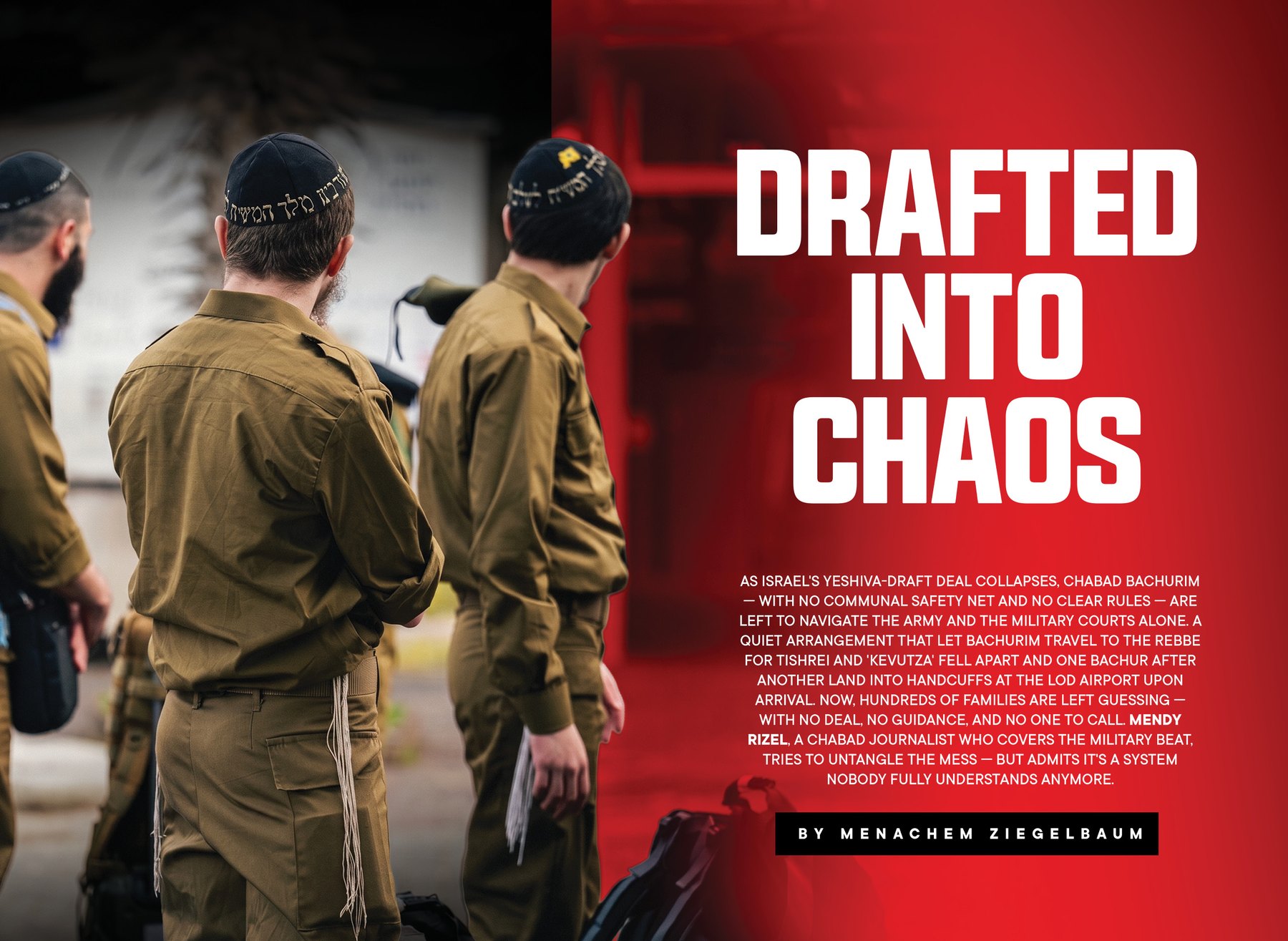
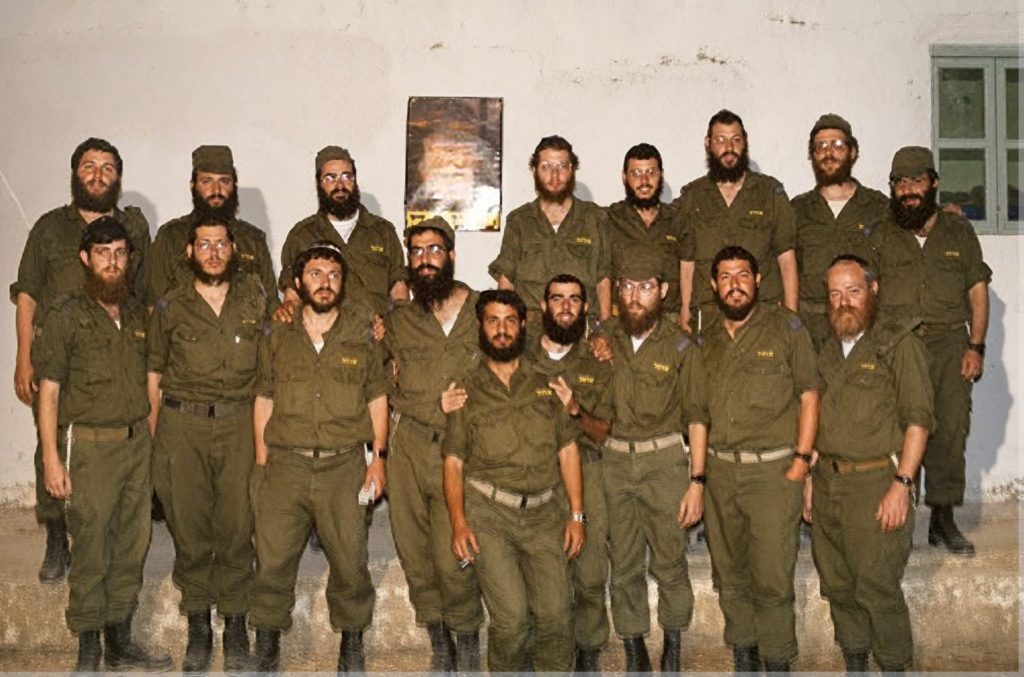
As Israel’s yeshiva-draft deal collapses, Chabad bachurim – with no communal safety net and no clear rules – are left to navigate the army and the military courts alone. A quiet arrangement that let bachurim travel to the Rebbe for Tishrei and ‘Kevutza’ fell apart and one bachur after another land into handcuffs at the Lod Airport upon arrival. Now, hundreds of families are left guessing – with no deal, no guidance, and no one to call. Mendy Rizel, a Chabad journalist who covers the military beat, tries to untangle the mess – but admits it’s a system nobody fully understands anymore.
The issue of drafting yeshiva bachurim, including ‘tmimim,’ has for some time been at the center of the news in Israel. Draft law or draft-evasion law, partial conscription or general conscription, special status for yeshiva bachurim or not, and who is considered to have “Torah as his profession” and who is not entitled to that status. All these issues, which simmered for roughly seventy years, have recently erupted into a massive blaze.
It all began after the High Court of Justice (Israel’s Supreme Court) ordered the cancellation of the arrangement that had applied to tens of thousands of yeshiva bachurim for decades, on the grounds of “equality” before the law. The Attorney General pressed the gas pedal even harder, ordering that yeshiva bachurim be drafted at any cost, even if that meant seizing them in the streets and in their homes and conscripting them (reminiscent of what is happening in Ukraine and Russia these days)—and if necessary, hitting them in the pocket through the withdrawal of a range of financial benefits.
The situation that had existed for years based on understanding and agreement has turned into a political battlefield. No, the army no longer needs eighty thousand yeshiva bachurim. It needs roughly twenty thousand additional recruits to fill its ranks and ease somewhat (and rightly so!) the burden on regular and reserve soldiers who have been serving grueling duty for the past three years on the southern and northern fronts; some haven’t seen their homes for very long stretches, and some have lost their businesses.
The price? Heavy. Very heavy! The rifts that existed in Israeli society have become deeper, almost impossible to bridge. This is no longer just about “filling the ranks” of the army; it has become a political struggle charged with passion. As elections draw closer, the issue takes on an increasingly political tone.
So what’s really happening? Brigadier General Shai Tayeb, head of the IDF’s Planning and Human Resources Division, revealed in a Knesset discussion that “most draft-dodgers today are not chareidi”…
And what does the army actually want? The army simply wants more soldiers. But what’s actually happening is that fewer and fewer yeshiva graduates are enlisting. Even those whose spirit was moved to enlist following the horrific massacre on Simchas Torah have since pulled back. “IDF disappointed by low turnout,” newspaper headlines reported just a month ago. “Decline in chareidi recruits: only 230 chareidi combat soldiers enlisted this week.”
The struggle within the community against the enlistment trend has turned into communal and rabbinic pressure against enlistment, at any cost. This backlash sparked fierce opposition to any agreement whatsoever with the army. Sharp statements by rabbanim and protests within the community against military enlistment did their work, and the army was left with only half of what it wanted.
Chabad Bachurim Have No Backing Today
That’s the general picture in chareidi communities. And what’s happening in Chabad? Where do the beloved talmidei ha’tmimim stand? What challenges are they facing?
Well, the current draft period is defined by everyone involved as a “crazy period” for Chabad bachurim too. The Attorney General’s decision to require every yeshiva student, whoever he may be, to enlist upended the situation and led to the cancellation of all the prior understandings that had exempted tmimim until now. The result is a total vacuum that leaves the tmimim in the lurch.
To understand the full picture, we sat down with journalist and military correspondent R’ Mendy Rizel (Kol Berama, Hamodia, and Channel 14). Rizel is a Chabad Chassid and one of the media figures deeply versed in the intricacies of this issue.
“If I put it in blunt terms—there’s no ‘mother and father’ on this issue today,” he states at the start of the conversation he held this week with Beis Moshiach. “Representatives of the Beis Din Rabbanei Chabad, who conducted lengthy negotiations with the army, have thrown up their hands and rightly so. From now on, every bachur has to look out for his own fate. Many parents are walking around confused. They don’t know what to do, whether to try to check their son’s medical status, or just take a deep breath and wait for a new arrangement. Many don’t want to lose hope that they might be missing something if they leave the army’s ranks entirely under the law.”
I remind Rizel that just in the past two weeks there were two massive rallies by Sanz and Gur Chassidim, led by their Rebbes, in front of Prison 10, after one bachur from the Chassidus was arrested for desertion…
Why are tmimim different from bachurim from Chassidic groups like Sanz and Gur, or from the Litvish and Sefardic communities, where they get full “backing,” while in Chabad there is none?
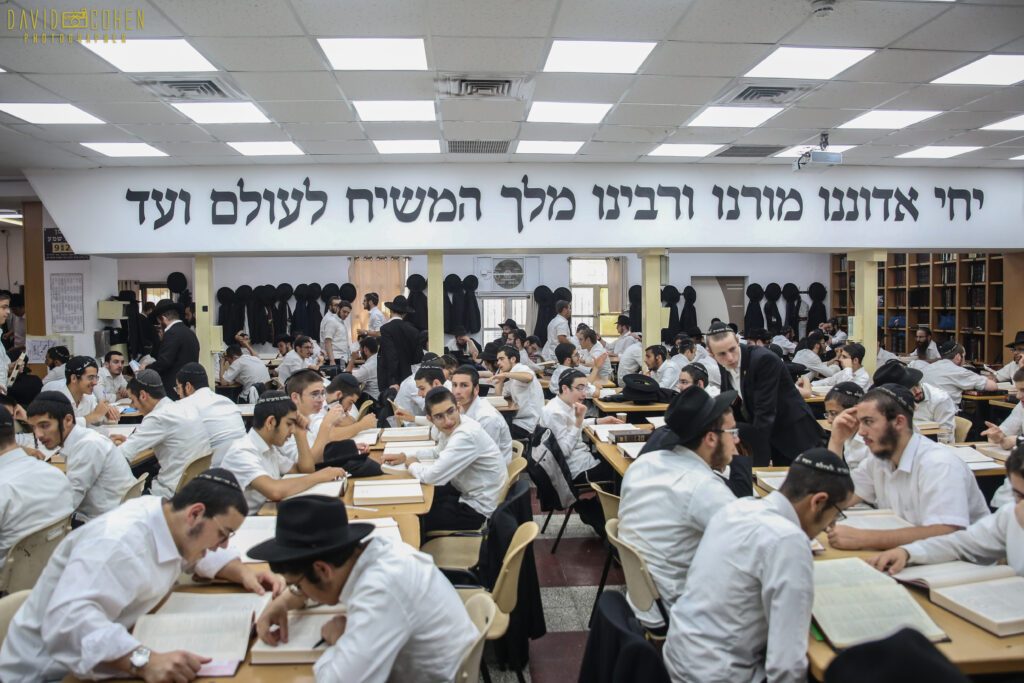
“You’re right. In Chabad there’s a feeling that everyone is left to fend for themselves. There’s no ‘backing.’
“And yet, in Gur and similar communities there was never any agreement or arrangement with the army the way there was in Chabad until about a year ago. They simply tell all their bachurim, across the board, ‘don’t report.’ The confusion among us stems from the fact that Chabad was the only group that had a formal agreement. In simple terms, the army that had been somewhat accommodated suddenly became ‘off-limits.’”
The Tishrei Trap and Border Control
One of the unique problems facing a Chabad bachur is traveling to chatzros kodsheinu (i.e. the Rebbe). While an average yeshiva bachur can stay in the country and continue his routine as much as possible, hoping he won’t suddenly be arrested by the police, Chabad yeshiva bachurim want to travel for Tishrei or even for the “Kevutza” year. This is the sensitive point of exposure where the traveler puts himself at risk.
“The problem in Chabad is far bigger,” Rizel agrees. “A bachur from another community disappears among tens of thousands of other bachurim and more or less flies under the radar. But our bachurim want to travel to the Rebbe, and rightly so, as has been the case for decades, and in doing so they expose themselves at border control. Instead of easing things for these bachurim, the state is essentially telling them: Want to travel? We’ll be waiting for you at the crossings.”
You mentioned earlier the lengthy negotiations between the Chabad Beis Din and the army. Can you give a brief overview of what the negotiations were about and why they fell through?
“As I said, Chabad had quiet arrangements with the army over the years that allowed for the ‘Kevutza’ year (a trip the Rebbe fought for) and bachurim going out for Tishrei.
“Starting in 5776, a unique ‘Chabad Arrangement’ was in effect (not without sharp disagreements among Chabad roshei yeshiva), under which Chabad yeshiva bachurim would leave the country to study during their ‘Kevutza’ year at 770 while signing a commitment to enlist at age 26.
“After the High Court struck down the draft law, the arrangement expired, and since then there have been ceaseless attempts to formulate an alternative framework.”
Even though the Chabad Beis Din presented the IDF with no fewer than four different, practical compromise proposals, its representatives ran into a brick wall. The army rejected all the proposals with the official argument of “legal constraints under the current situation,” which led to a dead end and forced the Chabad rabbis to consider drastic steps, including publishing a sharp public letter, which was indeed published last year, on the eve of the bein ha’zmanim break. The letter, addressed to parents and bachurim of Chabad yeshivas in Israel, spanned two pages. The rabbis clarified the role of a yeshiva bachur, to study Torah diligently and persistently, even to the point of mesirus nefesh!
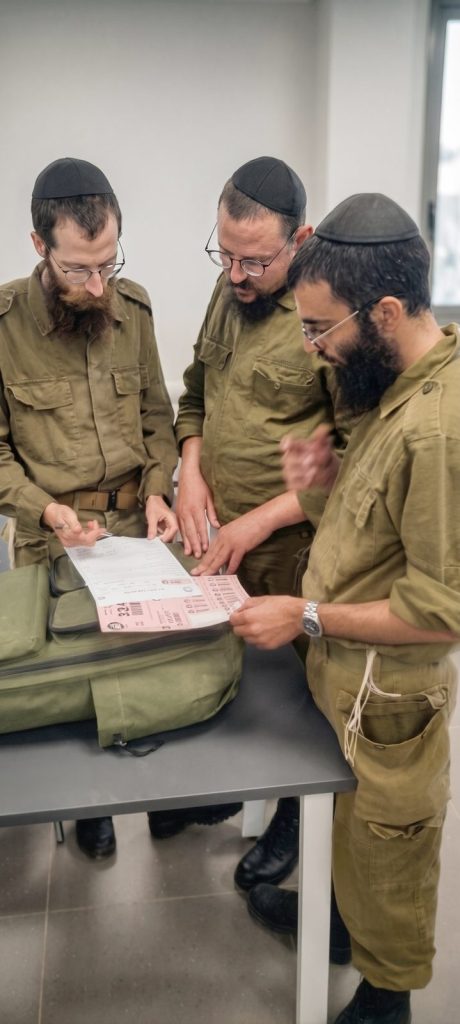
At the same time, they expressed sorrow that the framework agreed upon with the IDF, meant to allow bachurim to leave the country for the “Kevutza” year at the world Chabad center 770 had been canceled.
What is the point of contention today blocking an agreement between Chabad and the army?
“The central disagreement that emerged between the IDF and the Beis Din representatives trying to find a solution comes down to a single, decisive year. The army says: ‘I’m willing to exempt Chabad bachurim until age 23 and a half; beyond that year, they must enlist no matter what.’ The Beis Din refused this for a logical reason. Ages 23–24 are critical in terms of shlichus, semicha studies, and shidduchim. By age 24 and a half, the average Chabad yeshiva bachur has already completed his first year of marriage, he’s more stable and knows where he stands. But at 23, he’s still in shidduchim.” (As a rule, up until age 23 the army directs recruits mainly into combat tracks.)
That’s a gap of just one year.
“True, but it’s a significant year. In that year you can either build a Jewish home or you end up ‘married’ to the army instead…
“In the end, because of this specific dispute over the one year, the agreement never went into effect, and all the tmimim have fallen through the cracks.”
Why won’t the army compromise? After all, because of their insistence, they’re losing quite a few potential recruits…
“As I mentioned, even if the army were willing to compromise, it can’t, because of the legal constraints supposedly imposed on it by the Attorney General. She demands equality with no exemptions. Some have said that Chabad bachurim now need to find solutions on their own, each finding whatever solution works for him…”
Manpower Shortage Versus Systemic Rigidity
It’s no secret that the IDF currently suffers from an acute manpower shortage, and is more interested than ever in chareidi recruits. It’s also no secret that many yeshiva-background recruits have traditionally come from Chabad. On the face of it, a clear loss for the army, and yet, the system struggles to show flexibility.
“The army has lost a huge number of combat soldiers and is short on manpower,” says Rizel, “including from Chabad yeshivas, since it turned out that canceling the ‘Chabad Arrangement’ as of Av 5785 caused enormous damage to the army. The IDF lost hundreds of potential recruits, high-quality, highly motivated bachurim who had helped the IDF over the years meet its enlistment quotas from the chareidi public.”
Here Rizel reveals an interesting fact: “Not long ago, in a closed briefing at the Kirya (IDF Headquarters), Defense Minister Israel Katz said: ‘In the end, the vast majority of chareidim who enlist are Chabadniks.’ When I heard that, I approached him after the talk and said: ‘You may not realize it, but there’s been a major blowup. Chabadniks aren’t enlisting anymore.’ He was stunned and asked: ‘What? Hasn’t the issue with traveling to the United States, to the Rebbe, been handled?’ He immediately turned to his aides and asked them to look into it, and personally promised me he’d check how this could be resolved legally. As of now, nothing has moved forward. The army is rigid and operates strictly by the law, and the law has changed.”
And what about the chareidi askanim who work with the army?
“There are project managers who are genuinely trying to rebuild the bridge between the army and Chabad but the forces operating on the ground are stronger than all of them, and in the meantime, they’re the ones dictating policy even if it’s a losing policy.”
Great Confusion
This time year of among the bachurim has traditionally been one of arranging visas, fundraising for tickets, closing out flight bookings, arranging passports, and all the other preparations toward fulfilling the dream—being with the Rebbe during Tishrei as Chassidim have done for generations.
In the past year or two, the trip has become harder for bachurim who have reached draft age.
So what are those currently packing their suitcases for their Kevutza year supposed to do?
“We are in utter uncertainty,” one parent tells me this week. “We got study approval from the hanhala ruchnis, we settled the dormitory arrangement with the ‘Igud Talmidei ha’Kevutza,’ we got the coveted student visa but we don’t know what will happen at the border crossing on the way to the destination so longed for, the destination every tamim has waited for since his very first day in shiur alef in yeshiva ketana (mesivta)…”
In a close-knit group of “Kevutza Parents Pei-Zayin,” numbering over three hundred parents, opinions are divided, mostly confused. Parents want to save the situation, to help their sons, but truthfully no one has clear answers. The situation is such that there are no rules.
One of the mothers tells Beis Moshiach this week about a reality never before known within the yeshivas, illustrating the utter chaos in the relationship between the yeshivas and the army: “My son was drafted this past year, in the middle of shiur gimmel and as it now appears (and she emphasizes ‘now,’ because there’s still hope he might succeed…), he won’t get to join his friends for the Kevutza year. He wasn’t able to do what others did, and he was drafted against his will. Today he serves at a base somewhere in the south. At first they had him mopping floors in the dining hall, that’s it. He used his free time to put on tefillin with soldiers. As a result, they made him responsible for the base shul”…
What will happen next?
“We are praying and hoping for a miracle,” she sighs. “At the same time, we’re working through various channels to get him released, or at least to postpone the continuation of his service until after the Kevutza year. We know how significant this year is in the life of every Tamim…”
Dovid (his family name withheld at his request) actually managed to travel on Kevutza and even stayed a few more months but when he arrived at the entrance gate at Ben Gurion Airport, he was detained and arrested by the army.
“I ask that you not print my family name, since I’m still in proceedings with the army. I’m not looking for more trouble,” he warns me at the start of our conversation.
After a year and a half of studying at 770, Dovid landed in Israel straight into a cold, indifferent reality. His story reveals in full detail the chain of humiliations, bureaucracy, and callousness that some of the unlucky bachurim have to contend with.
“I landed from New York at Ben Gurion on a Friday morning,” Dovid recalls. “I arrived in the country with my mother, brother, and sister. Unfortunately, my passport didn’t clear. They separated us and put me for two or three hours into the room for ‘entry-detainees,’ the place where they hold everyone who has problems entering the country. After the nerve-wracking wait, four people in civilian clothes arrived, presented an arrest warrant, put me in handcuffs, and took me. Any attempt to talk to them or explain my special situation didn’t help.”
Dovid had to leave his large suitcase with his family. “They told me to bring clothes for a week or two, so I only took a small carry-on. In the end, even that carry-on wasn’t let in. In jail they take everything into custody, and they put your clothes into a bag.”
Dovid notes that friends had advised him to land on a Friday, thinking it would ease his entry process, but this worked against him: “Usually, on a weekday, the procedure is that they take you to Tel HaShomer for a military trial, where they decide whether you go to jail or get a deferral. Because I landed Friday at noon, there was no duty officer available to judge me, and I was taken straight to jail.”
The Journey North Handcuffed in the Car
The road to Prison 10 (currently the only military prison) was itself a journey of humiliation. “I waited another 40 minutes outside Ben Gurion with these four guys, until another vehicle arrived with three more, one in uniform and two in civilian clothes. The drive north wasn’t easy. I looked at my watch and saw Shabbos was approaching. I sat in the back, cuffed with handcuffs and a belt securing my hands to my waist, restrained from every direction.”
How did they treat you?
“Like air. They talked about me in the third person: ‘What do we do with him now?’ and so on. In the car they blasted trance music at full volume.”
Arrival at the prison came with an initial shock. “I went through intake, parted with my belongings, and was given a uniform. The uniform I got was too small for me, smelled bad, and the shoes pinched. The shirt was missing three of its five buttons, and the pants had no buttons at all, so the clothes didn’t close. I complained, but no one cared.”
Time was pressing and Dovid wanted to manage to put on tefillin before Shabbos began. “They put me in a small holding cell, three by three meters, with a toilet in the middle separated only by a barrier half a meter high. They told me, ‘Pray here.’ I refused. There’s no way to pray next to an exposed toilet. Finally, minutes before Shabbos came in, one of the female soldiers agreed to let me step out of the room just to quickly put on tefillin, and immediately put me back in the cell, like the lowest of criminals.”
Because Dovid arrived without a prior trial determining the severity of his sentence, the system automatically placed him in Wing C, the toughest wing in the prison. “It’s a wing of people who sit there for months on end, half a year, two years,” he describes. “They already have set jobs in the prison. Everyone there knows the officers. The population there is made up of Bedouins, Ethiopians, and chevra, some of whom had grown closer to religion during their time in prison. There wasn’t a single chareidi there, certainly no Chabadnik. I admit I was in complete shock.”
The Shabbos was a breaking point. A yerida m’igra rama (descent from the heights) of 770 to bira amikta (the depths below). “The biggest difficulty is mainly the uncertainty; when you don’t know how long you’ll be in this place. I didn’t eat the Shabbos meal since the food was awful. There’s an option to request a meal from the rabbinate, but I didn’t have the strength to fight for it. I just chewed a piece of bread and went back to my cell. I was alone, and I just fell apart.”
The night and the quiet brought no comfort. “The bed is essentially an ‘emergency mattress,’ a thin piece of foam. There’s no pillow, and the blanket is your sleeping bag. It was cold. Just as I was starting to fall asleep, two female officers and one officer came in to do a count. Because I was alone, it’s against regulations to leave a prisoner alone in a cell in case something happens to him, they ordered, ‘You have 20 seconds to grab your things.’ Even though I didn’t want to move in the middle of the night to a cell with people I didn’t know, they moved me to another cell with guys who were already asleep.”
The treatment from the staff, Dovid describes, was cold and mechanical: “These are young officers, male and female. They owe you nothing. If you ask something more than twice, they simply ignore you. They answered me mechanically and without a drop of empathy.”
Even the attempt to get warm clothing hit a wall: “On Sunday I again complained that the coat was too small and I was cold. They took me back to intake, but then they said: ‘Well, you’re getting out on Tuesday anyway, we won’t bring you a coat.’”
Light Within the Darkness
Despite being told that trials don’t take place on motzoei Shabbos, Dovid was called to be tried on motzoei Shabbos. “Some officer sat behind a desk. I told him I came to Israel to sort out my status with the army, not to run away. He sentenced me to five days of actual imprisonment (instead of 21), after which I have to report to the recruitment office. If I violate the condition, I’ll serve the remaining 15 days I didn’t serve now, plus 20 additional days, 35 days total. The moment I got the ruling, my appetite and my smile instantly came back. I knew that from Tuesday morning I’d be out”…
Even in the darkness of the jail, Dovid didn’t forget he was a tamim and a shliach. “Despite the hardship, without a mikva, I would get up at 5:20 in the morning, ten minutes before we had to stand for roll call, in order to have a shower instead of a mikva. Also, there was a guy in my cell who had grown closer to religion in the past but had stopped the process. I did mivtzaim with him, and we also learned together to make use of the time.”
Roshei Ha’Yeshivos Keep Their Mouths Shut
We tried to speak with the heads of major yeshivas to hear their point of view. For their own reasons, they chose not to talk, certainly not to be quoted. Those who did agree to speak had no good news to offer. They have no ability to influence the situation, not even minimally.
One of the roshei yeshiva mentioned what the Rebbe said that the entire purpose of a tamim in yeshiva is Torah study, and that this study is what protects the Jewish people in Eretz Yisrael.
“In response to his letter of the 25th of Menachem Av, asking whether a yeshiva student in the Holy Land is obligated to be drafted into the army there,” the Rebbe presents the question with great clarity. He expresses puzzlement that there should even be doubt about it or a need to ask from afar, since the clear halachic ruling of the rabbanei Yisrael is well known and publicized and of course, it is grounded in our Torah, the Torah of life, that bnei yeshiva should not be drafted and should not serve in the army. Their study of our holy Torah with diligence and application protects and saves our holy land and those who dwell in it. (Igros Kodesh vol. 20, p. 317; printed in Likkutei Sichos vol. 24, p. 448)
The Rebbe clarifies unequivocally the place of a yeshiva bachur: next to his sefarim. And what about bearing the burden of war? “Their study… with diligence and application protects and saves our holy land and those who dwell in it” is the clear answer.
The conclusion of the current investigation points to systemic paralysis. There is no privilege for a Chabad Chassid under current law as there once was, and this despite the (theoretical) willingness of the defense establishment to absorb Chabad bachurim. All yeshiva bachurim are in the same boat regarding the draft obligation but Chabad bachurim are more exposed because of the trips to the Rebbe, in addition to the fact that at age 18 or 19 the vast majority of Chabad bachurim are still far from marriage, unlike other Chassidic groups. “A guy who gets married, not to mention one who has children,” says Rizel, “his whole status in the army changes. They prefer not to take him.”
Can you give a sentence or two, in closing, for the confused parents?
“Everyone should act according to their own Rav, ask their mashpia, follow the principle of ‘asei lecha rav,’ and ask around with their friends at the yeshiva, because in the end there are individual solutions, including exemptions. This period is crazy, and the hanhalos are pushing for exemptions for understandable reasons.
My recommendation to the parents? Hold on, pray that the Rebbe will be revealed, and b’ezras Hashem everything will work out”…
Beis Moshiach #1520 • pp. 14-23
© 2026 Beis Moshiach Magazine. All rights reserved.
This article originally appeared in Beis Moshiach #1520. You are welcome to share it with friends and family by email or in print, provided that you do not change, add to or omit any part of it, you credit the author and Beis Moshiach, and you include a link to archive.bmoshiach.org (written out in full in printed copies).
To republish this article in a newspaper, magazine, book or website, please request permission in advance at [email protected].