Taming the Wild West
How Seventy Shluchim Across Twenty-Two States Are Proving No Soul Is Ever Lost
Stories of bitachon and brotherhood from the Regional Kinus HaShluchim in the mountain air of Colorado.
One of the stories that illustrates the connection between the forces of nature and the work of shluchim was recently shared by one of the shluchim, who described the events of Shavuos at a Chabad House in a particularly remote location. The time came for the Torah reading, the small congregation waited to hear the Aseres HaDibros, but only nine Jews were present in the shul. A sense of missed opportunity hung in the air. But the Rebbe’s shluchim do not give up. An unusual decision was made: rather than read without a minyan or forgo the reading entirely, they decided to “delay” the davening, make Kiddush, and sit down first for the traditional dairy meal, hoping that by its end a miracle would occur and another Jew would appear.
Indeed, the tense wait paid off. Just as they finished the meal, the door of the Chabad House suddenly opened and a Jewish man, a local resident, walked in. The joy was immense, and the entire congregation hurried back to the shul to open the Aron Kodesh and proceed with the Torah reading of maamad Har Sinai.
Outside, the weather had suddenly begun to change, and a stormy winter system was making itself known. The baal korei opened the Sefer Torah and began to read. When he reached the words “and there were thunders and lightnings,” something unbelievable happened. At that exact moment, a tremendous and powerful bolt of lightning flashed outside, accompanied by thunder that shook the walls of the building. Hashgacha pratis was more visible and tangible than ever. The shliach recounted that in that moment he felt a shiver throughout his entire body; he understood how important and precious that small, remote minyan was to Hashem, Who had waited for them and arranged the forces of nature to recreate the experience of maamad Har Sinai at that very second.
This story is not just an interesting episode. It is the quintessential story of the work of shlichus in deserts and remote places around the world. Work driven by a burning faith that Hashem accompanies every step and illuminates every forsaken corner.
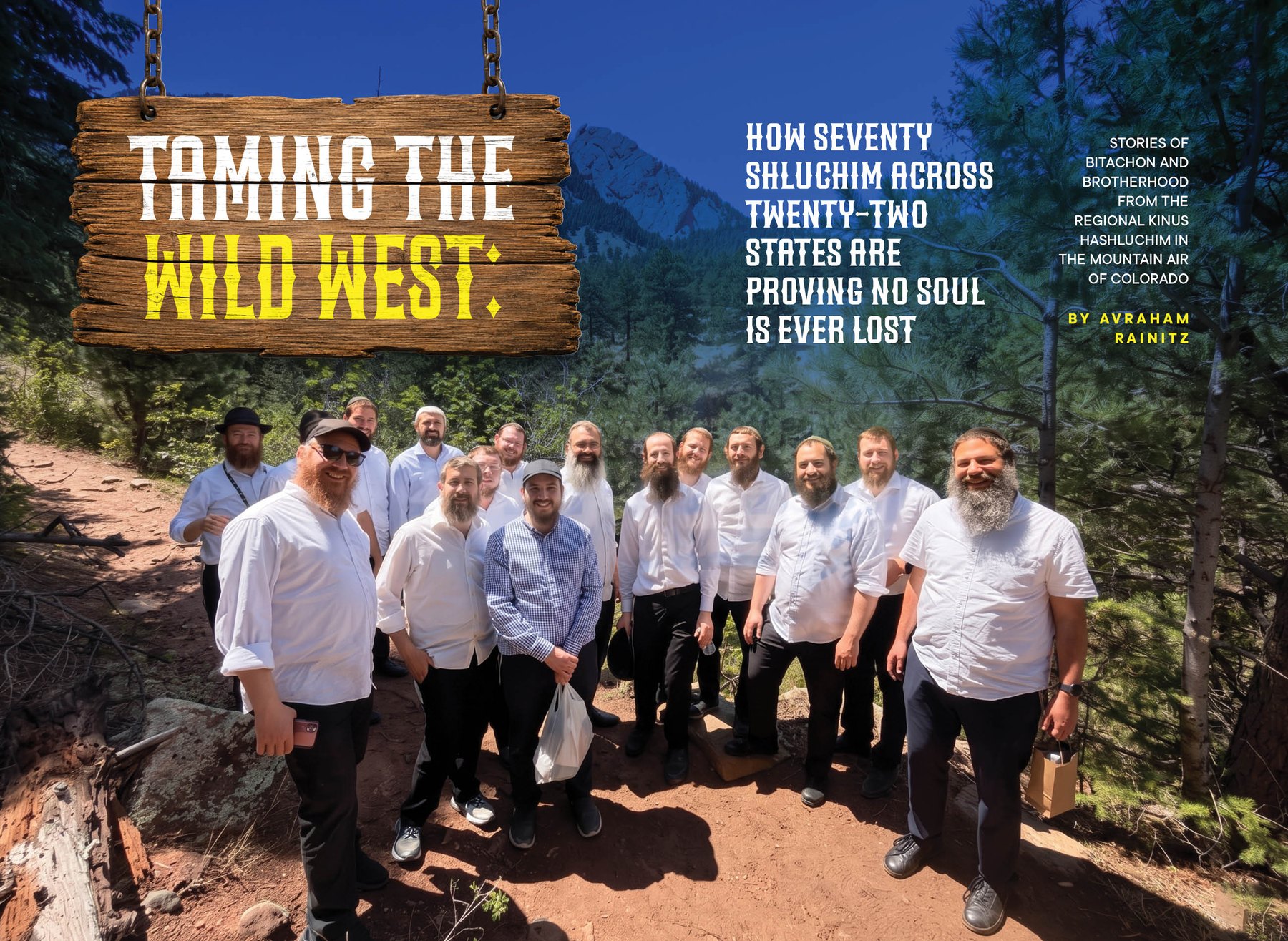
This powerful faith, this uncompromising dedication to each individual wherever they may be, is precisely what recently had dozens of shluchim from the most isolated regions of the western United States gathered for a Shabbos of elevation in the mountain air of Colorado.
Powerful Regional Kinusim
The kinus was centered at the Rohr Chabad House at the University of Colorado, devotedly run by the shluchim Rabbi and Mrs. Yisroel and Leah Wilhelm. The impressive building, situated at the heart of “University Hill” and extensively renovated in 2020, has long become a vibrant center and a magnet for Jewish students. But last weekend, it became a “command center” of immense Chassidic energy.
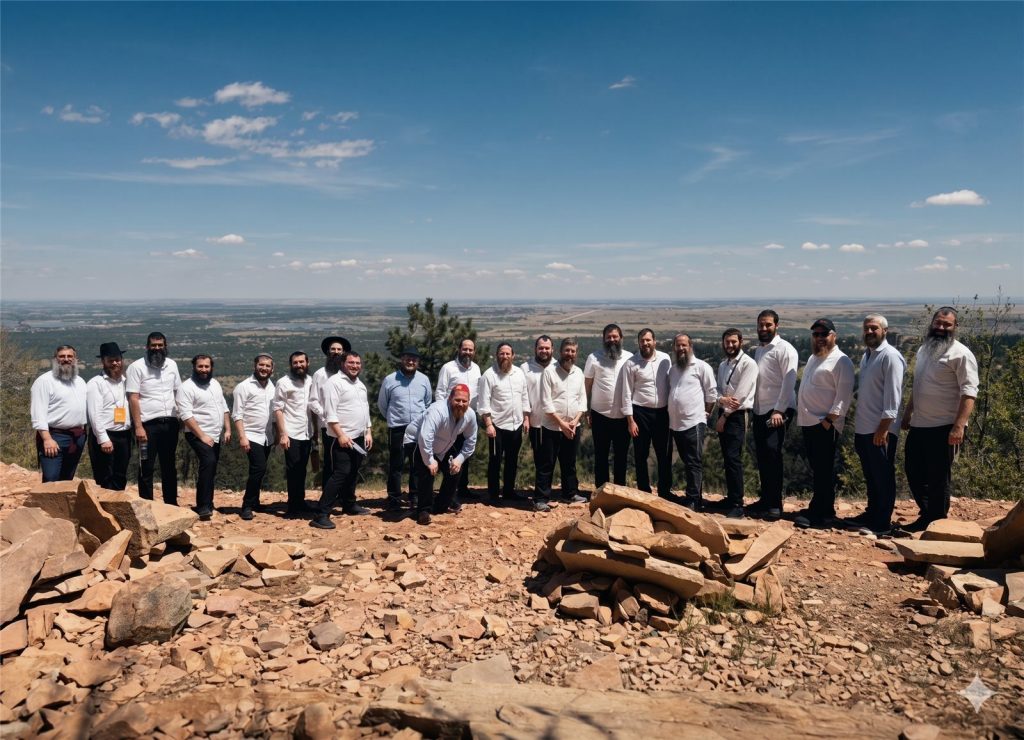
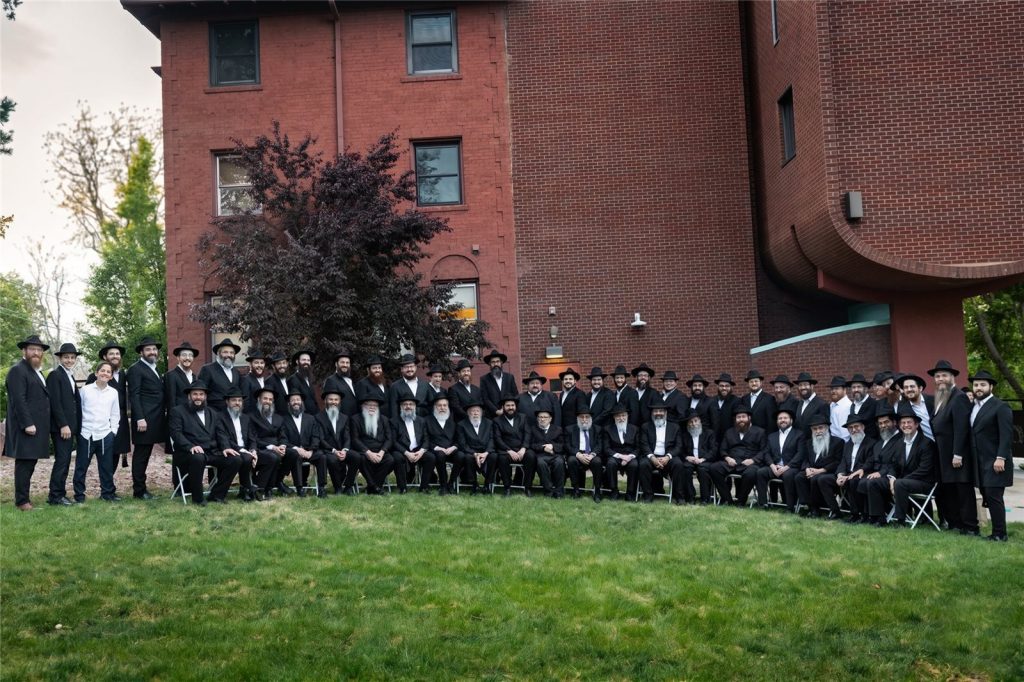
The bare numbers tell the story of the spiritual revolution. When these regional kinusim began years ago, only 14 shluchim participated, responsible for 22 western U.S. states. And this year? Some 70 shluchim packed the hall, making it one of the largest and most powerful regional gatherings ever held in the western United States.
There is something unique, familial, and intimate about a regional kinus, stemming directly from the guidance and instruction of the Rebbe MH’M. After the international “Kinus HaShluchim” in Crown Heights grew, boruch Hashem, to enormous proportions, a situation arose where it wasn’t possible for most shluchim to have individual expression during the kinus. The Rebbe suggested that smaller regional kinusim also be held, where the goal is for every shliach to be able to speak, share, and unburden themselves. And indeed, throughout the Shabbos meals in Boulder, this directive was fulfilled completely. One by one the shluchim rose, sharing words of Torah, special insights, and stirring stories from the remote and far-flung places in which they operate.
But Shabbos did not consist solely of farbrengens and stories. Beyond the traditional group photograph documenting the large army, the shluchim rolled up their sleeves and dove into fascinating professional workshops. They discussed educational dilemmas, strategies for building communities out of spiritual wilderness, and the day-to-day challenges on various campuses.
Breaking a Road Through the Human Desert
Alongside the geographical desert, the shluchim must contend with a “human desert,” i.e. walls of indifference and freezing coldness from those they are trying to bring closer. During the Shabbos meals in Boulder, Rabbi Naparstek shared a story that touched precisely on this sensitive point, illustrating how one must never despair based on appearances.
He told of a Jewish man in his city whom he would devotedly visit, going to his home again and again, sometimes bringing fresh challahs for Shabbos. But time and again the response was cold. The man showed not a trace of excitement, reacted with overt coolness, and made it abundantly clear that he had no interest whatsoever in religion or spiritual connection. From time to time he would send small, symbolic donations but the emotional wall continued to broadcast absolute distance.
Then, one day, a surprise arrived. Rabbi Naparstek received a letter from that same Jewish man, and inside was a check for $1,500. But more than the sum, it was the moving message: the man wrote him warm words, thanked him from the depths of his heart, and explained that he had been watching from the sidelines all along, seeing clearly and greatly appreciating everything the shliach had done for the community and those around him. Suddenly it became clear that the challahs given with a smile, the visits that never stopped despite the rebuffs, all of it had seeped inward, deep into the soul, even when nothing was outwardly apparent.
“We simply need to make our effort and do our part,” concluded R’ Naparstek before his fellow shluchim. “We truly don’t know where we are having an effect and how far our work reaches.”
This worldview, that nothing is coincidence, and every step is directed from Above, stood at the center of many of the Shabbos farbrengens. In this spirit, the shliach from the wild state of Montana told how he once drove two full hours in each direction, a long and exhausting journey, just to visit a Jewish family about whom he had received information. When he finally arrived at his destination, he discovered to his disappointment that the family had already moved away.
An ordinary person would have been filled with frustration over the lost time and effort. But Rabbi Shapiro knew that “from G‑d are a man’s steps established,” and from complete bitachon that everything is by hashgacha pratis, he decided to turn to the first person he would encounter and ask whether he was Jewish.
And so he did. He approached a completely random passerby and asked him the direct question. To his astonishment, the man answered that while he knew very little about Judaism, his mother’s mother, his grandmother, had been Jewish! That random question opened the door to a deep relationship and this proved, once again, in the desert, just as no drop of water is wasted, so too no journey and no effort of a shliach is ever lost.
The Love of Shluchim Crosses Borders
Within the intensive work of drawing Jews closer, it is easy at times to forget that the shluchim themselves have needs, struggles, and material hardships. Shabbos at the Colorado kinus saluted not only the mesirus nefesh on behalf of mekuravim, but also, and perhaps primarily, the deep caring among the shluchim for one another. The feeling in the air in the Boulder hall was that of one elite unit in which every soldier watches over his comrade in the trenches or in this case, on a magical and isolated island.
To understand the power of this togetherness, one needed only to listen to the moving story of Rabbi Levi Gerlitzky, the shliach serving in Kona, Hawaii. By hashgacha pratis, an unfortunate incident occurred at his Chabad House in which an unknown person broke the entrance gate of the institution. The Rabbi filed with the insurance company, submitted the documents, and received a certain compensation. But afterward a few small and insignificant scratches were discovered and in an almost miraculous and completely illogical insurance development, the company suddenly decided to send him an additional enormous compensation check of $10,000!
An ordinary person who received such a sum entirely unexpectedly would immediately rejoice in his lot, pay off some debts, or renovate the building. But the mind and heart of a Chassid operate on an entirely different frequency.
R’ Gerlitzky recalled a Chassidic story about a woman who came to the Rebbe and told him she had suddenly received a large sum of money. That woman’s conclusion was: “If G-d suddenly sent me money that I am not accustomed to receiving, it surely wasn’t for my personal needs; it was sent specifically so I could bring it to the Rebbe!
“I thought to myself,” he shared with disarming pashtus before his fellow shluchim, “if $10,000 suddenly landed on me out of nowhere and for no logical reason, surely Hashem didn’t give it to me for my own Chabad House. He gave it to me to be a channel to pass it on to another shliach who needs it right now!” And indeed, out of a sense of mutual responsibility, the shliach from Hawaii transferred the entire enormous sum to help another shliach who was in financial distress.
This brotherly solidarity is expressed not only in financial support, but also in genuine sacrifice to establish educational infrastructure for the shluchim themselves in remote places. For example, one new face stood out at the kinus, Rabbi Kadouri. R’ Kadouri, from Eretz Yisrael who has a family, arrived in Hawaii only in the last two months. He was recruited by the Gerlitzky family for one purpose: to establish a Jewish Chassidic school there, and to serve as a teacher for the shliach’s sons and a small handful of other children.
The Rebbe — A Father to Every Individual
Throughout all the hours of the Colorado kinus, what could be felt in the air was the source of the shluchim’ inexhaustible energy: hiskashrus. The shliach’s deep sense that the Rebbe is with him, caring for him as a father for his son, and guiding him. The same fatherly love that the shluchim absorbed themselves, they seek to bestow upon every lost Jewish soul they encounter.
On Sunday of the kinus, Mrs. Fishman stood and shared with the assembled shluchim a personal and deeply moving testimony that illustrated this point precisely. She spoke of her youth, as a girl who had lost her father at age ten and was searching for her way. When she arrived at a crossroads regarding marriage, she felt alone and at a loss. In an attempt to find an answer, her inner impulse led her to travel to 770.
“When I arrived there, I was so overwhelmed with emotion that I simply sat down outside the building and cried.” At that moment, a distinguished-looking Jew with a beard approached her, it was the Rebbe’s senior personal secretary, Rabbi Chodakov. He asked why she was crying, asked her to wait a moment, and went inside, returning with news that went beyond all normal procedure: a yechidus with the Rebbe had been arranged for her for the following day.
In her first private yechidus, the Rebbe ruled decisively about the current shidduch suggestion (“Remove this proposal from your agenda”). But the emotional climax came at her next meeting, when a new shidduch idea had arisen. The Rebbe looked at her and asked an unexpected question from her perspective: “Do you love this man?” The surprised Mrs. Fishman hesitated slightly and replied that she had ahavas Yisrael toward him. At that moment, the Rebbe smiled from ear to ear—a kind of secret smile—and said to her in Yiddish: “For a husband, one needs more than just ahavas Yisrael.”
“From that moment,” Mrs. Fishman told the riveted shluchim, “I knew that I had merited not just a guide, but someone who would serve as a father figure for me… The knowledge that thousands of people from around the world had experienced similar things never diminished my feeling that I was precious to the Rebbe like an only daughter.”
This sense of being an “only daughter” or “only son” is what the shluchim seek to give to Jews in every corner of the world. And indeed, this connection with the Rebbe does not cease for a moment, it only deepens. Rabbi Yosef Yitzchok Greenberg, the shliach in frozen Alaska, told a moving story on Shabbos about the Chassid R’ Itche Meir Kagan, of blessed memory (father-in-law of the kinus’ host, Rabbi Wilhelm), who in the month of Tishrei after Gimmel Tammuz 5754 asked R’ Greenberg whether he could come to remote Alaska to celebrate Simchas Torah with him. He said that when he is on shlichus, he feels that he is “with the Rebbe”…
Even From Afar — A Sign of Geula
The most resonant question, the one that lay at the foundation of the entire regional kinus of shluchim in Colorado, is the question of “why.” Why leave warm communities and travel to the ends of the earth? Why go to places so remote that few Jews live there, who often seem to have no interest in any connection whatsoever? The answer to this question, which closed the uplifting Shabbos, lies in an incredible story recalled at the kinus by R’ Greenberg of Alaska, about the Chassid R’ Shmuel Chefer a’h.
It was erev Purim 5728. R’ Chefer, who devotedly ran the institutions of Beis Rivkah in Kfar Chabad, had come to New York to be with the Rebbe. Like any Chassid, he waited with great anticipation to experience Purim in the Rebbe’s presence: to participate in the tefillos, to hear the reading of the Megillah, and above all to be present at the Rebbe’s famous Purim farbrengen, which lasted many hours and elevates the soul. But immediately upon his arrival, he was summoned to the office of Rabbi Chaim Mordechai Aizik Chodakov, who gave him a surprising assignment: to fly to Minneapolis, Minnesota, join the young shliach Rabbi Moshe Feller, and together continue to the city of Ames, Iowa to read the Megillah there. And all this, on Taanis Esther!
R’ Shmuel quickly composed himself and set out, for the Rebbe’s assignments are carried out with joy. But when they arrived at their destination and waited at the address of a wealthy Russian Jew, the demographic picture that emerged was bleak: some fifty people had gathered, the majority assimilated Jews, including Israeli expatriates who had come together with their non-Jewish partners. R’ Shmuel’s heart sank. The thought hammered stubbornly in his mind: “I traveled specifically to America to be with the Rebbe. Instead, I’m sent to such a remote place, to read the Megillah to assimilated Jews who come with non-Jewish spouses?”
Despite these feelings and the exhaustion after the fast, the two shluchim strengthened themselves, read the Megillah devotedly, and spoke passionately about the uniqueness of the Jewish people and the miracle of Purim, aiming to kindle at least a small spark of emuna.
After an exhausting journey back, the two landed in New York at midday on Purim. R’ Shmuel hurried to 770 and managed to secure a place at the Rebbe’s grand farbrengen. Suddenly, in the middle of the farbrengen, the Rebbe departed from the main topic he had been addressing and began to tell a story: “There is a Jew who traveled two thousand miles from here, to a congregation about whom there is a doubt whether they even fall within the obligation of Megillah reading, and he went to read the Megillah for them…” R’ Shmuel froze in his place. The Rebbe continued, reading his thoughts one by one: “In his heart he was embittered, why did he have to travel so far? After all, he could have been here!” And then, the Rebbe said the sentence that defines to this day the lives of all the shluchim: “One can be two thousand miles away from me, physically, and yet be within my four cubits. And one can sit within my four cubits, and be two thousand miles away from me!” And if R’ Shmuel had any slight doubt as to whom the words were directed, the Rebbe turned to him directly, smiled his radiant smile, and signaled to him to say l’chaim over a large cup.
“Why, really, are shluchim sent to such small and remote towns?” asked R’ Greenberg of the dozens of shluchim at the kinus and summed up the answer in one powerful sentence that closed the Shabbos: “One of the reasons is because engaging with the lost and the scattered, that is the clearest sign that Moshiach is about to come.”
This was the essence of what the shluchim felt at the kinus. They are the vanguard of the Geula. Every challah they distribute with a beaming face, every pair of tefillin they put on someone, every class on inyanei Geula and Moshiach, and every smile they give to a lost soul in the heart of the wilderness—these are what actually bring closer the day when “the lost ones in the land of Ashur and the dispersed in the land of Mitzrayim shall come,” with the revelation of the Rebbe MH’M speedily and immediately.
A Spark in the Depths of the Forest
The breathtaking, untamed mountains in one of the most desolate regions of the western United States evoke an atmosphere of ancient majesty, but also of complete human isolation. Over the decades, people seeking to disconnect from civilization—and often to leave behind their past and identity—fled into the depths of these forests, mountains, and deserts. For the Rebbe’s shluchim in these areas, the wild landscape is not merely a picturesque tourist setting, but the daily arena of a mission to seek out and reconnect with lost souls.
For example, in one isolated mountain town, the local shliach spent thirteen full years trying to make contact with a Jewish man named Zack, who lived deep in the remote forest, completely cut off from society. Every attempt by the rabbi to approach him or extend a hand was met with anger and firm rejection. Thirteen years of metaphorical, and literal, slammed doors could have caused any reasonable person to give up and move on to the next destination. But in the lexicon of a devoted Chassid who lives by the Rebbe’s teachings, there is no such thing as despair when it comes to the neshama of a fellow Jew.
Then, through remarkable hashgacha pratis so characteristic of life on shlichus, a turning point arrived. The shliach happened to meet a non-Jewish forest resident who knew Zack’s exact location deep within the woods. Armed with this new information, the rabbi set out, carefully navigating dirt roads until he arrived at the entrance to the secluded Jew’s home.
The moment the door opened could easily have become yet another confrontation. But miraculously, the iron walls built over thirteen years collapsed in an instant as though the neshama itself had been waiting all those years for the kelipa surrounding it to break. To the rabbi’s complete surprise, Zack welcomed him warmly and graciously, and for the first time in his life, there in the depths of the remote forest, rolled up his sleeve and put on tefillin.
Zack’s story is not an isolated episode. It is the distilled essence of shlichus work in deserts and remote corners of the world: laboring deeply in barren soil, driven by the burning faith that behind every rejection, every cold response, and every vast geographical distance, there lies a neshama merely waiting for someone to walk the entire path into the depths of its forest and rekindle its spark.
That unwavering devotion to the Jewish soul is precisely the common thread that recently brought dozens of shluchim together for a Shabbos of spiritual elevation, hiskashrus, and brotherhood.
Beis Moshiach #1511 • pp. 12-20
© 2026 Beis Moshiach Magazine. All rights reserved.
This article originally appeared in Beis Moshiach #1511. You are welcome to share it with friends and family by email or in print, provided that you do not change, add to or omit any part of it, you credit the author and Beis Moshiach, and you include a link to archive.bmoshiach.org (written out in full in printed copies).
To republish this article in a newspaper, magazine, book or website, please request permission in advance at [email protected].