Opposites Attract – But Do They Last?
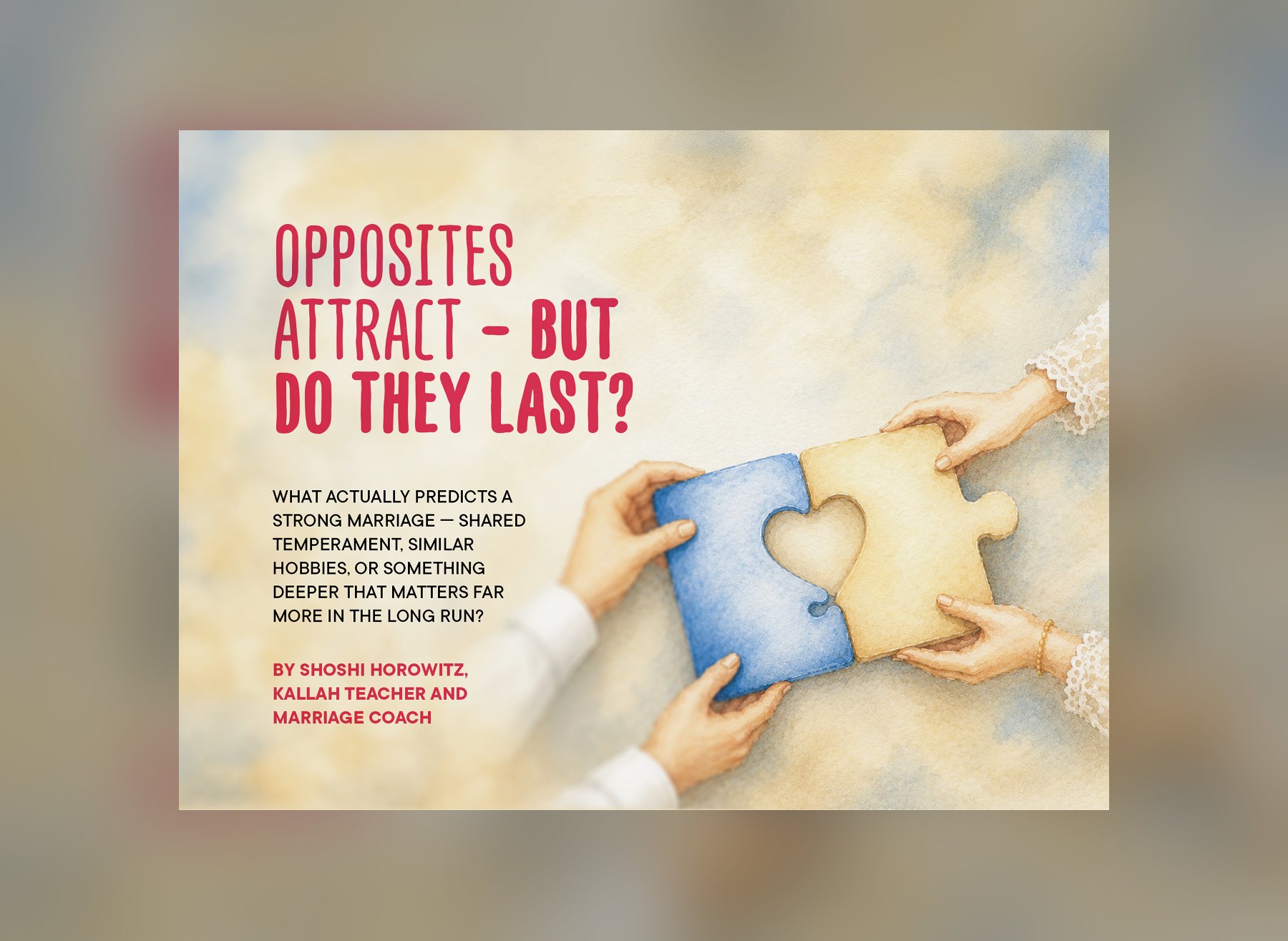
What actually predicts a strong marriage – shared temperament, similar hobbies, or something deeper that matters far more in the long run?
A few months ago I met a young woman who had, unfortunately, gone through a divorce. She said something that has stayed with me for a long time:
“I knew what I wanted, but I didn’t know what was right for me.”
That line touches on one of the central questions of the shidduchim period: do we really know what’s right for us when it comes to building a life together?
Getting to Know Yourself First
Before trying to understand “who is right for me,” you need to clarify “who am I, really.”
Many young people enter shidduchim with a list of traits they’d like to find in a spouse, but they don’t always have a deep understanding of the values on which they want to build their home, what gives them a sense of security, what atmosphere they dream of creating at home, and which traits would genuinely and healthily complement them.
That’s why when having pre-marital discussions, these are often devoted specifically to self-discovery—understanding one’s personality, aspirations, strengths, emotional needs, and core values:
What truly matters to them?
What are they unwilling to compromise on?
Which gaps can they accommodate, and which could become a fundamental difficulty?
It is precisely through this inner clarification that the choice itself can be made more precisely. The more deeply a person knows themselves, the more they are able to build a marriage from a conscious, stable, and well-founded choice.
What Makes a Good Marriage?
This is one of the questions that occupies many young people: is it best to look for someone similar to us or someone who complements us?
Some are convinced that to get married you need to find someone “just like me”—the same temperament, the same way of thinking, the same pace of life. Others look for the opposite, someone who brings traits they themselves lack.
But when you look closely at married life, the answer turns out to be more complex. The person who attracts us isn’t always the person it’s right to build a home with. And the right question isn’t always how similar the couple is to each other, but rather how capable they are of walking together in the same direction over time.
Dr. Liraz Margalit, a behavioral researcher, has noted that studies show many people in the dating period declare they’re looking for someone with opposite traits to their own. Yet research shows there’s no necessary connection between an early “wish list” and success in building a stable marriage over the years.
Initial attraction can create excitement, but marriage is built from an entirely different depth: shared values, inner stability, the capacity to give, mutual respect, and a shared outlook on life.
Not Duplication But Completion
One of the common mistakes in the world of shidduchim is thinking that compatibility means being identical. But people don’t need a copy of themselves. They need someone who can complete them.
There are traits where difference actually creates healthy balance within a marriage. For example: an open person is good for someone closed off; a pleasant assertiveness is important for a people-pleaser; when one side is very sensitive, it can help for the other side to be more stable and level-headed; stubbornness needs flexibility, and hesitation needs decisiveness.
A healthy marriage isn’t necessarily a meeting of two identical people but of two people who can contain, balance, and help each other grow.
Chazal already alluded to this in their interpretation of the phrase “a helper opposite him” (ezer k’negdo). On the surface it’s a contradictory phrase—if it’s a “helper,” why “opposite him”? But that’s exactly where one of the great secrets of marriage lies. A spouse isn’t meant to be merely a mirror reflecting us. Sometimes the person across from us adds what’s missing in us, softens rigid places, and opens areas in us we didn’t know existed. Difference, when it comes from mutual respect, doesn’t break a home apart—it enriches it.
Where Similarity Really Is Essential
Still, there are areas where difference is no longer complementary but a real gap. You can differ in personality, temperament, and hobbies but there are foundations on which a couple must see eye to eye.
The Rebbe wrote in one of his letters, “one must clarify a person’s worldview… whether it aligns with the teachings of the Torah of life… and that differences in temperament shouldn’t be a concern… when that core alignment exists, such differences pose no real obstacle” (Igros Kodesh, vol. 19, p. 15).
The truly important question isn’t whether the couple like the same foods, the same hobbies, or the same music. The question is:
Do they see life the same way?
Do they share a similar world of values?
Do they want to build the same kind of home?
Do they have shared life goals?
People don’t have to be the same “type” to get married. But they need to agree to walk in the same direction.
Sometimes two people are very similar in personality, yet the values gap between them is enormous. For example, when one sees family life as a supreme value, and the other aspires mainly to a life of nonstop shlichus, with a home open without limits, the gap can surface later with great force. In such cases, even where there’s outward compatibility, the relationship can erode over the years.
By contrast, there are couples who are very different in nature yet share a common vision, similar values, and identical life goals. It’s often precisely such couples who succeed in building a stable, deep home over many years.
Of course, shared values don’t guarantee perfect communication either. People change over the years, and marriage requires constant work. But a shared foundation of values provides much steadier ground for dealing with gaps and challenges.
What’s Really Worth Checking During Shidduchim?
In a world where many are busy searching for “the perfect match,” people sometimes forget to ask the truly important questions. It’s not enough to ask: Is there chemistry? Is he funny? Is she easygoing?
The important question is: is this someone I can build a life with?
During the process of meetings and inquiries, it’s worth examining:
Are there shared values?
Is there mutual respect?
Is there an ability to listen?
Does each side know how to make room for the other’s differences?
Is there responsibility?
Is there stability?
Is there a genuine desire to build together?
Is there a natural, healthy attraction?
One of the most important things in marriage is the ability to accept that the other person is not me. Another person will never think exactly like us, feel exactly like us, or act exactly like us. The ability to respect that difference is one of the cornerstones of a healthy home.
Two Who Are One
The story of Rabbi and Mrs. Yitzchok and Zelda Nemes illustrates this well.
In many ways they were very different from each other. He was quiet and modest by nature, while she was sharp, active, and full of energy. Their backgrounds and temperaments were completely different too. Yet it was precisely within that difference that a deep, strong bond was woven. What connected them wasn’t outward similarity, but inner identity. Both lived with yiras shomayim, responsibility, chesed, and devotion to family.
Their daughter later recounted that as a child she didn’t understand how her parents had gotten married; they were so different. But as she grew up, she came to understand that in what truly mattered: Chassidus, family, and chesed, they saw everything eye to eye.
Their story illustrates that the real question often isn’t how similar a couple is, but whether they belong to the same inner world.
Difference Doesn’t Have to Be Frightening
Sometimes it turns out he’s quiet and she’s talkative, she’s emotional and he’s analytical, she’s organized and he’s spontaneous, and so on. Many young people fear such differences. But not every difference is a sign of trouble. Sometimes it’s precisely the gaps that create healthy movement within a home. Sometimes a person needs someone who will soften them, give them stability, or believe in them exactly where they themselves still feel afraid.
The problem isn’t the difference itself. The problem begins when there’s no shared foundation to build on.
And perhaps this is one of the most important insights about marriage: we’re not looking for a perfect person. We’re looking for someone we can build a home with. Marriage isn’t based only on momentary feeling or initial excitement. It’s built with listening, compromise, responsibility, giving, and growing together. And the wider the shared space of values, the more a couple can hold differences in personality and temperament.
You can be very different from each other and still build a real, deep connection and a stable home. Because in the end, the question isn’t how similar the couple is, but whether they share a common way of life.
And to close with what the Rebbe said, “ I said to ___ when he was here that a person’s wife can be a help to him or against him, and that although it’s hard to know with full certainty in advance exactly how a relationship will unfold over decades, one important and meaningful measure is the mutual understanding between the young couple regarding each other’s outlook before marriage, something each side should try to clarify as much as possible. And regarding the young man specifically, that he should not conceal from her anything about his current outlook on life, and should ask her to clearly state her own view in response to his outlook” (Igros Kodesh, vol. 9, p. 111).
The author is a kallah teacher and marriage coach.
Beis Moshiach #1520 • ט״ו אלול תשפ״ו • pp. 48-50, 51
© 2026 Beis Moshiach Magazine. All rights reserved.
This article originally appeared in Beis Moshiach #1520. You are welcome to share it with friends and family by email or in print, provided that you do not change, add to or omit any part of it, you credit the author and Beis Moshiach, and you include a link to archive.bmoshiach.org (written out in full in printed copies).
To republish this article in a newspaper, magazine, book or website, please request permission in advance at [email protected].