The “Wrong” Corridor
A Yud Beis Tammuz Story
The Rebbe was brought into Shpalerka in the middle of the night.
Even grown men trembled when they heard that name.
Shpalerka was not an ordinary prison. It stood in the center of Leningrad, one of Russia’s largest and most important cities—dark and feared, a place where enemies of the government disappeared behind locked doors, sometimes forever.
That night—Tes-Vov Sivan, 5687 (1927)—the Rebbe Rayatz, Rabbi Yosef Yitzchok Schneerson, was brought there. He had been arrested in his own home while eating supper with his family.
The men who brought him were Lulav and Nachmanson, two members of the Yevsektzia—Jews who worked for the cruel Russian government against their own people. They hated the Rebbe because he refused to stop teaching Torah and strengthening Yiddishkeit.
Now they had brought him here. To Shpalerka.
But something weighed on Nachmanson and Lulav as they hurried him along. They were running late. They had meant to deliver the Rebbe before midnight, and now midnight had already passed.
When they reached the great gate of the prison, it was shut tight.
They rushed up to it. But the guard on duty would not let them in. A small slot in the gate slid open for a moment, and then snapped shut again. At midnight the gatekeepers had changed shifts, and this new guard refused to open for them. He was angry that they had come at the wrong time, and the argument dragged on and on.
Nachmanson and Lulav had no idea that this delay—these wasted minutes at a locked gate —was the very first thread of a much greater story. We will return to it at the end.
* * *
At last the gate was opened, and the Rebbe was led inside.
Nachmanson handed some papers to a guard. “Take this man,” he said. “Here are his documents. Walk him to the office and give the papers to the clerk.”
Then Nachmanson and Lulav hurried away, disappearing into the night—for they still had more “work” to do before morning.
The guard pointed down a long hallway. At the very end was an open door.
“Go there with the papers,” the guard told the Rebbe. “Give them to one of the clerks inside.”
The Rebbe looked down the hallway. His heart sank.
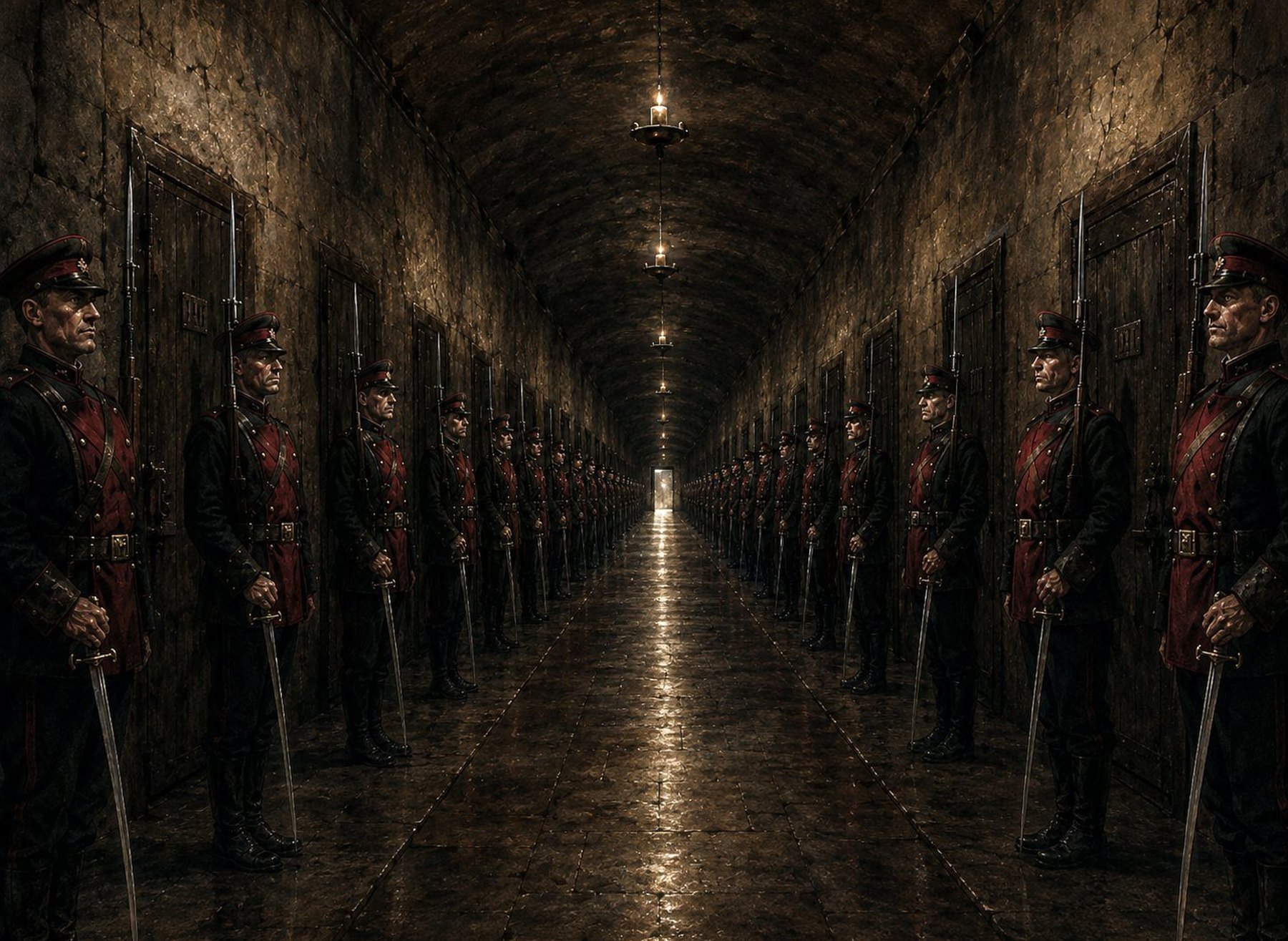
It was long and narrow, about twenty-five meters from one end to the other. Along both sides were closed doors, and beside every door stood a soldier.
The soldiers were huge, with broad shoulders and hard faces. They wore red and black uniforms. Each one was covered in weapons, a sword in one hand, a rifle in the other, and a sharp spear strapped to his back.
They did not move. They stood as still as statues. Only their eyes moved, watching everything.
The walls were black. The hallway was dark, lit only by a few tiny candles hanging from the ceiling. Their flames flickered weakly, barely pushing back the heavy darkness.
Everything was silent. A terrible silence.
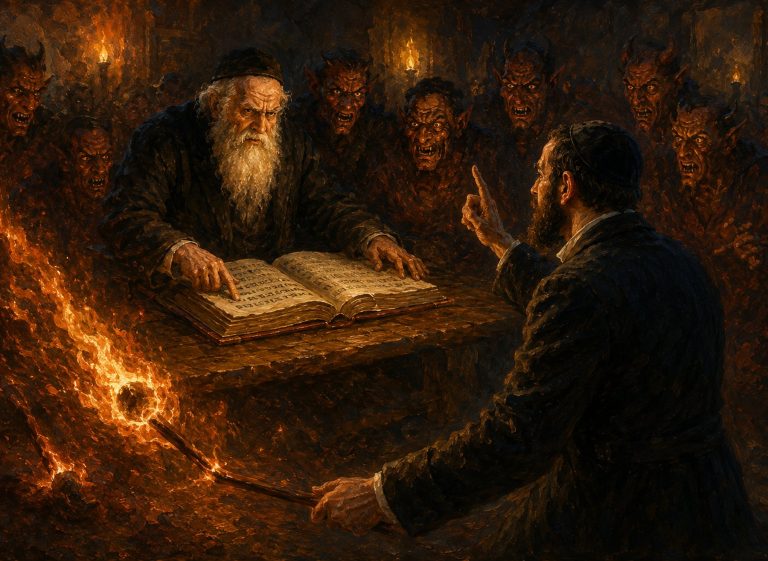
Later, the Rebbe wrote in his diary that the scene looked like Gehinom itself.
The Rebbe began to walk. Step by step. The dark walls. The armed soldiers. The open door at the end. One thought kept circling through his mind: Where am I going? What will they do to me there? How will this end?
* * *
As the Rebbe came close to the open door, something caught his eye.
There was another doorway off to the side. Beyond it stretched a different hallway.
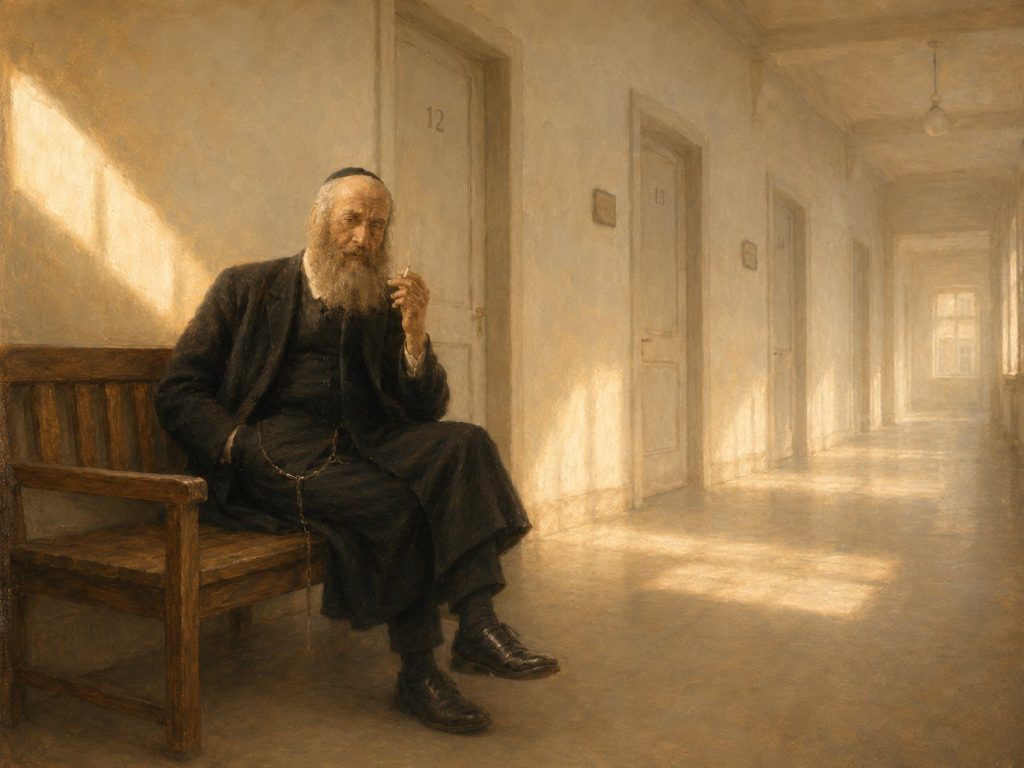
This hallway was long too, but it was completely different. The walls were white. Bright light filled it from end to end. Instead of armed soldiers, there were benches along the wall. The doors were painted clean white, each one marked with a number. Beside every door was a small sign with the name of the person who worked inside.
It was like stepping from night into day.
And then, without anyone stopping him, without anyone calling out to him, the Rebbe found himself walking into the white hallway instead.
A few moments later, he stopped.
Wait.
He was not supposed to be here. He had been told to walk through the dark hallway, straight to the open door at the end. How had he wandered into this one?
For a moment, fear entered his heart. What if the guards thought he had done it on purpose? What if they accused him of sneaking through the prison to spy on its rooms and hallways? That could make everything far worse.
But the Rebbe did not turn back.
He thought to himself: “I never would have dared to walk here on my own. But now that I am already here, without meaning to be, this too must be from Hashem. If Hashgacha Pratis guides even a piece of straw, even a leaf blowing in the wind, then surely Hashem is guiding my steps now.”
So the Rebbe kept walking.
Only later would he understand what that “wrong turn” had really done.
* * *
The Rebbe was exhausted. He had been awake for hours. He was weak and not feeling well. When he saw a bench nearby, he sat down to rest, taking out a cigarette to smoke.
And then his thoughts flew home.
Only a short time earlier, he had been sitting with his family. Now he pictured his mother, the elderly Rebbetzin Shterna Sara, crying. He pictured his wife’s pale, worried face. He thought of his daughters, frightened and heartbroken.
He thought of his son-in-law, Rashag, Rabbi Shmaryahu Gurary.
He thought of his future son-in-law, the Ramash (later to be the seventh Chabad Rebbe), who had hurried to rescue the Rebbe’s precious holy writings and important documents before the police could take them.
Had he reached them in time? Had he been caught too?
Warm tears slid down the Rebbe’s cheeks. His heart pounded. His body trembled.
By now, the Rebbe understood clearly: a trap had been set for him. And the net had been pulled tight.
* * *
Then a powerful thought flashed through the Rebbe’s mind. And Hashem? What about Him? Who had made all of this happen? Everything is from Hashem.
The Rebbe thought: I am a son. I am a husband. I am a father. Many people lean on me and need me. But I lean only on Hashem, who created the whole world. I have done my part. Now Hashem will do what He wants to do.
With that thought, something changed inside him. The fear loosened its grip. The worry grew quiet.
The Rebbe settled himself on the bench, calm in body and calm in soul. He no longer felt like a trapped prisoner. He decided that when they questioned him, he would answer clearly and strongly, without fear—no matter what they asked.
A deep peace filled him. There, inside the most feared prison in Russia, the Rebbe sat calmly, as if he were resting in a quiet garden.
* * *
The first thin rays of the morning light began to glow on the white wall across from him.
Then the Rebbe heard voices. A nearby door opened, and three men stepped out.
The moment they saw him, they froze. A Jew in a beard and peyos, wearing long black rabbinic clothing, was sitting calmly on a bench in the middle of Shpalerka, a cigarette in his hand.
The men stared at him. Who was this man? How had he gotten here? And why did he look so calm?
The Rebbe was not frightened on the outside. He simply looked back at them, peaceful and steady, as though he were sitting in his own home. Inside, his heart was pounding—but he decided to be strong, and so he was.
The three men walked away. A few minutes later, one of them returned with another official.
“What are you doing here?” the official asked. “Who are you waiting for?”
“I did not come here on my own,” the Rebbe answered calmly. “They brought me here and told me to go to the front office. I am waiting for my tallis and tefillin. The men who took me from my home promised me a place to daven. They said I was only being called in for a few hours to answer some questions.”
The official listened carefully. Something did not make sense. This was Shpalerka. Strangers did not sit peacefully on benches here.
And yet the Rebbe spoke with such calm confidence that the official felt he must be telling the truth.
* * *
The official took out a cigarette of his own, quickly lit a match for the Rebbe, and then sat down beside him.
“It is half past three in the morning,” the official said. “They brought in so many people tonight. We have all been working far longer than we should.”
Then he asked, “Where are you from?”
“I am from a small town,” the Rebbe said. “You have probably never heard of it. It is called Lubavitch.”
The official’s eyes lit up. “Lubavitch? Of course I know it! That is no small town. It had a big marketplace and two shuls. A tzaddik lived there, with his own courtyard. I am from the town of Gusin. I used to travel with my father to the fairs in Lubavitch. We would water our horses at the spring in the Rebbe’s courtyard. There was even a special gate for the farmers, so they would not dirty the courtyard.”
The Rebbe’s heart stirred. This man was describing the very place where the Rebbe had been born and raised. But the Rebbe also understood something else. It was time to move.
* * *
“I need to go to the office,” the Rebbe said, standing up.
“Yes,” the official said. “I will come with you and show you what to do. Have you been here before? Do you know how this works?”
“This is my first time,” the Rebbe answered. “I do not know what to do, and I do not know what to write on the forms.”
The official began to explain. There would be clerks. There would be forms. They would take away his money, his watch, and his belongings.
Then the official asked a simple question.
“Which hallway did you come through to get here?”
The Rebbe pointed back toward the white hallway and explained that he had been tired from the stairs. When he saw the benches, he had sat down to rest.
The official stopped walking. His face changed.
“You came through this hallway?”
He looked the Rebbe up and down carefully. “Who are you? Where did you come from? How long have you lived in Leningrad?”
“I am the Lubavitcher Rebbe, Schneerson,” the Rebbe answered. “I came to Leningrad three years ago.”
The official stared at him. “But why did they bring you through that hallway?” he demanded. “Were you arrested with a group of rebels? Did they find writings against the government in your home?”
“They arrested me in my own home,” the Rebbe said quietly, “while I was eating supper with my family. They searched and found nothing suspicious. The men who brought me here were two officials named Nachmanson and Lulav.”
The official’s face darkened. “Then why did they bring you through that hallway?” he said sharply. “That hallway is not for regular prisoners. That hallway is only for the most dangerous criminals—the worst enemies of the government!”
He leaned closer. “You are not telling me the truth.”
But the Rebbe did not change his answer. Again and again, calmly and steadily, he told the same simple truth. He had only followed the guards. He had grown tired. He had sat down to rest. He knew nothing more.
* * *
And then the Rebbe understood.
Nachmanson and Lulav had brought him through the dark hallway on purpose. It was a trap. They wanted the prison officials to treat him like one of the most dangerous enemies of the government. They wanted the doors to close around him in the worst possible way.
And there was something darker still—something the Rebbe learned only later.
Just a few days earlier, the Russian ambassador to Poland had been killed in another country. The government in Moscow was furious and wanted revenge. So that very night, a secret order had been sent down: whoever was arrested that night would not come out alive.
That night, ten Christian clergymen had already been killed in the prison. The officials were told that if they did not also kill a Jew, people would say the government was only against Christians—so they needed a Jew too. And the Rebbe was the Jew they had brought.
The dark hallway led straight to that order. The wide-open door at its end—the door the guard had pointed him toward—was a door that no one walked back out of. That was where Nachmanson and Lulav had sent him.
But Hashem had led the Rebbe differently.
What had looked like a foolish wrong turn was not a wrong turn at all. The Rebbe had strayed into the bright hallway instead—and there, the officials simply left him alone on a bench. He was not marked as a dangerous criminal. He met a man who remembered Lubavitch. And quietly, hour by hour, the night slipped past—until the hours of that deadly order had run out, and it was no longer in force.
The Rebbe had not escaped because of strength. He had not escaped because of cleverness. Every step had been watched from Above.
* * *
And now we return to the locked gate.
Remember how Nachmanson and Lulav had been stuck outside, arguing with the guard who would not let them in?
That delay was no accident either.
That very night, those two men had another terrible plan. After delivering the Rebbe, they were supposed to rush to the home of the Rebbe’s devoted secretary Reb Chaim Lieberman and seize the Rebbe’s precious holy writings—letters, manuscripts, and irreplaceable treasures of Torah as well as documents with information about the Rebbe’s secret network of Yeshivia and Chadorim, schools for Jewish children.
But the locked gate had cost them precious time. And in those very minutes that they wasted arguing outside, others were able to reach the writings first—and the holy treasures were saved.
The same Hashgacha Pratis that had guided the Rebbe’s tired feet into the bright hallway had also held shut a heavy iron gate across the city. One quiet miracle inside. One quiet miracle outside. Both on the same dark night.
* * *
Later, the Rebbe wrote about that night in his private diary.
He wrote about the power of emuna and bitachon—the pure faith every Jew inherits from Avrohom, Yitzchok, and Yaakov.
A Jew may be standing in the darkest place in the world. But he is never alone.
Hashem had guided the Rebbe’s footsteps through Shpalerka—like a piece of straw, like a leaf carried by the wind. What looked like a mistake had been Hashgacha Pratis.
The Rebbe had done his part with calm, courage, and bitachon. And Hashem had done the rest.
Beis Moshiach #1511 • pp. 55-59
© 2026 Beis Moshiach Magazine. All rights reserved.
This article originally appeared in Beis Moshiach #1511. You are welcome to share it with friends and family by email or in print, provided that you do not change, add to or omit any part of it, you credit the author and Beis Moshiach, and you include a link to archive.bmoshiach.org (written out in full in printed copies).
To republish this article in a newspaper, magazine, book or website, please request permission in advance at [email protected].