Seeing Hashem in the Darkness
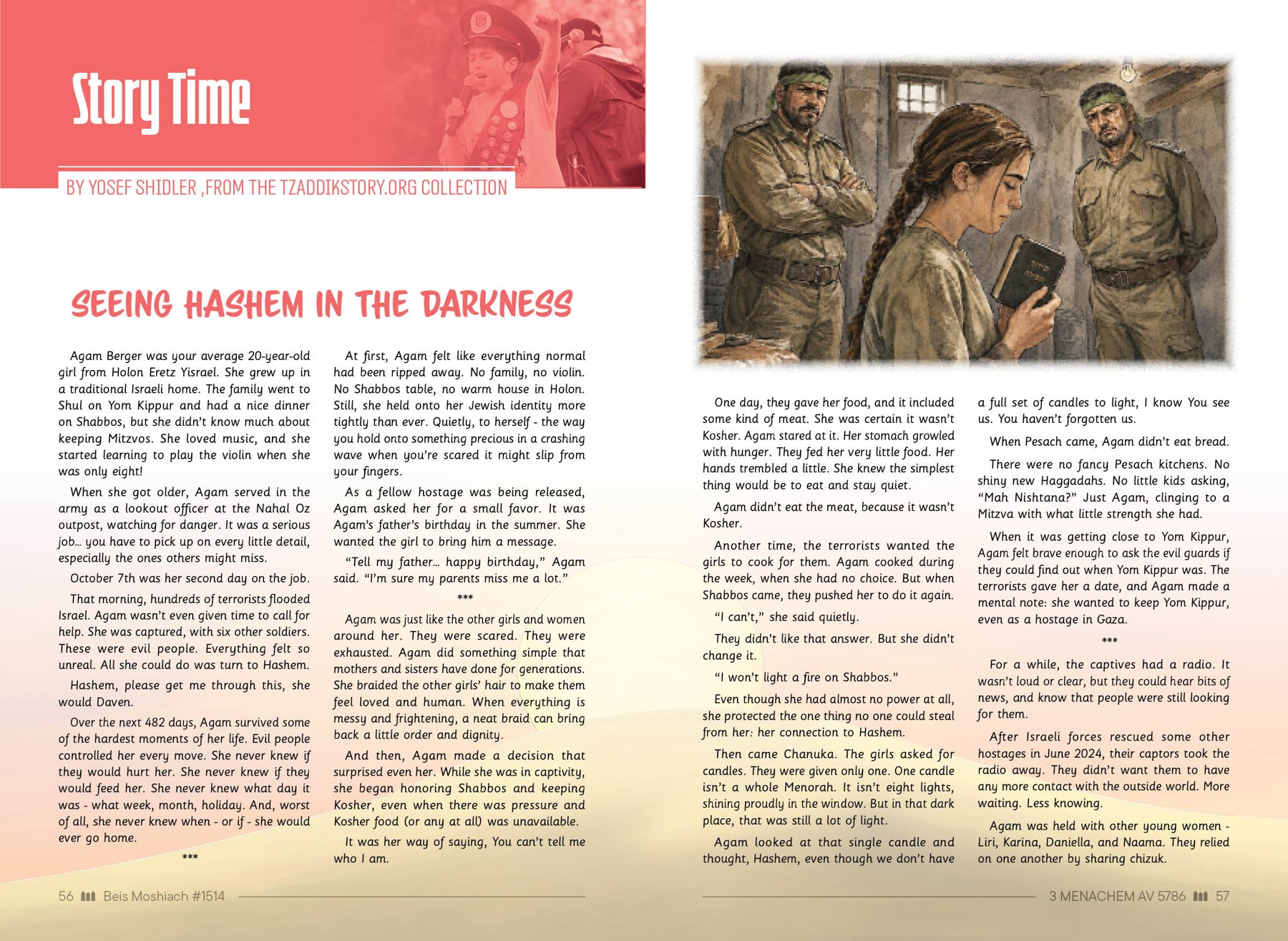
Agam Berger was your average 20-year-old girl from Holon Eretz Yisrael. She grew up in a traditional Israeli home. The family went to Shul on Yom Kippur and had a nice dinner on Shabbos, but she didn’t know much about keeping Mitzvos. She loved music, and she started learning to play the violin when she was only eight!
When she got older, Agam served in the army as a lookout officer at the Nahal Oz outpost, watching for danger. It was a serious job… you have to pick up on every little detail, especially the ones others might miss.
October 7th was her second day on the job.
That morning, hundreds of terrorists flooded Israel. Agam wasn’t even given time to call for help. She was captured, with six other soldiers. These were evil people. Everything felt so unreal. All she could do was turn to Hashem.
Hashem, please get me through this, she would Daven.
Over the next 482 days, Agam survived some of the hardest moments of her life. Evil people controlled her every move. She never knew if they would hurt her. She never knew if they would feed her. She never knew what day it was – what week, month, holiday. And, worst of all, she never knew when – or if – she would ever go home.
* * *
At first, Agam felt like everything normal had been ripped away. No family, no violin. No Shabbos table, no warm house in Holon. Still, she held onto her Jewish identity more tightly than ever. Quietly, to herself – the way you hold onto something precious in a crashing wave when you’re scared it might slip from your fingers.
As a fellow hostage was being released, Agam asked her for a small favor. It was Agam’s father’s birthday in the summer. She wanted the girl to bring him a message.
“Tell my father… happy birthday,” Agam said. “I’m sure my parents miss me a lot.”
* * *
Agam was just like the other girls and women around her. They were scared. They were exhausted. Agam did something simple that mothers and sisters have done for generations. She braided the other girls’ hair to make them feel loved and human. When everything is messy and frightening, a neat braid can bring back a little order and dignity.
And then, Agam made a decision that surprised even her. While she was in captivity, she began honoring Shabbos and keeping Kosher, even when there was pressure and Kosher food (or any at all) was unavailable.
It was her way of saying, You can’t tell me who I am.
One day, they gave her food, and it included some kind of meat. She was certain it wasn’t Kosher. Agam stared at it. Her stomach growled with hunger. They fed her very little food. Her hands trembled a little. She knew the simplest thing would be to eat and stay quiet.
Agam didn’t eat the meat, because it wasn’t Kosher.
Another time, the terrorists wanted the girls to cook for them. Agam cooked during the week, when she had no choice. But when Shabbos came, they pushed her to do it again.
“I can’t,” she said quietly.
They didn’t like that answer. But she didn’t change it.
“I won’t light a fire on Shabbos.”
Even though she had almost no power at all, she protected the one thing no one could steal from her: her connection to Hashem.
Then came Chanuka. The girls asked for candles. They were given only one. One candle isn’t a whole Menorah. It isn’t eight lights, shining proudly in the window. But in that dark place, that was still a lot of light.
Agam looked at that single candle and thought, Hashem, even though we don’t have a full set of candles to light, I know You see us. You haven’t forgotten us.
When Pesach came, Agam didn’t eat bread.
There were no fancy Pesach kitchens. No shiny new Haggadahs. No little kids asking, “Mah Nishtana?” Just Agam, clinging to a Mitzva with what little strength she had.
When it was getting close to Yom Kippur, Agam felt brave enough to ask the evil guards if they could find out when Yom Kippur was. The terrorists gave her a date, and Agam made a mental note: she wanted to keep Yom Kippur, even as a hostage in Gaza.
* * *
For a while, the captives had a radio. It wasn’t loud or clear, but they could hear bits of news, and know that people were still looking for them.
After Israeli forces rescued some other hostages in June 2024, their captors took the radio away. They didn’t want them to have any more contact with the outside world. More waiting. Less knowing.
Agam was held with other young women – Liri, Karina, Daniella, and Naama. They relied on one another by sharing chizuk.
At one point, they were told those four would be released. Agam watched them leave.
She was happy for them, of course she was. But when the door closed, she was left there by herself. Imagine watching your friends go home, and still not knowing when your turn would come.
* * *
That night, Agam tried to sleep, but her mind wouldn’t stop racing. She thought about her mother. Her father. Her violin. She thought about Shabbos. About Tefilla. About words she wished she knew how to say properly. At some point, she finally dozed off.
In her dream, she saw a Siddur, so clear it felt real. She held it close and opened it. She had the words of Davening right in front of her, like a map made of letters.
When she woke up, her heart was pounding.
It was only a dream… but it didn’t feel like that.
Agam had to be brave again. She asked a guard for a Siddur. They’d helped in the past, at least in some tiny ways, but the guard laughed and walked away.
Agam’s face grew hot. But she didn’t stop talking to Hashem. If she didn’t have a Siddur, she’d Daven with her own words.
Hashem, please. Please help me.
Two days passed.
Nothing.
And then – two days later – the same guard returned. He tossed something toward her.
A small book.
Agam caught it and froze. It was a Siddur.
For a moment, she couldn’t even breathe.
The guard stared at her, then said something that made Agam’s whole body go still.
“Your G-d must really love you,” he said, almost like he didn’t understand how it had happened himself. “Look what I found.”
A Siddur. Here. In Gaza! After she’d dreamed about it…
Agam gripped the Siddur like it was a precious jewel.
From that day on, she Davened from it until she was finally released – although they didn’t let her take the Siddur home.
* * *
Days. Weeks. Months. And then, after 482 days, Agam found out she would be free. Her family worried about one thing – Shabbos. They’d heard she was careful about Shabbos in captivity, and the plan was that she’d be released on Shabbos.
They didn’t want her return to involve breaking the promise she’d fought so hard to protect.
And then, in a twist that felt like Hashem’s smile, she was released on a Thursday, for reasons no one knows. All that mattered was that it wasn’t on Shabbos.
When she was back in Israeli hands and on the helicopter, they gave her a whiteboard to write a message.
She wrote a sentence that told her whole story in one breath:
“I chose the path of Emuna, and in the path of Emuna I returned.”
Great miracles don’t always come through thunder and hail. Sometimes they come through gentle hands in tangled hair, and whisper, Hashem, please get me through this.
Story 2
Inside a small government meeting room, a group of leaders sat around a table covered with papers and maps. Nobody was smiling. A heavy silence hung in the air.
One official cleared his throat. “We received a message from Hamas,” he said. “They’re offering a deal.”
“…is this about the hostages?”
“Yes,” the official answered. “They’re saying: Pause the war, and we’ll release some hostages.”
“And… what do they want in return?” someone asked.
“They want prisoners released,” he said. “A specific list… a few of these names belong to really dangerous people.”
A security adviser leaned forward. “Give an example.”
The official nodded and tapped one name on the page.
“Na’el Obeid,” he said. “Seven life sentences, plus another thirty years, for participating in a suicide bombing at a café in Jerusalem. The attack killed seven people and injured many more.”
The room went quiet again. Not because they didn’t have words – but because they had too many.
Then, someone said what everyone was thinking.
“But if we don’t agree… those hostages are stuck in Gaza.”
A woman from the hostage families’ side of the table spoke softly. “My child is still in there,” she said. “Every day feels like a year.”
A minister rubbed his forehead. “We’re being forced into an impossible choice,” he said. “Release people who want to hurt us… or leave our people trapped.”
The security adviser added, “If we release men like this, we may be putting more lives in danger later.”
“And if we don’t,” the other official said, “we may be leaving lives in danger right now.”
In the end, Israel decided it was worth taking the risk, and agreed to the deal so some hostages could finally come home.
People cried with relief when hostages returned. Families hugged like they’d never again let go. But at the same time, people worried about what the freed prisoners were capable of.
Then, only a week after he was released, Na’el Obeid fell from a rooftop near his home in Issawiya. The fall took his life. Hashem had made sure this man could never hurt anyone else.
Beis Moshiach #1514 • pp. 56-59
© 2026 Beis Moshiach Magazine. All rights reserved.
This article originally appeared in Beis Moshiach #1514. You are welcome to share it with friends and family by email or in print, provided that you do not change, add to or omit any part of it, you credit the author and Beis Moshiach, and you include a link to archive.bmoshiach.org (written out in full in printed copies).
To republish this article in a newspaper, magazine, book or website, please request permission in advance at [email protected].