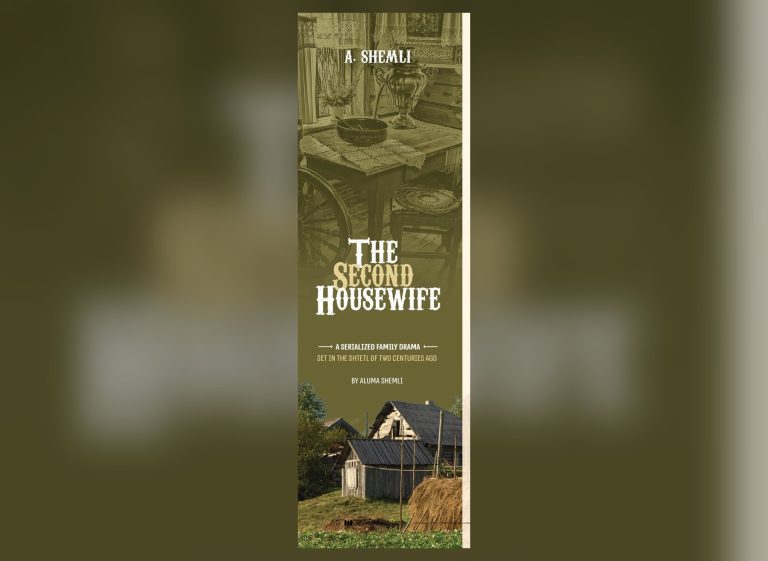
Readers’ Feedback on The Second Housewife
READERS FEEDBACK on “The Second Housewife”
The final installment of Aluma Shemli’s The Second Housewife brought an outpouring of letters from readers around the world. We were moved by the depth of feeling – and the sharpness of the questions. Here is a selection.
“A Title Worth Reconcidering”
Bassie opens with a warm compliment – and a sharp observation: My husband and I have been enjoying The Second Housewife from the first chapter, and we hope the author will continue after it concludes. My husband does mainframe database programming and I do paralegal proofreading – we both have university degrees – and yet both of us were unclear about who a third of the characters were at various points.
The title itself raised a question for us: the dictionary defines a housewife as a married woman whose primary occupation is managing her household. Clearly, Aidel’s role was something quite different – perhaps the title was not correct?
“We Waited All Week”
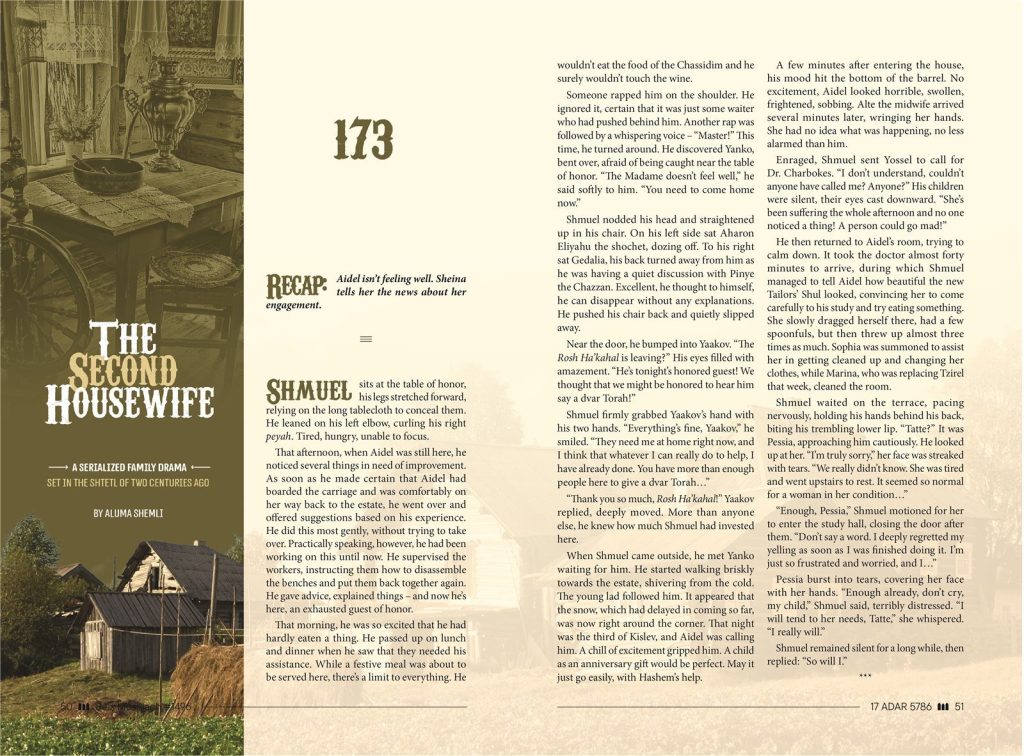
Another reader describes the anticipation her family shared – and the competition it created: My sisters and I waited impatiently all week for the magazine to arrive – just for this story. When it came, we literally competed over who would read it first. There was something about the pacing, the descriptions, the way you could feel yourself inside the estate in Lubianka, that made it impossible to put down. And when the installment ended, the week suddenly felt very long.
“A Window Into Another World”
Sara Turen describes a weekly ritual: As soon as Beis Moshiach arrived in the mail, I put everything down and read this serial. It was written so well and offered such a vivid glimpse into what life may have been like during that era. I feel I learned so much from the sacrifices that Chassidim and their families made – the way they navigated community, family, and faith under enormous pressure. It gives me strength when I think about the challenges that come with publicizing the Rebbe as Moshiach. Thank you for this wonderful weekly inspiration.
“Touched the Deepest Layers”
One reader shares what the story meant to her on a personal level: This story touched the deepest layers in me. I connected to the events of these lives, and it gave me enormous insight – not just into that world, but into my own. There is so much to learn here about interpersonal struggles in general, and family relationships in particular. The way the characters navigated conflict, love, and change gave me tools I didn’t expect to find in a serial story. Every week felt like both entertainment and growth. It will be very hard to say goodbye to these characters.
“Four Years With This Family”
Chedva, another reader reflects on the full journey: I don’t know where to begin. This story has accompanied us for almost four years. We were swept along, we cried, we laughed, we felt everything. The whole dynamic – so unique, so delicate, so tzniusdik. Every character felt real. Every conversation felt like something that could have actually happened. The writing is so tangible, so grounded, that it gives you the feeling the whole story truly took place. I don’t want it to end. And I very much hope that Aidel does not go anywhere.
“So Many Loose Ends”
Mrs. Segal isn’t ready to let go: I don’t believe The Second Housewife is almost finished – it seems to me there are still unanswered parts, though you did very well to address many of them:
Did Shmuel ever find out that his life was saved because of the Rebbe listening to Pesach Tzvi? What was the real story with the barrels? Did Shmuel ever become a Chassid?
What happens to Meir, Chaiky, and the Rosh Yeshiva?
Does Pesach Tzvi ever fully recover, and do he and Pessia have a baby?
What happened between Shmuel and his former mother-in-law regarding naming the baby?
There was a young man who learned with Pesach Tzvi – the one who wasn’t up to Meir’s standard. What happened with him?
One pointed aside: I Googled morphine and it does not promote fertility.
This has been our favorite section of Beis Moshiach for years. As my daughter kept asking week after week — did Aidel have her baby yet?
“It Deserves to Be a Book”
Batsheva Feldman has been reading since the very first installment – and she has questions: I’m not sure how everything can be tied up in just one more chapter. What was the conversation between Shmuel and his previous wife’s mother? What will the baby’s name be? How long until Pesach Tzvi and Pessia have children? What about Meir – he just disappeared. How was there no consequence for his actions? And Mendel – does he actually recover?
The chapters should have been longer; waiting a week for 3.5 pages felt drawn out. This story deserves to be made into a book where each character and relationship is developed more fully. The world that was built here – the estate, the town, the relationships – is too rich to leave behind in a magazine serial.
“We Want Our Nachas”
Sara Tova Best speaks for her whole family – the men included, she is careful to note: Our family is very, very sad that the Aidel story is coming to an end. It was so much a part of our Shabbos life. I know people who tell me they only buy Beis Moshiach because of this series.
We struggled through so many crises with this family – we would like to enjoy some nachas: to watch Aidel’s baby grow, to see Pessia have a baby, to watch Pesach Tzvi recover his cognition, to see Shmuel slowly become a Chassid. Each of those storylines is raw and undeveloped, without closure. It would be so lovely to have just a few more months – or longer.
We use fiction to find comfort from the struggles of daily life. The readers have used up their quota of pain. They don’t need it in their stories as well.
“I would Recognize Lubianka If I Visited”
Chana Gittel Goldstein closes our letters with a literary appreciation:For months I have been wanting to write, and now that the final installment has arrived, I want to express my heartfelt gratitude to the author for putting her heart and soul into this serial – and I look forward to reading it as a full-size book soon.
The author was respectful of both Misnagdim and Chassidim, and allowed us to view the Rosh Hakohol and his family in a positive light, especially as they grew and improved in their relationships. I appreciated the real and often raw emotions expressed between the family members – the conversations felt honest and human. The town of Lubianka and the estate were described in such rich detail that I would surely recognize them if I were to visit.
This was a wonderful read, and I hope Aluma Shemli, the talented novelist, will continue to share her warmth and wisdom with Beis Moshiach for many years to come.
Chag kasher v’sameach – yasher koach to the author.
Beis Moshiach #1501 • pp. 48-49, 50
© 2026 Beis Moshiach Magazine. All rights reserved.
This article originally appeared in Beis Moshiach #1501. You are welcome to share it with friends and family by email or in print, provided that you do not change, add to or omit any part of it, you credit the author and Beis Moshiach, and you include a link to archive.bmoshiach.org (written out in full in printed copies).
To republish this article in a newspaper, magazine, book or website, please request permission in advance at [email protected].