8 Days at Bedford & Dean – Part I
The 5706 (1946) Dedication of Tomchei Tmimim in America
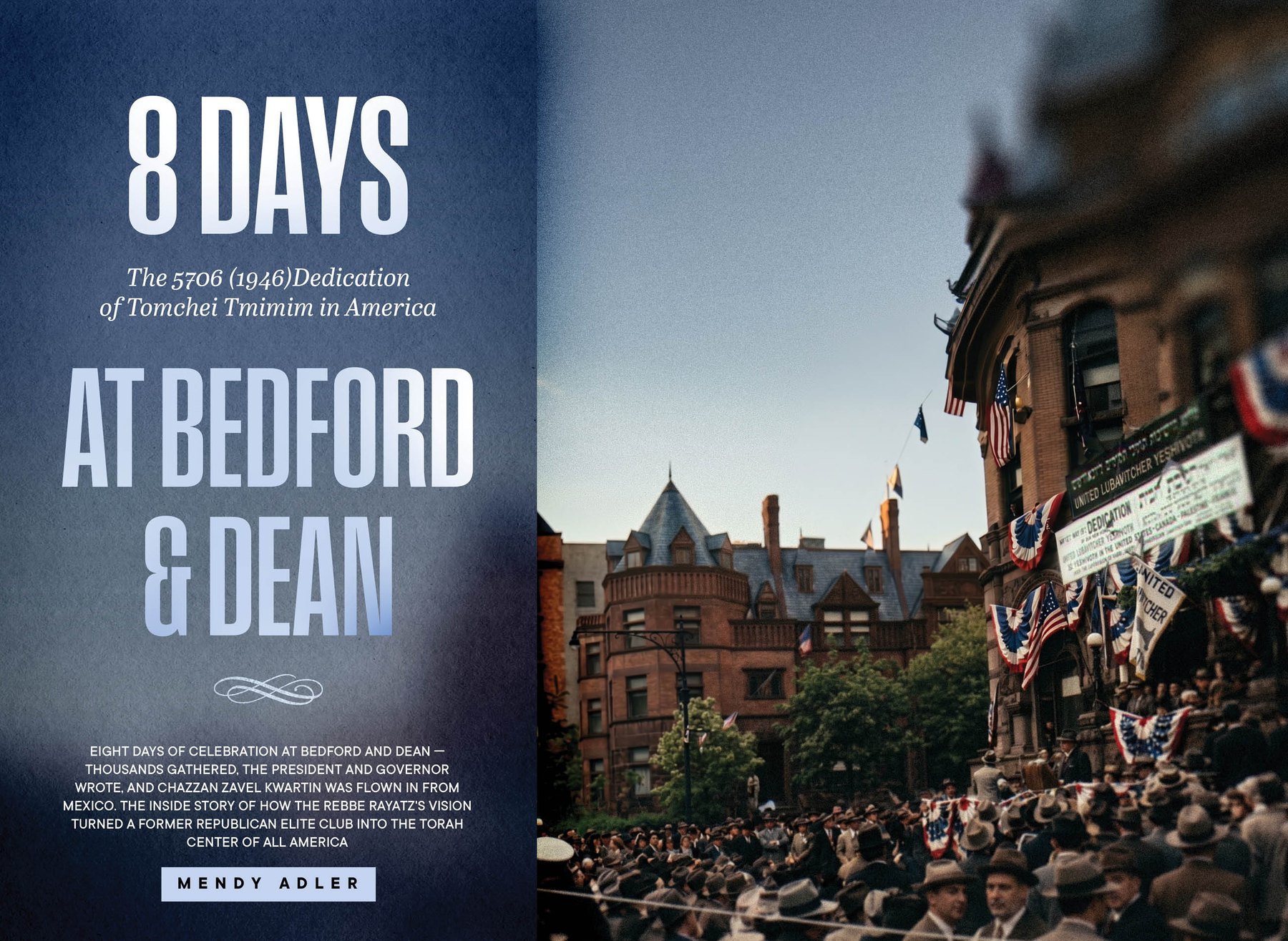
Eight days of celebration at Bedford and Dean – thousands gathered, the President and Governor wrote, and Chazzan Zavel Kwartin was flown in from Mexico. The inside story of how the Rebbe Rayatz’s vision turned a former Republican elite club into the Torah center of all America
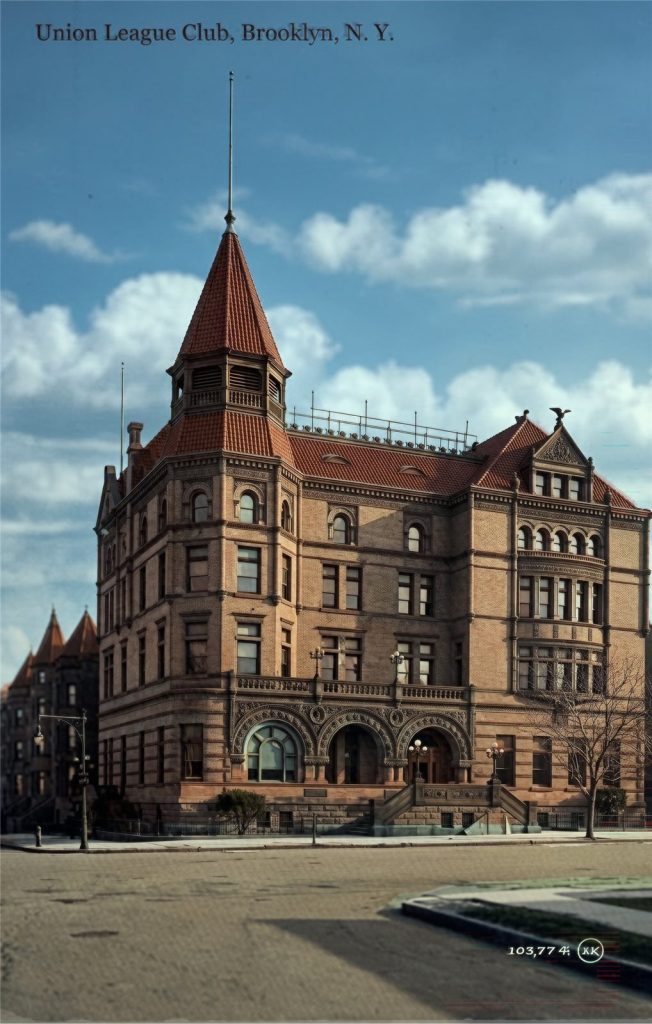
Anyone who walks in the ‘tahalucha’ on Yom Tov toward the Williamsburg neighborhood knows that moment: Just before entering the neighborhood, at the corner of Bedford and Dean streets, an imposing building stands on the right, with a castle turret rising from its center. It happens that someone knowledgeable approaches one of the walkers, points to the structure, and says conspiratorially: “Did you know? Yeshivas Tomchei Tmimim was housed here decades ago, in the lifetime of the Rebbe Rayatz.”
The building, standing in a beautiful central square, captures the imagination as one tries to understand the story of this unique structure: How did the yeshiva operate inside such a building? How did they come to acquire a building of such size in those days? How was it funded?
The answers to these questions contain within them the story of the founding and establishment of Yeshivas Tomchei Tmimim in the United States following the destruction of the yeshiva network in Europe.
In those early years of Chabad in America, purchasing a spacious building and converting it into a dormitory with dining halls was by no means a given, particularly since the Lubavitch coffers were empty at the time. Yet the Rebbe Rayatz, in his resolute declaration that “America iz nit andersh” (“America is no different”), made clear that here too there would be Yeshivas Tomchei Tmimim, just as in the Old Country.
All the preparations and efforts converged toward the month of Iyar 5706, exactly eighty years ago. With the help of press reports from those days and archival documents, we will now reveal the stages, preparations, and details of the historic event that left its mark on American Jewry as a whole.
America Is No Different: The Early Days
The Rebbe Rayatz arrived in the United States on 9Adar Sheni, 5700. The very first decision he made, on the day of his arrival, was to establish Yeshivas Tomchei Tmimim on American soil. The very next day, a handful of students began learning, even before there was a proper building.
A few days later, the Rebbe said: “Our teacher the Baal Shem Tov says that ‘your beginning was small’ is in some measure the foundation and basis for ‘your end shall greatly increase.’ Yeshivas Tomchei Tmimim Lubavitch in America opened in the spirit of ‘your beginning was small,’ without fanfare or noise, in a very small shul with a small number of students. But I am confident, by virtue of the merit and blessing of my holy ancestors, and the prayer of our holy Nasi, my revered and holy father, that in a relatively short time there will be fulfilled in Tomchei Tmimim Lubavitch: ‘your end shall greatly increase.’ Not only will the students of Tomchei Tmimim raise, with Hashems help, the banner of Torah and the bnei Torah in the United States and Canada, but it will also set the tone for the existing Orthodox yeshivos.”
Despite the Rebbe’s clear words, the reality on the American street of those days was entirely different. Many struggled to see how a Torah institution in the traditional spirit of burnt-out Europe could survive in the United States. On the very first night of the Rebbe’s arrival, two distinguished Jews entered his room and presented their objections. “We heard what you said about establishing a yeshiva,” they told the Rebbe, “but to our great sorrow, we are obligated to inform you that the hope of building a yeshiva here in America in the spirit of the European yeshivos is not realistic. It is our duty to save you from an embarrassing failure and to protect your honor and the honor of Chassidus Lubavitch.”
They went on to describe the character of the country as they saw it. “America is a land that devours the great and the good, and even the greatest who comes here with the best of intentions, after a period of time, is reduced to the smallest of the small,” said the elder of the two, while his companion added: “In America, people get excited quickly and calm down quickly. It has happened many times that there was great enthusiasm at the start, an initial joy, and then everything was forgotten as if it had never been.” The two concluded that they wanted the Rebbe to succeed in his plans, “but we felt obligated to tell you the truth.”
In practice, however, exactly as the Rebbe Rayatz had declared, the number of students in the yeshiva only grew. A few months later, at the end of the summer of 5700, the building at 770 Eastern Parkway was purchased, and the students moved into their new home, where today the ‘small zal’ is located. Over time, 770 became too cramped to contain the students and the departments that were added. Already in the summer of 5701, discussions and searches began for a spacious building suited to the dimensions of a central yeshiva.
From Republican Elite Club to the Bastion Of Torah
The prolonged search bore fruit in 5704. At that time, the former ‘Unity Club’ building was located and purchased at the corner of Bedford and Dean Streets in Brooklyn. Dov Ber Rosenzweig was appointed to oversee and supervise the construction and renovation work, having been named chairman of the building committee, and he devoted himself entirely to the project.
The building had previously served as the beating heart and seat of power for the political and business elite. It was considered an architectural and technological marvel, containing its own independent electrical power station, magnificent halls, and impressive decorations. The structure served as a prestigious and exclusive gathering place where senior figures of the Republican government, the military, and the economy had made fateful decisions during the days of the Civil War; staging grand events and shaping the direction of the city and state. The building suited in every respect the growing public stature of the yeshiva.
Acquiring the enormous building required massive renovation work to transform it into a place of Torah; preparing the halls for study and making fundamental adaptations to the various needs of hundreds of bachurim.
Toward the completion of the work, in the winter of 5706, on Sunday the 12th of Teves, a massive rally was held, defined as a ‘preparatory gathering for the chanukas ha’bayis of the Lubavitch Yeshiva.’
More than a thousand people attended the event, an enormous number for those years! On the dais sat representatives of the yeshiva’s administration alongside the public figures who had supported the construction project: Judge Philip (Fishel) M. Kleinfeld, attorney Sam Kramer, and the activists Yaakov Kestenbaum and Benjamin Milberg. The yeshiva’s director, Rabbi Shmarya Gurary (Rashag), delivered the main address and officially announced that the yeshiva would move to the new building at the end of the winter term.
The highlight of the occasion was the reading of the holy letter of the Rebbe Rayatz, sent for the event. His letter opened with words expressing special joy: “Distinguished assembly! Mazel tov, Yidden! Mazel tov to all of Klal Yisrael upon the opening of a new and splendid building for the spread of Torah and chinuch with yiras shomayim. Mazel tov to each and every one who has a share in this through active participation and financial assistance. A special mazel tov and heartfelt ‘yasher koach’ to all the yeshiva’s activists, and at their head my son-in-law Rabbi Shmarya Gurary, chairman of the executive committee, for their devoted and tireless work.”
Further in the letter, the Rebbe Rayatz recalled the atmosphere that had prevailed only five years earlier: “When casting a glance backward, five years back, when I arrived in America with a broken heart after a painful parting from the beloved Jewish sons and daughters in Europe, exhausted from the unusually difficult communal work of the past several decades, and with a heavy heart regarding the fate of European Jewry on one hand, and the spiritual situation in America on the other, I now find now a measure of consolation in seeing that the shlichus of Divine Providence, which brought me here, is being carried out with Hashem’s help, by virtue of my holy ancestors. These beautiful fruits in the field of educational work should awaken a feeling of great joy among the Jewish public in general, and among each and every one of our activists in particular.”
The Rebbe concluded his letter with a call to the public and to American Jewry as a whole to share in the great expenses of the yeshiva.
A Chanukas Ha’Bayis That Lasted Eight Days
The costs of this grandiose project were immense and posed an unprecedented financial challenge for the yeshiva’s administration. The leadership and activists understood that in order to raise the required sums and properly establish the institution, a routine chanukas ha’bayis and ordinary ceremony would not suffice. A series of meetings gave birth to an ambitious idea: the yeshiva’s administration decided to produce a public event of dimensions never before seen in Jewish America, one that would position the yeshiva as a leading Torah center and awaken the broader public throughout the United States to take an active part in the building project. The goal was to turn the opening of the Heichal HaTorah in Brooklyn into the focal point of interest for all of American Jewry.
This decision gave birth to an unprecedented public relations campaign, carefully planned to ensure that every American Jewish donor would feel this was the most important Jewish center. A special committee was established, headed by activists Benjamin Milberg (appointed chairman of the dedication committee), Yosef Shapiro, and Philip Slansky. Together they conceived and initiated a detailed plan, from beginning to end, intended to make every Jew throughout New York acquainted with the yeshiva, its work, and the great message it carried, the proof that America is no different.
The committee decided to hold a week-long chanukas ha’bayis, eight consecutive days of activity, from Sunday to Sunday, during which the building would serve as the focus of massive events for all the Jews of New York, modeled on the eight-day dedication of the Mishkan. In preparation for the event, a special blank was printed featuring the outline of the building, under the large heading ‘Chanukas HaBayis’ and the dates of the special week.
Before Pesach 5706, an initial campaign was launched under the heading ‘The Rescue Campaign,’ which reverberated across the Yiddish press. The campaign appealed to the public by invoking the emotional connection between the yeshiva and the destruction in Europe: “The famous Lubavitch Yeshiva in Otwock, Poland, was the first yeshiva to be bombed in September 1939 . . and now it is the first of the destroyed Torah centers to be rebuilt in America.” The public was called upon to give the yeshiva a ‘Pesach gift’ and to forward the yizkor pledges they had made in shul on the last day of Pesach directly to the building fund.
This effort brought the yeshiva to broad public awareness. Simultaneously, an official appeal was published in the press on behalf of the ‘Agudas HaRabbanim of the United States and Canada,’ calling to “support and sustain this mikdash me’at (small sanctuary).” This call granted the yeshiva official and institutional backing, while urging the public to come and participate in the chanukas ha’bayis.
Letters from Government and International Recognition of the Yeshiva
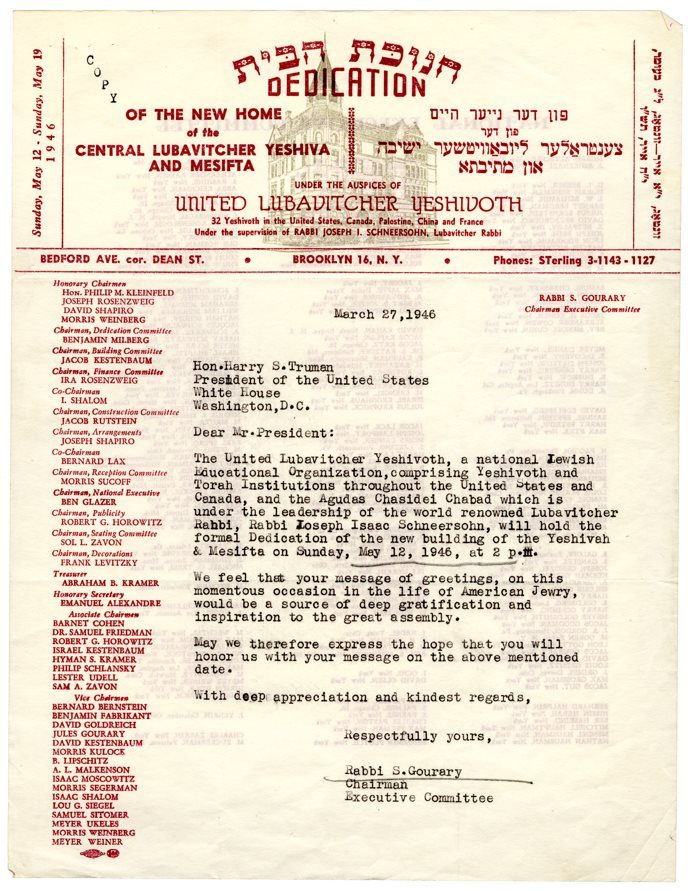
As part of positioning the new institution at the center of the American stage, the administration worked energetically to obtain official recognition from the highest levels of government in Washington. Documents from that period preserved in the United States National Archives document the approaches to the White House. Toward the end of Adar Sheini, Rashag sent an official letter to U.S. President Harry Truman: “Dear Mr. President: The organization ‘United Lubavitch Yeshivos’… together with ‘Agudas Chasidei Chabad’ under the leadership of the world-renowned Rabbi of Lubavitch… will hold the official dedication of the new building… We feel that your message of greeting, on this momentous historic occasion in the life of American Jewry, will be a source of deep satisfaction and inspiration to the large audience.”
To lend additional weight to this appeal before the President’s office, a personal letter from Judge Philip Kleinfeld was attached. He was a friend of the movement who had greatly assisted in the public activities of Agudas Chasidei Chabad and served as honorary chairman of the dedication events. In his letter he noted: “The ‘Chabad’ movement is composed of a group of Orthodox Jews whose conception of a proper religious way of life is fear of heaven, learning, knowledge, mutual aid, and charity. The overwhelming majority of Chabad Chassidim in the United States are American citizens… Because of the holy character of Rabbi Schneerson and his self-sacrifice for the religious welfare of his people, I have been deeply interested in this movement… I hope, therefore, that you will find it appropriate to send a fitting message of congratulations to this very worthy institution.”
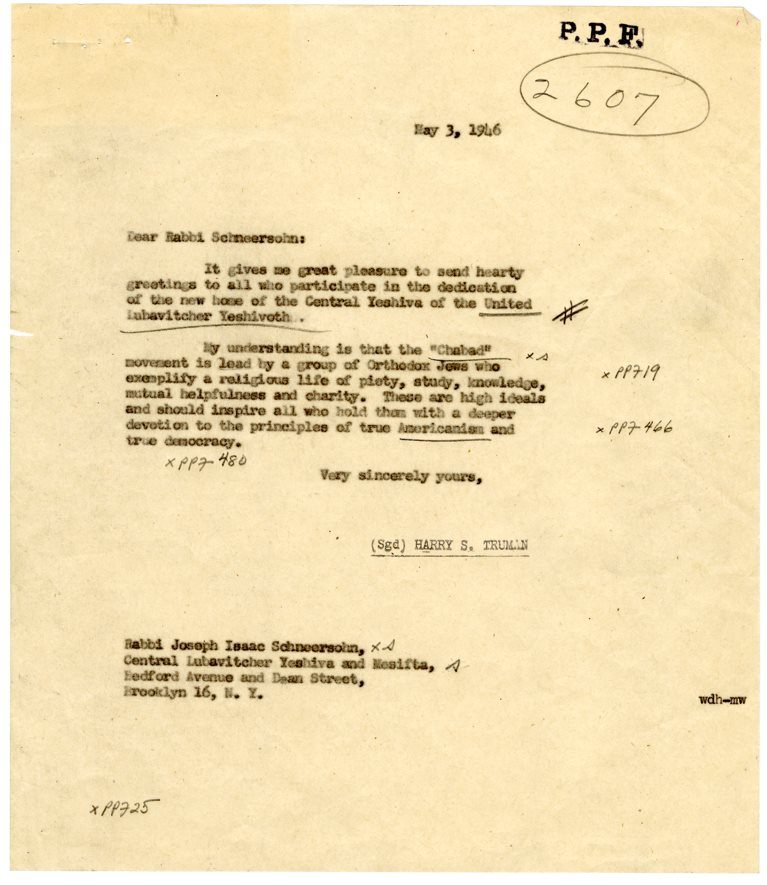
The intense efforts bore fruit, and President Truman sent a letter of greeting for the dedication. Before the start of the events, the special letter was published in the press, in which the President wrote to the Rebbe Rayatz: “Dear Rabbi Schneerson: It is a pleasure to send cordial greetings to all those participating in the dedication of the new building of the Central Yeshiva of the Union of Lubavitch Yeshivos. It is my understanding that the ‘Chabad’ movement is led by a group of Orthodox Jews who are exemplars of a religious life of piety, learning, knowledge, mutual aid and charity. These are high ideals, and they should inspire all who hold them to a deeper devotion to the principles of true Americanism and true democracy. Very sincerely yours, Harry S Truman.”
To this was added a letter from New York Governor Thomas Dewey, obtained for the occasion. His letter was published in the Jewish press and drew enthusiastic responses from all segments of the population, as he referred to the yeshiva as “a great and sacred addition to the spiritual life” of the city. This series of actions officially anchored the yeshiva in the heart of the American nation.
Throughout the month preceding the event, the committee ensured that dozens of items were published in the press daily: paid notices, publications, and reviews from trusted correspondents who repeatedly mentioned the upcoming chanukas ha’bayis. The daily media saturation was intended to prepare the public for the ‘historic chanukas ha’bayis’ the likes of which America had never seen.
At the end of Nissan, the Rebbe Rayatz’s personal call was published in the newspapers, urging people to come and participate: “I appeal and request of all our friends and lovers of Torah, and particularly of shuls and battei medrashos, to come and participate in great multitudes in the joy of Torah and to visit the building of the Heichal HaTorah of the Central Yeshiva and Mesivta Tomchei Tmimim on Bedford and Dean Streets, Brooklyn, during the days of the Chanukas HaBayis which will take place, G-d willing, the 11th through 18th of Iyar.”
To ensure the message truly reached every Jewish home, the yeshiva’s administration made use of all the modern tools at its disposal at the time. Among other things, airtime was purchased on local radio stations, and advertisements were published calling on the public to listen: “Tune your radio sets today, Friday, at 11 in the morning… to hear the wise and captivating words of the master orator, the Maggid of Bialystok… with an important message regarding the upcoming dedication of Lubavitch Yeshiva.”
Alongside the extensive media work in New York, Orthodox youth organizations such as “Zeirei Agudath Israel” and “Young Israel” were enlisted, publishing their own official calls for participation.
As a global echo of the event’s magnitude, dozens of congratulatory telegrams began flowing into the yeshiva’s offices from every corner of the world – from the remnant of survivors in the Displaced Persons camps in Germany, from the group of yeshiva students who had been exiled in Shanghai, from the “Association of Students of Tomchei Tmimim in Eretz Yisrael,” from Rabbi Yaakov Yisroel Zuber of Sweden, and from communities and rabbis in England, Finland, Argentina, Mexico, and Johannesburg.
American Jewish public opinion was now primed and expectant. The magnificent building stood ready, and all that remained was to open the gates for eight days of the ‘Chanukas HaBayis Festival.’
Three days before the opening, a large advertisement appeared in the press under the bold headline: “Why You Should, Must, and Will Participate in the Chanukas HaBayis.” The advertisement summarized all the yeshiva’s achievements and presented it as a national center absorbing students from across America, Canada, and refugees from Europe. Woven into the advertisement were the words of the Rebbe Rayatz and Rashag and, l’havdil, the letters of the President of the United States and the Governor of New York, displayed prominently with their photographs.
The decision not to settle for a single-day opening event and to spread the celebrations across “eight days of the festival” also stemmed from the immense joy of the institution’s leadership that despite all the dire predictions, persecutions, and imprisonments, the Rebbe Rayatz had succeeded in raising up a world of Torah in a magnificent vessel. It was genuine joy over a success that exceeded all natural expectation.
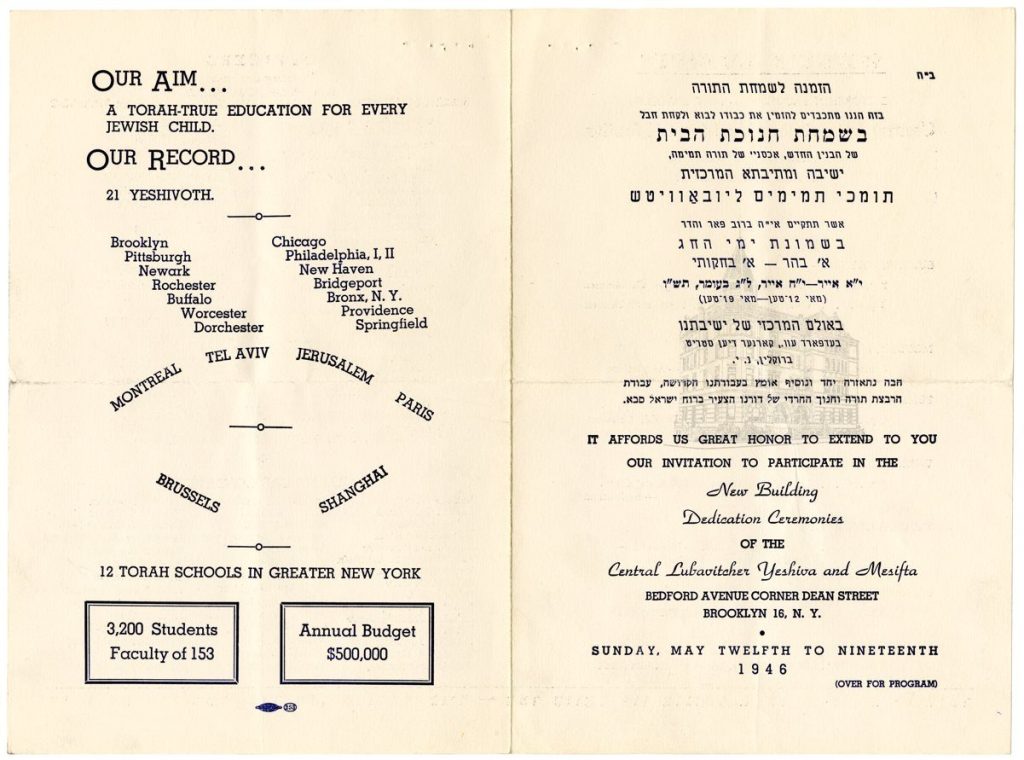
The official invitations distributed throughout New York provided the public with numerical data reflecting the institution’s growth since the Rebbe’s arrival in America: a network of 21 yeshivos from Montreal to Shanghai; 3,200 students; a faculty of 153; and an annual budget of half a million dollars. At the bottom of the invitation was printed the slogan that accompanied the events: “Di Torah iz der sod fun unzer kiyum – der kvall fun unzer hofnung un oysdoyer” (“Torah is the secret of our existence – the source of our hope and endurance”).
To be continued
Beis Moshiach #1505 • pp. 14-22
© 2026 Beis Moshiach Magazine. All rights reserved.
This article originally appeared in Beis Moshiach #1505. You are welcome to share it with friends and family by email or in print, provided that you do not change, add to or omit any part of it, you credit the author and Beis Moshiach, and you include a link to archive.bmoshiach.org (written out in full in printed copies).
To republish this article in a newspaper, magazine, book or website, please request permission in advance at [email protected].