Every Child Has a Letter
Life in the city of Toulouse, France, was usually busy and noisy. Cars rushed through the streets, people hurried to work. Children ran to school with backpacks bouncing on their shoulders. But inside the Chabad House, Rabbi Chaim Hillel Matusof was always thinking about one thing: How can I help another Jew?
* * *
One morning, the day after Purim, the rabbi’s phone rang. “Rabbi,” said the voice on the line, “there’s a Jewish child in the hospital. He’s only five years old. He is very, very sick.”
The rabbi listened carefully. “The doctors are afraid,” the man continued. “There’s a terrible infection in his body. They worry it will reach his brain. If that happens…” The man’s voice became quiet. “They say there may be no way back.”
“What’s the family’s name?” the rabbi asked. When he heard the name, he froze. “…I know this child,” he said softly.
* * *
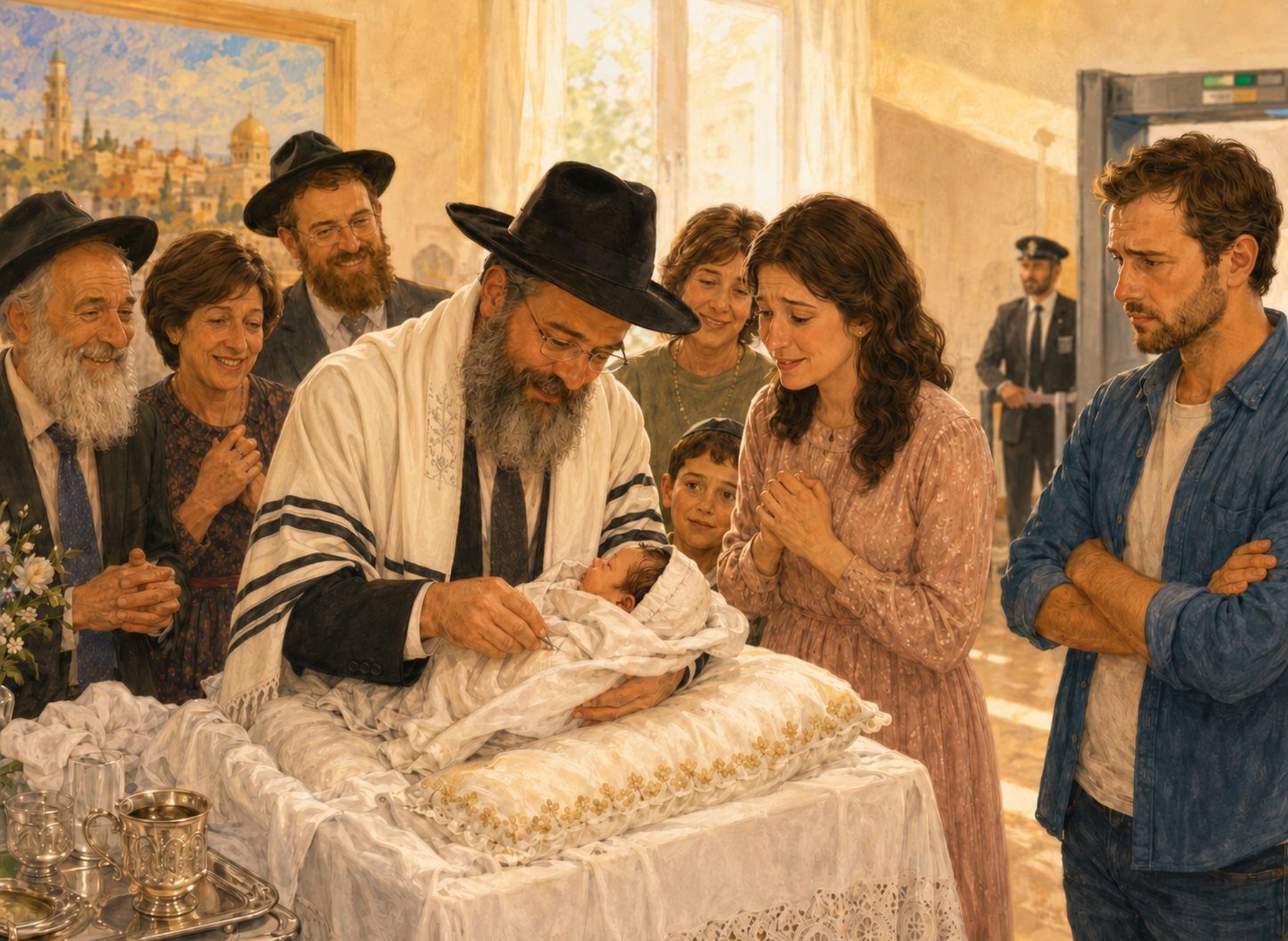
Just a few years earlier, Rabbi Matusof had been the mohel at this boy’s bris. The boy’s mother was Jewish, but his father was not. Sadly, the father wasn’t only far from Yiddishkeit – Jewish life, Torah, and mitzvos – but he was also strongly against Eretz Yisrael, the Land of Israel. He was one of the leaders of his local “Free Palestine” movement. He helped lead angry demonstrations, stood at the front of protests, and spoke publicly against Israel and the Jewish people.
It was a painful and confusing situation. This man had married a Jewish woman, and his own little boy was a Jewish child. Yet instead of feeling close to the nation his son belonged to, he stood against it.
At the time of the bris, the father hadn’t wanted it to happen. But the mother had insisted. “Our son is Jewish,” she said. “He needs a bris.” In the end, the father agreed.
* * *
During the planning stages, the family wanted to hold the bris in the hall of the local Chabad school. It should have been a simple, happy arrangement: a Jewish baby, a bris, family and friends gathering together. But when the security company received the guest list, one name immediately caught their attention: the baby’s father.
The security guards recognized his name from his activities at the protests. They worried this man would bring that anger with him into a Chabad school, filled with Jewish children.
The security company immediately called Rabbi Matusof and told him firmly, “Rabbi, there’s no way we’re letting this man into the building.” Rabbi Matusof understood their fear. They weren’t just being dramatic. Their job was to protect the children in the school, and they knew what this man stood for. But the rabbi also knew that this was not a regular guest. “He’s the father of the baby,” Rabbi Matusof explained. “This is his son’s bris. You have to let him in.”
The security team discussed it carefully. They were still very worried, but finally they agreed to allow him inside on strict conditions. Before entering the building, he would have to be carefully checked, and he wouldn’t be allowed to bring his phone. They didn’t want him taking pictures or videos of the building or the school. They were afraid those pictures could later be used in a dangerous way.
It was a tricky and frightening situation. A Jewish baby was about to enter the bris of Avrohom Avinu, yet his own father was considered such a concern that the school security nearly refused to let him through the door. Still, the bris took place. Rabbi Matusof stood there as the mohel, looking at this precious little child. The baby’s mother wanted him connected to his people, while the father had only agreed to the bris because the mother had insisted. And despite all this, the child himself was pure, a tiny Jewish neshama entering the eternal covenant of the Jewish people.
* * *
After the bris, when things had calmed down, Rabbi Matusof turned gently to the parents. “There’s a beautiful custom,” he said. “Every Jewish child can have a letter written for him in a Sefer Torah. Your son can have his own letter in the Torah.” He handed them the form. For a moment, the mother looked interested. Maybe this was another way to connect her son to something meaningful.
But the father’s face changed. “No!” he burst out. “Enough! I agreed to the bris. That’s enough. Leave us alone!” Rabbi Matusof tried to remain calm, but the father wouldn’t hear of it. “My son doesn’t need a letter in a Torah,” he said angrily. “Especially not a Torah being written in Israel. We’re not interested. Don’t contact us again.”
* * *
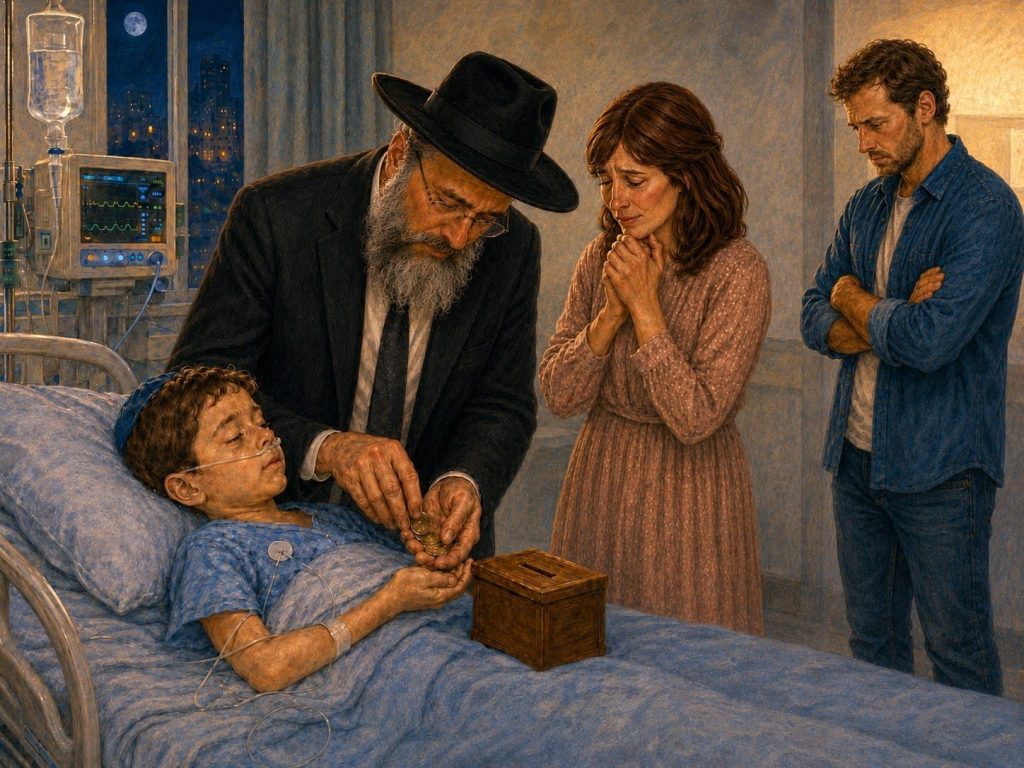
Now, a couple of years later, that same little boy was no longer a healthy baby at a bris. He was five years old, lying in a hospital bed, fighting for his life. The infection was spreading through his body, and the doctors were terribly afraid it would reach his brain.
Rabbi Matusof wanted to go right away. A Jewish child was in danger. But he also remembered how angry the father had been right after the bris, and he knew the family was in a very sensitive situation. He didn’t want to walk into the hospital as “the rabbi” and make things worse.
“Please ask them first,” Rabbi Matusof told the caller. “If they agree I can come, I’ll be there right away. But I don’t want to upset the father or cause a scene.”
About an hour later, the phone rang again. “Rabbi, the situation is really bad. Both parents are broken. They said you can come.” Rabbi Matusof didn’t wait a second longer. He hurried to the hospital.
* * *
When he arrived, he first went to speak with the doctor. Rabbi Matusof was also a chaplain in that hospital, so the doctors knew him well. But this time, the doctor’s face was very serious. “Rabbi,” he said, “you need to understand. His body is collapsing. We’re very afraid the infection will reach his brain tonight. You should see him right now. We really don’t know how much longer he has.”
His meaning was clear. The doctors didn’t think the boy would survive until morning.
Rabbi Matusof walked slowly into the room. The little boy lay in the hospital bed, terribly weak, with the hospital equipment around him. His face was pale, and his body looked weak. There was almost no strength left in him. The room was quiet.
The rabbi’s heart trembled. “What can I do now?” he thought.
* * *
Then he remembered something his uncle, Rabbi Shmuel Azimov, had once taught him. When you visit a Jew in danger, bring three things: Torah, tefilla, and tzedaka. Words of Torah, a heartfelt prayer, and a mitzva of charity.
Rabbi Matusof reached into his pocket and took out a few coins. He placed them gently into the boy’s small hand. The child’s hand was cool and still. The rabbi carefully guided the boy’s hand to drop the coins into a pushka.
The coins dropped inside. It was a small sound in a quiet room, but it was a mitzva, a little spark of light in a place that felt very dark.
Then Rabbi Matusof said pesukim with the child, sharing words of Torah and saying Tehillim. The mother stood nearby with tears in her eyes. The father was there too, quiet and tense. No one knew what would happen next, but Rabbi Matusof had brought all he could: Torah, tefilla, and tzedaka.
* * *
Then Rabbi Matusof remembered something else. The Rebbe had spoken many times about the importance of every Jewish child having a letter in a Sefer Torah. Years earlier, in 5741 (1981), the Rebbe began a special campaign, encouraging children all over the world to pay for their own letter in a Torah written in Yerushalayim. The child would give one dollar, and in return, one letter would belong to them.
The Rebbe explained that a Sefer Torah is made from many letters, and every letter matters. If even one letter is missing, the whole Torah is incomplete. So, too, every Jewish child matters. One child may live in France, another in America, another in Eretz Yisrael, and another in Russia, but through the Torah, they’re all connected.
There were stories that showed how powerful this connection could be. In Russia, behind the Iron Curtain, one Jewish boy heard he could have a letter in a Sefer Torah. He didn’t even know what a Sefer Torah was, but the idea stirred something inside him. He kept asking, until he was finally taken to a shul in Moscow, where he saw a Sefer Torah for the first time. One letter had awakened his connection.
The Rebbe also spoke about this campaign at a time when Eretz Yisrael was facing danger. In 5741 (1981), before Israel destroyed the Iraqi nuclear reactor, the Rebbe urged Jewish children to unite through letters in the Sefer Torah. When Yidden are united through Torah, it brings bracha and protection.
* * *
Rabbi Matusof knew all of this. A letter in the Torah was more than a nice certificate or a “beautiful custom.” It meant that the child had their own place in Torah. It meant they were connected to Hashem, the Jewish people, and the bracha that comes from achdus.
Now, standing beside the little boy’s hospital bed, Rabbi Matusof remembered the form he’d offered the parents years earlier, after the bris. Back then, the father had refused. But this child still had a place waiting for him.
Rabbi Matusof turned to the mother and asked softly, “Did you ever get him a letter in the Torah…? The form I gave you after the bris – did you ever fill it out?”
Before the mother could answer, the father spoke sharply. “No. I told you already. We’re not interested. Don’t bring that up now.”
But this time, the mother didn’t stay quiet. She looked at her little boy, lying in the bed. She looked at the doctors, who had no more answers. Then she looked at the rabbi.
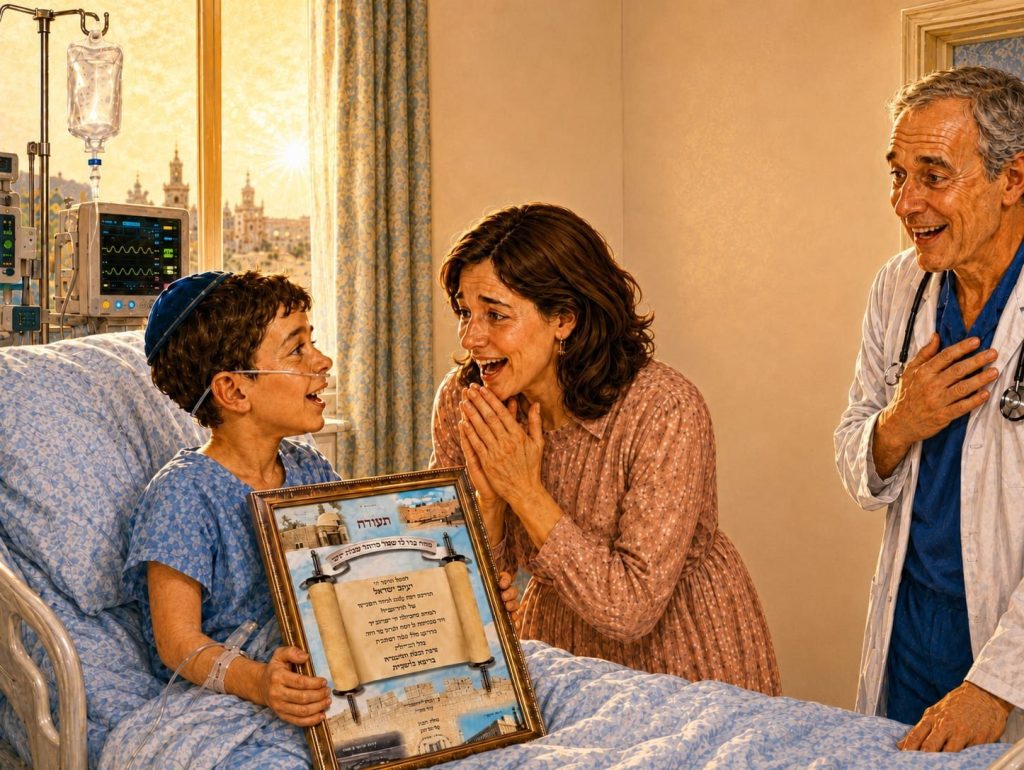
“Rabbi,” she said, “at this point, there’s nothing left. The doctors gave up. If you say we should do it, we’ll do it.” She took a breath. “I don’t know where the old form is. It may be somewhere in the house.”
“Don’t worry,” said Rabbi Matusof. “We can do it right now.”
He took out his phone and went to a website where you can buy letters in the Children’s Sefer Torah. Together, they entered the Jewish names of the boy and his mother, paid the value of one dollar, and submitted the form.
A letter in the Torah now belonged to this precious Jewish child.
* * *
After leaving the hospital, Rabbi Matusof went back to the Chabad House. His heart was still heavy from what he’d seen – the child’s pale face, his cold hand, and the fear in the room. He worried he may never see the boy in this world again. He put on his gartel and sat down to write a letter to the Rebbe, to be sent to the Ohel.
He wrote from the heart, asking for a bracha for this sweet Jewish child. He asked Hashem to send him a complete refuah and an open miracle. Then, after sending the letter, Rabbi Matusof went to teach his Torah class.
During the class, his phone began to ring. Rabbi Matusof didn’t answer. When he was teaching Torah, he didn’t look at his phone. But then it rang again, and again, and again. Finally, he glanced down. It was the child’s mother.
* * *
A moment later, a message appeared. She’d sent him a video. After the class, Rabbi Matusof opened it. He stared at the screen, and could hardly believe what he was seeing. The same little boy who’d been lying in bed with no strength, the same child the doctors feared might not live through the night, was now sitting up in bed, awake and speaking to his parents.
Rabbi Matusof quickly called the mother. “Rabbi!” she cried. “You don’t understand what happened. Shortly after we got him the letter in the Torah, he woke up. He stood up. He started talking!”
Two days later, the good news tripled. The child was being released from the hospital. He was going home.
* * *
Rabbi Matusof later told the mother, “After such a miracle, we need to thank Hashem. Let my wife and me come to your home and show you how to light Shabbos candles.”
The mother agreed. After everything she’d seen, she was ready. A new mitzva entered the home, and a new light entered the family. Soon afterward, that same little boy who had been so terribly sick was celebrating Pesach with joy.
The doctors had done everything they could. Doctors are Hashem’s messengers, and a Jew must always listen to their doctors and try to make a proper keili through nature. But a Jew is connected to something higher than nature, and that connection is stronger than anything human doctors can do. Sometimes, it’s our only hope.
Every Jewish child has a letter in the Torah, because every Jewish child is part of the Torah. And when a Jew is connected Above, they don’t fall below.
* * *
As heard from Rabbi Chaim Hillel Matusof, Shliach in Toulouse, France
Beis Moshiach #1510 • pp. 55-59
© 2026 Beis Moshiach Magazine. All rights reserved.
This article originally appeared in Beis Moshiach #1510. You are welcome to share it with friends and family by email or in print, provided that you do not change, add to or omit any part of it, you credit the author and Beis Moshiach, and you include a link to archive.bmoshiach.org (written out in full in printed copies).
To republish this article in a newspaper, magazine, book or website, please request permission in advance at [email protected].