Tznius: Keeping The Jewels Safe
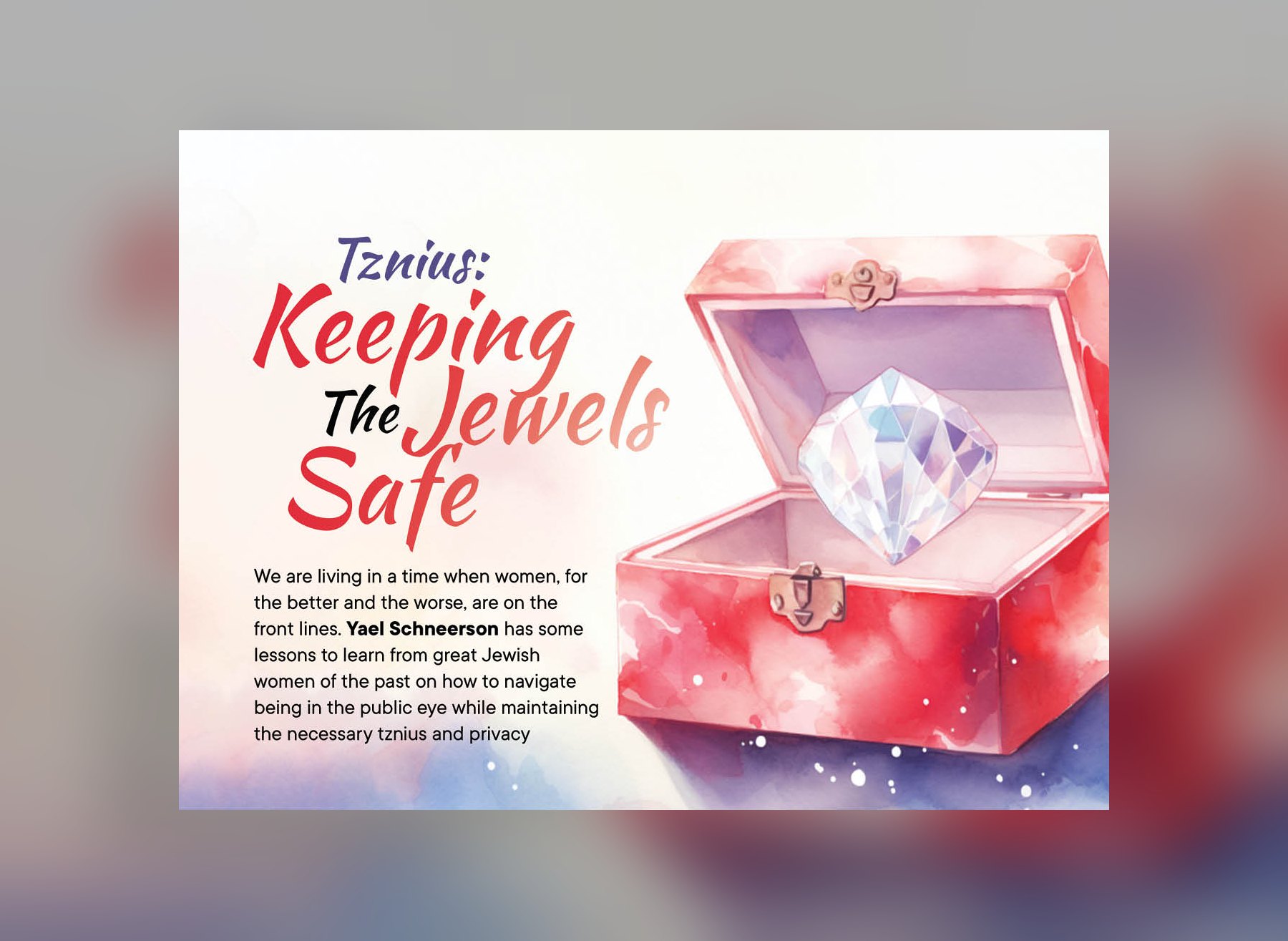
We are living in a time when women, for the better and the worse, are on the front lines. Yael Schneerson has some lessons to learn from great Jewish women of the past on how to navigate being in the public eye while maintaining the necessary tznius and privacy
“All the glory of a princess is within,” says Shlomo HaMelech. Nowadays, however, it’s hard to find women who are exclusively inside. Most of us go out to work, shlichus, mivtzaim and even when we’re home, the media often causes us to turn our house into an inseparable part of the outside, of the world around us. Sharing, uploading, publicizing. With the click of a button, it’s no longer clear where this place is that Shlomo HaMelech refers to.
We went on a journey with some small tasty tidbits from history, some inspiring words from righteous women and food for thought. You’re invited to join in and connect to your own ‘inner space.’
The Tznius of Our Mothers
We’ll start with Sarah Imeinu, wife of Avrohom, whose Chabad House was open 24 hours a day for acts of kindness, tzedaka and the revelation of G-d’s light in the world. Sarah was part of all this and nevertheless, she preserved her modesty.
“Where is Sarah your wife? In the tent.” She worked and prepared copious amounts of food for the guests and remained in the tent. “The glory of a princess is within.”
Sarah was also involved in spreading the wellsprings but again, with outstanding modesty. “Avrohom converted the men and Sarah converted the women.” She didn’t sit idly by; she did everything she needed to do. She influenced thousands of women in her time, and did so modestly, carefully protecting the feminine, Jewish diamond, modesty.
Rivka Imeinu was involved with chessed from the age of three, “Drink and I will draw for your camels too,” and she preserved her modesty. “And she took the scarf and covered herself,” because there doesn’t need to be a contradiction between them.
Thoughts About Kimchis
Yehudis, a dear friend, shared her thoughts with me:
“Throughout the generations, we’ve seen great women in Am Yisrael who influenced the nation and propelled it forward, and all this was done while preserving the bounds of modesty.
We all know the story of the Kimchis woman. The Rebbe asks: A woman can say, why should I exert myself that much so that my sons will be high priests? Isn’t it enough that they be regular priests, just good Jews, “all Jews are holy?”
The Rebbe answers, from here is the instruction that if a woman has the possibility of her children becoming high priests, she needs to realize that this is her role, and if she didn’t do it, she didn’t fulfill her obligation in the world; she didn’t fulfill G-d’s will! The Rebbe proves this from the lighting of the menorah which was done in the Heichal, for if it was possible to light it in a holier place, this would be done and we would not suffice with less.
Sometimes, we invest so much in our children, in their care, their appearance, the matching clothes, their academic and social success.” What mother doesn’t want her children to be perfect? The Rebbe shows us the proper order of values. Spiritually, we don’t compromise for less! That’s where we need to strive for perfection!
Let’s think about it – does investing in the children’s appearance, the running after labels and the nonstop uploading of pictures help our children’s ruchniyus or…? Aren’t we wasting our time and resources on things that divert us from our main goal in raising high priests?
At the moment of the hisgalus, will we be able to say, “See the children we have raised?” without stammering.
Think about it.
Our Rebbetzins
Rebbetzin Rivka, the “mother of Tomchei Tmimim,” who took care of the material needs of the talmidim, was known and famous. She ran all the affairs of the “court” but it was all done with modesty and holiness because there is no contradiction.
Rebbetzin Chaya Mushka, whose modesty and keeping away from all publicity is, to us, her defining characteristic. With that, over the years, hundreds of stories became known about her works and significant activities to the point that the Rebbe considered her passing the start of a new era! At the same time, she was hardly heard or seen.
The tests of our generation when it comes to tznius are many and not simple, whether work related or the media which rules our lives We must learn the halachos and ask a rav before every move – is it in keeping with the bounds of tznious or not?
The Rebbe explains that in the Ezras Nashim in the Beis HaMikdash a balcony was built only so that the women could stand there during the Simchas Beis HaShoeiva, so as not to lead to the mixing of women and men at such a holy time and place. Although originally it was constructed for just one week a year, it remained year-round! The Rebbe says, “The making of the balcony which was meant for modesty (of the righteous women in Israel, who are called that specifically because they are modest women) led to an addition to the building of the Beis HaMikdash!” (Simchas Torah 5716)
This is yet another point about tznius which we must note. True, we all daven in shuls with a mechitza, but do we make sure that the mechitza is always closed, as the halacha requires? And what about standing and waiting for fathers/husbands near the shul as the men are coming out? Our miniature sanctuary and the entire area around it must be sanctified according to all the rules of halacha and bounds of modesty and holiness.
I’ll conclude with a story that might sound a bit cutesy but it left me with lots of food for thought. In my work in special education preschools, there are children who come by bus. At the beginning of the year, I was contacted by a new bus monitor who introduced herself as Sarah. Sarah, a young, frum woman, came every day to bring the children and take them home.
A few days after the start of the year, I heard one of my colleagues, who it seems was a friend of Sarah, call her “Chana.” I was sure I hadn’t heard properly because she told me her name is Sarah! When this happened again the next day, I began to doubt my memory.
I asked my workmate, “What’s the name of the new bus monitor – Sarah or Chana? If I’m not mistaken, though maybe I am, she introduced herself as Sarah.” My friend laughed and explained that her full name is Sarah Chana. In their community, everyone knows her as Chana, but when she started working as a bus monitor, she wanted to prevent a situation in which the drivers or others in charge would call her by her first name, because it’s not modest (being too familiar). She decided to use her other name at work, a name she doesn’t regularly use, to prevent a situation in which a man would use her usual name.
I don’t know if she asked a rav and whether this is the right thing to do, but it definitely raised thoughts about another aspect of tznius that needs strengthening, and the sensitivity that needs to be on high alert in our daily lives.
Sound the Alarm
As the central body of all branches of Nshei Ubnos Chabad in various parts of the world, it is particularly your urgent obligation to launch an intensive campaign to shake up the entire Jewish world, especially Jewish women’s organizations, their specific goal whatever it may be, so that addressing the tznius problem becomes an integral part of everything they do.
To rouse the attention of Jewish mothers to the danger of a weakening of tznius in their daughters’ education.
To rouse the hanhalos of girls’ schools, of all ages, to be more particular about tznius in their schools and explain to the students that tznius is the most beautiful midda, the crown of a Jewish daughter and woman. Make an effort to convince all those who have a proper appreciation for tznius and are particular about it, to take responsibility for their sisters and that it’s their obligation to influence them through words and even more by being role models, strengthening tznius at home and in their circles.
Jewish women and girls should be feeling Jewish pride and disdain for empty, hollow, false and misleading trends, styles that have no meaning other than the financial interests of those who push them.
In the merit of strengthening and spreading tznius in all aspects of life, may Hashem fulfill the brachos that the Torah promises those who are particular about tznius in a way of hiddur, especially with Jewish nachas from children and grandchildren, health and abundant parnassa, and much joy together with one’s husband, for length of days and good years.
Beis Moshiach #1411 • pp. 42-44
© 2026 Beis Moshiach Magazine. All rights reserved.
This article originally appeared in Beis Moshiach #1411. You are welcome to share it with friends and family by email or in print, provided that you do not change, add to or omit any part of it, you credit the author and Beis Moshiach, and you include a link to archive.bmoshiach.org (written out in full in printed copies).
To republish this article in a newspaper, magazine, book or website, please request permission in advance at [email protected].