When The Torah And World Perspectives Clash, Is There A Question Where Is The Truth?
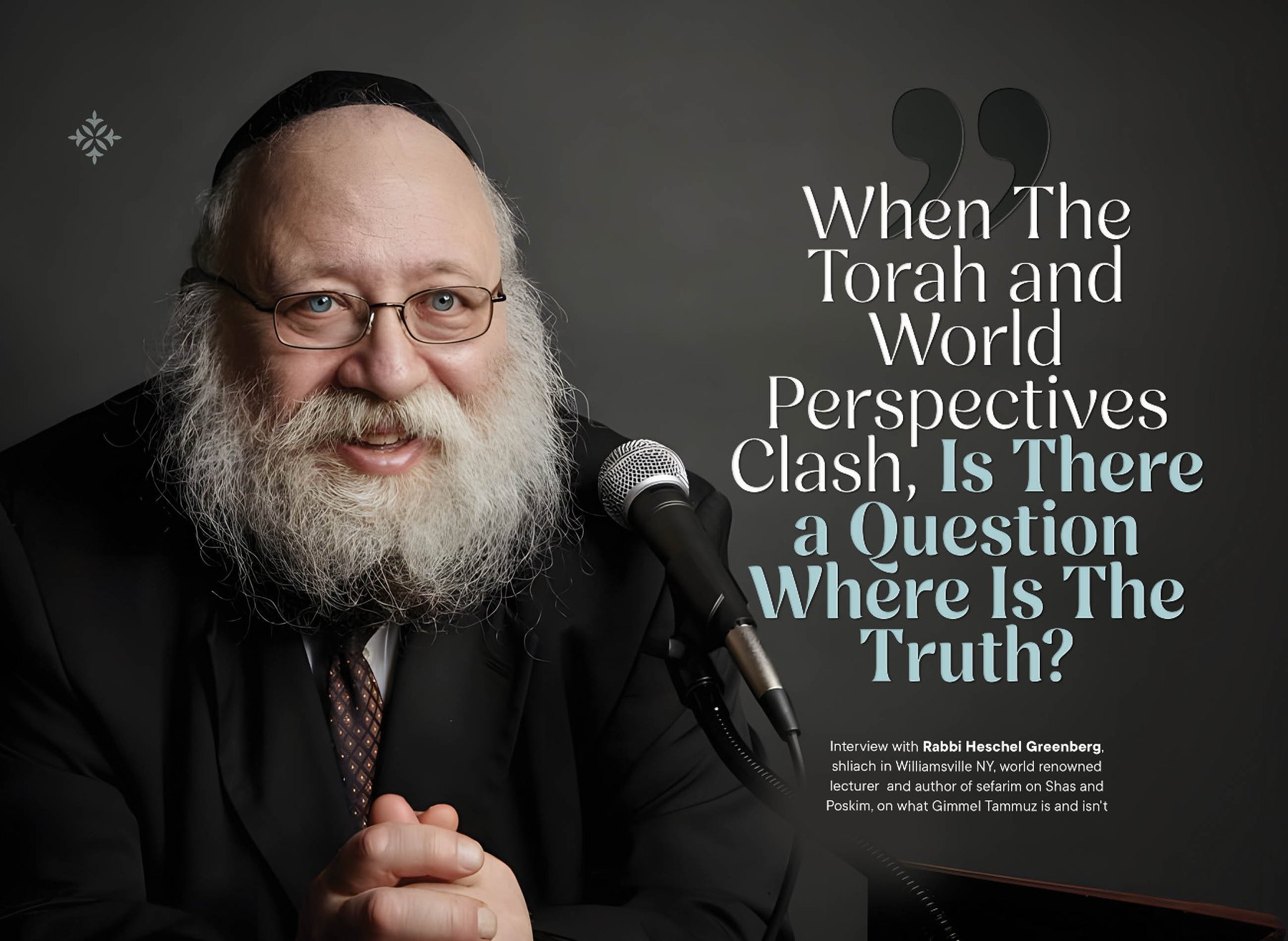
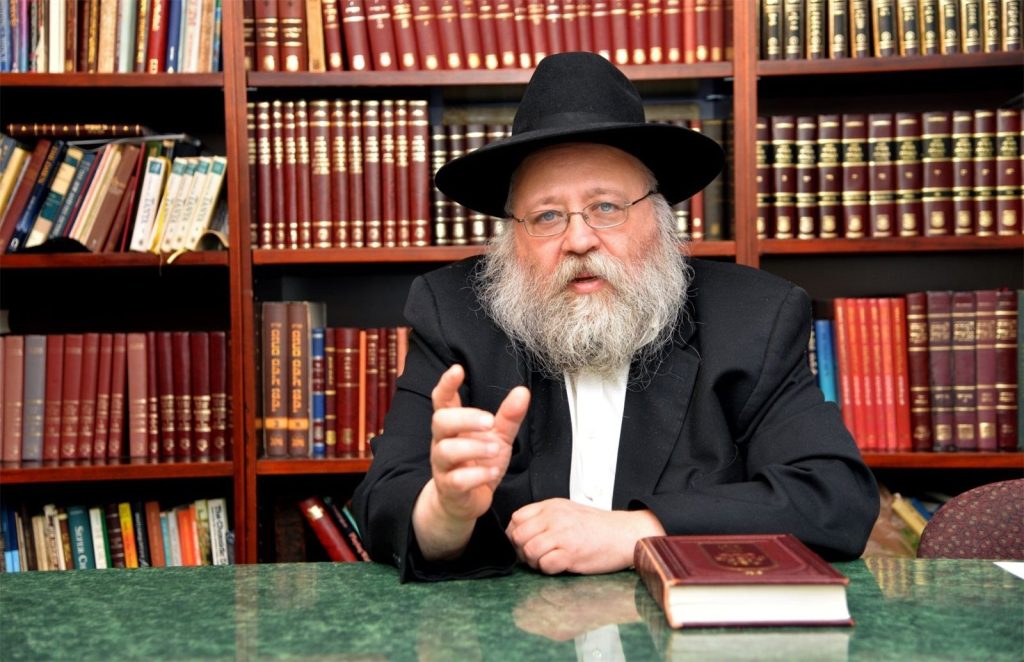
Interview with Rabbi Heschel Greenberg, shliach in Williamsville NY, world renowned lecturer and author of sefarim on Shas and Poskim, on what Gimmel Tammuz is and isn’t
As we approach Gimmel Tammuz – a day that puts us in conflict between its content as presented extensively in the Rebbe’s sichos as a day of “Ischalta d’Geula” and a day when the Rebbe Rayatz was transferred from a fate of the opposite of life to life, and what appears to our physical eyes, a day when the greatest concealment began – we chose to discuss the significance of the day with HaRav HaGaon R’ Heschel Greenberg shlita, shliach of the Rebbe MH”M to Williamsville for decades and the author of many scholarly sefarim and books.
Rabbi Greenberg, besides being an exceptional lamdan and tremendously knowledgeable in Shas and poskim – is known as a wonderful expounder, whose lectures have brought thousands of Jews closer to the Rebbe and Chassidus.
Q. Rabbi Greenberg, we’re approaching Gimmel Tammuz. What is the significance of this day for you?
A. Gimmel Tammuz was a relatively anonymous day until recently. But if we go back to the beginning of Jewish history, we’ll find that Gimmel Tammuz was the day when Yehoshua made the sun stand still during the conquest of Eretz Yisrael.
When the Rebbe Rayatz was released from prison to exile in Kostroma in 5687 (1927), the third day of Tammuz gained some publicity. However, even then, the importance of the day was overshadowed by the yemei ha’geula that followed soon after – Yud-Beis and Yud-Gimmel Tammuz, when the Rebbe Rayatz was completely released from Communist prison.
This continued until Gimmel Tammuz 5754 (1994). Since then, this date stands before our eyes every day, and holds great significance for us.
Many will speak about the events that occurred on this day in Jewish history, and about what happened on Gimmel Tammuz 5754. But with your permission, I will focus not on what Gimmel Tammuz does say, but on what it doesn’t say. I believe that on the following points there is unanimous agreement in the family of Chabad Lubavitch Chassidim:
• The eternity and relevance of the Rebbe’s teachings certainly did not stop on Gimmel Tammuz.
• The need to carry out the Rebbe’s mivtzaim, to reach every Jew with unconditional love – is of course no less important since Gimmel Tammuz.
• The Rebbe’s presence and influence on our lives – have not changed since Gimmel Tammuz.
• It’s clear and understood that the Rebbe’s sichos, in which he demanded that we prepare ourselves and the entire world to greet Moshiach Tzidkeinu – are immeasurably important even after Gimmel Tammuz.
• Everyone also agrees that unlike in previous generations, the Rebbe’s leadership was not transferred to a new Nasi. The meaning of a generation in this context, of course, is measured by the Nasi HaDor, and the Rebbe made this clear in no uncertain terms when he said that we are in the seventh generation which is the last of galus and the first generation of Geula. Only when the Geula is complete will the Rebbe inform us that this is the sign of our entry into the eighth generation. Until then, the Rebbe, the Nasi of the seventh generation, continues to be the Nasi of our generation until the true and complete Geula.
After listing the things that no one disputes, I want to pose an obvious question: If nothing has really changed, why has Gimmel Tammuz become such a significant date in our generation?
It seems that every Chassid agrees that despite all of the above, the situation as it has been since Gimmel Tammuz is unbearable.
The very fact that we live in a time when the Rebbe is not visible to our eyes, as predicted in the book of Daniel and several other sources, is the complete opposite of the entire essence of the Rebbe’s approach. Throughout the years, the Rebbe fought against darkness, sadness, despair, compromise, and everything included in the galus reality of concealing Elokus.
We cannot be comforted by knowing that the Rebbe’s influences have not diminished since Gimmel Tammuz. This does not satisfy us – even though the Rebbe’s influence has grown immeasurably – and it doesn’t satisfy the Rebbe either. The Rebbe is not interested in anything less than absolute good, unlimited revelation of Elokus within this lowest world: mamash, mamash, mamash and without quotation marks.
As long as the Rebbe remains concealed from our eyes and as long as even some of us have not managed to open our eyes and see the Geula before us – the work that the Rebbe demands from us has not been fulfilled.
Now to your question: “What does this day mean to me?” The answer is clear: Gimmel Tammuz warns us that we cannot sustain ourselves on memories and tradition from the past. We also cannot find comfort in the fact that the Rebbe’s spiritual presence hovers “above us”. We can’t even be satisfied with the fact that the Rebbe is with us, in any way, if we can’t see him with physical eyes.
On a day like Gimmel Tammuz, the anticipation for the Rebbe’s hisgalus (revelation) takes on a completely different dimension than any other date. This is a day when we express supplications from the depths of our hearts to Hashem and cry out with all our heart and soul: “Ribbono Shel Olam, ad mosai? We are not satisfied with anything less than the true and complete Geula! We cannot accept anything as a substitute. We want Moshiach now and Geula now in the most literal and simple sense, so that we can see the Rebbe with our physical eyes, and say before him with feelings of joy and happiness: Yechi Adoneinu Moreinu V’Rabbeinu Melech HaMoshiach L’olam Va’ed.
Q. In the coming week, we will mark thirty years since Gimmel Tammuz 5754! Some people who are not from Chabad were sure it was only a matter of time before Chabad Chassidim would disconnect, G-d forbid, from the belief that the Rebbe is Melech HaMoshiach, but they are unable to understand how it is that after such a long time that the Geula has been delayed, this faith is not weakened at all, and on the contrary: it is growing stronger, and the number of believers is growing. Is there an explanation for this?
A. First of all, the passing time strengthens and intensifies the longing and anticipation for the complete revelation of the Rebbe Melech HaMoshiach. Therefore, precisely with the passing time, the desire to see our king grows stronger, which is expressed primarily in adding actions to hasten the Geula. This desire and longing are also expressed in the cry of “ad mosai” coming from the heart of every Chassid, who cannot bear this terrible exile, and the proclamation of “Yechi Adoneinu”, which also bursts forth like a flame from his heart, out of complete faith in the Rebbe’s words that this proclamation hastens and accelerates the complete hisgalus we all yearn for.
And regarding your question – at first glance, the doomsayers should have been right. Time, apparently, works against us, and every moment that passes should weaken our faith and cause hesitations and doubts.
One thing they didn’t take into account is that it is a matter of emuna: faith, at its root, is above intellect, and therefore it is not subject to the limitations of intellect, and is capable of strengthening and intensifying against all logical reasoning.
The truth is that if you look at the matter with true Torah logic, there is no difference between Gimmel Tammuz 5784 and Gimmel Tammuz 5754, and even Gimmel Tammuz 5752, because from the moment the Rebbe said that there had already been a revelation of Moshiach’s existence in the world (see Sicha of Vayera 5752), and his revelation to all began through his actions, and there is nothing holding it back, then even one moment later, there is no logical explanation for the continuation of galus.
The Rebbe himself said that there is no explanation for the continuation of the exile, after Am Yisrael has already done Teshuva, and the time of Geula has already arrived. In one of the most painful sichos we ever heard from the Rebbe, after the murder of Mrs. Lapine HY”D,(11 Adar I 5752) the Rebbe expressed painful expressions, and the content of the words was that the Rebbe himself does not understand, and that in essence, it is impossible to understand why Moshiach has not yet arrived. This means that it is impossible to understand the current galus, even at the highest level of holy intellect. And if in Adar 5752 it was not understood intellectually why the revelation of Moshiach was delayed, then the same question existed in Nissan, in Iyar, and so on till this very moment!
Therefore, to come and say that thirty years ago the faith of the Chassidim was logical, but after thirty years have passed it is less acceptable – is first-rate nonsense! On this issue, even logic says that there is no difference between one day and thirty years!
The same super-rational faith that gave us the strength to believe in 5752 is what gives us the strength of soul to continue believing in 5784.
Q. Still, how do we explain the fact that almost thirty years have passed since Gimmel Tammuz, and we still haven’t merited the revelation of the Rebbe Melech HaMoshiach?
A. We don’t explain. Plain and simple. The Rebbe never asked us to understand why the Geula is delayed. On the contrary: the Rebbe asked us to not accept and understand this! The Rebbe wants us to understand that Moshiach is coming any moment, to understand that the time of Geula has already arrived, to understand that Moshiach has already begun his actions, to know that the table is already set with the Livyasan and the Shor HaBor and the Yayin HaMeshumar, and we just need to open our eyes and “drag the Geula into our room,” as the Rebbe said to Rabbi Mordechai Eliyahu.
Every Jew has the freedom of choice to use the power of intellect and understanding in the right direction. And our direction should be as the Rebbe wants, that it should be ingrained in us with decisive and clear understanding that the time of Geula has arrived, and therefore galus is the strange and incomprehensible reality.
Now, by nature, we think exactly the opposite, but the Rebbe demands that we overcome nature, and work on ourselves so that our intellect and our understanding, is permeated with the matter of Moshiach, with the fact that Moshiach should already be here, and the Rebbe should already be revealed completely. Until this becomes a thing understood intellectually, and the galus reality becomes refuted and incomprehensible.
Q. Does this seem practical to you?
A. If the Rebbe demands this from us, it’s certainly practical, because as Chazal tell us about Hashem that “I only ask according to their ability”. Indeed, it’s very difficult, and as the Rebbe himself said (Shabbos Parshas Balak 5751) that “despite the ‘shturem’ in the matter… after seeing the wonders that testify that this is the ‘year that Melech HaMoshiach is revealed in it’, we see that there is difficulty (‘es kumt ohn shver’) to instill the recognition and feeling that we are on the threshold of the days of Moshiach literally, so that we begin to ‘live’ with matters of Moshiach and Geula”.
But in the same sicha, the Rebbe offers the way to overcome this difficulty: “And the advice for this is through learning Torah in matters of Moshiach and Geula, because [it is] in the power of Torah… to change human nature, so that even when one’s emotional state is still, G-d forbid, outside the matter of Geula (since he has not yet left the inner exile), through learning Torah in matters of Geula, he elevates himself to a state and condition of Geula, and begins to live with matters of Geula, with knowledge, recognition and feeling that ‘behold, he [Moshiach] is coming’”.
The difficulty in living the Geula stems from the very fact that we are in galus… Galus doesn’t just mean that we are outside of Eretz Yisrael, but mainly that we are in an inner exile: our thinking is galusdik, our view of life is from a galusdik perspective. In a galusdik view, the assumptions of the world take first place, and the assumptions of Torah are far, far away, if at all. Leaving the inner galus means: declaring war on nature. And this is difficult…
Q. Regarding Gimmel Tammuz, Mashpiim often quote the Rebbe’s words regarding the histalkus of the Rebbe Rayatz, that “the event that occurred is only a test” – what is the explanation for this, and how do we explain this to people like us who are used to determining reality only according to what they see with their eyes?
A. Look, one of the most prominent characteristics of the Rebbe’s teachings is undoubtedly the reference to Torah as Toras Emes. Torah that is truth. Truth is not just the absence of falsehood, but the idea of consistency, something that does not cease and does not change. The Rebbe takes the idea of consistency to a higher level. Not only must something in Torah naturally fit and be consistent with all other parts of Torah – since all of Torah is essentially one point – but Torah must fit and be consistent with the reality of our existence. No one can separate the reality of Torah from the reality of the physical world.
The fact that we do see dichotomies and inconsistencies when Torah and reality do not match, is only a result of galus. Galus blurs the absolute truth of Toras Emes. Torah in general, Chassidus in particular, and the Rebbe’s teachings in the most specific detail, are directed at removing the barrier between the reality of Torah and the perceived reality of our experience.
We see this throughout the Rebbe’s teachings. For example, regarding the apparent conflict between Shabbos observance and business income. Since Torah is the blueprint of creation, it’s inconceivable that Shabbos observance could interfere with and harm a Jew’s livelihood!
We see this also in the context of the Gemara’s declaration in Taanis (5a) that “Yaakov Avinu did not die”, and in Sotah it is said that “Moshe did not die”. What is the difference between Yaakov and Moshe and other tzaddikim who are also clearly alive in terms of their soul (“even in their death, tzaddikim are called living”) and have a positive continuing influence on the world but it is not said about them that they “did not die”?
The Rebbe explains that Yaakov Avinu and Moshe Rabbeinu embody the quality of truth. Truth means there is no inconsistency and conflict between the life of the soul and the life of their body. While for all tzaddikim their soul obviously continues to live (and to some extent even their bodies), for Yaakov and Moshe life continues through the continuation of their soul within their body.
Similarly, in the words of our Rebbeim, who are truth and their Torah is truth, there are no expressions of exaggeration or overstatement. Since a Rebbe embodies “truth” and “Toras Emes” in all his essence, there is no room for inaccuracy or mere expressions and wishes in the Rebbe’s words.
After this introduction, we can know how to assess and evaluate the seriousness to be attributed to the Rebbe’s declarations about Moshiach. Because if Torah is truth and the main parts of expressing truth are in halacha and Chassidus, then Moshiach is the most prominent expression of truth. Therefore, it is clear that the Rebbe will not say trivial things about Moshiach and his identity. It’s ridiculous to think that the Rebbe, of all people, would use exaggeration or overstatement regarding any part of Torah, and certainly not regarding Geula and Moshiach.
Therefore, when the Rebbe explicitly says that “Moshiach, Menachem shmoi”, and this is in continuation to the leadership of the Rebbe Rayatz and the role of the Rebbe Rashab in bringing Moshiach, it is inconceivable that he is speaking in riddles or just expressing a wish. Similarly, if the Rebbe writes that the number 770 is the gematria of “Beis Moshiach”, it’s impossible to think that he meant to bring a nice literary description, and when the Rebbe declares that Moshiach has already been revealed and begun to act in the world as part of Moshiach’s actions, is it true to say that the Rebbe actually meant this only metaphorically and not in the most serious way? It’s clear that we need to take the Rebbe’s words as absolute, every word precisely as it was said.
To present the Rebbe’s words in any other way and try to interpret and explain that his inner intention does not align with the clear words he said, is to apply a galus mentality and way of thinking, chas v’Shalom, to the Rebbe who is the complete opposite of galus!
Q. You mentioned earlier the Rebbe’s prophecy that the time of Geula has arrived. What does this actually mean – has the Geula already begun in practice?
A. Indeed, this is a quote from the Rebbe’s words and it’s very important to be very precise in these matters, since the Rebbe fought for many years against all those who say that there has already been an “Ischalta d’Geula” (beginning of redemption) with the formation, in 5708 (1948) of the State of Israel.
In fact, if you look carefully at the Rebbe’s words, you won’t find even once that the Rebbe expresses himself in the language of “Ischalta d’Geula”. There are similar expressions, but very different. The Rebbe stated dozens of times that “higia zman Geulaschem” (the time of your redemption has arrived), “higia” from the word “touch,” that we are already “touching” the time of Geula, and as the Rebbe expressed elsewhere that “we are already standing on the threshold of the beginning of the days of Moshiach, on the threshold of the beginning of the Geula” (Balak 5751), “matters of Geula have already begun” (Shoftim 5751), “our days – the days of Moshiach – in which we are now” (19-20 Kislev 5752), “we see (a foretaste and) the beginning of Melech HaMoshiach’s action on the nations” (Mishpatim 5752), and more.
The time of Geula has arrived, matters of Geula have already begun, there is a foretaste and beginning of the prophecies of Geula, and our days are already defined as “the days of Moshiach”, but the Geula itself has not yet begun. Because Geula is a clear halachic concept, which begins when Melech HaMoshiach builds the Beis HaMikdash in its place and gathers all the dispersed of Israel. Only after these two conditions are fulfilled – does the Geula begin.
We are currently in an intermediate stage, or as the Rebbe defines it, the “peak time”, this is the transition point from galus to Geula. At this point, Moshiach has already been revealed and begins to act in the world, and the whole world begins to change towards Geula. We are already touching Geula, but still in galus. Therefore, at this stage, the main work should focus on “greeting Moshiach Tzidkeinu in actual practice”.
In other words, at a deeper level: All matters of Geula have already been accomplished in this physical world, but we need to open our eyes and see the reality in actual practice. Therefore, as long as we haven’t opened our eyes, and we don’t see this true reality with physical eyes, we can’t say that from a halachic perspective we’ve reached a state of Geula.
The exact same thing applies to the belief that the Rebbe is alive and well. We know, based on the Rebbe’s sichos, that this is the true reality, but we don’t see it with physical eyes. To say we’re happy with this situation? Chas v’Shalom! No one is happy, but we know the true reality, and we do everything so that this will also be the visible and revealed reality.
In the maamar of Erev Shavuos 5749, the Rebbe said that “when Jews issue a psak din (halachic ruling) according to Torah that the time of the Geula has already arrived (because all the kitzin have passed and the Jewish people have already done teshuva) so it will be and immediately the Geula comes”.
By the way, it’s interesting to note what the Rebbe’s source is for “the Jewish people have already done teshuva” is. The Rebbe references “As the psak din of my father-in-law, the Rebbe, that a sigh of a Jew is great teshuvah which is cited in HaYom Yom for 3 Tammuz…
The terrible concealment of Gimmel Tammuz 5754 caused a great sigh in every Jew, and if an ordinary sigh is great teshuva, then that sigh of Gimmel Tammuz is the greatest teshuva that has ever been!
The very fact that a Jew can think that the Rebbe is not with us, this is the greatest helem v’hester (concealment and hiding). This is not the Geula the Rebbe spoke about, and this is not the Geula we yearn for. When the main point of Geula, Melech HaMoshiach, is not revealed to our physical eyes, this is the greatest helem v’hester. But precisely because of this, we must do everything to remove the helem v’hester and reveal that he is ba’chaim – the Rebbe is alive and well, because the more we see and show that the Rebbe is alive and well – this removes the helem v’hester!
Q. Why is it really so important to publicize that the Rebbe is alive, when this is something people not familiar with Torah and Chassidus concepts can perceive as strange and outlandish?
A. This is part of hiskashrus (connection) to the Rebbe! One aspect of hiskashrus is the chayus (vitality) and ‘koch’ (enthusiasm) in the matters that the Rebbe is involved in himself with a ‘koch’. When we look at the Rebbe’s sichos from the years 5710-11, we see a special koch that the helem v’hester is only a test, and we need to know that the Rebbe is alive and well. After the Rebbe accepted the nesius (leadership), of course there was no need to agitate about the fact that the Rebbe is alive and well (although even in later years, when the subject came up, like during the period of the sefarim trial, the Rebbe again emphasized in words that cannot be misunderstood, that the Rebbe Rayatz is alive, and no rabbi or lawyer can change the simple reality that he is alive, so there’s nothing to talk about inheritance!).
But now, when we are in a helem v’hester where we don’t see the Rebbe, we need to learn these sichos, and engage with koch and chayus in what the Rebbe was engaged in at the time. Additionally, the Rebbe said then that we need to study the last sichos we heard from the Rebbe with precise attention. When we do exactly that with the last sichos (for now) that we heard from the Rebbe, we see clearly that the Rebbe is talking about there being no interruption in the seventh generation, but we enter into Geula through eternal life. From the natural feeling of a Chassid, he engages in matters that the Rebbe engages in, even if he doesn’t understand what the benefit is.
All the more so in our case, when this approach, that the Rebbe is alive, stems from the approach that says that Elokus, Torah and the Rebbe are eternal truth, and the helem v’hester is not truth. This is the whole matter of Moshiach – “Emes Hashem l’olam” (G-d’s truth is eternal), that we see the true reality of the world, as it is reflected in Torah eyes, not as it appears in the assumptions of the world.
In a well-known sicha for Parshas Vayechi (Likkutei Sichos Vol. 35), the Rebbe says that there are two approaches: how Hashem looks at things, and how the world looks at things. The Egyptians considered the assumptions of the world, and therefore when “it appeared to them that he [Yaakov Avinu] died” they did what was expected, but we need to see everything from Hashem’s perspective. Fine, during the time of galus there is room to look according to the assumptions of the world, but when we are already touching the Geula, we need to emphasize how the Torah looks at things.
And in our case, the Torah’s perspective on the Rebbe’s existence is that the Rebbe is chai v’kayam! This is explicitly stated in the sichos, and this is understood by anyone who learns in Chassidus about the role of the Nasi HaDor in general, and Melech HaMoshiach in particular.
If we look at a peripheral matter through the eyes of worldly assumptions, perhaps it’s not so terrible, but when we take the matter that is the very heart of the Geula, Melech HaMoshiach, and look at him with galus eyes – this is a contradiction and the greatest inconsistency!
When the Rebbe says we need to ‘live with Moshiach’, it means we need to live with the assumptions of Torah, to look at everything from a Torah perspective. And as is extensively brought from the Rebbe’s sichos – through learning Torah in matters of Geula and Moshiach, we accustom the mind to look at the world from a Torah perspective, a perspective of Geula.
Beis Moshiach #1416 • pp. 10-18
© 2026 Beis Moshiach Magazine. All rights reserved.
This article originally appeared in Beis Moshiach #1416. You are welcome to share it with friends and family by email or in print, provided that you do not change, add to or omit any part of it, you credit the author and Beis Moshiach, and you include a link to archive.bmoshiach.org (written out in full in printed copies).
To republish this article in a newspaper, magazine, book or website, please request permission in advance at [email protected].