Think Good, You’ll Speak Good!
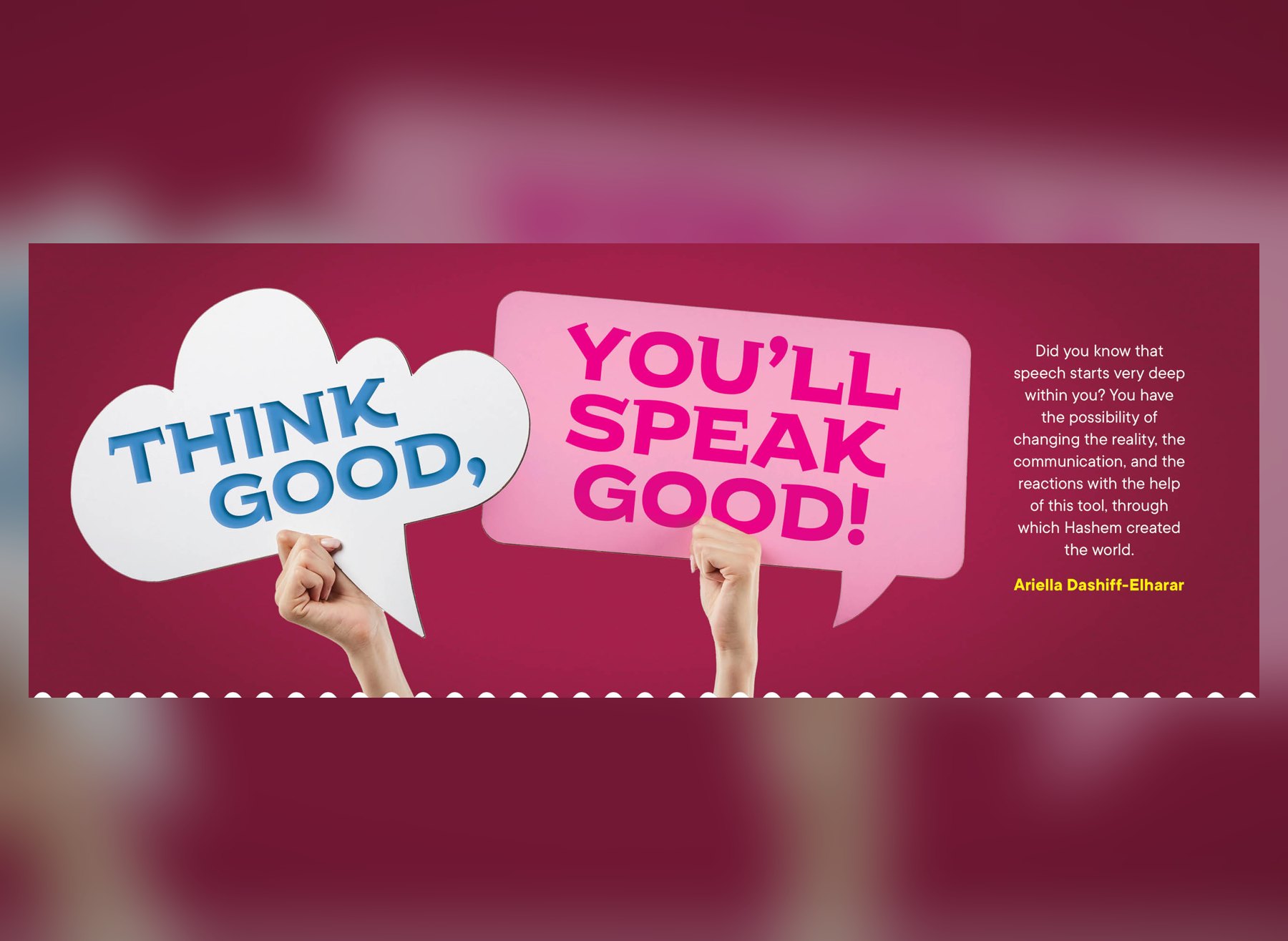
Did you know that speech starts very deep within you? You have the possibility of changing the reality, the communication, and the reactions with the help of this tool, through which Hashem created the world.
Speech: Enlivening and generating worlds. When positive speech comes forth from a good heart, it builds the world, one block at a time, it builds relationships between couples, between family members, close and distant, builds an environment, and creates worlds. There are people who infuse us with energy when we get close to them – literally. What do they have that is so energizing? – A ready smile, a willingness to be there for others, and a good word flowing to them from the heart. What is the axis around which this positivity revolves? The good heart within them. And what causes this good-heartedness? This is the illumination in their hearts. Light, joy, and positivity. What is the axis around which the positivity and joy revolves? Inner positive speech.
Inner speech: This is the name given in modern psychology to what Chassidus calls “letters of speech.” Each person has a constant flow of thoughts, and these thoughts are essentially a way in which the person speaks to himself. Among the three garments of the soul – thought, speech, and action – the garment of thought is the closest to the nefesh. It describes the state of mind, the movement felt within the soul, in the most immediate and constant manner. The letters of thought are the sentences defining what we feel within the inner essence of our soul. There are instances where the state of mind has yet to be translated into the letters of thought. This is the sub-conscious. When a person’s state of mind is positive, happy, and dependable, the resulting thoughts will be positive, reliable, and calm.
Hard Right!
From personal experience, the situation quite often is that the person’s state of mind is not positive. Within the “beinoni”, the “animal soul” is what controls the heart, and therefore by default, it appears first within our thoughts. This soul is from the element of dust, and it has a tendency towards sadness and lethargy. We just opened our eyes, we haven’t even had a definitive thought, yet a bitter feeling creeps into our heart. “I don’t feel like getting up, things aren’t going well for me, I’m sad, I’m cold, I feel alone. No one likes me…” (I read some marvelous things from Rabbi Yoram Abergel on the Zohar about how Amalek is also called ‘the kelipah of the night (leilis)’, after its constant whining (yalalus) and complaining…)
If we haven’t immediately uprooted such thoughts, then the next stage is excuses. “I feel this way because…” – a million excuses. “The car broke down two days after the insurance expired, and I didn’t manage to renew it. Our son is having problems in Talmud Torah, our daughter’s shidduch, the house is always upside down – I have no strength!” And lots more excuses. These excuses aren’t the reason for the bitterness and resentment; it’s actually within us. They were just the first things to turn up, and then afterwards, there might have been something to arouse the bitterness. Here, however, the process is reversed. First there’s the bitterness, and then we think that there might be a real reason, attributing the bitterness to all kinds of unpleasant situations that all of us face in our daily lives. At this point, we need to grab the bull by the horns, immediately make a hard turn to the right, and start talking to ourselves using positive inner speech: words of faith, Divine Providence, thanks, and joy. (How good it is that the Creator of the World gave us the tefilla of ‘Modeh Ani’ with which to begin our morning, a tried and true segula for making a ‘hard right’, when we say it with kavana.)
Needless to say, or actually we should say, it is forbidden to speak lashon hara, even about ourselves and even if we just think it! Don’t hesitate for a moment, G-d forbid, rather push it aside with both hands as you would some repulsive thought, precisely as we learn in Tanya about evil talk. Push it away with both hands!!! Without excuses. Such thoughts are simply f-o-r-b-i-d-d-e-n!
Thus, a sharp right-hand turn enables us to communicate positively with ourselves, and this also means to be connected with our positive strengths, with our G-dly soul. It uplifts and surrounds our faith, our trust in what is good, and our desire to do good for ourselves and for others.
See the Good and Speak It
The Holy Torah commands us in a variety of ways that keep us a safe distance away from improper speech: prohibitions against speaking lashon hara, gossip, slander, falsehoods, deceit (i.e., causing anguish to others through speech or distorting the truth and causing people to fail).
During the process of my becoming a baalas teshuva, I decided to learn the Chafetz Chaim’s sefer ‘Shmiras HaLashon.’ When I read it, I felt that I wasn’t just reading a sefer on halacha; it was a sefer on Jewish thought and outlook. This sefer is so basic in the life of every Jew. It speaks about all those prohibitions listed above, and I felt that it was arousing a tremendous sense of good-heartedness within me, looking positively upon the world in general and Jews in particular. One of the subjects discussed is a change in our manner of thought – thinking well about every Jew, as this is part of the commandment “You shall judge your fellow with righteousness… but you shall not bear a sin on his account.” This commandment, which brings much correction to the Jewish People, is ample proof to show how the Torah is G-dly.
Human society only came to a proper understanding of the importance of viewing people in this fashion in the last one hundred years, to a large extent in the merit of Jewish psychologists such as Adler, Frankel, Marshall Rosenberg (the Giraffe method), Martin Seligman (positive psychology), and many more. In my opinion, it gives a powerful push towards the days of Moshiach.
Another significant meaning to the concept of positive speech is speaking in terms of what there is, what is good, what Hashem has given and blessed. Naturally, we all know the Rebbe MH”M’s guidelines on speaking in this manner – a literal instruction from the Torah. This is how a Jew is supposed to think and talk. You always need to see and speak about the good, not only to avoid opening your mouth and saying bad things, rather because such speech proceeds to create more good. As in the saying of the holy Baal Shem Tov, those who cleave to kindness, draw kindness upon themselves. And from the positive, one can deduce the negative.
In the NLP (neuro-linguistic programming) approach, there exists a strong emphasis upon changing one’s inner speech in the direction of thinking about what there is and what is positive. According to neuroscience surveys, the concept of ‘No’ doesn’t exist in our consciousness, because in order to reject something, you have to bring its sense of reality to light, and only then can you discard it. It’s impossible to reject something that isn’t in our state of awareness. For example, if we tell someone not to think about food, we bring the concept of food into his consciousness, and then we place a big X on it. The more the ‘No’, the greater the degree of its importance.
How Do We Get Untangled?
By thinking about what’s positive, we speak more positive. Instead of saying “Don’t act wild”, we should say “Play more quietly”, instead of “Don’t run” – “Inside the house we walk.” In matters of thought: Instead of “I have no strength to organize the house”, we’ll think about we can do: “I’ll start organizing the house for five minutes.” Instead of thinking about what’s forbidden to eat for reasons of preserving my good health, I’ll think about what’s permissible for me, focusing on it and enjoying it in my imagination. All the rest doesn’t exist at all. Of course, in cases of emergency, you can say, “No!” right away, but in most instances, we can find a positive way to say things. This usually proves to be a much more effective way to communicate, since the approach of “Do good” is far more effective than the approach of “Turn away from evil”, when we’re talking about a change in conduct. The form of our inner speech will change, G-d willing, with the passage of time. This positivity can have an influence over our body, making it more relaxed, more functional, capable of building more pleasant and beneficial personal relationships, dismantling the landmines along the way.
USEFUL TIPS FOR DISMANTLING LANDMINES
Life is something like a minefield. Until I made several good resolutions on proper speech, I would enter the house and step on the first landmine I encountered. The children or my husband who would come home tired, hungry, and exhausted, the mess they made again in their rooms… The initial instinct is to fight back. What should I do?
Such landmines or other things familiar to us… How do we deal with them? Here are a few suggestions:
Relax – Remember that G-d runs the world. You can be certain that there’s a solution and a way to find it.
Ask – What do you want? What are you expecting? Try and see how to meet your expectations in a calm manner.
Speak about my feelings – Instead of “You’re always late”, say “Your tardiness gives me a feeling of pressure and frustration.”
Transform every complaint into a positive request – Instead of “You constantly make a mess! Your room is always upside down!”, try “Come, let’s decide together when is an appropriate time to organize your room”, and stick to it. For example, “Every Wednesday between 2-2:30 p.m.”
Try to reach practical conclusions – “Starting today, there will be a calendar with the dates of weddings written down to keep me from forgetting to buy a gift.”
Compliment, treat favorably, appreciate effort, find the good, speak kind words of love.
And this is literally G-dly speech: “I loved you, said Hashem,” and” I led you out, I saved you, I redeemed you, I took you, and I brought you to me.” Do this, and you literally won’t be sorry.
Have a good life filled with G-d’s blessings!
Beis Moshiach #1419 • pp. 40-43
© 2026 Beis Moshiach Magazine. All rights reserved.
This article originally appeared in Beis Moshiach #1419. You are welcome to share it with friends and family by email or in print, provided that you do not change, add to or omit any part of it, you credit the author and Beis Moshiach, and you include a link to archive.bmoshiach.org (written out in full in printed copies).
To republish this article in a newspaper, magazine, book or website, please request permission in advance at [email protected].