Safe Landing

A Baal Teshuva’s path from the exciting discovery of the truth of Torah towards day-to-day Jewish living is a bumpy road. What are they experiencing? What challenges them most? A must-read for Baalei Teshuva and for their friends and mentors
I landed in Tzfas fifteen years ago with a huge backpack, sandals, and a basic blouse that was custom sewn for me at the big market in Pushkar, India. I arrived focused on my goal and determined to shed everything I had once been and become one of those Chassidim about whom I had read nonstop in recent months. Learning by heart “L’haskilcha Bina,” disconnecting from the material coarseness of this world in favor of “alma d’iskasya” and living largely in the world of Atzilus (with occasional breaks for coffee and cake).
I’m sure that every baalas teshuva reading this understands good and well what I’m talking about and is chuckling to herself. On the other hand, someone who hasn’t experienced a teshuva process might feel that this is foreign to her (or perhaps not).
The “Oros” (Lights) of the beginning of teshuva is a phenomenon hard to describe in words. Actually, I sat and wrote an entire sprawling book to do this accurately and I’m still not sure I succeeded because there are experiences that are almost impossible to put into words, among other reasons because by their very nature they transcend words. But I’ll try a little, nonetheless, because you have to at least give it a shot.
Pleasure of Discovery
The teshuva process mostly begins with the discovery experience, with the feeling of, “How come nobody told me this before?” You are exposed to a world of meaning and experiences that weren’t accessible to you before, and along with this revelation your worldview changes significantly. There are moments like this at the beginning of teshuva, like at the beginning of falling in love, mythological moments that are engraved within your consciousness for life. These are moments when it’s like you are seeing beyond the mundane reality, the G-dly light that is beyond the world. Chassidus tells us that this is the vision of tzaddikim, leaders of the generation, but a baal teshuva starting out often merits a glimpse into that experience of reality.
The power of this experience is hard to convey in words. One who touches for even a moment the sweetness of the sense of integration with Hashem, the elevation of a true experience of holiness that he was never exposed to before, cannot, simply cannot return to his life and continue as though nothing happened. Therefore, a baal teshuva treads the path of memory. He experienced things that are difficult to convey in words and the entire initial period of teshuva is an attempt to relive these big experiences, to live in a reality which is beyond reality.
Really, Hashem is generous with baalei teshuva. The beginning of teshuva is a time full of huge experiences, impossible to contain. When you give yourself over to Hashem’s will in a way that is beyond reason, beyond the ordinary patterns and ingrained habits of your life, Hashem pays you back and the “Oros-Lights” are plentiful. The baal teshuva is truly given a taste of the Infinite One.
But how does this affect the psyche?
Many baalei teshuva describe the initial period of their teshuva process as comparable to falling in love. Falling in love is so powerful that the entire world melts and nothing else matters, and from this uplift of spirit it’s as if a new existence is born – the new identity of a baal/baalas teshuva. Black and white, a beard and hat for men; sleeves, stockings, a skirt for women. You turn into someone new and unrecognizable, and feel wonderful and filled with possibilities especially because of the foreignness to your own self.
At the same time, whatever you were before is set aside, put in a box. It feels like the leftovers of a meal, like an old dress that you don’t need and for which there is no reason to keep, because what you have now is so captivating, why look back? Old habits, old loves, old identities, whatever used to be important to us is set aside, labeled as irrelevant. The new image, the fresh religious woman, takes center stage.
But then time passes.
The Inexorable Effects of Time
Time passes and brings along changes. Teshuva, like everything else in nature, grows and develops in a predetermined trajectory, at least for most people. Like the development of a baby who starts turning over at a certain age and crawls at another age, and walks and speaks, the same is for a baalas teshuva; although it’s a highly personal journey it’s also, in many ways, a universal one. (Of course, there are exceptions like in anything. I’m speaking only of what I see around me, personally and professionally.)
Over time, most baalei teshuva get married. Those who don’t marry start to despair and think they won’t marry. Either way, the baal teshuva enters a new phase, one of routine.
The strongest force in the world is that of routine; nothing can stand in its way. Like the waters of the deep that with one drop and another drop can break mountains, the same is with routine. The hardest work for a believer is maintaining some degree of wonder, some feeling of transcendence, in the face of gray routine. If this avoda is hard for everyone, for the baal teshuva it’s way harder, for various reasons.
One can say that every couple who marries transitions into a new, unfamiliar routine. But there is a difference between going from one routine to another routine, and experiencing a turbulent event that changes everything about you, and out of that to adjust back to routine. The gap is just too big. At the moment, you are sure that the world will no longer be routine; that from now on, you will only swim and swim within a soup of G-dliness in which the world has no place at all and suddenly, you need to wash dishes and they have remains of pasta on them that you made, and some of the sauce is stuck to the fork. These small details of daily life seem ridiculous in the context of the intensity of the experience, and it’s really difficult to contain them.
From the Mountain to the People
All that was said above is especially strong for women. Note that at the beginning of this article I wrote, “and become one of those Chassidim,” not Chassidos! No woman becomes a baalas teshuva and thinks she is leaving her previous life in order to change eight diapers a day, throw up in the mornings, scrape toffee from the floor with a knife, do four loads of laundry a day and stand and cook couscous at midnight. This is absolutely not the script she has in her head, no matter how many times they tell you that this is what fills the life of a Chassidishe akeres ha’bayis who is, first and foremost, the mainstay of the home.
I remember that in seminary we would call one another Temimos because as far as we were concerned, we were a branch of Tomchei Tmimim and we wanted precisely what they want, to learn Chassidus all day, daven with dveikus, go on mivtzaim, and prepare the world to welcome Moshiach. If the male baal teshuva manages to keep at least a significant part of this vision in the first years after he marries, the woman, more often than not, lands directly from her personal Maamad Har Sinai into the life of a woman struggling through the day that she never planned on having.
Loss and Grief
This transition is often accompanied by a sense of great loss. Those initial Lights were not insignificant. You can tell a baal teshuva a million times that the nature of Oros is to gradually dim, no matter what heights you reached; it won’t help. It’s never a parting that you are prepared for. The existence of these Lights and their withdrawal are a significant loss in the teshuva process, and one can learn and philosophize that these Lights are makif and consequently they cannot reside in the daily-life world, and with their transition back to the world, they must become more “pnimiyim,” which by their nature will also be less impressive and inebriating; all that’s fine and well on the level of understanding. On the experiential level there is a loss, and like with every loss, there is grief, and it’s a grief that often has no place since from the perspective of the larger society, “Look at what miracles G-d did for you; you’re already at the bris of your third child.”
At this stage, there can be a feeling that you were sold a bill of goods. This is not what you signed up for. If they would have told you at the Chabad House, where you sat and learned Chassidus with dveikus, that in another five years you would have three children, you would sleep on average four hours a night, and the high point of your day would be the ten minutes from the moment you got into bed to the moment you fell asleep, it is highly likely that: 1) you wouldn’t have believed it; 2) you would have made a quick about face and disappeared off onto the horizon.
This is a very hard time because only you know what you gave up on in the name of this new love of yours, and if you suddenly feel, even for a moment, that maybe it wasn’t worth it, it’s an especially tortuous experience.
This is also the stage when old parts of yourself start to wake up, whether it’s simply because of the passage of time or because of your feeling of frustration that causes you to reexamine everything you gave up, but something from what you used to be comes knocking at the door. Old habits and loves start calling to you.
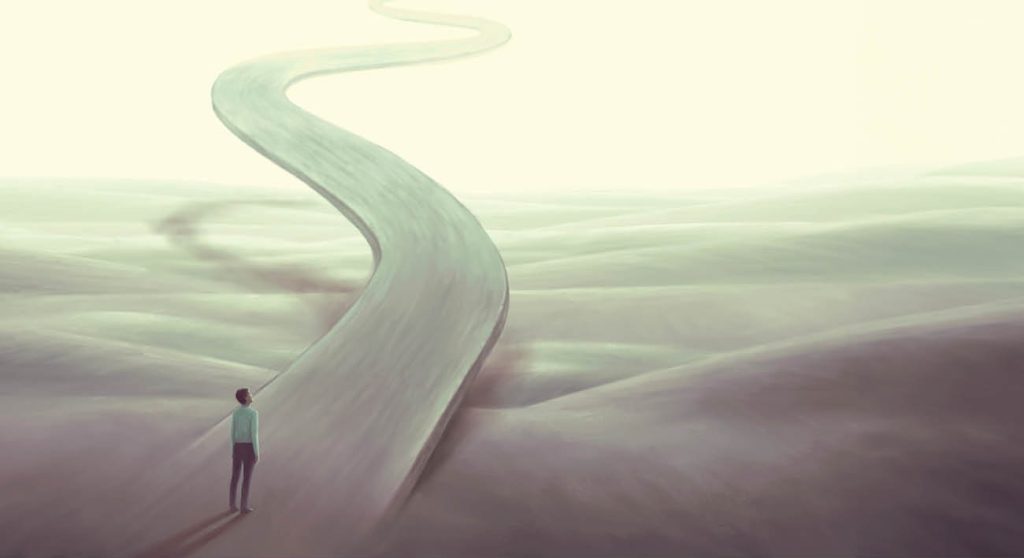
Parenthetically, at this point it’s important to say that one of the reasons that I enumerate all this is in order to emphasize how normal and widespread this is. Numerous baalei teshuva go through this and I think that the few who, after everything, become shaken and drop out at this stage, are those who find it the hardest to accept the disappointment, the pain, the yearning for what was. When you expect to continue sticking solely to the new, pious identity and keep silencing everything you once were because it’s not befitting, it’s likely to burst out in roundabout ways, not always pleasantly. Like with everything, we need to allow some space for our own selves, to offer some gentle strokes.
Return, Release, Move Forward
As time goes on, the parts of our ‘selves’ that were silenced for so long, continue to rear their head with greater force and it’s no longer possible to dismiss. They demand a response. This is the stage where many baalei teshuva start getting back to themselves, to their routines, fields of interest, involvements and relationships that they had completely given up in the first stage.
In truth, the goal of this return backward is really to move forward. It’s like a person who walks into a room and the hem of his garment gets caught in the threshold. If he continues walking, it will tear. There’s no choice but to go back, release it, and keep going. (This can also be said, by the way, for psychological treatment).
Although the goal is to advance, this going back is very likely emotionally complicated, painful in the form of a murky pain which is hard to distinguish whether it’s repulsiveness or intolerable yearning. Going back to places that were once you, when you were a completely different person, is not simple. Some baalei teshuva don’t successfully manage this and they come crashing back to one of the extremes that is familiar to them, but most start the most important and longest stage, the stage of integration, the stage of what to all appearances is a wholesome life.
Integration is needed because, on the one hand, we don’t want to go back all the way; our choice still stands. We chose to be Chassidim and that hasn’t changed. On the other hand, within this choice, we will slowly need to restore parts of ourselves. To go around for the rest of life with an engineered image that I wrapped myself in at a certain stage of my life, is a crime against my personal potential and it is also, simply, not sustainable. A healthy person needs to feel true to himself and not live the life of someone else; it just won’t last. In the end, Chassidus demands that a person know himself, his abilities, and use his unique talents (See the HaYom Yom about a person who bakes bread. As important as that is, if he can work with pearls, then baking bread would be sinful for such a person).
At a certain point, a baal teshuva has to start, sometimes against his will, the work of intricate and complex weaving – to connect the person that he was with the person he will be, removing from the attic memories, desires, hopes and dreams and seeing how they can be incorporated into the new world, with the new perception of self that he built for himself.
Teshuva in Chabad: Ashreinu!
It’s important to remember that in many places we see that the Rebbe encouraged this inner journey. Significant percentages of baalei teshuva were sent back where they came from in order to work there specifically. Often, when they didn’t want to go back, when it was comfortable for them in the new world that they built, the Rebbe sent them there more explicitly. (We see this, for example, with how the Rebbe related to baalei teshuva’s studies in academia. To a great extent, someone who wanted to go back and study, was encouraged by the Rebbe to continue learning in yeshiva, but someone who wanted to remain in yeshiva and forget about what he did until then, was encouraged to go back where he came from).
This is the stage in the world of teshuva outside of Chabad that is sometimes called “teshuva for the teshuva.” It’s the process in which routine wakes us up from the dream of teshuva and we can examine both the process we went through and are still going through, wax nostalgic, mourn, and part from everything that could have been and wasn’t.
I think that the source for the concept of ‘teshuva for the teshuva’ came from worlds where the baalei teshuva klopped al cheit for their approach to teshuva which obliterated everything. I sense that in Chabad it’s not as widespread a concept (or apparently an experience). I’d like to think that this is because the presence of the Rebbe, the presence of mashpiim who bring the Rebbe’s inyanim down to below ten tefachim, makes it more refined, enables a softer landing.
I also believe that the Lubavitcher baal teshuva’s joining a new chevra is smoother. He doesn’t feel as much the subtle (or overt) rebuff which baalei teshuva in other sectors of the frum world feel. Over the years, there are more and more rabbanim and mashpiim who understand the psyches of baalei teshuva, who know how to set limits in the beginning where limits need to be set, and who know how to help preserve the parts of ‘self’ that clearly cannot be erased or released, even if they don’t align with the initial intensity of the Oros of teshuva.
It’s important to say that the fact that the Lights drop off does not negate them whatsoever, it doesn’t change them into some delusion nor does it say that the teshuva process ended there. On the contrary, Oros have a true and powerful lasting existence and they are the engine, the foundation on which the teshuva progresses onward and upward, at least emotionally. But like a baby learning to walk, who at first needs help, at a certain point if you don’t let go, he will never be able to develop on his own. The same goes for teshuva; at a certain point, the Oros recede so we can advance independently and make a dira specifically in tachtonim. Like another saying from the HaYom Yom, of 29 Av, “… it’s loftier when they take you by the hand and lead you [from Above]; more precious when you do it yourself.” From there, a deeper teshuva process begins, one that is more authentic, integrative, more capable of containing paradoxes.
To Summarize
It’s been a number of years already that I’m speaking on this subject and occasionally, I hear voices saying – “Stop with all these titles of baalei teshuva and not baalei teshuva; we are all Chassidim of the Rebbe. Why emphasize that which is different instead of that which is similar?” Well, if it works for you, by all means. What I’ve written is meant for two main groups: those of us who did not experience the teshuva process and might not realize what is going on inside the heart and mind of their baalas teshuva neighbor.
For those of you who identify with what I’ve written and maybe have found comfort, hope, and can relate to the description of your experience by someone else, to its normalization.
If only we all soon merit the Geula manifestation of the Divine Essence which enables the joining of bli gevul (Oros) with gevul (routine), in a way that the advantage of each is fully appreciated. ■
Beis Moshiach #1419 • pp. 44-49
© 2026 Beis Moshiach Magazine. All rights reserved.
This article originally appeared in Beis Moshiach #1419. You are welcome to share it with friends and family by email or in print, provided that you do not change, add to or omit any part of it, you credit the author and Beis Moshiach, and you include a link to archive.bmoshiach.org (written out in full in printed copies).
To republish this article in a newspaper, magazine, book or website, please request permission in advance at [email protected].