Checking The Hostages’ Mezuzos
50 Years After The Ma’alot Massacre
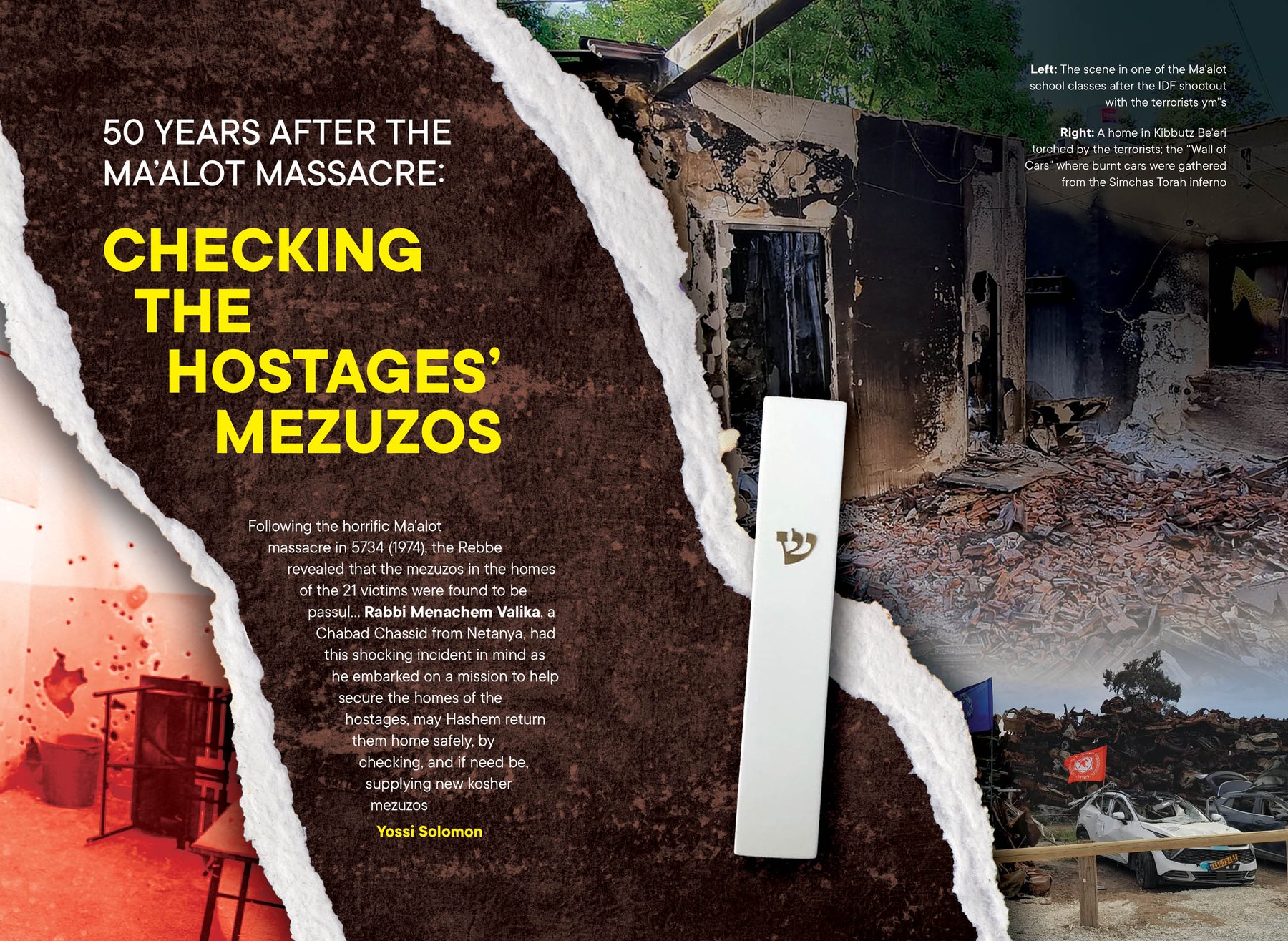
Following the horrific Ma’alot massacre in 5734 (1974), the Rebbe revealed that the mezuzos in the homes of the 21 victims were found to be passul… Rabbi Menachem Valika, a Chabad Chassid from Netanya, had this shocking incident in mind as he embarked on a mission to help secure the homes of the hostages, may Hashem return them home safely, by checking, and if need be, supplying new kosher mezuzos
Jews were horrified the morning of 23 Iyar 5734/1974. A group of students from Tzfas, who were on their annual trip, spent the night in a school in Maalot. Terrorists came to the school and held them hostage, 150 students and ten adults. They demanded the release of twenty imprisoned terrorists.
After hours of tension, Defense Minister Moshe Dayan ordered an operation to extricate the hostages. The results were devastating. Twenty-one students and three adults were killed and another sixty-eight were injured. Among the commandos there was one killed and others injured. The nation was in shock. Pictures of the murdered teenagers and stories of those who were saved made huge waves in Israel and in Jewish communities abroad.
The director of the Chabad House in Tzfas at the time, Rabbi Avrohom Eisenbach, checked the mezuzos at the school which the students attended and they were all pasul. When they counted the number of pasul mezuzos it was the same as the number of those who had been killed. Word of this quickly spread.
On the Shabbos after the massacre, the Rebbe spoke sadly about the pasul mezuzos at the school and the connection between the number of pasul mezuzos and the number of those who were killed. In rare fashion, the Rebbe revealed that “they pushed him” to the mivtza, and everyone understood who pushed the Rebbe to announce this mivtza.
“A yungerman [Rabbi Avrohom Eisenbach] called me from Tzfas and said [while the students were being held hostage] that since the children are not from Maalot but from Tzfas and they were on a trip to Maalot, he was asking for a bracha that they be mentioned at the Tziyun, to mention them in prayer.
“Afterward, he volunteered and said that when checking the mezuzos at their school [in Tzfas] there were 17 mezuzos and they were all pasul, and the number of children killed was 17. The next day, the papers said there were more, 20 killed. This was surprising to me. I asked him to check again regarding the mezuzos in that school and there were another few rooms with four mezuzos, two of which were pasul; the other two were questionable. Here, we openly see that this is by divine providence. In the first announcement, they said 17 children; likewise, they said 17 pasul mezuzos. Afterward, they announced another three; likewise, they announced another three pasul mezuzos.
“I was feverishly involved with Mivtza Mezuza, they pushed me and didn’t allow me to rest from demanding and speaking about mezuza. I myself don’t know why. At the time, I said reasons of shomer delasos Yisrael etc. but why specifically the mitzva of mezuza? There are many mitzvos and every mitzva has a segula, even though we don’t fulfill mitzvos in order to receive a reward but because it is a command of G-d. And now they saw how this entire episode was connected with the mitzva of mezuza.”
The Events In Uganda And Turkey Were Also Connected To Mezuzos
Another heavenly connection was made by the Rebbe following Operation Entebbe. Then too, he made a commotion about mezuzos and said the mezuzos of all the survivors should be checked, “not, G-d forbid, to catch a Jew with a mistake but so that from now on the situation will be as it should, and afterward they will publicize it and surely this will help have an impact on a number of Jews.”
The Rebbe then said that indeed, most of those rescued were lacking in the mitzva of mezuza; either they didn’t have any at all or they weren’t kosher or they weren’t put up properly. “It is a holy obligation and big mitzva for all the hostages who were rescued to publicize the results of the mezuzos of their homes being checked.”
On this occasion, the Rebbe asked that all the soldiers who participated in freeing the hostages from Uganda, should make sure they had kosher mezuzos in their room.
Today, everyone knows that whatever happens with us has a connection to kosher mezuzos, however back then, when the Rebbe announced Mivtza Mezuza, it was a chiddush.
“Following the events that occurred lately in Uganda and Istanbul by terrorists, it is an instruction to intensify security in the physical sense which is connected with intensifying spiritual security which, first and foremost, is the mitzva of mezuza.” The Rebbe said this in a special sicha for “metzuyanei Tzahal” (injured IDF soldiers) in 5736. The Rebbe asked them:
“When you return to the Holy Land, each of you should examine the mezuzos so that they are kosher and put up in such a way that the mitzva is properly fulfilled. I would consider it a great honor if you would accept a gift from me, through my representatives in the Holy Land – when you return, they will visit you with mezuzos and help you check mezuzos and put mezuzos up.”
Nephew Taken Hostage And Held In Gaza
Since the outbreak of the war in Gaza, Rabbi Menachem Valika, from Anash in Netanya took it upon himself to check the mezuzos in the homes of hostages, because of these instructions from the Rebbe fifty years ago.
R’ Valika leads the shul and Beis Medrash that he opened in Netanya after the passing of his mashpia, Rabbi Zalman Notik a’h. He wrote to the Rebbe using the Igros Kodesh and opened to a clear, positive answer about opening the place.
“Since the founding of this Torah center, I see blessings in everything I am involved with. Last Yud-Tes Kislev, we printed 200 copies of the Tanya here, as a zechus for the hostages and l’ilui nishmas those who were murdered,” said R’ Valika.
How did the checking of mezuzos in hostages’ homes begin?
“I’m usually not involved in checking mezuzos. When I get a request, I refer them to Chabad Judaica in the city center or to a sofer whose office isn’t far from us. But some time after the war began, my wife began giving out Shabbos candles to neighbors in our building. One of the neighbors who opened her door, cried when she saw my wife. She said that she’s been crying for days because her nephew is one of the hostages in Gaza.
“I suggested that she give his name and his mother’s name for prayer for his speedy release and that she buy a letter from a Sefer Torah for him. As we spoke, I was reminded about what the Rebbe said about checking mezuzos in the homes of the hostages who were in Entebbe as well as those who were killed in Maalot, and I asked her for the address of her nephew.
“She said the situation was very sensitive and it would be better to refrain from visiting them. I said, on the contrary, it’s an opportunity to hasten his release.
“After we got the consent of the family, I sent my friend, Rabbi Moshe Cohen of Raanana to check the mezuzos of that family. He worked quickly and returned the mezuzos before Shabbos, not before replacing four of them which were pasul.”
How did checking the mezuzos in the home of one hostage lead to checking the mezuzos in the homes of all the hostages?
During the following Shabbos, I thought, there are 240 captives (at that time) and if we get all the shluchim in the country involved, we can check all the mezuzos of all the families of hostages in one day.
On motzoei Shabbos, I called the Mara d’Asra of Nachalat Har Chabad, Rabbi Yitzchok Yehuda Yaroslavsky, and told him what I had been thinking. R’ Yaroslavsky wholeheartedly encouraged the idea and immediately issued a letter in support of the campaign, which added to my sense of the urgency of the matter.
How do you make a project like this work?
From ads that were published at the time, we got the names of the hostages and where they came from and we gave this information to the shluchim so they could go to the families in their area and check the mezuzos. We pointed out that this was in accordance with the Rebbe’s hora’ah.
We saw that a relatively large number of the hostages, about 83, lived in yishuvim in the Gaza Envelope. These kibbutzim don’t have a rav or shliach operating there on a full-time basis.
What did you do?
I knew that Rabbi Yaakov (Kobi) Ben Ari is a shliach who works with kibbutzim around the country and I contacted him. Before I began speaking, he immediately said, “I have no budget.” I told him not to worry since I wasn’t going to hit him with any costs.
“I’m asking you to go to the homes of hostages in the kibbutzim and put up new mezuzos.”
R’ Ben Ari said he would check with the secretary of the kibbutzim about how to do this in a sensitive, proper manner.
A few minutes later he called me back and said that many homes were burned or otherwise destroyed, many of them were in a closed military zone, and nothing could be done. In many other houses the families had temporarily moved to hotels and there was no permission to enter their homes to put up mezuzos.
I suggested that at least we could put up mezuzos on the front doors of hostages’ homes, for which I had the money. He hesitated but finally agreed to take on the project. Perhaps he was concerned about the traumatized evacuees. He got the shliach in the area of Dead Sea hotels involved, Rabbi Shimon Elcharar, and the two of them got to work.
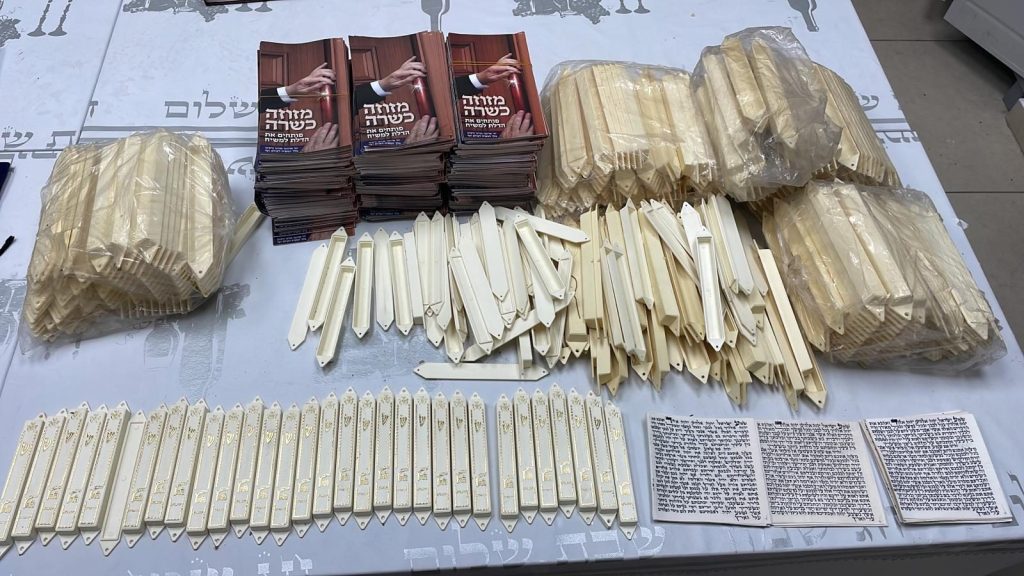
A few days passed and on Thursday of parshas Chayei Sarah, I was supposed to meet him at the Kinus HaShluchim in Eretz Yisrael and bring him all the mezuzos, 83 in all.
After a lot of difficulty, I managed, miraculously, to obtain the entire amount of mezuzos mehudaros within a short time. I also got easy payment terms.
That same evening, I gave the 83 mezuzos to R’ Ben Ari, 83 mezuzos for the homes of hostages and another three mezuzos for each main entrance to the hotels that the families from the Envelope were sent to. I noticed that the word “oz” is numerically equivalent to 83. Oz is strength; the Rebbe often told us that when it comes to shleimus ha’aretz and the safety of Jews, we need to go with strength.
Over the next few days, R’ Ben Ari put up the mezuzos at the hotels and at the homes of hostages.
Waiting For The Other Hostages
At the end of phase one of putting up mezuzos at the homes of hostages in the Gaza Envelope, it was time to get to the homes of hostages in other parts of the country and put up mezuzos.
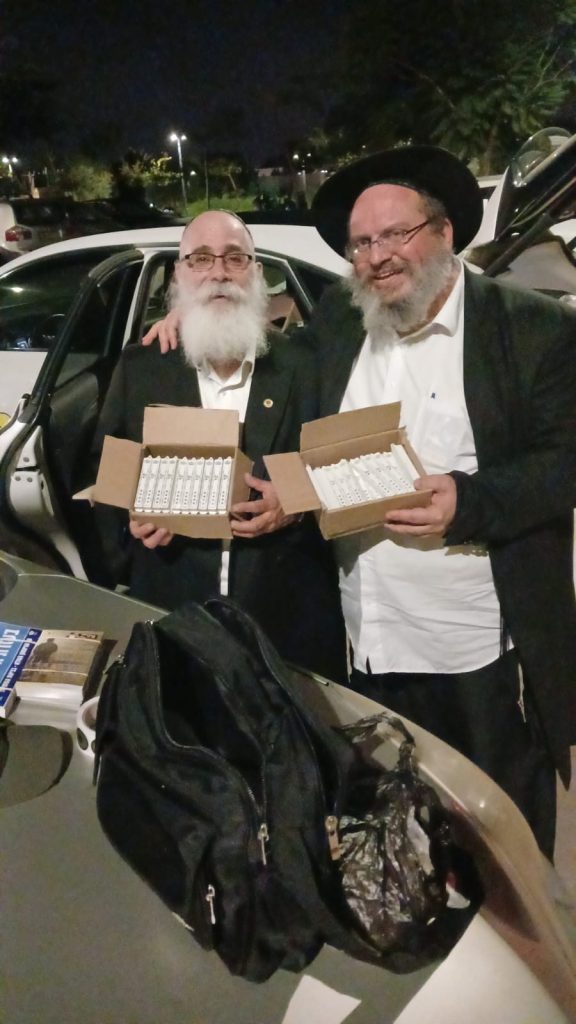
“I got Rabbi Yaakov Pinson, one of the shluchim who is involved with terror victims, involved. I let him know the places where we had already managed to operate and he was extremely impressed by what we had accomplished. I told him that the letter from the Rebbe in the Igros Kodesh had given me a bracha for this work.
Were there hostages whose mezuzos were replaced who were released from captivity?
“Yes. Just one week after we checked mezuzos in the homes of three hostages from yishuv Maaleh Tzivya, near Karmiel, we heard that the hostages who live there were released.
“The first group of hostages who were released under a ceasefire agreement, were from Nir Oz, the first place we got involved with mezuzos. We saw how fixing and replacing mezuzos have an effect in the world.
“As of now, there are still another 130 or so hostages in Gaza and we are continuing to work on this until we see the last of the hostages return home. Their personal Geula will hopefully lead to the general Geula of Am Yisrael.”
RETURN FROM CAPTIVITY
Rabbi Adi Aharonov, shliach in Beer Sheva, relates:
After October 7, many shluchim checked the mezuzos in the homes of hostages. I contacted the father of Noa Argamani; she was one of the women taken hostage at the Nova Festival. I offered to check the mezuzos and he said she also had an apartment that she rented near the university she attended.
When I went to her house, I started taking down mezuzos. When I got to her room, I opened the mezuza holder and there wasn’t even any parchment inside. The family was shaken up.
In the apartment she rented, some of the rooms had no mezuzos and the mezuzos that were there were pasul. The Chabad House of Beer Sheva replaced the mezuzos and boruch Hashem, we celebrated her rescue from captivity.
Beis Moshiach #1420 • pp. 18-23
© 2026 Beis Moshiach Magazine. All rights reserved.
This article originally appeared in Beis Moshiach #1420. You are welcome to share it with friends and family by email or in print, provided that you do not change, add to or omit any part of it, you credit the author and Beis Moshiach, and you include a link to archive.bmoshiach.org (written out in full in printed copies).
To republish this article in a newspaper, magazine, book or website, please request permission in advance at [email protected].