I Don’t Paint Chassidus
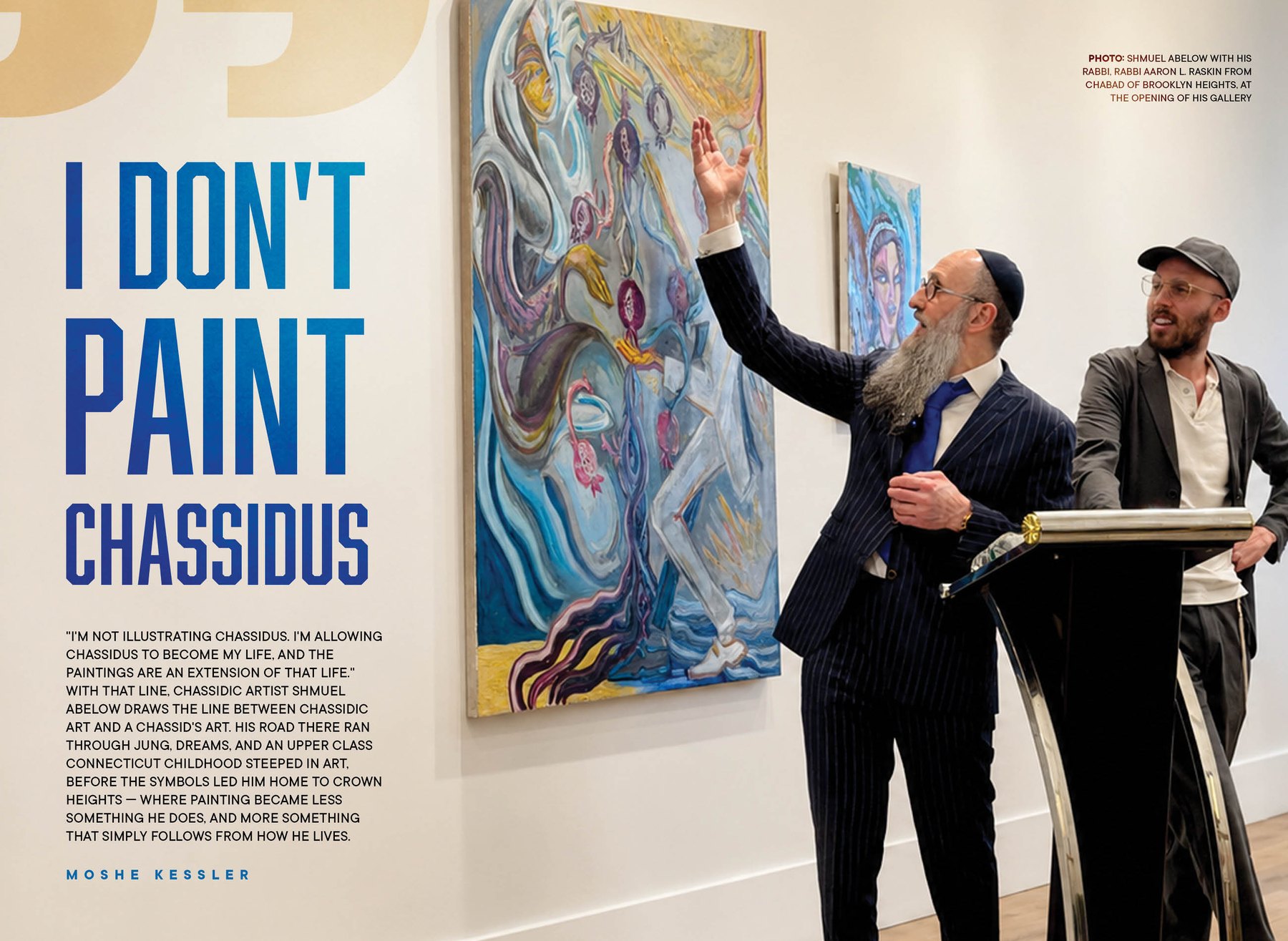
“I’m not illustrating Chassidus. I’m allowing Chassidus to become my life, and the paintings are an extension of that life.” With that line, Chassidic artist Shmuel Abelow draws the line between Chassidic art and a Chassid’s art. His road there ran through Jung, dreams, and an upper class Connecticut childhood steeped in art, before the symbols led him home to Crown Heights – where painting became less something he does, and more something that simply follows from how he lives.
“I’m not illustrating Chassidus. I’m allowing Chassidus to become my life, and the paintings are an extension of that life.”
With this sentence, R’ Shmuel Abelow captures the difference between making “Jewish art” and creating as a Chassid.
His paintings are striking at first glance—rich with color, movement, and feeling. But the deeper interest is not only what appears on the canvas. It is the person behind it: a baal teshuva whose road to Torah passed through the world of art, music, psychology, dreams, and searching, until the symbols and questions that filled his inner life began leading him back to his own people.
Abelow grew up in a secular Jewish environment where creativity was part of the atmosphere. Today, as a Chassid living in Crown Heights, those same kochos are being brought into a new center: Torah, mitzvos, the Rebbe, and the life of Chassidus. The result is not simply art with Jewish content, but the work of someone trying to let a Chassidishe life shape the way he sees and creates.
We sat down with R’ Shmuel Abelow to discuss his journey to Yiddishkeit, the responsibility of a Jewish artist, and how powerful creative energy can become a keili for kedusha.
Tell us a little about yourself and your background.
It’s funny, because people sometimes assume I’m Chabad from birth. I was at a gala recently, and an older Russian art collector came over to me and said, “You live in Crown Heights, right? Your family also lives in Crown Heights?” People see the way I dress now, the way I talk now, the fact that I’m always referencing the Rebbe, and they assume I come from that world.
But no. My family is so secular.
I grew up in Westport, Connecticut, and we knew we were Jewish in the sense It was a Jewishness connected to humor, art, ideas, music, film, and that whole secular creative world—but not really to Torah. Some people did Reform, but mostly it was nothing. Jewishness was there, but it didn’t mean Shabbos, kosher, mitzvos.
Westport is an upper-class town, and it has a very strong Jewish presence. And the world I came from was very connected to the arts. My father was an artist before he became an architect. My grandmother was a painter. My mother was a modern dancer. Around me were people in film, television, music, architecture, design. So being an artist was not weird. It didn’t mean you were lost or irresponsible. That’s what people did. They made things.
And I don’t want to pretend it was all dark or empty. If a young woman at a neo-Chassidic event asks me about my upbringing, I’ll say honestly: it was fun. We were partying, people had beautiful houses, there was a convertible by the beach going to a mansion. The world felt like it was at our fingertips.
But it was also chaotic. There wasn’t a lot of boundary structure in that environment. At the same time, I was given something real. I was given freedom. From when I was young, we were making bands, promoting shows, printing things, booking things, creating an identity and putting it out into the world. Adults around me understood that. They affirmed it.
So later, when I learned Chassidus, I had language for it. It was tohu energy. Powerful. Very powerful. And I don’t want to destroy that. That energy is a gift. But from a young age, I started feeling that it wasn’t leading anywhere on its own. It needed keilim. It needed tikkun.
However it wasn’t like I was looking for Judaism. That’s very important. Judaism was completely veiled from me.
In the world I came from, if someone was spiritually searching, Judaism was the last place he would think to look. You go to India, you go to Buddhism, you go to psychology, you go to art, you go to music. But Judaism? Not really. That was not the association.
For me, the search was happening first through art and music.
In college I studied in the Sonic Arts program at City College. It was music studies, sound production, engineering—a serious program. I don’t emphasize that part of my life now because my focus is painting, but it was important. It was one of the first times I felt what it meant to be rigorous. When something spoke to me, I could apply myself very intensely.
And I was looking. I was reading, painting, listening, thinking. I had this sense that art was not just a career, and not just decoration. It was connected to the inner life. It was a way of finding something in myself.
That is also where the psychologist Jung came in.
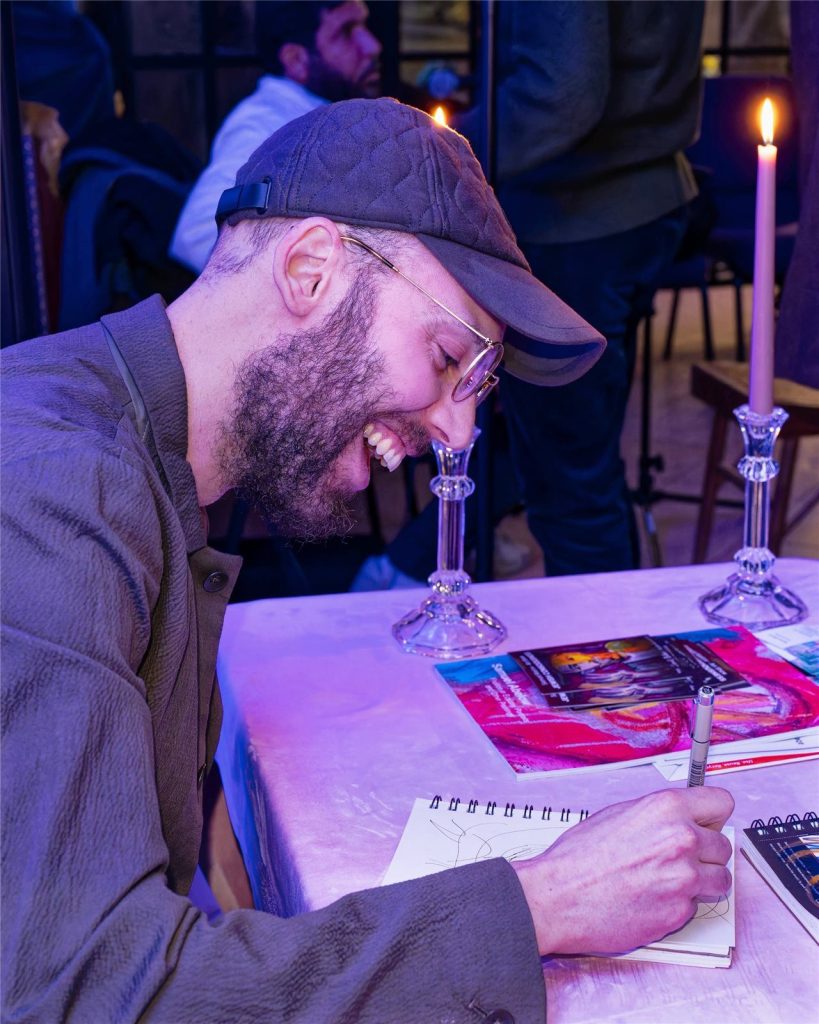
I found Jung in college. I’m owning the Jung thing because it happened, and I don’t know what the Eibishter wants from it. But it did happen. I even have a sketch somewhere of a portrait of Jung with one of his quotes.
Later, my mother could tell I was spiritually searching. She’s a sensitive woman, and she found a Jungian analyst near our house. So I started going to him once a week and analyzing my dreams. I did that seriously for eight or nine years.
For me, Jung was not just, “Oh, here is an interesting psychologist.” It became a serious practice. The dreams, the depths, the archetypes—that whole world became a way of trying to make sense of what was happening inside me.
The basic idea that affected me was that a person is not just random. There is something in the psyche that is trying to make the person more whole. Even if a person feels fragmented, the dream is trying to show him something. It is trying to bring different parts of the person into some kind of relationship.
That mattered to me. I had a lot of creativity, a lot of energy, a lot of freedom. But I was trying to understand what it all meant. Where was it going? What was the shape of it?
So before Chassidus, that was the path: art, music, dreams, analysis, the inner life. It was not yet Torah. It was not yet mitzvos. But it was a real search.
When did that search start connecting to Yiddishkeit?
It happened because the Jewish material started separating itself from everything else.
At first, there were Jewish symbols and Kabbalistic themes around me, but they were mixed together with all kinds of non-Jewish sources. Avoda zara, New Age books, random esoteric material. The non-Jews also took our Kabbalah, so for me it was all confused. I did not yet know how to differentiate.
But then certain things started to hit differently.
Someone once said to me, “My husband is a Sephardi Jew.” I didn’t even know what that meant. I said, “What’s a Sephardi?” I couldn’t spell it.
So I looked it up, and I saw an image of the Rambam. Something about it struck me. I thought he looked like my grandfather on my father’s side. I didn’t know anything.I thought Maybe there was something there.
So I made a painting called Self-Portrait Imagined as Maimonides. It was a real painting, and I exhibited it. But while I was painting it, I also started asking, who is this Rambam? What is this world?
At the same time, I was encountering Kabbalah through Jung and through writers like Gershom Scholem. It was still mixed up. It was not clear yet. But my dreams, my psyche, my whole inner life began responding very strongly to the Jewish material.
At a certain point, even my analyst could not fully follow me there. He was trying to read Gershom Scholem and catch up, but the Jewish piece was becoming too central.
That was the discovery. Not just, “I am Jewish” in the cultural sense. I knew that already. But that my soul was responding to this. The art, the dreams, the symbols, the searching—it was all beginning to point back toward my own people.
Once it became real to you, how did that turn into actually keeping mitzvos?
That is an important question, because a lot of people get interested in Kabbalah or Jewish mysticism and it does not necessarily lead them to mitzvos.
For me, it did.
Part of it was that I already understood, from the work I had been doing, that spirituality cannot just be floating around. A person has to get down into this world. You cannot just become more and more spiritual until you are flying somewhere. That is not the purpose of a human being.
So when I started encountering mitzvos, they made sense to me. If you tell me the body needs a certain kind of food, that there is a way to eat, a way to mark time, a way to put on tefillin, a way to live with Shabbos—that was coherent to me. It was not just an abstract idea. It was spirituality entering the body, entering time, entering ordinary life.
And very quickly I saw that I was encountering something much larger than myself. At first, maybe there was a brief period where I thought, “This is my tradition, this is connected to my soul, this will be good for me.” But it did not stay on that level. Very quickly I felt that if I was being honest and earnest, this was something I had to move toward.
Soon I found Chabad.org, and I started watching Rabbi Raskin’s classes there. I liked him right away. Part of it, honestly, was that I have a certain feeling for someone who wears nice suits and can speak nicely. But it was more than that.
I watched a Rambam class and saw he had halacha. Then I watched him speak about Kabbalah and Chassidus, and he had that too. I felt, here is someone who can stretch up high and reach down low. He was integrated.
So I emailed him. And that night, at eleven o’clock, he got on the phone with me. Soon I was at his house for Shabbos and Shavuos—my first Shavuos. I got a bar mitzva. I announced it to everybody there. And boom, boom, boom, he took me in like a son.
I really think that warmth is why I kept growing.
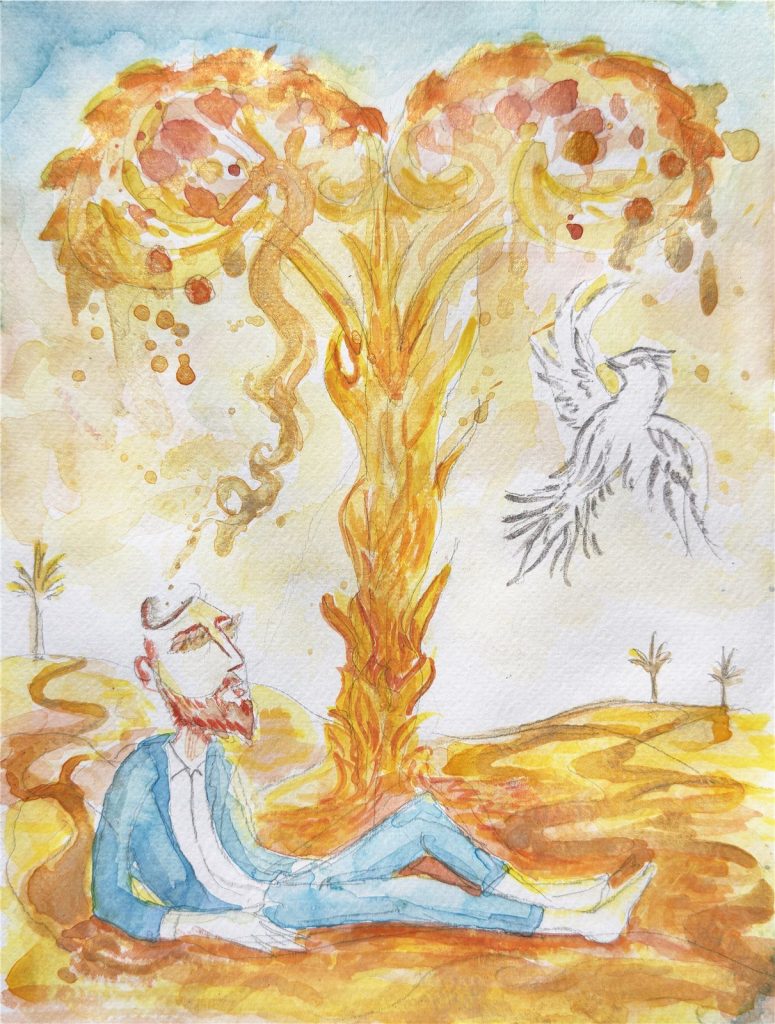
Once I started, it was very fast. I didn’t know Shabbos, kosher, tefillin—and then, in weeks, whatever I could understand and actually do, I did. It was not a slow progression for me. It was more like a light switch.
I was keeping Shabbos to the best of my ability. I was putting on tefillin. I was davening as much as I could. I was taking on boundaries in my life. It was hard and rocky in the beginning, but I wanted it very badly.
I think I also saw the beauty of the structure. Torah tells you to love Hashem and enjoy Shabbos, but there are also the “don’t do’s.” And I saw that the “don’t do’s” were very beautiful. I could see intuitively that the structure was going to be healthy for me. I needed it.
Rabbi Raskin wanted me to go to yeshiva. He could tell that if I was going to commit to this long-term, I needed to sit and learn properly. I was already older, and it was during the pandemic, so it took me some time. But when Tishrei came, I felt I had to be somewhere. I came to Crown Heights, went to Hadar HaTorah, and from doing a Tishrei in Crown Heights, I fell in love more deeply with it.
At a certain point, if you are being honest, you see what has to happen. For me, that was yeshiva.
How did becoming a Chassid change your art?
Right away, when I got into Torah, I saw that Torah would tell an artist to hold back from painting certain things. That itself was a big shift. That was not what I had been taught.
Before that, I was painting Greek myths, archetypes, stories like that. The Jungians love Greek myths, and I was very involved in that world. But then I started moving away from that and toward Tanach, Kabbalah, and eventually Chassidus.
But I don’t want to say that becoming a Chassidic artist means you just illustrate Chassidic ideas. That’s not really what I’m doing.
If someone paints the Rebbe, or illustrates a passuk, or makes a picture of something from Tanya, that can be beautiful and useful. I’m not knocking it. But that is not necessarily the same thing as art in the deeper sense. That can be illustration.
For me, the question is: what does it mean to be a Chassidic artist when you are not only illustrating the Rebbe? What does it mean when your soul is Chassidic, and the painting comes from that?
I think the answer is that I’m not trying to paint something I learned, like a page of Tanya. I’m trying to live something and let it come through. If I’m a Chassid of the Rebbe, and I daven, and I learn Chassidus, and I go to mikva, and I experience Tishrei, and I dance at Simchas Beis HaShoeivah, then the paintings become an extension of that living.
It’s not that I sit down and say, “Now I’m going to illustrate ratzo v’shov.” But if ratzo v’shov is part of how I understand life, then it may come through. If chochma is bittul, and the yud is bittul, and the head becomes like an empty cup filled with golden light, that image can become part of a painting. If malchus, or the feminine, or the desire to be in the world is something I’m really living with, then that also comes through.
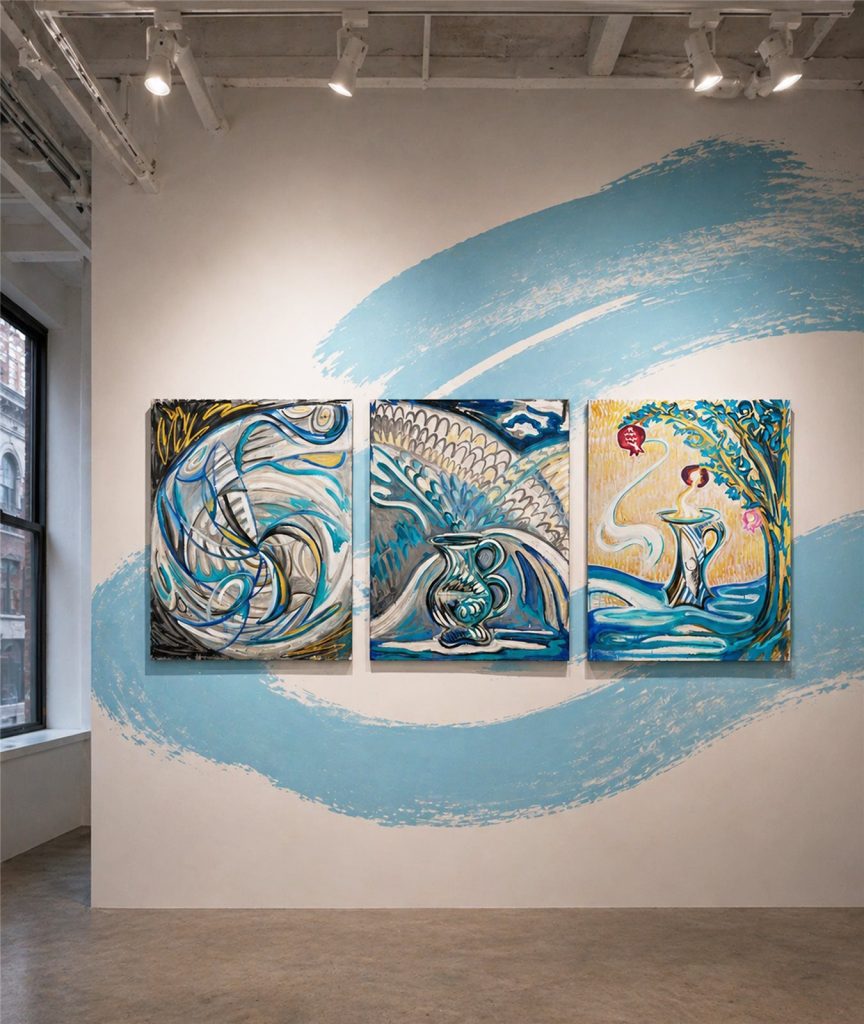
So I’m not illustrating Chassidus. I’m allowing Chassidus to become my life, and the paintings are an extension of that life.
A great artist is an explorer of consciousness. He is trying to be honest about what he is really seeing and feeling inside. So a great Chassidic artist has to do that honestly—but while living a Chassidic life. That is the difference.
The painting is not just a Jewish object placed on a canvas. It is coming from a person whose inner world is being shaped by Torah, mitzvos, the Rebbe, and Chassidus.
What can that kind of art give to a Chassidic community?
I think it can create a space for hisbonenus.
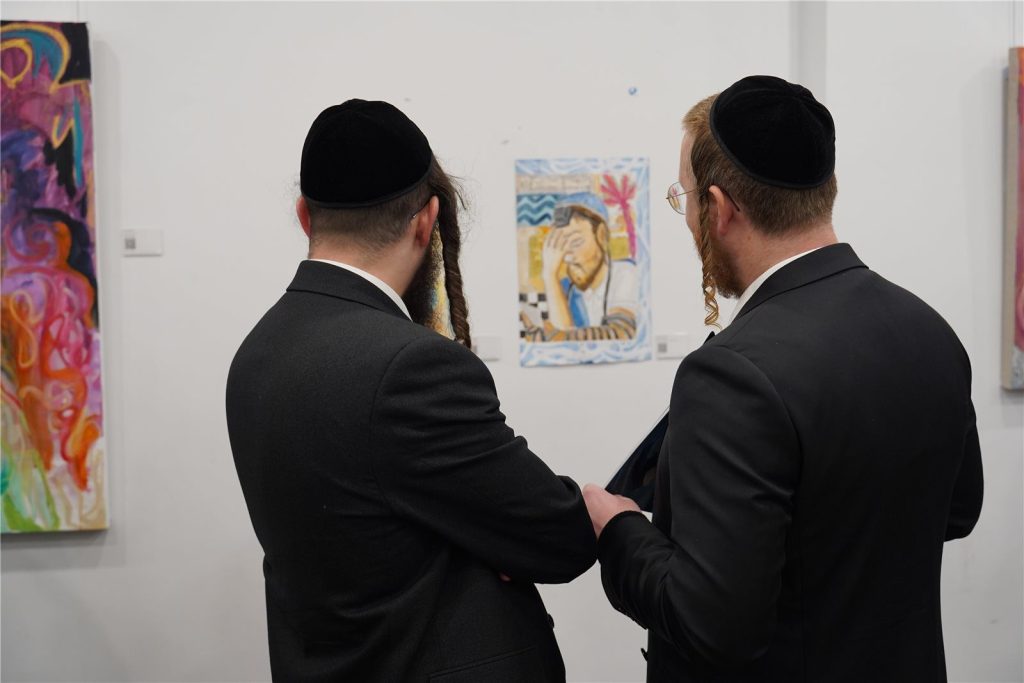
At the gallery, people are not only looking at paintings. They start talking about themselves, about their neshamos, about Torah, about what they learned, about what they are living with.
I saw that very clearly at the show with Rabbi Raskin at Chaya Eliyav’s gallery. The whole thing happened in a very Chabad way. I walked into a grocery store, and Chaya said to me, “Shmuel, when are you going to do a show at my gallery?” I said, “Okay, let’s do it.” Then there were all the practical details, the budget, the sponsor, the flyer, the hanging of the art—the whole thing.
But once the show happened, I saw people integrating around the art.
Someone who did not come from a strong Torah background was standing there asking, “Where are the sefiros in this painting?” Then he is doing a guided meditation with a rav on one of the Hebrew letters and its meaning, and he is moved by it. That is something.
Then there are seminary girls, or frum women, who know Chassidus, but they don’t always have a place where they can speak about it in that way. Suddenly they are standing in front of a painting and saying, “I learned a maamar of the Rebbe on this topic,” or, “Did you ever think of this?” The painting gives them a way into the conversation.
That is very important to me.
The gallery can also become a place where different kinds of Jews meet each other in a more inward way. A Chabad person, a secular Jew, a Williamsburg guy with peyos, a woman with a tattoo, a seminary girl—people who might not normally have that conversation. But around the art, something opens.
We are not just talking about paint. We are talking about our souls. We are talking about who we are. We are talking about our story.
That is what I mean when I say art can become a kind of communal hisbonenus. It takes something a person has been thinking about or living with, translates it into color, form, and mystery, and then lets people gather around it and be moved together.
The feminine seems to appear often in your work—Sarah, Rivka, Rachel, Malchus, even symbolic forms like a vessel or a vase. Why is that so central for you?
I think the feminine is very central, but I don’t mean that in a shallow way. It has to do with the way I understand this generation, and the way I understand Chassidus entering life.
People today want something very real. They want to be seen. They want real relationships. They want emotional honesty. They want their work to mean something. They want their homes to mean something. They don’t only want abstract ideas. They want the idea to enter their actual life. To me, that is connected to the feminine. It is connected to malchus. It is connected to embodiment—to the place where something becomes lived.
When I paint Rochel, or Rivka, or Sarah, I’m not trying to make a nice Jewish image. I’m trying to touch something that is already there in the soul of the Jewish people. There is longing there. There is pain there. There is dignity there. There is hidden power.
I have seen this very clearly with frum women who come to the paintings. Sometimes it is a painting of one of the Imahos, and sometimes it is even a vase, or some form that carries a feminine presence. They understand it right away. They feel seen. They feel acknowledged. Sometimes they are moved in a very deep way, because the painting reminds them that what they are doing, and who they are, has a spiritual purpose.
That means a lot to me.
At the same time, I don’t think honoring the feminine means everything becomes soft and without structure. It is the opposite. If you want the feminine to be revealed in a holy way, you need strong structure. You need boundaries. You need stability. You need a real masculine side also—not in a crude way, but in the sense of being dependable, giving form, creating safety.
Without that, the feminine does not really get honored. It just becomes chaos.
So for me, the feminine is not a side topic. It is part of the whole question of tohu and tikkun. There is tremendous feeling, tremendous life, tremendous longing. The question is: can it enter a vessel? Can it become dignified? Can it become holy? Can it become part of a life of Torah and mitzvos?
That is a lot of what I am trying to paint.
You speak about art as something that opens people up. But isn’t there also a danger in that?
Yes. There is a danger.
If art is real, it is not always calming. It is not always decorative. Sometimes it disturbs you. And I don’t mean that in a negative way. I mean it disturbs your equilibrium. It touches something that you may not have wanted to touch. Some of my earlier paintings, especially around the time I was doing teshuva, have that disturbing quality. I was trying to be honest about what I saw in the world, and what I felt in the world, and to bring that into images from Tanach.
Take Rochel, for example. When I paint Rochel weeping, I’m not just making a nice picture of a Jewish mother. I’m taking experiences of pain, things I felt and saw in the lives of the daughters of Israel, and I’m putting that into the form of Rochel. There is longing there. There is exile there. There is the pain of the Shechina there.
And we have to be honest: isn’t Tisha B’Av disturbing? Isn’t galus disturbing? Isn’t the exile of the Shechina disturbing? So if a painting touches that, it may also be disturbing.
But that is exactly why art has to be handled with responsibility.
I understand why religious people can be suspicious of art. Art can open a can of worms. It can open parts of the person that are not simple. Pain, desire, longing, confusion, imagination—these are powerful things. You can’t just say, “I’m an artist, so everything I express is holy.” That is not true.
A person has to have keilim.
In psychology also, if someone wants to go very deep, a serious analyst may say, “You’re not ready for that.” Not everyone can handle opening everything at once. Artists can become unstable. People can get lost in what they uncover.
So yes, there is voltage there. And I think I can handle a lot of voltage because I did a lot of inner work. I had the privilege to do that. I have strong capacitors, so to speak. I can go into difficult places and still keep my feet on the ground. But I don’t think that gives an artist permission to be reckless.
For me, the mitzvos are higher than the art. That is very important. I don’t want to do anything that would take me away from my real purpose. So there is an editorial process. I ask. I check with a rav. I’m not just fully doing whatever I want.
Being an artist means you are exploring consciousness, but it does not mean you have no boundaries. It does not mean you can use danger as an excuse. The whole point is the opposite: to take something powerful and give it a vessel.
That is the same question again—tohu and tikkun. Can you touch real energy without being destroyed by it? Can you reveal something painful without making it chaotic? Can the painting disturb a person, but in a way that leads him deeper into truth, not away from it?
That is the responsibility.
What would you tell a young Jewish artist who thinks he has talent? Where should he start?
Honestly? Talk to other artists.
And if they are older than you, listen to them. Really listen. Chabad is amazing, but if you come from a background where you were not exposed to art, then you have to learn. You have to read. You have to go look at art. You have to speak to people who actually understand the language.
If a baal teshuva comes into the community, you tell him, “Okay, you have to learn Kitzur Shulchan Aruch. You have to learn the basics.” Art also has basics. It has a history. It has a language. It has different forms. You can’t just say, “I’m talented,” and then expect to be taken seriously.
I would also tell him to think carefully about what he actually wants. Maybe you want graphic design. Maybe you want illustration. Maybe you want to draw cartoons. Maybe you want classical drawing, where someone can say, “This is technically good.” All of that is fine. There is nothing wrong with it. But it is not all the same thing.
Art, in the deeper sense, is something else. It asks more from you. It may not even be what every talented person should do.
I don’t know that everyone has to take on what I had to take on. I became an artist because I was brought up in a particular family, in a particular world, with certain connections, certain exposures, certain inner questions. I have to deal with that. Maybe someone else does not.
But if you do want to paint, then really look at color. Not just, “This is blue, this is red.” Sit with color. Look at it. Feel it. Get embodied and present to it. If you are painting, ultimately you are looking at color on a canvas. There is Elokus in that too.
So my advice is: don’t be shallow about it. Don’t reduce art to “I can draw well,” or “I can make a nice Jewish image.” Learn the medium. Learn the history. Speak to artists. Ask yourself what you are really after. And then, if you are going to do it, do it with seriousness, with humility, and with yiras shamayim.
You also work in video and social media. How do you think about that world?
Look, people like to say social media is a waste of time, and a lot of it is. I’m not going to argue with that.
But you also have to ask: why is it so powerful? Why are people looking at images all day? Why does a short video affect people?
We are a textual people. Yidden are connected to sefarim, to words, to learning. But the human psyche is also very imagistic. A child understands images before he understands complicated language. Dreams usually come in images. If a person sees something, even for a second, it can make an impression.
So when you have a technology that produces images constantly, that is powerful. The question is not whether it is powerful. The question is what you are doing with that power. With Rabbi Raskin, it is simple. He is devoted to shlichus. If he has an idea from the Rebbe, or an idea in Torah, and by putting it into a short video it can reach many more people, then why wouldn’t you use that? It is a way of spreading something.
But the main thing is that there has to be real value. People ask me sometimes, “What is the secret? How did this get so many views?” The secret is that the person actually has something to offer. Rabbi Raskin has been learning, teaching, speaking, and doing shlichus for decades. My father has been practicing architecture for forty years. When they speak, there is something there. Social media can package that. It can carry it. It can help it travel. But it cannot create depth where there is no depth.
If a person does not have something real to say, then he starts relying on tricks. Hacks. Trends. What will get attention? What will make people react? And that is where it becomes dangerous, because then the tool starts shaping the person. You go in not knowing exactly who you are, and you come out knowing even less.
So I don’t think everyone needs to be posting. Sometimes people come to me and ask about social media, and the real question is: will this move the needle? Will it help your shlichus, your business, your community, your message? If yes, then good. If not, then why are you doing it?
And even when it is useful, you need restraint.If I wake up in the morning and the first thing I do is start scrolling, that is not good. I need to say Modeh Ani. I need to daven. I need to learn something. I need to eat breakfast. I need to enter the day like a person, not like someone being pulled by a machine.
For me, video and social media are part of my parnassa, and they are also creative tools. I like video. I like technology. I like helping an idea come into a form people can receive. But it has to stay a medium. It cannot become the identity.
That is really the same point again. There is a lot of energy here. A lot of power. The question is whether it has keilim.
Beis Moshiach #1515 • pp. 12-22
© 2026 Beis Moshiach Magazine. All rights reserved.
This article originally appeared in Beis Moshiach #1515. You are welcome to share it with friends and family by email or in print, provided that you do not change, add to or omit any part of it, you credit the author and Beis Moshiach, and you include a link to archive.bmoshiach.org (written out in full in printed copies).
To republish this article in a newspaper, magazine, book or website, please request permission in advance at [email protected].