Spices and Secrets — Chapter 14
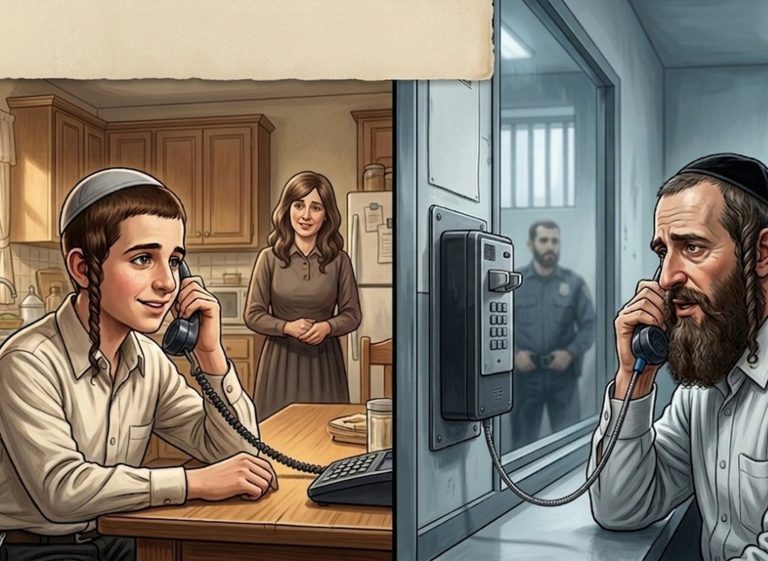
Recap: Zecharya calls Meir the police detective and asks him to interrogate the three Arabs who poisoned the peppers in his father’s vegetable patch. This is just what Meir does when he gets to the prison.
The three Arabs were astonished.
“Have you come to free us?!” they asked.
Meir looked at them for a few seconds and then burst out in laughter that could be heard throughout the prison wing.
“Free you?! The only place you’ll go from here is to solitary.”
The Arabs faces went from surprised to frightened.
“Then why are you taking us out of the cell? Did something happen?” the larger one among them dared to ask.
“No talking,” said the warden sternly. “Follow me; no nonsense,” he warned.
The three criminals began following the warden while Meir walked behind them, watching every move they made. After they crossed the entire hall, the warden took them down to the bottom floor, under the wing which contained the cells.
“Here,” announced the warden and he opened a side door. Before they realized where they were, they found themselves inside, landing heavily on hard wooden chairs. They looked around suspiciously.
The room was different than the other cells. It had a desk, a board covered in pushpins with a few notes scribbled on it in illegible handwriting, a large swivel chair and hidden recording devices everywhere, ready to record every syllable uttered during the interrogation.
“Welcome to our interrogation room,” said Meir in mock gaiety and he strode in and made sure to check that the door was locked. He stood behind the Arabs and pressed their arms on the seat of the chair.
“Ow,” moaned the thinnest one.
“I understand this is the first time you are here.”
The three Arabs nodded. They were new at this and had never been in the infamous interrogation room. The wardens, on the other hand, praised it since this is where important information was extracted from dangerous prisoners, thus preventing future attacks.
Meir sat down in the swivel chair and looked at the eyes of the three tense looking men. He knew that he needed an extra measure of siyata d’shmaya in order to get the whole story out of them. If they decided not to talk, that could be a problem.
The room was dark aside from a weak light that was aimed at their faces so they saw nothing. The light blinded them so that Meir could scrutinize their expressions.
“Let’s get straight to the point,” said Meir matter-of-factly. “I am not the usual interrogator here. I came for a specific reason. If you cooperate, wonderful.”
The three Arabs breathed easier. Many stories were told about the prison’s tough interrogator; they were chilling stories. They were nervous about this interrogation since their friends had warned them to beware of the interrogators.
Now, when Meir told them, between the lines, that he wasn’t the tough interrogator, they couldn’t help but look relieved.
Meir immediately noticed this; after all, it was his job as interrogator to notice the little details. His eyes narrowed. No! He wouldn’t let them relax.
“Although I am not the interrogator here, he’s like child’s play compared to me. If you don’t cooperate, you will beg for him to be the interrogator and not me …”
The faces of the three Arabs instantly changed to terror. They were new to the world of crime and were not familiar with the tricks that interrogators and jailers used. They didn’t know that Meir wasn’t really as tough as he made himself out to be.
“Of course we will cooperate,” the tall one was quick to say. “So… what do you want from us?”
Meir stood up, looking at them coldly without blinking.
“I need you to explain everything to me, from A-Z. What’s your story with old Tzadok?”
The Arabs were surprised.
“Uh, who is Tzadok?” stammered the short one. “What are you talking about?”
Meir was ready for this scenario.
“You’re sure you don’t know who Tzadok is?”
The man nodded and swallowed quietly.
“I see,” said Meir in icy silence and he pressed on a small red button under the desk.
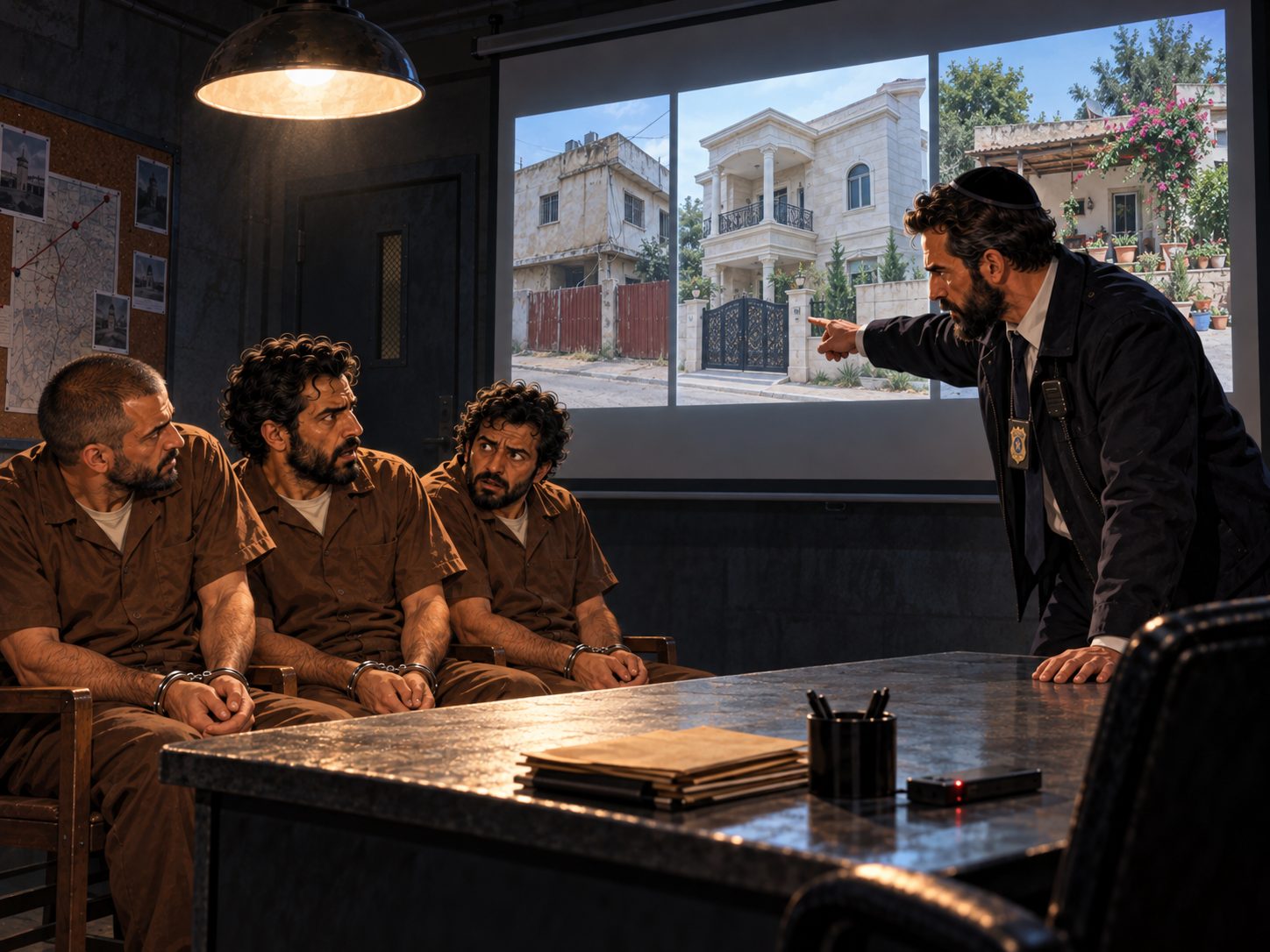
A large screen suddenly came down behind him, displaying a picture of some building.
“Hey, that’s my house!” said one of the Arabs in surprise. The picture was of a dilapidated two-story building surrounded by a fence made out of red boards.
Meir pressed on the remote and the picture changed. The next slide showed another house.
“Hey, that’s my house,” said another Arab. The picture showed a relatively new house that looked expensive, covered in marble tiles of various colors, with tall, carved pillars which held up the roof of the huge porch.
A moment later there was a third picture.
“You’ve figured out that this is my house,” mumbled the third Arab. He looked at his house, a simple village house with a garden full of flower pots and climbing plants, his wife’s hobby.
Meir shut the projector and it was dark again.
“It’s like this,” he began, sounding tougher than before, “you three had an innocent person incriminated. I’m asking you for the final time, why did you do this and what is your connection with him? If I don’t get answers from you, I’ll get the information out of you in any way I see fit and I intend on starting with your homes. You know that your homes were built without permits. Within an hour I’ll issue a demolition order. Oy vavoy,” wailed Meir in a mocking tone, “where will your wives and children go? What will they do while you are behind bars and can’t help them?”
“What are you going to accuse us of?” asked one of the Arabs.
Meir stood up and calmly said, “You really want to know? Let me refresh your memory so you won’t have to exert yourselves. First, you incriminated an innocent man. Because of the poisoning you perpetrated, Tzadok sat in jail for no crime that he committed.
“Second, you poisoned over a hundred people who needed to be hospitalized and whose lives were in danger. This is called a mass casualty attack which will, of course, be taken into consideration in your sentencing. Even if you are released after many years behind bars, you will need to pay reparations to the tune of hundreds of thousands of shekels to each family you hurt.
“Would you like additional accusations. Please, just ask… Another crime you committed is that you tried fleeing from the police ambush and obstructed an investigation.
“In addition to all that, here we come to the cherry on top, you threatened two children and are even suspected of an attempt to kidnap them, a crime whose sentence is at least twenty years in prison.” Meir could be heard mumbling, “Sounds reasonable to me.”
“So here’s my suggestion and I won’t repeat it. I can incriminate you for all these crimes or you can cooperate with me and in exchange, I will treat you leniently.”
The Arabs looked at one another. They felt trapped.
To be continued
Beis Moshiach #1529 • כ״ו חשון תשפ״ז • pp. 60-62
© 2026 Beis Moshiach Magazine. All rights reserved.
This article originally appeared in Beis Moshiach #1529. You are welcome to share it with friends and family by email or in print, provided that you do not change, add to or omit any part of it, you credit the author and Beis Moshiach, and you include a link to archive.bmoshiach.org (written out in full in printed copies).
To republish this article in a newspaper, magazine, book or website, please request permission in advance at [email protected].