From Kingston Avenue to Kingston Pennsylvania
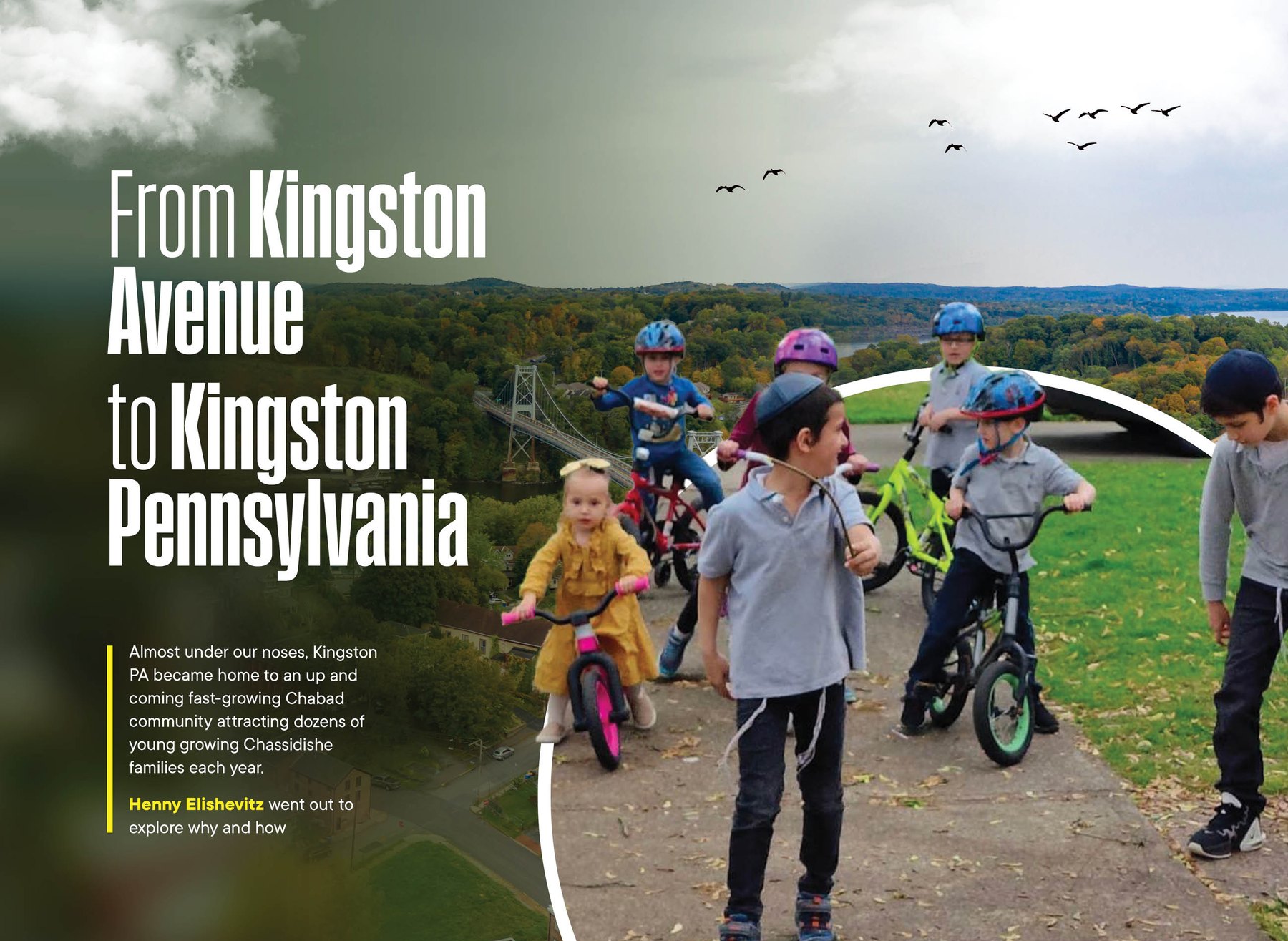
Almost under our noses, Kingston PA became home to an up and coming fast-growing Chabad community attracting dozens of young growing Chassidishe families each year. Henny Elishevitz went out to explore why and how
The new school year begins. Quite a few children find themselves facing a completely new beginning. Some of them have grown up and moved through a system, from staying at home with their mother they move to a daycare center or nursery school, from kindergarten they move to a school or a cheder, then they move to yeshiva or to a secondary school, etc. Then there are those who are starting fresh, not as a natural step in their progress or due to choice, but as the result of an outside factor.
Among the latter are quite a few children who started the school year in Kingston’s educational institutions. That’s right, this is not about Crown Heights but Kingston, the quiet and somewhat sleepy town in the state of Pennsylvania.
Get To Know Kingston
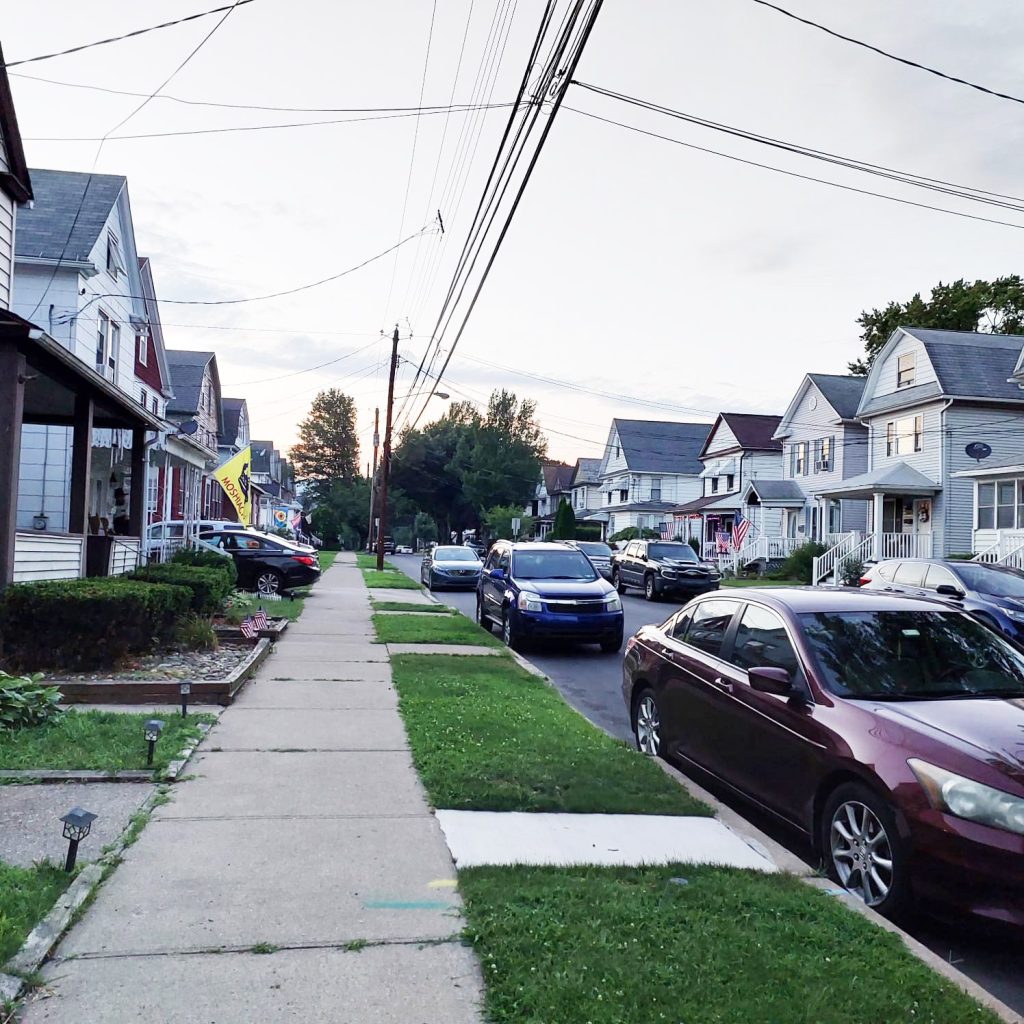
The town of Kingston is in the state of Pennsylvania, about three hours away from 770 (to the northwest). It was established by settlers about three hundred years ago, with most of the houses that exist there today (wooden construction) built 100 or more years ago, which have only undergone partial renovations since. Generally, these are one-or two-story houses designed for a single family or divided into two apartments, with each house surrounded by a small or large yard where most residents grow grass, flowers, vegetables and even trees. Many of the streets are also shaded by many trees.
Traffic in the city is not busy most of the day, and if in any case someone honks at you or tries to overtake you, they are probably new here… In fact, the whole look is reminiscent of a pleasant village. The population is mostly white (about 96% percent of the residents according to the last population census about three years ago). People are welcoming and there is relatively little street life of any kind.
When I walked the streets of the town, the people who came toward me (mostly gentiles, taking the dog for a walk…) always said “Hi” with a smile. At first I thought it might be a mistaken identification, but when the phenomenon repeated itself again and again I realized that these are the people who live here – people with good manners and a smile.

The three-hour drive from 770 to Kingston is not too daunting in US terms, but it was very symbolic for me – the beginning of the road goes through the crowded, dirty and busy streets of Manhattan’s high-rise buildings that completely block the field of vision, goes through a tunnel – and goes out to a road surrounded by wooded mountains and a beautiful landscape. At the end of your trip, a very clean town awaits you with private, bright houses, a quiet place that “breathes” nature and relaxation, a place that any mother would be happy to raise her children.
A Growing Community
Until about 15 years ago, the Chabad community in Kingston had barely a minyan of families, before Covid there were around two minyanim of Anash here, and today the opinions are divided – among the women I asked – whether it is about 200 or 300 Chabad families, when every week more and more ‘new faces’ are being added to the place and it’s already hard to get to know them all. The families come from different regions of the USA, with most families consisting of relatively young couples with small children, but certainly not only!
In the 5784 school year in Kingston, the boys and girls of elementary school age were in two different buildings (instead of two floors of the same building as in 5783) due to the large increase in the number of students, boruch Hashem. For the same reason, throughout the entire vacation, the hanhala was still looking for teachers for some of the ‘new’ classes, and not everyone can be accepted as a teacher. And at the preschool age (up to the age of two) to begin with, the daycare center was only for the teachers’ children, so if you want your little one to attend, you are invited to join the high-quality and dedicated staff, and teach at least part time.
Staff Investment
The hanhala invests a lot in the staff – and let’s start with something that is not obvious in a newly opened private school. The teachers here tell me that their salaries have always been paid on time, from the first moment the school was established! This is possible because the hanhala appreciates the staff’s work and makes every effort to obtain the required money (apart from parents’ tuition payments, which are certainly not enough). We are talking about various scholarships, government funds and also the help of an annual campaign, all so that lack of money will not be an obstacle to doing everything that is needed. That includes both a special budget the teachers are given to invest in class events at special times, and bonuses for the teachers themselves for the holidays to help with family expenses.
But even in the amount of staff there is a conscious investment, factoring in the necessary workload. For next year, it is planned that there will already be an assistant principal, more personnel to assist, another secretary… In new schools, usually an almost impossible load falls on the hanhala and the teachers because there are so few people and so much work. And here, a lot of thought goes into how to provide support and assistance to the staff.
One of the well-known problems in schools is the problem of substitutes. A teacher is missing and you need to find someone to take her place in the classroom. In Kingston, they implement an interesting idea that also brings out the warm community bond between the families:
At the beginning of the month, a monthly schedule is published and anyone who is willing and able slots herself in on the day she can come to fill a place if it is required. Those who sign up know that this day is reserved for the schools – and we are talking about mothers who work from home or those who, for their own reasons, prefer not to work, but gladly come to act as substitutes.
In 5783, there was also a teacher who preferred to become a permanent substitute – she actually came almost every day… although she did not have the responsibility of managing a class, contacting parents, preparing lessons and plans, etc. And the ambition here is that next year there will be two permanent subs as full time positions.
For girls, a high school has already been established, and post-elementary programs for boys that include a mesivta and a beis medrash and more is in the works.
A Warm And Chassidish Education
What stands out about the schools in Kingston – this is what mothers here told me with a lot of appreciation and respect – is the quality of the education, the personal attention given to each and every student, the warmth of all the teachers and the encouragement of the children to love Torah and mitzvos and to go b’darchei ha’Chassidus.
One mother explained to me: “In the schools there are clear regulations on the issues of Chassidishkeit and Yiddishkeit, and they are implemented in a ‘right hand draws near’ approach, and from an attitude that makes the children connect, love and want to be ‘better’, and feel a desire to draw closer to Hashem.”
One of the new students, when she tried to explain the difference between her previous school and the school in Kingston, used the following illustration: “There they made sure that the walls were white, and here they make sure that the classrooms bloom like gardens.”
However, not every student will be admitted to the school. The administration, which invests a lot in the well-being of the students, examines each case individually, and in the case where it’s just not a match, they will explain to the parents that it would be better for them to find another school (in the nearby town of Scranton, a 20-minute drive away, there is an ultra-Orthodox concentration – most of them not Chabad – and there are two schools there, one regular and one more adapted to special education).
In recent years, as mentioned, the town and the schools have experienced a very rapid growth of Lubavitcher families. While nine years ago the school had a small number of multi-age classes, up to a certain age boys and girls together and the location of the school was in the basement – today, although there are still classes of fewer than ten girls, there are also parallel classes in some of the grades.
A teacher on the staff explained to me: “As a result of the small classes, as well as the educational principle of education based on a personal relationship – the teachers do provide a really personal relationship to each and every child. Aware of the difficulties, gaps, they (mainly the teachers) guide step by step and really lead the students hand in hand with personal guidance until they reach the class level in every respect – including students who are not familiar with the school’s unique educational approach.”
What is special about your teaching method?
“Although as of today the learning is with the old methods – mainly frontal teaching, due to a lack of additional means at the moment, it is based on the work of the students in ongoing projects – and not every student is familiar yet or has the skill set to do this.”
So what do you do with a new student?
“I think that in a ‘regular’ school they would give such a student guidance and a little follow-up and above all attach a good student to her to help her, but here the teacher is the one who helps and follows and accompanies all along the way and guides the student until she is completely integrated.”
And do you think that with the growth of the school you will be able to continue like this?
“The great hope is that, despite the growth, the warm and family atmosphere will be preserved, an atmosphere where every student knows each of the students by first and last name, is friends with everyone and are all together one embracing and non-competitive family.
“I personally really hope that we will be able to continue to maintain a class size of a maximum of twenty girls and have a personal and caring follow-up with each and every student.”
The truth is that I also heard about this achdus from one of the mothers who told me: “My son told me with relief after the first day of school, ‘No one cared what kind of shoes I had! They were just my friends and that’s it.’”
Some of the women who belong to the older families said that they feel that something of the atmosphere of the simple and warm relationship and the personal acquaintance with everyone is starting to be missed lately with the massive increase. They are very concerned about preserving both the family feel as well as the simplicity devoid of competition. As one mother put it: “Let’s not get to a point where a girl has to wear socks that match the pattern of the dress to feel on a par with others or worse than that, worth more than others. We don’t want an atmosphere of competition and a feeling of different ‘classes’ to be created here. We ran away from that, and here I feel we’ve returned somewhat to a Chassidishe shtetl to some degree. Why should it be lost?”
I see there are families here with huge, beautiful homes and there are those who can only afford a smaller, more standard house. The classes exist anyway, don’t they?
“Indeed, even today there are very established families as opposed to families whose economic situation is not so great, but even though families with financial means bought larger and more luxurious apartments, as I see and feel life here (and I know almost all of them very closely!) this is not done out of a desire to ‘poke out eyes’ but a desire for a more comfortable life, and that’s why this did not create competition or jealousy. To this day, our lifestyle in Kingston is simple and unpretentious – and I can tell you that the children really feel it at school as well. That is the atmosphere and that is the education.”
A New Beginning In A New Year
I returned to the teachers:
What happens when two girls arrive in the middle of the year to a class that only has seven students, and the new girls are not only at a different level from the rest of the class, but they are used to a different learning style and conduct – including very different social codes?
“In such a case, the entire structure of the class that was built with great effort is undermined, and the learning cannot continue at the previous level and style either. What will happen is the teacher will have to invest a few months again in building a stable social fabric and an educational and social atmosphere like it was before.”
Not simple. And if another student shows up?
“True, it’s not easy, which is why last year there was an administrative decision not to accept students in the middle of the year. Anyone who wants to come to Kingston – welcome, but their children will only enter the classrooms at the beginning of the next school year.”
And so all families with children only move in during summer vacation?
“No… there were cases of families who did not find out the details of accepting students to the institutions before they moved, and there is no doubt that they were not happy to find out, but usually solutions of one kind or another were found, and the decision provided relative stability to the classes.”
And during the summer break do you accept everyone? Can every mother send her children to your school?
“It is important for me to point out – in New York, for example, a boy or girl who has difficulties will be able to receive much more professional help than in Kingston, although they will receive plenty of personal attention and assistance from the teachers at the school in Kingston, our resources are still relatively meager. But all in all, the decision whether to transfer children with difficulties to the schools in Kingston depends only on the parents’ consideration, because despite everything – it is not a mere academic difficulty that will prevent children from being admitted to the schools here.”
So what would stop you from taking in a student? A ruchniyus problem?
“It’s not because of a shorter skirt that we will not accept a girl. There are regulations, and we try very hard to adhere to them, and we will make every effort to bring everyone closer to the right path. But regarding the question itself: in cases of great incompatibility – both in level and in ability and behavior, etc. – we will advise parents to send the children to institutions in Scranton – which also include a special school with all the resources to help.”
Help With Government Funding
A nice woman I met at the shul explained to me:
“Given that the costs involved in educating the children are the highest expenses for a Chabad family in America (due to separation of church and state, there are no government funded religious schools so every Lubavitch school is considered a private school), every school works on being entitled to receive government funding for certain secular studies so that it can lower the parents’ payment a little, but in addition there are government scholarships for families who are eligible for this – which helps a lot with the educational budget. The thing is that not everyone knows that they are entitled to a scholarship and what they must do in order to receive it.
“We personally did not receive a scholarship at the previous place where the children studied, but the school here has a secretary who helps each family receive the maximum scholarship to which it is entitled and if one of the parents works at the school, the tuition for her children is very low. (Apparently because they want to encourage suitable parents to come to work at the school). You could say that the schools are doing a lot to encourage family growth without realizing it…”
Being Able To Buy A Home
The well-organized and high-quality schools here are part of Kingston’s appeal, along with the possibility of enjoying a high quality of life – with city services and well-organized community institutions for almost all Jewish-Chassidic needs. When I tried asking a number of families who came here in the last few weeks or years what made them move here, the answers usually started with the possibility of purchasing a home at a very reasonable price, and as mentioned, we are also talking about spacious homes with a garden around them, an option that almost does not exist, for example, in Crown Heights for families of average income. Although recently there has been a certain increase in housing prices in Kingston as well, these are still incredibly low prices compared to most other Chabad concentrations in the United States.
It is appropriate to quote here the words of the Rebbe in the Igros Kodesh regarding renting versus buying a home:
“…and it seems [right] to me the explanation that you write about buying a house, and not renting, in that’s a pity for the rent that is paid to others when they can use this money to pay the mortgage, and may it be that in this too you will be able to relate good news.” (Igros Kodesh, letter #6204).
Also:
“…My opinion is already known regarding the reasoning that you write in regards to purchasing a home, that it is correct to buy a house and not to rent an apartment, since with the same rent monies that are paid to another person [=the landlord], you can pay the mortgage for yourself. And it’s easy to understand.” (Igros Kodesh, letter #6215).
Other reasons (besides chinuch and the possibility of buying a home) given by women I spoke with were:
• Possibility of economic growth – as is the way of a new place (new in relation to community growth), there is a need for various services, and people with initiative can find themselves a niche, open a small business and at the same time provide the community with its needs. Also, quite a few women (and men) are engaged in work here via computer or other forms of work that do not depend on the place of residence.
• Very warm and embracing community support. For example – every family that moves here receives a dinner prepared by ‘Shifra and Puah’ for the first two or three days – “until you get organized with the boxes,” and of course the help for a new mother is also very pampering – two full meals every day for the mother and her family for two weeks after the birth – including Shabbos meals. People see you, are happy to meet you in shul (and there are three Chabad shuls) and generously volunteer their experience and knowledge.
• And finally (and not because it is the last consideration, as many families moved for this reason), relatives who already live in Kingston strongly encourage their family members to take the same step…
The community services that welcome the families who move to Kingston as of today (because as mentioned, the place is constantly growing, boruch Hashem):
Three Chabad shuls (two of which are active mostly only on Shabbos, the third is also a beautiful and large event hall), mikvas, schools, a Judaica store, a large store for kosher products – which has developed a lot in the last year.
A meat restaurant – selling prepared food: salads, meats, etc. A pizza/dairy restaurant, and all kinds of other small businesses that help and make life easier for the Lubavitcher residents of the town.
– This is, of course, apart from the general shops and businesses in the town.
So what do you say, is there any type of small (or large) business you would like to open in Kingston? Everyone is welcomed there, whoever she is, with a warm welcome and even thanked for the initiative…
Just remember, with all due respect to all the positives and the private transportation that always exists between Kingston and New York, and the people will willingly put you in their car if there’s room – you won’t be able to make it to three tefillos a day in 770. Also, at the moment of Geula you may have to find another cloud for your family (and home), if it turns out that the cloud of the Beis HaMikdash and 770 does not pass the airspace of Kingston on its way towards Yerushalayim…
Beis Moshiach #1428 • pp. 18-25
© 2026 Beis Moshiach Magazine. All rights reserved.
This article originally appeared in Beis Moshiach #1428. You are welcome to share it with friends and family by email or in print, provided that you do not change, add to or omit any part of it, you credit the author and Beis Moshiach, and you include a link to archive.bmoshiach.org (written out in full in printed copies).
To republish this article in a newspaper, magazine, book or website, please request permission in advance at [email protected].