The Story of Moshe “Sukkos”
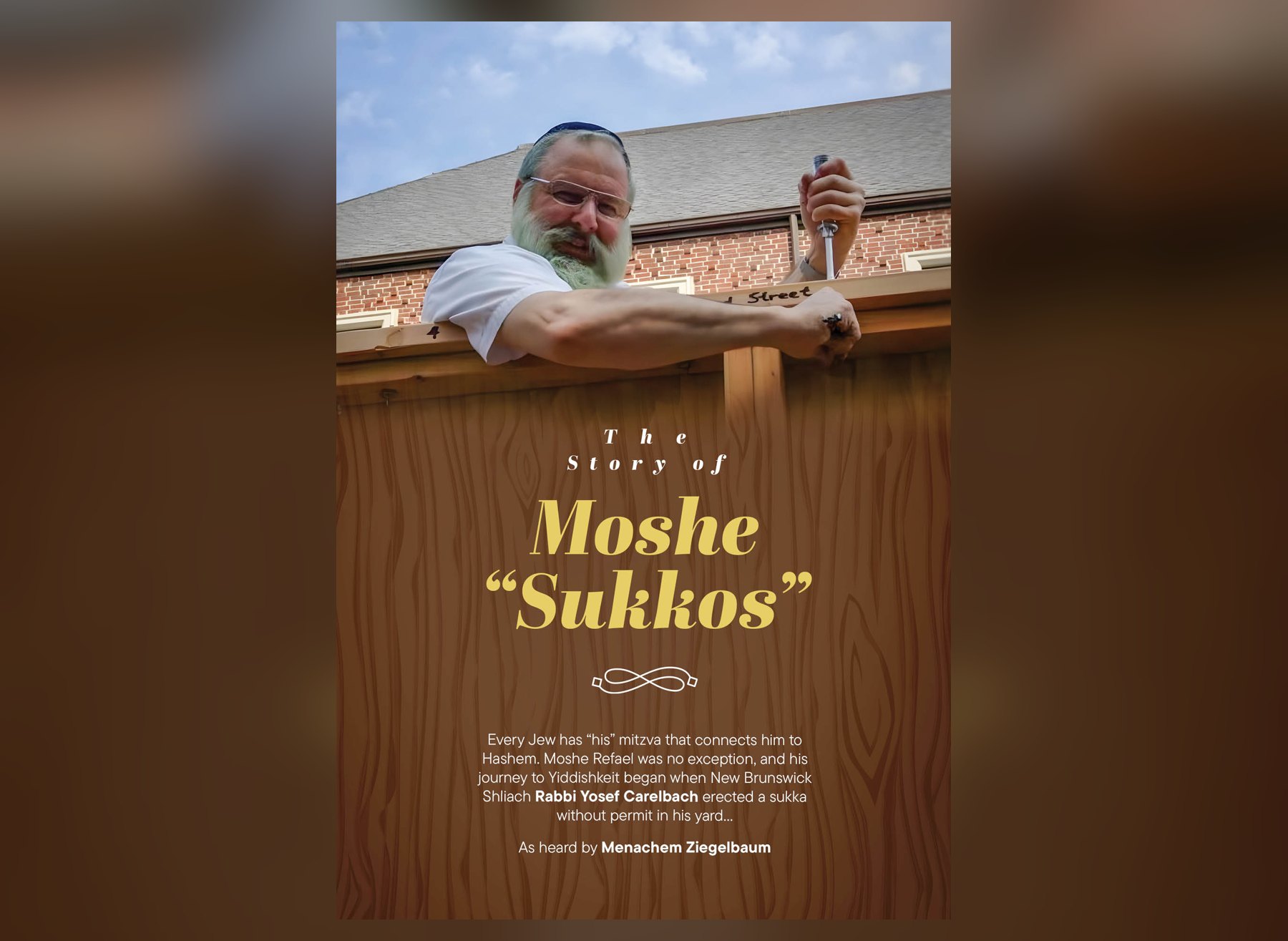
Every Jew has “his” mitzva that connects him to Hashem. Moshe Refael was no exception, and his journey to Yiddishkeit began when New Brunswick Shliach Rabbi Yosef Carelbach erected a sukka without permit in his yard…
I
At the end of Tishrei 5783, two years ago, Rabbi Yosef Carlebach, shliach of the Rebbe in New Jersey, was speaking at the “Tzeischem l’Shalom” for the thousands of guests who came from all over the world.
“We are at the end of Tishrei but for me, it’s the beginning of the month of Tishrei. I just arrived at 770. Forty-two years ago, the Rebbe told me to go on shlichus to spread Yiddishkeit at Rutgers University, and since then, I’ve spent all the Yomim Tovim where I was sent. I can only be here before or after the Yomim Tovim.”
Rabbi Carlebach then went on to tell the following moving story.
II
The first Yom Tov after he and his wife, Rivka, went on shlichus, was Sukkos 5739. It was only about one month after they married. The initial difficulties plus missing Beis Chayeinu brought them back to Crown Heights for Rosh Hashana and Yom Kippur. However, they realized that as shluchim they had to be in their place of shlichus, especially on the Yomim Tovim. It wasn’t easy to jump into the water but necessity brought the couple back to New Jersey to prepare for Sukkos.
The first problem was a sukka. You were not allowed to build a sukka without permission from the city. Rabbi Carlebach wracked his brains for a solution and approached his landlord. The landlord understood the importance of a sukka and waved his hand dismissively. “Don’t ask questions and don’t ask for a permit. Just build a sukka in your parking space.”
A day or two later, when he returned home, he found a small note stuck on his door. “Rabbi, I heard that you’re building an illegal sukka. I also want a sukka …” The note had a phone number.
Rabbi Carlebach was pleased; a Jew wanted a sukka. He called the number and the person introduced himself as Moshe; his full name was Moshe Refael Verter. He lived near the Carlebachs and wasn’t religious but for some reason he wanted to build a sukka. After some discussion, they decided to build a sukka in his yard and eat together.
III
Shabbos Chol Ha’Moed Sukkos.
It poured that night. Nevertheless, Moshe Refael sat in the sukka. Even after the meal, he continued to sit and enjoy the rays of the Shechina in the presence of the holy Ushpizin.
“Moshe, are you crazy?” shouted his wife from the window of the house. “Come inside!” But Moshe Refael didn’t listen and stayed all night in the sukka.
The same thing happened the next day. It poured and Moshe remained in the sukka. Yes, he was Rabbi Carlebach’s first baal teshuva.
“You could say that that Sukkos 5739, he became a Chassid of the Rebbe,” says Rabbi Carlebach.
After that, Moshe became more and more involved in Yiddishkeit, learning Torah and doing mitzvos. He did this in his way, with deep thought and great feeling, without compromising on anything. Still, from then on and for the rest of his life, the mitzva of sukka was dear to him and he gave it special attention.
Since he was an engineer, he decided to bring Sukkos to the awareness of the public and he designed strong though plain sukkos that could be sold cheaply. There were sukkos for $18 and more elaborate sukkos that sold for $36 or even $72.
Over the years, Moshe sold more than a thousand sukkos to Jews in New Jersey and he acquired the nickname “Moshe Sukkos.”
R’ Moshe Refael also built a huge sukka for the five hundred Jews in Rabbi Carlebach’s community. When one of the mekuravim, an engineer, walked into this sukkka, he looked around and then said to Rabbi Carlebach, “Rabbi, you didn’t build this; it’s not the work of a rabbi, it’s the work of a maven.”
IV
R’ Moshe passed away in Elul 5771, about a month before Sukkos. How befitting it was that the sheloshim gathering took place in the Chabad House’s giant sukka which he had designed.
He was a familiar person around town and many loved his energy, his delightful personality and his caring for everyone. About five hundred people filled the sukka and although one does not eulogize on a holiday, they talked about him.
Among those honored to speak about him was the Rav of the neighborhood. “I’d like to ask mechila of R’ Moshe,” is how he began. Everyone wondered what he meant by that and the Rav began to tell his story.
* * *
Moshe grew up in an irreligious home which is why he didn’t learn the alef-beis. As an adult, when he found the light of Yiddishkeit, he began learning the letters and tried to make up for what he missed over the decades. Not surprisingly, his Shacharis took two, even three, hours every day. Mincha took an hour as did Maariv. He never made allowances for himself and he took no shortcuts.
One night, R’ Moshe went to daven Maariv in this Rav’s shul. He took a siddur and began davening slowly, word by word. When the tefilla was over, people went home but R’ Moshe was still in the middle of Shemone Esrei. The gabbai of the shul also wanted to go home but R’ Moshe was standing and davening half an hour, an hour …
The impatient gabbai began to say, “It’s late, I need to go home,” but R’ Moshe stood at the wall, his eyes in his siddur.
The gabbai was annoyed and he shut the lights, locked the door, and went home. R’ Moshe Refael was unable to continue davening because he couldn’t read the words in the siddur in the dark and he couldn’t continue by heart.
He stood there helplessly, unable to continue and unwilling to end his davening at that point. It was nine at night and he just stood there. It was ten o’clock, eleven, twelve, and he still waited. He figured he’d have to continue standing there until dawn when he could read from his siddur and finish Shemone Esrei.
A little after midnight, the phone in Rabbi Carlebach’s house rang. It was Moshe’s worried wife. “Do you know where my husband is? He went out to shul hours ago and didn’t come back.”
Since Moshe worked at the Chabad House occasionally, Rabbi Carlebach asked someone in the community to check the Chabad House. The answer was, Moshe wasn’t there. At one in the morning, before calling the police as a last resort, Mrs. Verter took her daughter and drove to all the shuls. When they arrived at the shul of that Rav, she noticed one car in the huge parking lot, her husband’s car.
She called the Rav, waking him up. He hurried over with the keys, turned on the light, and discovered R’ Moshe in the middle of Shemone Esrei.
“I ask your forgiveness, R’ Moshe,” he wept.
That was R’ Moshe Sukkos.
Beis Moshiach #1430 • pp. 50-52
© 2026 Beis Moshiach Magazine. All rights reserved.
This article originally appeared in Beis Moshiach #1430. You are welcome to share it with friends and family by email or in print, provided that you do not change, add to or omit any part of it, you credit the author and Beis Moshiach, and you include a link to archive.bmoshiach.org (written out in full in printed copies).
To republish this article in a newspaper, magazine, book or website, please request permission in advance at [email protected].